
20mA for the stereo isn't bad. If you have an amplifier there will ba a large capacitor array that will draw some current. So 20mA sounds reasonable.Yeah, I don't want to use the term "didn't make sense" but when the total draw was 60 mA there was no way the alarm would do 80 by itself.
I was kind of happy to see the computer alone only drew 7 mA. On the other hand 20+ on the stereo seems high so I check all the wiring on it and it all was good. I was thinking the remote on wire might have been wired wrong but it was not. The stereo came wired in the sub when I got it.
I guess the best part in all this is I have gone through all the after market wiring now.
You guys know I'll be following this up as time goes on with updates on my battery state.
CK5

You are using an out of date browser. It may not display this or other websites correctly.
You should upgrade or use an alternative browser.
You should upgrade or use an alternative browser.
Optima batteries, 4/10/18...battery status update
- Thread starter 76zimmer
- Start date

20mA for the stereo isn't bad. If you have an amplifier there will ba a large capacitor array that will draw some current. So 20mA sounds reasonable.
That big fat red wire goes straight from the battery to the amp.
Ya what I meant was inside that amp will be a large capacitor array on the power supply side of the amplifier. That will consume some power regardless if it's off or on.That big fat red wire goes straight from the battery to the amp.
Ya what I meant was inside that amp will be a large capacitor array on the power supply side of the amplifier. That will consume some power regardless if it's off or on.
Cool, thanks for the info.

Ya what I meant was inside that amp will be a large capacitor array on the power supply side of the amplifier. That will consume some power regardless if it's off or on.
Sounds like some leaky capacitors!. Most caps don't draw much once they are charged.
Just got through tinkering with a small Ford truck that was running the battery down.
Somehow the radio was drawing almost an amp with the key and radio turned off.
Weird part was, pulling the radio fuse had no effect. But if you pulled the fuse marked alarm, which also killed the starter circuit, the load went away.
But disabling the alarm did nothing.
If you unplugged the radio, the load went away, whether the alarm fuse was in or not.
According to the schematic, the radio should not be able to pull power from that fuse.
I'm guessing that there is an anti-theft system for the radio that does not show up on the schematic.
It's usually a parrallel bank of caps. And those go to a set of power transistors.Sounds like some leaky capacitors!. Most caps don't draw much once they are charged.
Just got through tinkering with a small Ford truck that was running the battery down.
Somehow the radio was drawing almost an amp with the key and radio turned off.
Weird part was, pulling the radio fuse had no effect. But if you pulled the fuse marked alarm, which also killed the starter circuit, the load went away.
But disabling the alarm did nothing.
If you unplugged the radio, the load went away, whether the alarm fuse was in or not.
According to the schematic, the radio should not be able to pull power from that fuse.
I'm guessing that there is an anti-theft system for the radio that does not show up on the schematic.
5-10mA is common. The other 10mA is probably comming from the stereo.
As for the alarm depending on which radio it is, it may in fact have a alarm built in it. There was a time period where they were trying to add basic alarms to aftermarket radios. Try pulling the starter kill relay and see if your current draw goes away.

I know its off topic but whats the best way to revive an optima? My buddy is giving me a red top, that just lost a charge(sitting for 5 months) He said it may still be good, he hasn't tried to recharge it yet.
I know its off topic but whats the best way to revive an optima? My buddy is giving me a red top, that just lost a charge(sitting for 5 months) He said it may still be good, he hasn't tried to recharge it yet.
Do a search on youtube for optima, I think it's tech tip 3.
Tim, thank you for taking the time to record and post those videos, I really appreciate your efforts and insight and I apologize for any inconvenience I may have caused you. When I first spoke to Jonathan, I was in an elevator and my reception was cutting in and out, so I had a hard time verifying whether the standard draw on alarms like your's was 60 milliamps + 80 milliamps or just 80 milliamps total. I was able to get ahold of Jonathan today and he indicated CS-series alarms like your's, do draw a total of about 80 milliamps. Even though that number is consistent with the discharge issues you've been having as well as parasitic draws indicated by other alarm manufacturers, it is obviously not consistent with the numbers you measured in your videos.
I don't have an answer as to why these discrepencies exist, but I certainly don't doubt your measurements. I do wish you would've taken me up on my offer to exchange your battery for a new one at our expense, as we would've like to have examined your battery in our lab.
Last year, I had a goal of sitting down with someone from an alarm company and someone from an alternator company at SEMA. Unfortunately, I only had time last year to meet with an alternator company. That was a great meeting and actually lead to another tech tip video we will be producing this year in conjunction with them. I will definitely make a point of tracking someone down from an alarm company this year, although Autopage does not attend SEMA, as I understand that all of these components end up in commons systems. Even though I'm on the battery end of things, I do want to know more about the various alarm systems our customers are using and how they impact battery performance.
Jess, the video Tim referenced can be found here.
Jim McIlvaine
eCare Manager, OPTIMA Batteries, Inc.
www.facebook.com/optimabatteries
I don't have an answer as to why these discrepencies exist, but I certainly don't doubt your measurements. I do wish you would've taken me up on my offer to exchange your battery for a new one at our expense, as we would've like to have examined your battery in our lab.
Last year, I had a goal of sitting down with someone from an alarm company and someone from an alternator company at SEMA. Unfortunately, I only had time last year to meet with an alternator company. That was a great meeting and actually lead to another tech tip video we will be producing this year in conjunction with them. I will definitely make a point of tracking someone down from an alarm company this year, although Autopage does not attend SEMA, as I understand that all of these components end up in commons systems. Even though I'm on the battery end of things, I do want to know more about the various alarm systems our customers are using and how they impact battery performance.
Jess, the video Tim referenced can be found here.
Jim McIlvaine
eCare Manager, OPTIMA Batteries, Inc.
www.facebook.com/optimabatteries

- Joined
- Mar 3, 2000
- Posts
- 9,126
- Reaction score
- 7,090
Just followed the tip on reviving an optima. So far working good.
I had it on the charger with the other battery for 2.5 hours, then on the charger itself for 2 to 3 days. It is an older cheepie sears charger that only has 2 and 6 amp selections so I had it on the 6 amp setting. It has a dial that shows percentage charged. The highest that ever went was 75 percent, then I let it sit for a couple days and periodically checked the volts, which never dropped below 12, then charged it for about 8 hours and hooked it up. Took a 15 minute drive then took it to an auto parts store where they tested both the battery and alternator and did a load test on the battery and said it showed 100%. Battery was purchases in early 2007 and has been abused by welding, hooked up to a winch on a trailer and used until it was totally dead, left sitting for 4 to 6 weeks at a time, jumped several times, then revived.
I have now let it sit over night and it fired right up this afternoon. I will post updates when they happen.
Its a red top by the way.
I had it on the charger with the other battery for 2.5 hours, then on the charger itself for 2 to 3 days. It is an older cheepie sears charger that only has 2 and 6 amp selections so I had it on the 6 amp setting. It has a dial that shows percentage charged. The highest that ever went was 75 percent, then I let it sit for a couple days and periodically checked the volts, which never dropped below 12, then charged it for about 8 hours and hooked it up. Took a 15 minute drive then took it to an auto parts store where they tested both the battery and alternator and did a load test on the battery and said it showed 100%. Battery was purchases in early 2007 and has been abused by welding, hooked up to a winch on a trailer and used until it was totally dead, left sitting for 4 to 6 weeks at a time, jumped several times, then revived.
I have now let it sit over night and it fired right up this afternoon. I will post updates when they happen.
Its a red top by the way.
Tim, thank you for taking the time to record and post those videos, I really appreciate your efforts and insight and I apologize for any inconvenience I may have caused you. When I first spoke to Jonathan, I was in an elevator and my reception was cutting in and out, so I had a hard time verifying whether the standard draw on alarms like your's was 60 milliamps + 80 milliamps or just 80 milliamps total. I was able to get ahold of Jonathan today and he indicated CS-series alarms like your's, do draw a total of about 80 milliamps. Even though that number is consistent with the discharge issues you've been having as well as parasitic draws indicated by other alarm manufacturers, it is obviously not consistent with the numbers you measured in your videos.
I don't have an answer as to why these discrepencies exist, but I certainly don't doubt your measurements. I do wish you would've taken me up on my offer to exchange your battery for a new one at our expense, as we would've like to have examined your battery in our lab.
http://www.facebook.com/optimabatteries
Maybe Jon needs to look at the video too. Clearly either he or I am is wrong and judging by the video it's him. I don't have a draw even close to 80 mA.
I wasn't interested in the idea of providing either you or optima my personal information and phone number when I could take a 5 minute drive and be done with it.
I will definitely make a point of tracking someone down from an alarm company this year, although Autopage does not attend SEMA, as I understand that all of these components end up in commons systems. Even though I'm on the battery end of things, I do want to know more about the various alarm systems our customers are using and how they impact battery performance.
That is somewhat true. Here in the US DEI has pretty much bought up the rights to a LOT of car accessory companies. So most car alarms on the market are owned by DEI. Part sharing does occur with these alarms.
Autopage however is owned by a japanese company. I've never cared for their alarms personally. No alarm should be using 80mA that is way to much current to monitor a car. If your really interested I'm sure you could contact someone at DEI and they will tell you about the current demands of their alarms. DEI probably gets you 60-70% of the US market. MOst of these alarms have sleep states that will require less current the longer they are armed.
- Joined
- Mar 3, 2000
- Posts
- 9,126
- Reaction score
- 7,090
Well my Optima is done. After two days. 8.75 volts. Also the draw with key off is 17 to 19 milliamps.
So just went to O'reilly's and they had an AGM style so I bought it. Time will tell.
As I have said before my optima did pretty good for 5 years with the abuse it went thru.
So just went to O'reilly's and they had an AGM style so I bought it. Time will tell.
As I have said before my optima did pretty good for 5 years with the abuse it went thru.
nsxxtreme, I did actually contact DEI as well and this was their response- “Our run of the mill alarm systems have a current draw of approximately 17-20mA. A GPS enabled SmartStart adapter will pull around 40-42mA. This means you will have a combined current draw of approximately 60mA. A healthy car battery will last about 5 days with that kind of current draw (without being driven).”
Based on that draw alone, I think they are a little conservative on their estimate of how long a battery can last without being driven. However, they probably realize that many of their customers who install their alarms generally do it to protect other valuable accessories, like aftermarket stereo systems, which will also increase the draw and decrease the time a vehicle is able to sit without having a charge to the battery.
Jim McIlvaine
eCare Manager, OPTIMA Batteries, Inc.
www.facebook.com/optimabatteries
Based on that draw alone, I think they are a little conservative on their estimate of how long a battery can last without being driven. However, they probably realize that many of their customers who install their alarms generally do it to protect other valuable accessories, like aftermarket stereo systems, which will also increase the draw and decrease the time a vehicle is able to sit without having a charge to the battery.
Jim McIlvaine
eCare Manager, OPTIMA Batteries, Inc.
www.facebook.com/optimabatteries

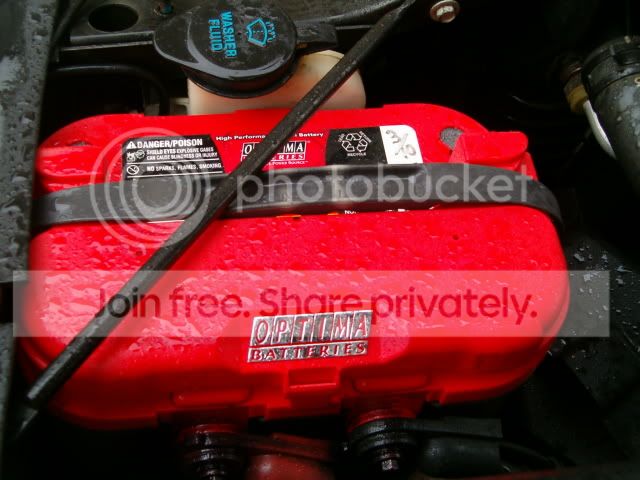
This is a new Redtop, I bought in March/2010 for my Daily Driver. I will try to keep track of these and post up good or bad news on a 6 mo. basis (if I can remember)
 [/quote]
Just for the record as I mentioned I would try to do with these two new Optimas':
The Yellow top was new in May of 2010 and tonight it shows 13.6 voltage. It has had a couple of battery tender feeds since it was new. But not on a contiunual basis, and it has been sitting in my shop for about a month with no attention, and had numerous starts of the BBC with it before that, so it hasn't had any tender in about 2-3 months.
My Redtop I bought in Mar 2010 shows 12.7 tonight. It is in my daily driver 2500.[/quote]
_______________________________________
update 5/22/12
today I checked my Redtop DD battery...12.83
the yellow top in the Maiden was 13.2 has been sitting with the battery switch off for about 3 mo.
Just for the record as I mentioned I would try to do with these two new Optimas':
The Yellow top was new in May of 2010 and tonight it shows 13.6 voltage. It has had a couple of battery tender feeds since it was new. But not on a contiunual basis, and it has been sitting in my shop for about a month with no attention, and had numerous starts of the BBC with it before that, so it hasn't had any tender in about 2-3 months.
My Redtop I bought in Mar 2010 shows 12.7 tonight. It is in my daily driver 2500.[/quote]
_______________________________________
update 5/22/12
today I checked my Redtop DD battery...12.83
the yellow top in the Maiden was 13.2 has been sitting with the battery switch off for about 3 mo.
Last edited:
nsxxtreme, I did actually contact DEI as well and this was their response- “Our run of the mill alarm systems have a current draw of approximately 17-20mA. A GPS enabled SmartStart adapter will pull around 40-42mA. This means you will have a combined current draw of approximately 60mA. A healthy car battery will last about 5 days with that kind of current draw (without being driven).”
Based on that draw alone, I think they are a little conservative on their estimate of how long a battery can last without being driven. However, they probably realize that many of their customers who install their alarms generally do it to protect other valuable accessories, like aftermarket stereo systems, which will also increase the draw and decrease the time a vehicle is able to sit without having a charge to the battery.
Jim McIlvaine
eCare Manager, OPTIMA Batteries, Inc.
www.facebook.com/optimabatteries
Jim,
Ask them what the "stand-by" current is. There is no reason for a GPS system to be actively locating itself when the vehicle is not moving. While it's actively trying to get a location I'd agree it will pull some current. Jim this is low power circuit design 101 stuff. You don't keep things running when there is no work to do. This would be like asking you to run in place when you have no where to go.
I'd ask to talk with an engineer and not a tech or sale rep. Good to see you actively tracking down answers though. DEI is the one you wanna asks the questions as they own about 80% of that market. They have boughten up just about every auto accessory manufacturer out there. They have a very large porfolio of brands.
Last edited:
DEI's feedback is consistent with what we've heard from other manufacturers. If you have specific questions you'd like to ask their engineering team, I would encourage you to contact them directly.
Jim McIlvaine
eCare Manager, OPTIMA Batteries, Inc.
www.twitter.com/optimabatteries
Jim McIlvaine
eCare Manager, OPTIMA Batteries, Inc.
www.twitter.com/optimabatteries
DEI's feedback is consistent with what we've heard from other manufacturers. If you have specific questions you'd like to ask their engineering team, I would encourage you to contact them directly.
Jim McIlvaine
eCare Manager, OPTIMA Batteries, Inc.
www.twitter.com/optimabatteries
Jim I and everyone can measure these systems ourselves. There isn't anything magic about measuring the current of an alarm system. If it reads 20mA then it uses 20mA.
What I am proposing to you is the people that you are talking to might not know exactly what your asking or may not know how to read the specs acurately. While I don't design these alarms and don't claim to know everything I am an Electrical Engineer that designs low power circuits for a living. In fact I wouldn't be surprised if you're using a piece of hardware I designed to reply to these messages.
When it comes to low power circuits only a fool would leave clocks up and running while you're parked doing nothing. I suspect the rating you are geting is an idle current where things are running but not transmitting. A further stand-by current which is when things go to sleep will reduce current even further.
Anyway I dont want to get in an argument with you if you want to believe alarm companies use 80mA of current so be it. Blame the problems on the alarms I dont care. I have nothing to gain in this anyway just trying to get you an accurate picture.

My 7 year old optima red top reads 12.6, i daily drive my hd and have about 50,000 miles of use with it. If these batterys are still as good as the old ones ill definately buy another...lol
Sorry to chime into your thread zimmer..
Sorry to chime into your thread zimmer..
My 7 year old optima red top reads 12.6, i daily drive my hd and have about 50,000 miles of use with it. If these batterys are still as good as the old ones ill definately buy another...lol
Sorry to chime into your thread zimmer..
thats what it has turned into Rob...input good or bad about Optimas.
I try to put my .02 in about my two batts every once in a while for a DD and an occasional use application of the Optimas.


