CK5
Register an account today to become a member! Once signed in, you'll be able to participate on this site by adding your own topics and posts, as well as connect with other members.

Ovaled lower shock mounts

dyeager535

1 ton status
 Premium
Joined
Dec 13, 2000
Posts
31,561
Solutions
1
Reaction score
2,900
Location
Roy, Washington
Last time I was under the truck, noticed one of the rear lower (axle) shock mounts had oval-ed itself out.

Is there a preferred fix? It seems "repair weld washers" would be ideal (like these https://barnes4wd.com/products/repair-weld-washer-5-8 ). The other option would seem to be buying replacement mounts. New mounts are cheap, but seems like a lot more work.

To me the repair weld washer on one side, with a nut welded on opposite sounds like the best approach. Way more meat for the bolt shoulder to ride on, no chance for movement on the nut side, and one-handed bolt removal.

What's the failure mechanism on these? I was told that the bolt being loose won't keep the inner sleeve in place, which can make it easier for this to happen. Used axle, for all I know the hole was already oblong before I got it and just didn't notice when I bolted the shock up.

Finally, not being where the truck is, are the bolts typically 5/8"? I presume they are whatever is correct for a later K5, that's what the shocks are for.
 
That’s the best fix is to ream out the hole and use a weld washer where it’s stepped and it sits in the new hole. The welded nut is a nice touch.
 
That weld washer would be more durable than a new shock mount, due to the thickness of the hole. You could also make a repair plate out of a piece of flat stock. Drill your hole to size and weld it on the side of the existing mount.
 
That weld washer would be more durable than a new shock mount, due to the thickness of the hole. You could also make a repair plate out of a piece of flat stock. Drill your hole to size and weld it on the side of the existing mount.

I suspect the weld washers will protrude too much and will need ground down to fit the shock anyway, so definitely an option. If my 1/8" thick guess for mount thickness is right, would need to remove about 30% of the bearing surface to make it flush.

Could also drill a nut out to the bolt shoulder thickness and use that I suppose.

While I like the idea of how clean the weld washers look installed, I'm not sure how well a drill will open up an oblong hole without walking or breaking either. That could be an irritating process. A carbide burr would probably make pretty quick work of it I suppose.
 
Didn't want to totally usurp the other post about the bolts, but I finally got under the truck. Funny story...

The mount holes are either hogged out or were the wrong size initially and I didn't notice. That seems unlikely. I don't know what size they are, but large. It's a 14SF (Metric 6 lug) that supposedly the guy had on a square body, but anyway...

The shock bolts are definitely supposed to be 9/16" (with metal sleeve in the bushing). The bolts however, who the heck knows where I found them. I put this together when saving money everywhere I could was important. (Edited with current info once project was complete) The one side is not a 9/16 bolt, closer to 35/64. It is not metric based on headstamp (or diameter), but regardless, a very odd size. It is not worn down (except where the shank hit the mount as it moved), but close enough to 9/16 that in a hurry I can see it being mixed up. I suppose it's possible, but unlikely that the bolt wore down from the sleeve moving around, but the bolt is still quite round based on my calipers. With the shank and threaded portion being ground down where they hit the mount, I think the bolts were simply a weird/wrong size to start with. Only lasted 20 years or so, jeez. Other side is the correct 9/16".

Only one local store has a bolt selection, but too limited on 9/16 so didn't have the right ones. Ordered online from Napa to store, hoping they show up today.

I'd have to look at bolt specs, but the 9/16 they did have, the unthreaded shank clearly supports the weld washer far better than the threaded portion. The clearance with the weld washer seems much tighter on the shank than the threads. Nothing scientific, just more "wobble" on the threaded portion. Trying to find the right bolts can be tedious, I can see why someone might just go with full threaded, or perhaps partially threaded but more thread than unthreaded portion, but I'm not going to.

For future reference, napa (perhaps the manufacturer too) part number for a grade 5, 3.5" 9/16-12 bolt (1.375 threaded portion) is RFD 301771B, a matching nut is RFD 4752034R. Interestingly, appears dorman is no more? Or sold out or merged? The dorman numbers all seem to point to "Rockford" numbers now, and napa lists it as Dorman Rockford, parts listing states Rockford, and the part numbers are a different format for sure.

I need a bit more length due to the weld washer, so if anyone is reading this later, you'll need to verify if it's a standard shock mount, that you don't run out of thread before the nut will actually tighten against the mount. I would think thick washers on either side would ensure enough thread.
 
Last edited:
I don't think welding a nut on the shock mount is a great idea. Starting the bolt in the threads while holding a shock that want to stretch out, seem like a recipe for cross threading, and a struggle.
Just my thoughts, I thought I'd share.
 
So they are supposed to be 9/16, but you have something else? Probably M14.

I was so irritated when I got to the other side that I "repaired" both of them lol.

I think the mounts are 9/16", but the one was clearly damaged from the wrong bolt. I measured the bolts as I was taking them apart, sure enough, the drivers side was 9/16" through and through. Whatever was in the passenger side is absolutely not 9/16 or metric. If I run across the bolt again I'll measure it. But it's not worn down, it's just not 9/16". 35/64 is the next step down that it's closest to. I swear the head is standard, not metric.

As to your comment Wes, I don't disagree and I had considered that as a potential downside. As I was putting it together, I realized (or felt, scientific lol) that is a benefit to coarse thread. The coarse thread bolt/nut fit is fairly sloppy, and with the shock out of the way, I could see the bolt walk itself into the threads as I was trying to align it. It went together with no effort, and I don't expect to worry about cross threading it. I've not had that experience with fine thread.

I held the whole assembly together with a bolt while welding, I didn't experience any significant misalignment afterwards. The shocks are kind of a pain to deal with (on your back on the floor instead of on a lift) but they don't exert much pressure, they are just slow to compress. Once the bolt starts in the shock eye, it's over. A bit of wiggling of the bolt and inward pressure at the same time, and done.

Really only needed one side done, but sooner or later these ancient (20+ years!) parts store cheapy shocks are going to die and this will make replacement that much easier. I was already under there, had the tools and parts, one side done, why not, right??
 
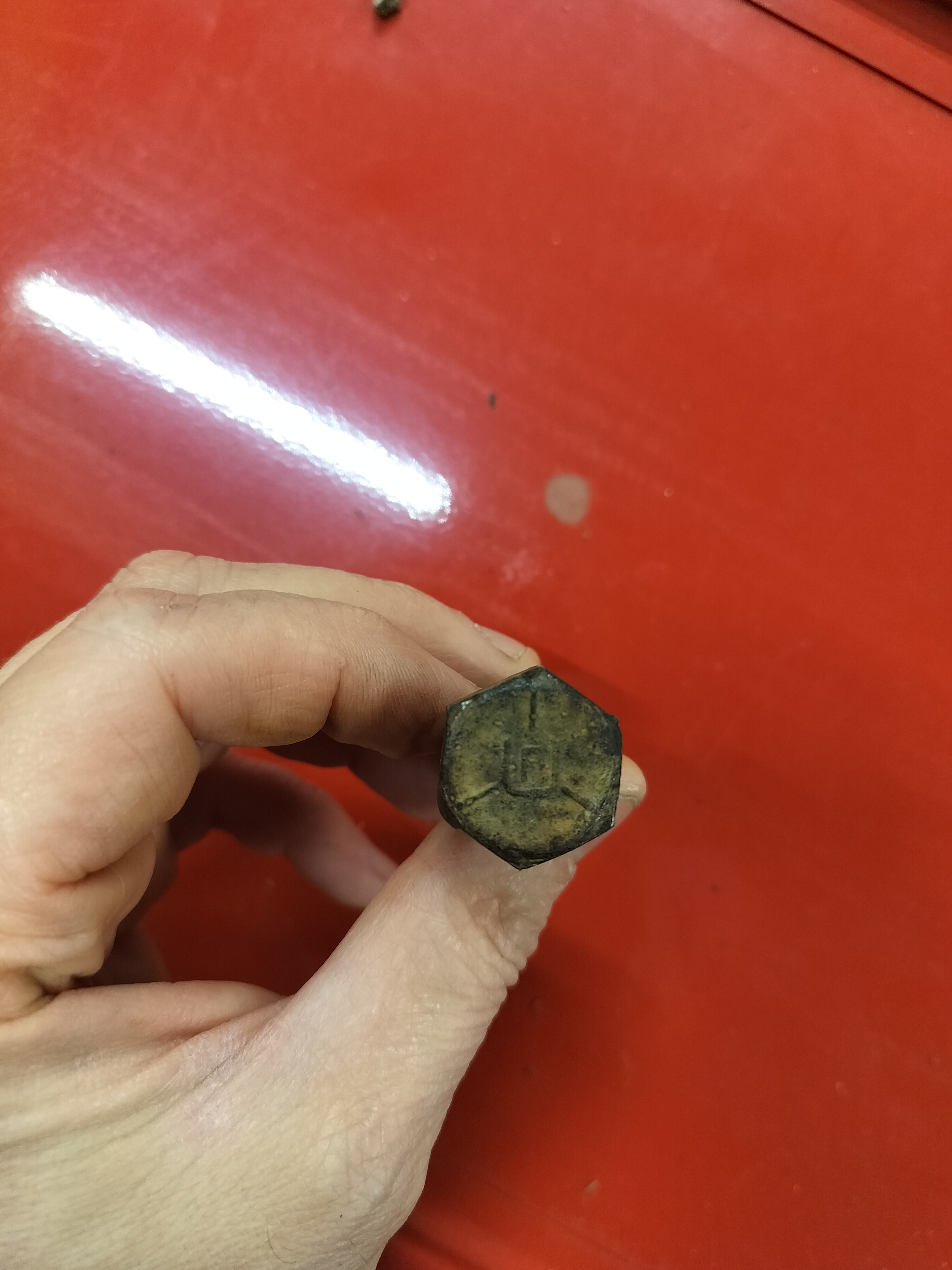
Got a picture of the bad bolts head stamp? The age is right for left counterfeit over seas bolts we inundated with in the 90s and 2000s.
Remember inspecting all our equipment and replacing fasteners for years. You know lowest bid.
Those bolts did change our contracts after, we had Lawson, Tifco, or Kimberly Midwest.
 
Got a picture of the bad bolts head stamp? The age is right for left counterfeit over seas bolts we inundated with in the 90s and 2000s.
Remember inspecting all our equipment and replacing fasteners for years. You know lowest bid.
Those bolts did change our contracts after, we had Lawson, Tifco, or Kimberly Midwest.

I actually did look at the bolt in better light and closely. It almost looks like it saw service in a high heat application. The head is severely corroded (like Ive seen on exhaust manifold bolts) enough that on closer inspection, what I thought was a standard bolt grade indicator isn't clearly what is there.

It is possible with that head corrosion obliterating the actual head mark that it's metric, I'll measure with the calipers again and see. 14mm is right in that range, and would seem more likely, although no idea where a bolt that old would have come from, that size.
 
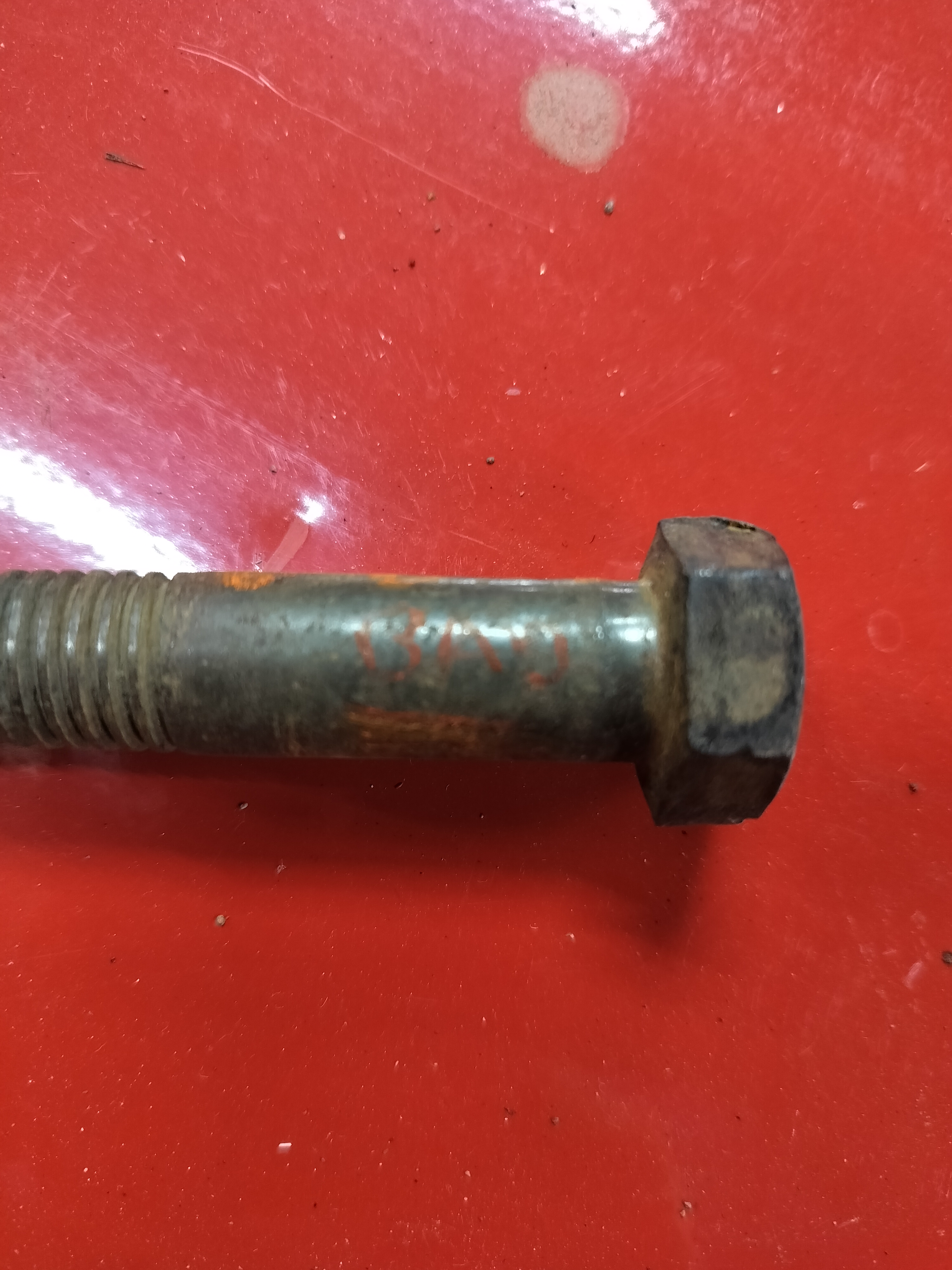
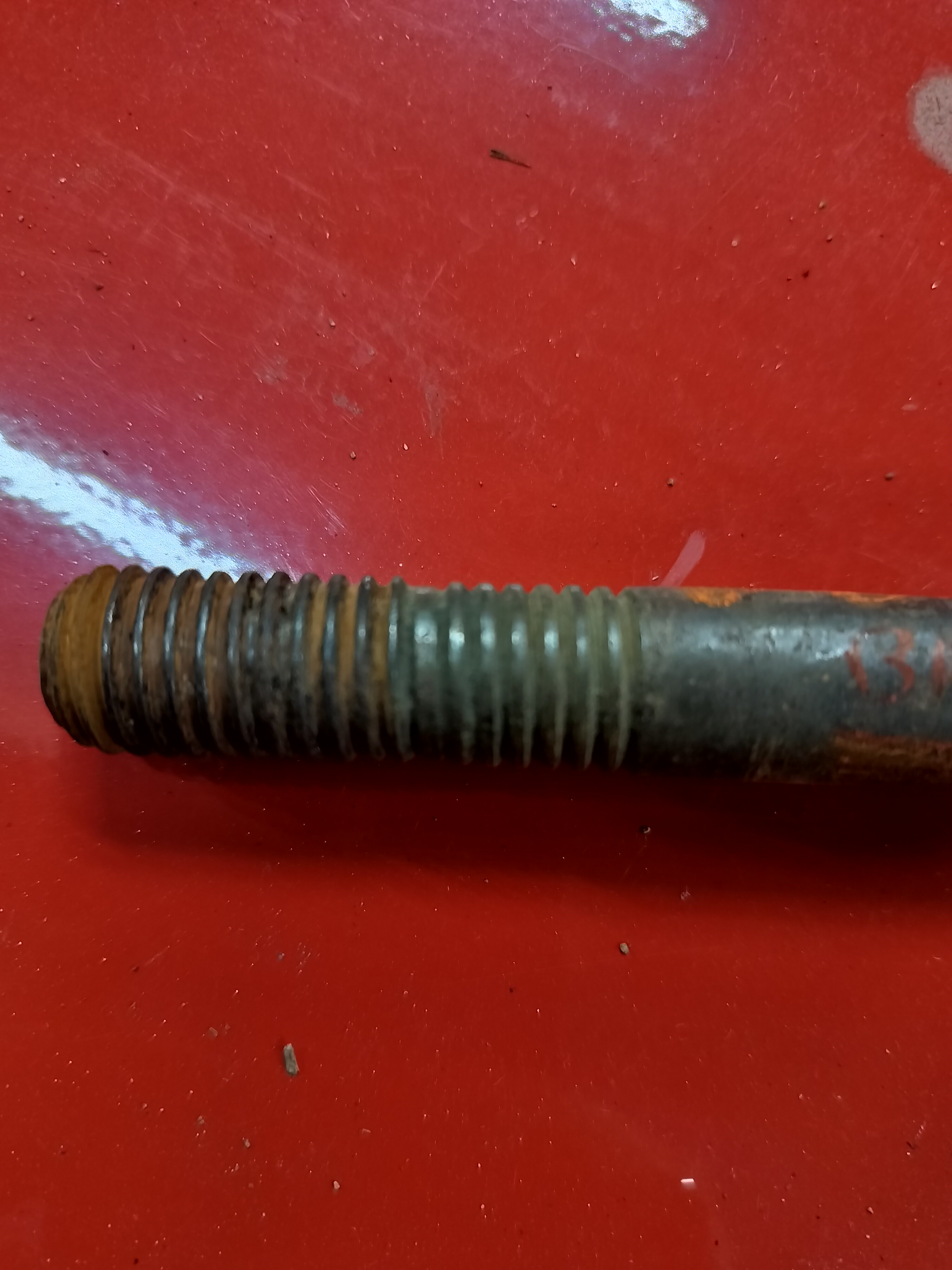
Eh, I spent more time with it and realized I had mixed the bolts up after disassembly. So I took pics and actually wrote the numbers down this time.

The shank of the bolt measures ~.540. There is enough roughness to give a bit of a variation, but that's going to be very close. For comparison, same dial calipers, the 9/16 bolt on the other side came in at .560.

If you look closely you can see just under the head and again partway down the threads the shock mount ground/beat the bolt down to an even smaller diameter.

I'd say this doesn't answer anything. It's clearly a standard bolt, but the shank diameter isn't close to other normal bolt diameters, even throwing in +/- .002 margin of error. I don't see enough wear on the shank to indicate it has been worn down as well. Especially since it measures quite round.

full


full


full
 
Standard tolerance for 9/16" bolts is .5545" min to .5625 max. There is definitely something wrong with that one bolt, but it is not wear related. Wear would be a ring at the shock mount plates and none inside of the bore of the shock. There is sign of wear at that location, but it isn't the root cause of your problem.

1762406346506.png

1762406326511.png
 
I'll keep it as an oddity lol.

I wonder if the headstamp can be deciphered to get an idea of who made it. I've never tried to look up bot manufacturer by the mark on the head.
 
Maybe it was over torqued at one point in its life and streched/shrank it.
A quick googlefu says possibly Fastenal brand bolt by the headstamp?
 
I at one time had a list of counterfeit head stamps not sure if it is still around. I don't recognize that head stamp, but it looks funny for a cap screw.
 
Last edited:

Latest Posts

Top Bottom