CK5
Register an account today to become a member! Once signed in, you'll be able to participate on this site by adding your own topics and posts, as well as connect with other members.

quadrajet, HEI, small brain, won't start:

vandelay industries

1/2 ton status
Joined
Jan 3, 2014
Posts
903
Reaction score
149
Location
east coast
Non-electronic q-jet
HEI distributor
Cranks, but doesn't start.

i feel we should start systematically with root causes first, then move to the next possibility etc. vs. the, "it could be this." "It could be that" "This happened to me one time, so do this" approach. Don't get me wrong, i really do appreciate any and all help, i just feel it would be better to start with the most likely/or root cause, then if it checks out move the next step and so on.

However, if we want to do random solutions i'm not opposed to that either at this point.
 
i have to add one, likely, piece of background info:

This problem started IMMEDIATELY after i did the following modification to the carb----adjusting the secondary plates(secondary throttle plates , NOT air flaps) to open more

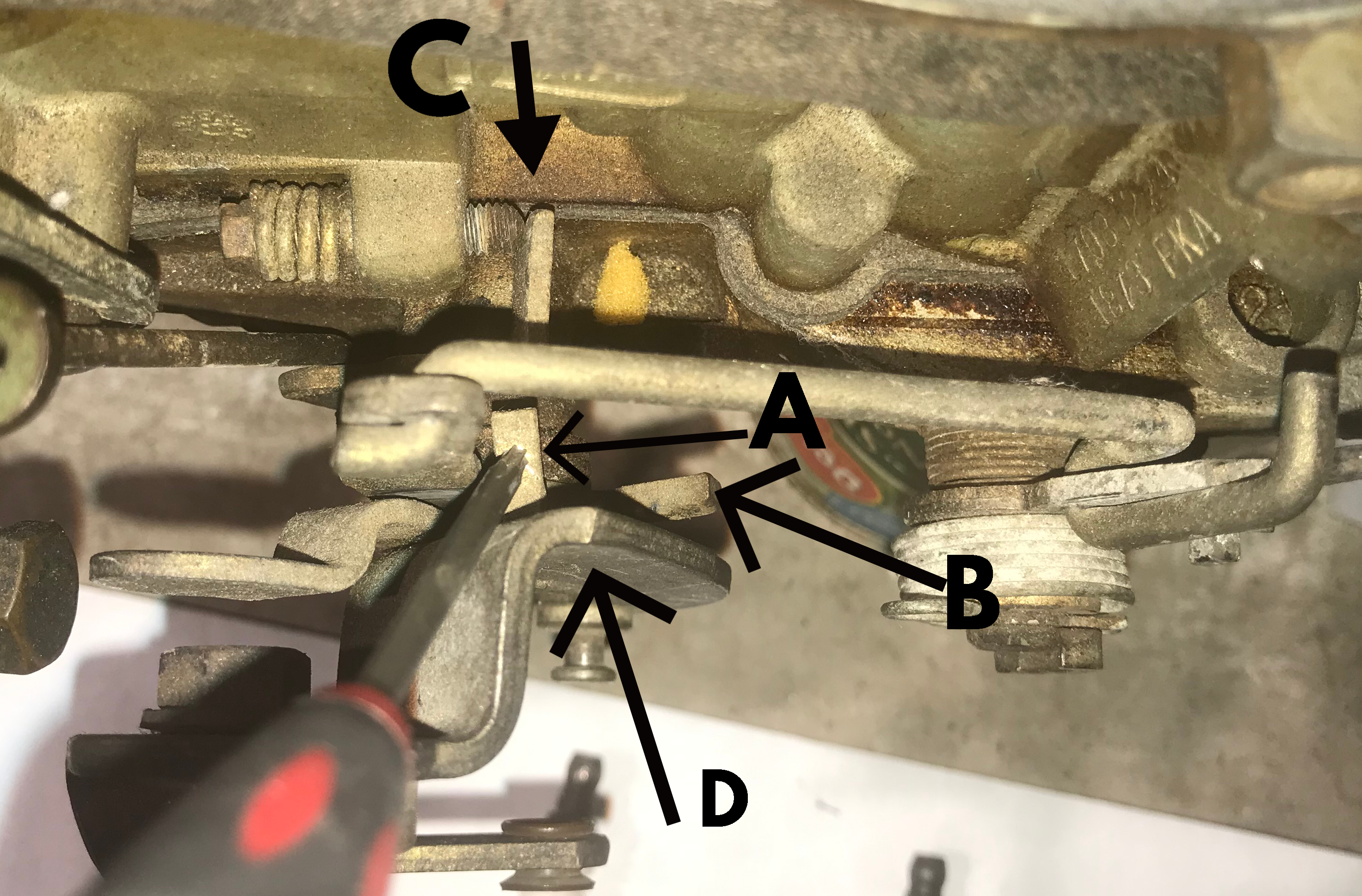
Here is a pic to help better illustrate:
GC8yG6x.jpg


i bent tab "A" to contact tab "B" sooner.


I
 
if the carb mod, caused flooding I think the plugs may be saturated.

Basics.
Spark
Compression
Fuel
You need these 3 to run.
#1 check spark
Pull a plug, put back in the wire. Hold the ground strap against the block( nice clean unpainted spot) have someone crank the engine. You should see and hear the spark.
#2 compression
Pull all the plugs, disable the spark(remove battery wire from distributor) lock open primary throttle plates. Install compression gauge crank engine, 4 compression strokes.
Watch the needle. The 1st jump should be the largest, the next 3 should be about equal. Do this for all cylinders. Ideal is no more than 5% difference, 15% is acceptable.
#3 test fuel delivery. Methods very depending on your fuel system. But if you work the throttle while looking down the carb and see fuel squirt you should be good.

For my suspicion, remove all the plugs crank the engine over, while looking for gas spraying out of spark plug holes. DISABLE spark before doing this.(outline above). You will start a fire if you do not do this.
Inspect plugs if they look wet, blow them off with compressed air. If they are old and worn replace them.

If you ever suspect the engine is flooded. Put the throttle to the floor and crank. It might start. You need to hold that throttle open till it clears, but not so long you damage the engine. Don't lift and try again, you just add more fuel. tip most EFI system also have clear flood mode at wide open throttle while cranking.
 
How I figure stuff like this out is backtracking from where it went bad. Making those adjustments to the carb isn't going to make you lose compression or lose spark.

Like Wes said, it could be flooded and that's why it won't light off. Pull a plug or two. If they look wet and smell like fuel, change them out.

Is it possible the HEI lost power to the coil at the same time you were working on the carb? Sure. Validate you have spark. The chance you did have a coincidental failure of anything in the ignition side is pretty darn slim though.
 
Make sure you have spark first. Get a test light, spare spark plug, or spark plug tester and plug it into one of your spark plug wires. see if you have spark. If you do its probably flooded. pull plugs, cook them with a torch and reinstall. Try not to flood it again.

If you dont have spark. Check for 12v at the coil. If you have it there check to see if the ignition module in the HEI is good. and check if the coil is good. Those are the only things in a HEI, if the three are good it will work. ALL of these parts are interchangeable with a V8 hei. So if you have a SBC somewhere you can swap parts to trouble shoot. Well there is also a magnetic pickup but I doubt that died.

I have had an ignition moduel crap out on me randomly trying to warm up my truck, they just die sometimes.
 
1) Pretty sure we have spark as i got one of those spark plug looking tester things and yes there's spark, plus i can occasionally get it started. The last time i was able to get it started was yesterday around noon.

2) Pretty sure we have compression......see #1 above.

3) No doubt there is fuel as i can see squirt if/when pumping throttle+ can see the float thru the small slot near the air cleaner stud.

i am leaning towards flooding too, BUT how could messing with the throttle arm/secondary linkage cause flooding?

Here's the best/only thing i can come up with:
GC8yG6x.jpg


In order to adjust secondary thottle opening, you have to bend tab "A" towards tab "B." In doing this, you'll soon find out that this also moves the throttle arm "D" clockwise towards "B" as well since "A" is directly connected to "D". So i grasped throttle arm "D" in order to prevent it from moving so i could bend "A."

i MAY HAVE, without realizing it, "OVER-ENTHUSIASTICALLY" twisted throttle arm "D" counter-clockwise----in order to counter-act the bending forces of bending tab "A" which would have been in a clockwise motion. (Note: Now that i think more about it, i may have used a wrench to hold the throttle arm.....)

This, in turn, caused tab "C" (the throttle arm stop) to also bend------which, in turn, now caused the PRIMARY throttle plates to now close up more or close up completely; This cause the stall out problem in the other thread and may be causing the no-start situation now----because the primaries have to be open at least a little in order to not only start, but to idle?


May be bunk. Irregardless of all that, we have yet ANOTHER problem(which may or may not be contributing to THIS problem) and that is the starter maybe/is likely hosed. It does not turn over very fast and cuts out---like the timing is very advanced, which it is not. Please keep in mynd this is a 4.3 v-6 and i can turn it over by hand---by the crank bolt and socket wrench fairly easy with only one spark plug out.

i did do quite a bit of cranking these past few days, but i don't think (hope) i overheated it. If it's an autoparts store cheapy, then i don't feel bad as i suspected i needed a new one anyways. If it's a delco-remy then i feel bad.

Battery tested good with load tester.

Can we discuss how to do a voltage drop test on the starter cables? And voltage drop in general?
 
Voltage drop, put on lead on positive at battery, the other lead at main lug on starter. When you crank engine observe meter. you should see @.5 volts. if cable and connections are good. 1 volt or more and you have an issue with that cable. Use 20v dc scale on your meter.
 
The easiest and most likley thing to fix it. Take the spark plugs out. Burn off the excess fuel with a torch. Get them good and hot to get all the fuel from down inside the plug where its actually shorting. or just get new/"new" plugs. While they are out crank the engine to dry out the cylinders. Put the plugs back in and see if it starts. If you flooded it really bad the plugs will all be fouled with fuel and itll never start as they just keep getting wet when you try to start over and over again.


Engine only needs fuel, air, and spark. It has air, and you say it has spark (at least at the wire), then it needs fuel. if you see fuel like you say then it must not be getting one of the other things. Most likely spark from flooded plugs.

If you really want to rule out the carb. just use starting fluid and not fuel. but again. Its probably fouled spark plugs from flooding. the SBC and its little friend the 4.3 are simple old engines. They will run on only a few cylinders. They will run with bad cams. they will run with bent rods. they will run with low compression.

What Im saying is, dont over think it. Start simple
 
Last edited:
Voltage drop, put on lead on positive at battery, the other lead at main lug on starter. When you crank engine observe meter. you should see @.5 volts. if cable and connections are good. 1 volt or more and you have an issue with that cable. Use 20v dc scale on your meter.

Does it matter if we touch the cable ends or the terminals (battery, starter, whatever etc.) with the Voltmeter leads? Or makes no difference?
 
The battery terminal and the starter lug. That will include both connections. there will be minor voltage drop across each connection. If you suspect a connection has to much resistance, test on either side to see the drop.
 
To clarify slightly what Wes is saying, any connection is suspect, and the meter leads have to be on opposite sides of a connection to detect a problem.
Plus, what is not obvious from what he is saying, the circuit has to have a load on it, the more the better.
The starter is the ultimate load on a truck, but its not there long.
For general battery cable checks, I turn on everything in the truck. Headlights, fan, ignition, radio, the more load the better.

I was just at a friend's house last week. He and his father were about to pull the starter on his truck. Said it had been dragging and barely able to spin the engine.
Of course, I asked about the battery. He said they had put a brand new one in, and cleaned the terminals. No help.
I had my meter with me, so what the heck.
Turned on everything in the truck including a spotlight he had. Measured from the battery terminal to the clamp. Positive and negative.
Zero volts.
Then, I measured from the battery terminal to the actual wire by pushing my probe through the insulation.
Almost a full volt on the positive side. Molded battery cable.
Told him he needed either a new cable or at least a clamp. He did not want to believe me. Cables were nice and shiny. I picked up a wrench on the body, and gave the molded part a gentle whack.
The wire snapped right off and lots of white corrosion fell out. It was corroded inside the clamp where it was molded around the wire.
New positive wire, and the starter spins fine.
But that would not have showed up if not under a load. If I had checked it with the starter turning, it would probably been two or three volts drop.
If you go from the actual battery post to the actual starter post, like Wes said, you will be checking every connection between the two.
If you were to go from the battery post to the connector that is hooked to the starter, you will not be checking the connector to starter post connection.

Testing voltage drop is a very valuable tool for troubleshooting, but it is one of the most misunderstood ones I know. Many times I see people trying to check voltage drop with next to no load. And don't understand why it didn't show the actual problem.
 
UPDATE:

i think the starter is hosed; For voltage drop, i got .01V loss on the negative cable. i got at most .2V on some pulses when cranking on the positive side. Some pulses were around .03. The starter is cranking even slower than ever. Also somewhat hot when i removed the voltmeter leads.

This is sad in that yes, it was a Remy.
However:

1) i didn't think i did THAT much cranking, but i am using a wrap (this works for me vs. a shield) and i think i may have roasted it. The wrap may have held the heat in.
i don't think i cranked more than 10 seconds at a time if that. But i may have not let it rest for 2 mins between tries.


2) i was wanting to get things as light as possible with this engine eventually anyways, so irregardless i was planning on getting a hi-torque mini starter. i'm thinking of going with a ProForm unit.


Side note: i don't think Remy is owned by GM anymore? But Ac Delco still is?
 
Some of the 90's and later oem gm starters, if not all, have copper coated aluminum armatures. These are a failure point. late model gm mini starters work on gen 1 small blocks.
hopefully someone will post up which ones work, I don't recall.
 
Some of the 90's and later oem gm starters, if not all, have copper coated aluminum armatures. These are a failure point. late model gm mini starters work on gen 1 small blocks.
hopefully someone will post up which ones work, I don't recall.

6449
 
I just put a Denso 281-002 on my BBC and it cranks that like a lawnmower. There are other brands and remans of this gear reduction starter.

But nobody has mentioned the two key voltage drops yet. What is the voltage at the solenoid S terminal? That can be fixed with a remote solenoid and wake up even a crappy starter sometimes. The 2nd key drop is through the solenoid. Again, pitted solenoid contacts are helped by driving that thing with full voltage, not the 6V or so remaining after the bulkhead, fusebox, ignition switch and back through the engine bay on 18AWG wire.
 
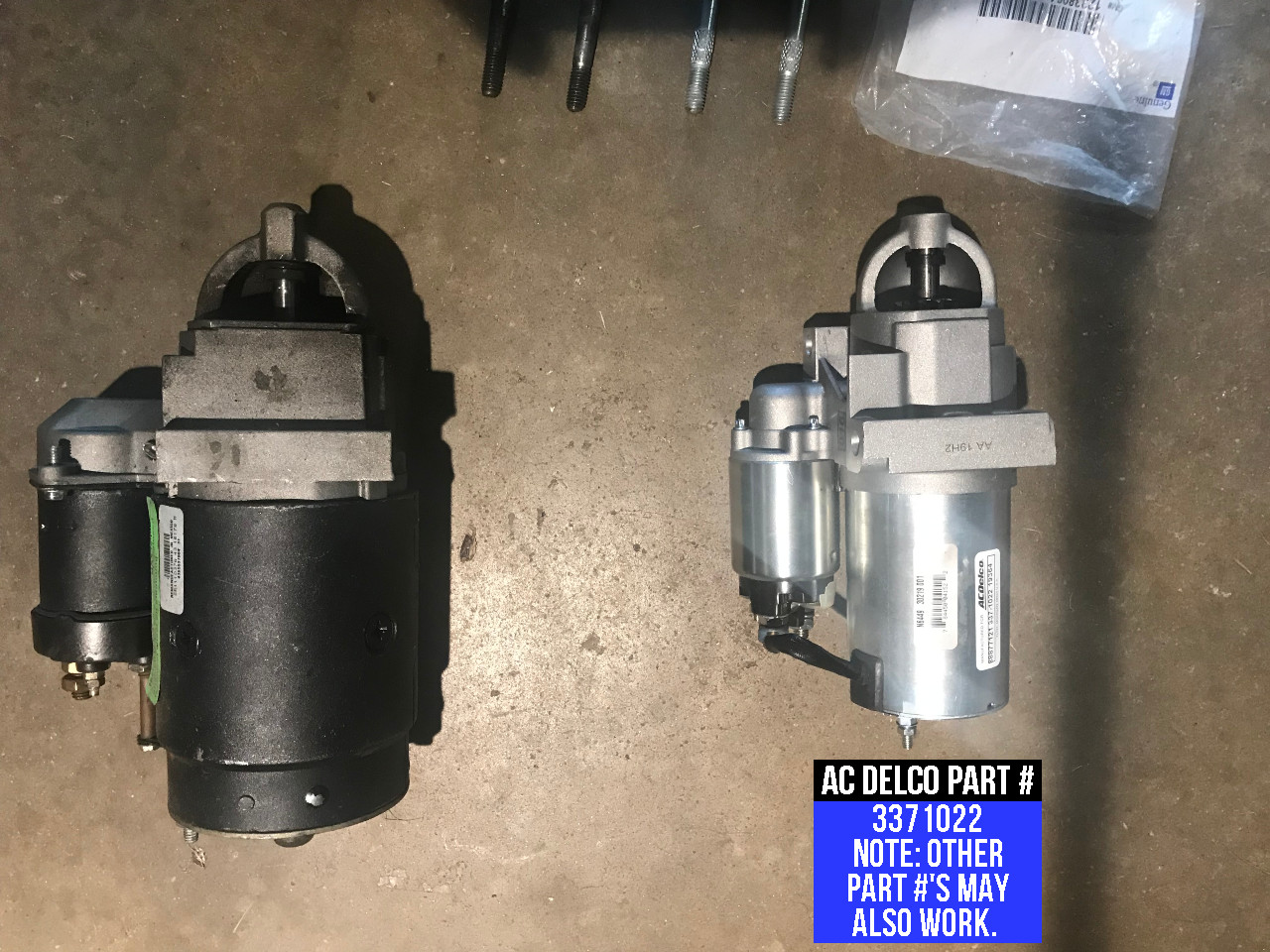
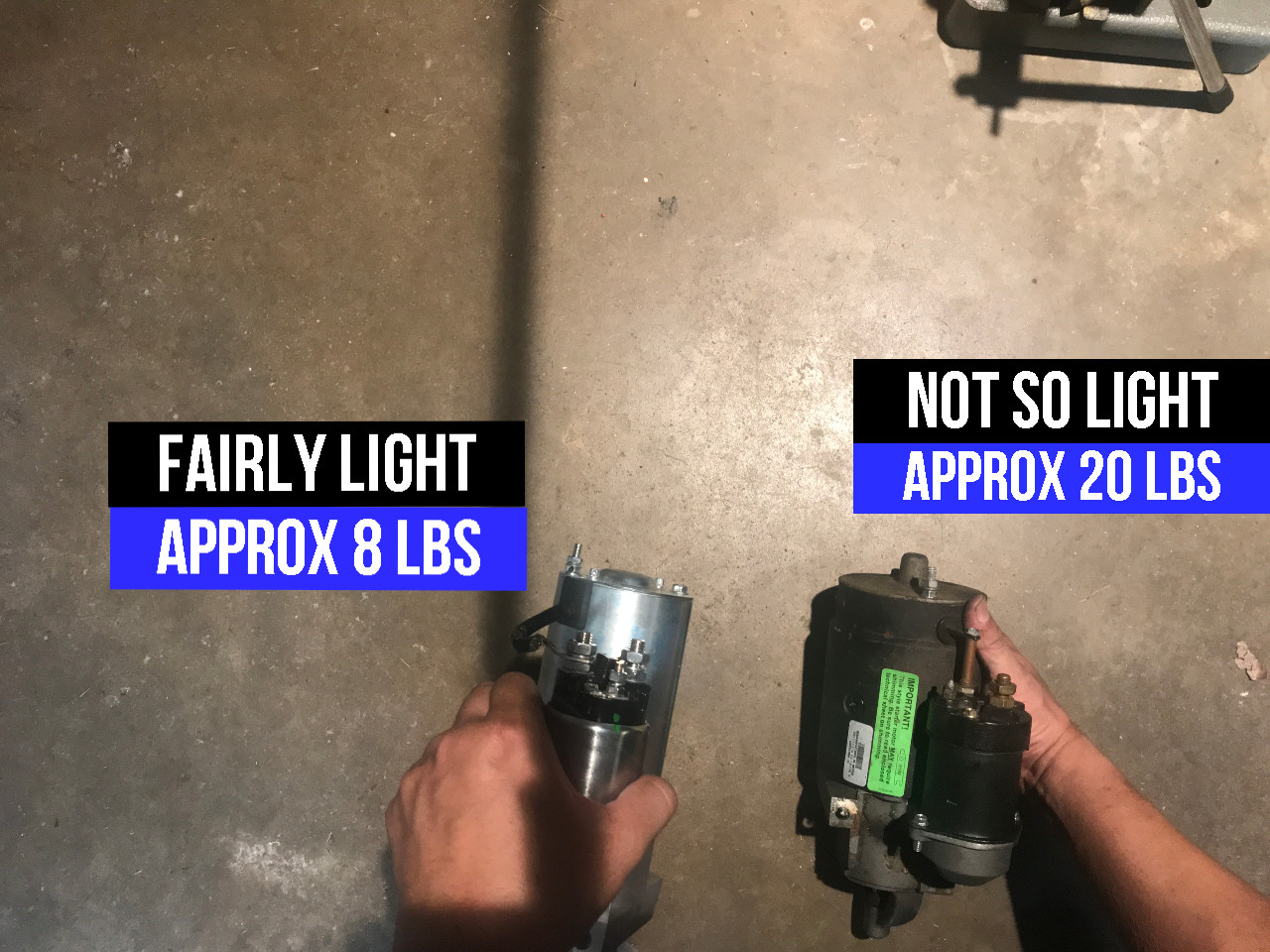
i ended up getting a later-model "mini" type AC delco starter. AC delco part # 3371022. This cross-references to a 1999 c-1500 pickup. Much lighter and smaller than the "regular/traditional" starters used from like 1958-1995 ish....? $147 new from the delco store.

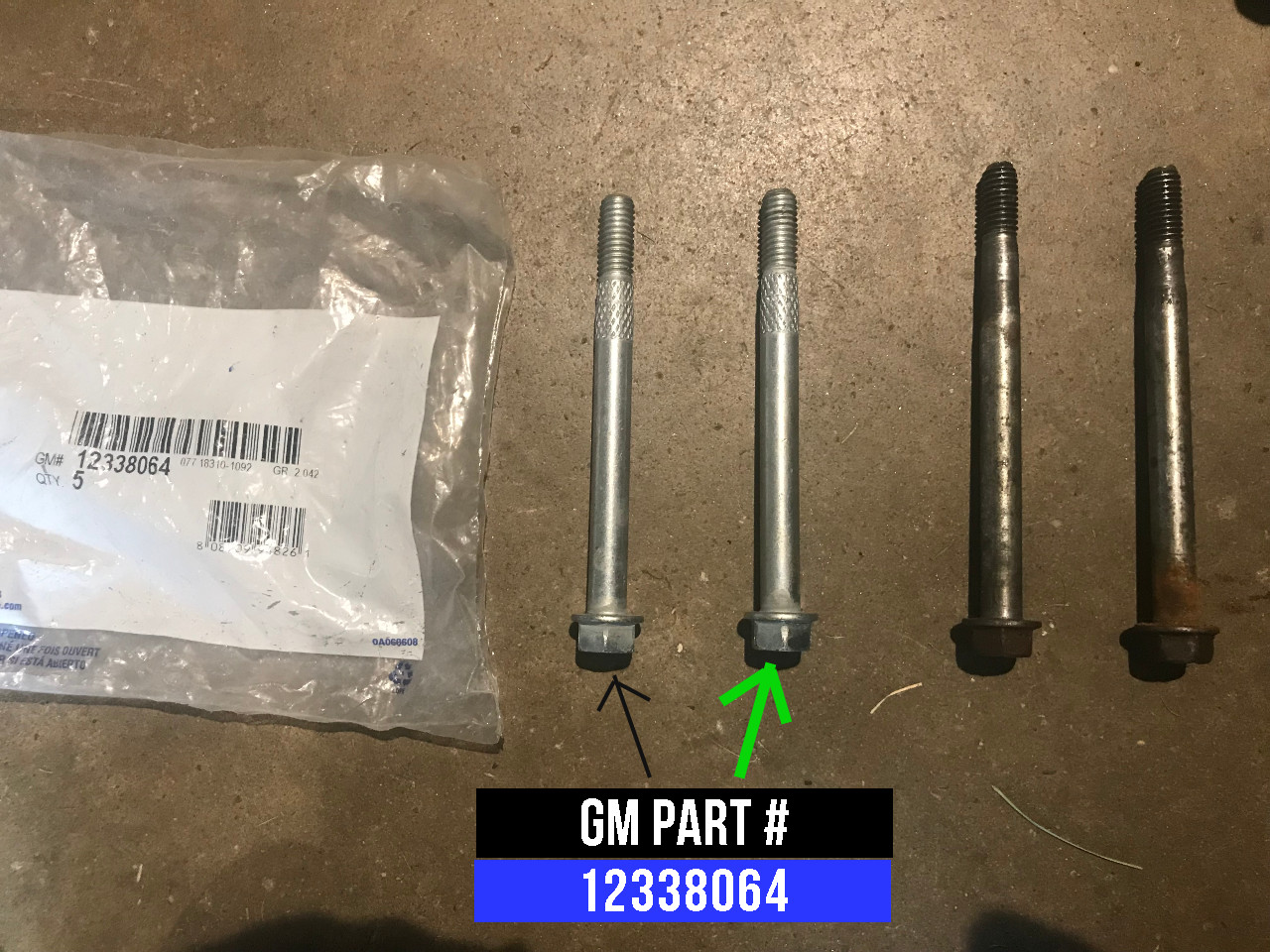
Important NOTE: You will need starter bolts, GM part # 12338046. These bolts are shorter than the traditional starter bolts----i ASSume because the newer style starter bodies are shorter too?

Bottom line for starter bolts: The traditional starter bolts WON'T work with the newer starters. You need the specific newer starter bolts.

MyOOYaS.jpg

VKj0sVk.jpg

ZhZusKq.jpg
 
So anyways, where we are now is, i was able to get it started again, albeit with more than normal cranking duration (moron this in a sec) AND i was able to get it to idle at 800-1100 rpm with NO PEDAL INTERVENTION. (This makes me feel like my theory of inadvertently making the primary throttle blades close too much when i did the secondary throttle plate adjustment to probably be correct.) The change here, made after the original problem was to open the primary plates a little bit with the idle speed screw. Currently i have the plates open just under the horizontal vacuum "slot" in the throttle bore (the "slot" for vacuum advance).

1) i can get the engine to start when cold, but only with longer than usual cranking time and with playing with the pedal.....a little. So, maybe 6-10 seconds of cranking with a little pumping of the pedal. Whereas before all of this, i could get it to start within one crankshaft revolution if not less.

2) Still can't get it to re-start when engine warm. Before all of this, it was not a problem.

3) Just before the starter crapping out (last week) i discovered that the idle mix screws were so far out you could wiggle them; i, apparently, thought that they were seated, when in fact, they were not and therefore what i thought was a bench setting of 7 turns out was actually WAY TOO far out. i got them seated properly and as a bench setting i now have them 4 turns out for real.
So, all this time, i may have been idling too rich and may have contributed to the idle problems all along?


At any rate, i think the problem now is:

Hard starting cold.
Unable to start warm.
 
4 turns on the mixture screws may be too much. I normally start at 2 and adjust for best manifold vacuum.

Cold may need a excessive crank due to the well plugs leaking all the fuel out of the float bowl.
Hot could be vapor lock, or flooded.
While idling look down the primary barrels if you see fuel dripping from the venturi nozzles, it is getting to much gas.

This could mean the float level is to high, or the primary throttle plates are open to far.
What base gasket are you using?
How tight are the front 2 bolts.
Is the air horn still straight at the front bolts?
 
4 turns on the mixture screws may be too much. I normally start at 2 and adjust for best manifold vacuum.

Cold may need a excessive crank due to the well plugs leaking all the fuel out of the float bowl.
Hot could be vapor lock, or flooded.
While idling look down the primary barrels if you see fuel dripping from the venturi nozzles, it is getting to much gas.

This could mean the float level is to high, or the primary throttle plates are open to far.
What base gasket are you using?
How tight are the front 2 bolts.
Is the air horn still straight at the front bolts?

i hear 2 screws out on the idle mix screws is a good bench setting, but i have the later carbs with the fine thread on those screws, so i actually hear 7-8!! as a bench setting. So i went with 4.........

i don't think the well plugs are leaking because of all the times i had the carb off the engine i didn't notice any leaking. Also, i usually run the electric pump a little before cranking.

i'm thinking vapor lock could be the problem when hot; The gas is from last winter and here, we get REAL cold winters...

i'll check the primaries to see any gas dripping at idle IF i can manage to get it started again. However, the primaries are open at curb idle just below the horizontal "slot" for the vacuum advance

i'm using the stock "cardboard" base gasket between the intake and carb. All 4 carb to intake bolts are tight within spec.

Here's a video that might better illustrate what i'm going thru:

At about 9 secs, we hear the electric pump turn on. Then, at 15 secs, i give it a pump a gas. Then cranking for 7 seconds---which i consider excessive. Only after 7 seconds and i open the throttle, does it start. What would this tend to indicate?

Also, the choke plate probably shouldn't be flopping around during cranking. i fixed that, but it didn't make any difference.
 
Top Bottom