CK5
Register an account today to become a member! Once signed in, you'll be able to participate on this site by adding your own topics and posts, as well as connect with other members.

quick CAGE question (strength/size)

K85 Octane

People Fatigued
 Premium
GMOTM Winner
Joined
Nov 2, 2009
Posts
15,354
Reaction score
5,948
Location
San Bernardino CA
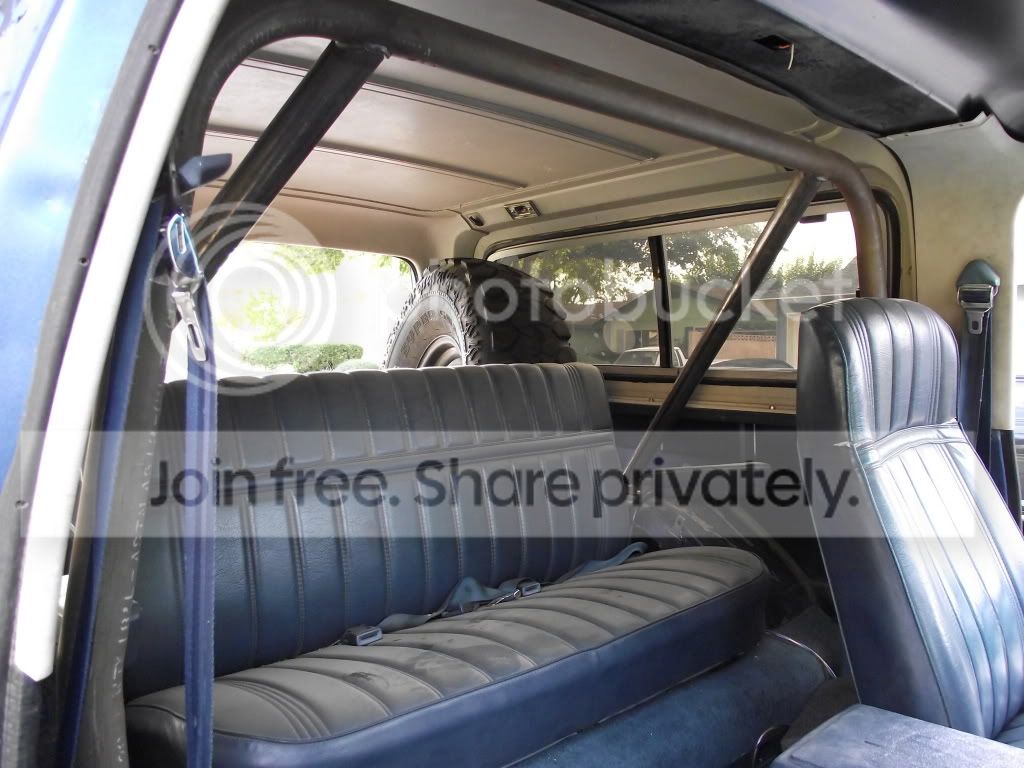
Ok, it's a weekend warrior, full body 85 blazer. It will see passengers all the time, but not always offroading. (going to football games, hockey, concerts, etc.)

A & B hoops are 2" .120 wall DOM
C is not made but will be the same

For the connecting pieces going between the hoops, can I use 1.75 or even 1.5 HREW heavy wall tubing to finish it off? Or does that just sound stupid?:dunno:

Keeping cost down. These areas don't need DOM, but do they need the size? Just looking for a little less steel above my head, without less strength above my head :D YA DIG?
 
My entire cage along with many other here will be 1.75 .120 HREW or DOM. I got 300' of 1.75 HREW for $2/ft so thats what I am using. I know Rene's cage was the same.

I believe most people will stress about design more than .25 in material diameter so long as you are using .120 wall or greater..
 
mm good point
I've been searching all over this website for cage pictures and interesting points. It's awesome, just haven't come across this kind of question yet.
 
I an 1.5 .120DOM as connectors. You would be OK with thick wall HREW. I built mine for high speed go over. Connect it with plate gussets to the body at the A and B pillars for more riggidity and strength.
 
As long as the wall thickness is the same you shouldn't have any problems where the material joins each other, but I think I would use DOM if I was using 1.5, I think 1.75 would be fine as HREW.
 
Id like to see what you got there.
Me?
I have nothing in the truck yet, just an A and B hoop laying around.
I have Vee's B hoop, and his A hoop he had laying outside. It goes through the dash and tucks in nicely. I'll have a spreader put in for strength at the A hoop's bend, just above the dash. More than likely a "^" or single tube going from spreader to top of hoop. And a couple more between A & B hoop's feet, along the floor. Rather not block the doorway.

Everything made to connect the hoops will end up 1.5"-1.75" depending on how easy material is to get around here. And of course $$$. The C hoop will be 2" DOM, with smaller "nodes" (??) connected to hoops B and A. Triangulation and reverse Vs seem to be the name of the game.
backseatrollbar.jpg
 
My entire cage is 1.75 diameter, 1.20 wall DOM. That really seams to be the offroad standard.

I am not a fan of HREW for heavy vehicles but a lot of people say it is fine. If it is protecting me in a fullsize, I am spending the extra coin to get DOM. I would not go any smaller than 1.75. Again because of the wieght of the vehicle.

Your roll over protection is not the areas you want to try to save money.
 
My entire cage is 1.75 diameter, 1.20 wall DOM. That really seams to be the offroad standard.

I am not a fan of HREW for heavy vehicles but a lot of people say it is fine. If it is protecting me in a fullsize, I am spending the extra coin to get DOM. I would not go any smaller than 1.75. Again because of the wieght of the vehicle.

Your roll over protection is not the areas you want to try to save money.


Yeah but I've seen loads of arguments on pirate regarding the fact that HREW in the correct size and thickness is actually better than DOM when it comes to low speed rollovers and especially when it comes to rubbing trees with the tube.

I'd love to see an actual engineer crunch the numbers on it and put it to bed. Personally I'll be using HREW
 
Personally, I always figured it's better to use a good size DOM/wall for the hoops and any bends. The connecting pieces seem like they could be HREW. That's more than likely what I'll do. If I can do real thick 1.5 and still be strong, I might do that too. :dunno: yet

2nd. I would like to do 3 spreaders total. Across A and B, then a third right behind the back seat. Across C hoop, I will have one but only along the floor.
Spreaders for B hoop and behind the bench seat will be for seatbelts. I want these removable though, so I might pin them on the sides. I want easy access to the rear through B hoop. I also plan on sleeping and hauling with it, so a removable rear spreader would be nice, keeping the cargo area free. They would all be in place during offroading, so the strength should be there.
 
Yeah but I've seen loads of arguments on pirate regarding the fact that HREW in the correct size and thickness is actually better than DOM when it comes to low speed rollovers and especially when it comes to rubbing trees with the tube.

I'd love to see an actual engineer crunch the numbers on it and put it to bed. Personally I'll be using HREW


I have no engineering or structual data to base my opinion on. It is just my opinion.

I am curious do they recommend heavier than .120 wall for HREW? What is the claim HREW is better?

I have taken both DOM & HREW in the 1.75" .120 wall flavors & beat them flat with a sledgehammer, the HREW will split at the seam. The DOM is much tougher to beat flat. That is why I prefer the DOM.
 
I have no engineering or structual data to base my opinion on. It is just my opinion.

I am curious do they recommend heavier than .120 wall for HREW? What is the claim HREW is better?

I have taken both DOM & HREW in the 1.75" .120 wall flavors & beat them flat with a sledgehammer, the HREW will split at the seam. The DOM is much tougher to beat flat. That is why I prefer the DOM.

I believe the comparison I remember reading was between a size up in HREW from the DOM. But I cant seem to find it. Was something regarding an ALLpro tube bed on a yota I believe.


EDIT: Heres part of what I was saying. Its based on USA made HREW vs cheap import DOM (IE what you'd go "O THATS A GOOD PRICE!" from an online metal supplier)

http://board.marlincrawler.com/index.php?topic=60158.msg741060#msg741060
 
I am doing my cage in all 1.75 .120 wall DOM. My family rides in it so I don't want to be cheap on this area.
 
The process in which the tubing is manufactured as well as the tensile strength (mainly due to carbon content) are the two major factors in the strength debate.
That being said my cage is HREW. If I was blasting through the desert at 80mph I would have sprung for DOM but IMO for slow speed wheeling it's like comparing a 50,000 lbs working load tow strap to a 90,000 lbs working load tow strap. Sure the 50k strap is weaker when compared to a 90k strap but does that mean the 50k strap isn't up to the task of pulling out your truck?
I'm no engineer, just my personal opinion.


For some good reading I stole this from Pirate...

DOM is the best material for price/strength. part of the reason is the higher carbon content the other is when DOM is made it is drawn over a mandrel (DOM) that compresses and alignes the molecular structure. Heres a nice graphix I found to illistrate the process:

http://www.steeltubeinstitute.org/pr...m_Process.html

So in goes 1020 HREW and out comes 1020 DOM with a finer grain and highly accurate dimensions.

Also, tensile strength on 1010 is around 45,000 psi and DOM is around 80,000-85,000 and 4130 is around 90,000-100,000 (before heat treating).


Keep in mind that the base metal you start out with is not the same between 1010 and 1020.

CARBON CONTENT: " The last two numbers in the S.A.E. numbers always indicates the carbon content of the steel in hundredths of one percent. This would mean that S.A.E. 1010 would have .10% carbon content and 1020 would have .20% carbon content."


1010 specs out at: (%)

C .08-.13
Mn .30-.60
P .035 max
S .035 max

For CREW/HREW:

Tensile strength (ksi) 55
Yield point (ksi) 40
Elongation (% in 2") 20
Rockwell hardness RB60


1020 specs out at: (%)
C .15-.25
Mn .30-.60
P .040 max
S .050 max

For HREW/CREW then DOM

Tensile strength (ksi) 80
Yield point (ksi) 70
Elongation (% in 2") 15
Rockwell hardness RB80

Notice that the average carbon content is .20% for 1020 and .10% for 1010?

As Carbon Content is increased (within limits), Tensile strength increases, but Ductility decreases. For Example, a normal everyday piece of low carbon flat bar, usually A-36 with a carbon content of .26-.28% - you can put one end in a vise and wobble its other end without deforming the metal. This is demonstrating its elasticity. Yet you can bend it just by applying enough force. At the point that it starts to permanently deform, I.E. bend is the point that it has reached its elastic limit, which would also be its yield strength. If you bend it tight enough or apply enough force the section will start to narrow and stretch out. This is demonstrating its ductility. If you apply even more force, the metal will stretch enough that it breaks or fractures. This is demonstrating the tensile strength. Basically as Carbon Content increases, the tensile and yield strength increases, but the zone between yield and tensile narrows. Take the same size of a piece of high carbon steel such as a file, which would have a carbon content of approx. 1.2-1.3% and try to bend it. Would not happen, you could only break it with the application of a much larger force than required to bend the flat bar as it’s tensile and yield strength would be much higher than the flat bar but the difference between tensile and yield would be much smaller. This is a much better demonstration in a shop with a file and a chunk of flat bar.


Basically there are 2 factors contributing to 1020 DOM strength increase: Carbon Content as well as the cold working of the metal through the DOM process.
 
I have taken both DOM & HREW in the 1.75" .120 wall flavors & beat them flat with a sledgehammer, the HREW will split at the seam. The DOM is much tougher to beat flat. That is why I prefer the DOM.
please :haha: no arguments here :whistle:
but for this reason alone, I like the idea of using DOM for the hoops (cause the bends are weak and thinner) and areas of possible high impact. The spreaders should probably be DOM too, but it seems the stuff along the roof doesn't.

I don't know what the price difference is between the two. I haven't priced anything yet. :doah: Also, I should emphasize that everything I say comes from my brain, which isn't the best source at times. I have no experience with most truck stuff :rolleyes: other than my current build.
 
As far as slow speed stuff goes, design is more important then HREW vs DOM

It boils down to this an HREW cage will save your life once. A DOM cage will do it more than once.

Given the same size HREW is somewhat weaker and if you don't do your bends with the seam on the inside of the bend this can be a problem too.

My favorite cage I built I used 1.75" .120 wall DOM for the main tube. 1.75" HREW for most of the rest. 1" .088 wall for some braces and 1.5" .088 wall for some different braces.
 
As far as slow speed stuff goes, design is more important then HREW vs DOM

It boils down to this an HREW cage will save your life once. A DOM cage will do it more than once.

Given the same size HREW is somewhat weaker and if you don't do your bends with the seam on the inside of the bend this can be a problem too.

My favorite cage I built I used 1.75" .120 wall DOM for the main tube. 1.75" HREW for most of the rest. 1" .088 wall for some braces and 1.5" .088 wall for some different braces.

Personally I dont see any cage in a fullsize rig holding up to an end over end flop as far as doing it and going "Wow nothing moved!"
 
Personally I dont see any cage in a fullsize rig holding up to an end over end flop as far as doing it and going "Wow nothing moved!"

Too many variables to say anything like that, terrain the rig hits, speed, cage design, materials.

I have seen an old smittybilt cage that was bolted to the floor hold up to a front flip all the way over back on his wheels. But it was at the dunes. Nothing moved on that cage at all. Shoot there was no body damage and it was an early bronco, they don't fare too well in rolls.

A true endo is rare though, you can't build a cage to survive all situations but you can build a cage so YOU survive all situations
 
I watch a 1700lb buggy go end over end at a desert race. 1.75" cromolly. They walked away but the structural part of the cage over theier heads was bent beyond repair. Crash situation will determine cage damage most of the time. I saw a slow roll in a truck with 1.5 HREW exo cage. It survived in tacked.

Something more is always better.
 

Latest Posts

Top Bottom