CK5
Register an account today to become a member! Once signed in, you'll be able to participate on this site by adding your own topics and posts, as well as connect with other members.

Rear ABS retrofit?

dyeager535

1 ton status
 Premium
Joined
Dec 13, 2000
Posts
31,569
Solutions
1
Reaction score
2,908
Location
Roy, Washington
Before I dig too far into the '88+ C/K manuals about what it may take, is the rear ABS in the trucks worth it?

Sad fact anymore is that outside of clearance, my FWD car is 100 times better to drive in the snow than the truck. Part of the reason it's better are the brakes, but that's four wheel ABS. It would be nice to let the truck compete with the car a tiny bit for drive time when it snows.

I've never driven one of these trucks with this system though, so I'm not sure how effective it is. Curious what others have to say about it. This would be on the 14SF, my assumption would be that the system will be similar, but have some different components than a 10 bolt application.(?)
 
I took the rear wheel abs junk out of my 91. It had been hacked by the previous owner in the first place so it didn't work anyway. I'm not missing it. I don't need it.

Having ABS in the rear is dumb to start with. The main reason for ABS is to maintain directional control in the event of lock up. But if it's only keeping the rear from locking up, the fronts can still lock up and loose steering control.

I took my K5 to work a couple of weeks ago and came across some black ice. Noticed taillights and headlights on the same side of the highway I was on as I was coming towards a stoplight. I gently started to apply the brakes and felt them lock up and start a skid. So I released the brake and let off the throttle too. The engine slowed the truck predictably and allowed me to change lanes safely to avoid the other cars sliding around. Most of those cars sliding around had full 4 wheel abs too. ABS is not a replacement for safe driving practices. People wreck on snow/ice all the time with 4 wheel ABS, stability and traction control systems. Most of the time it's due to driving too fast for the conditions.

For me, I don't see the upside to going through the expense and work required to try and retrofit a 4 wheel ABS system to a squarebody. The 4 wheel systems require wheel speed sensors at each wheel in order to know if any wheels are locking up. Each brake has to have a dedicated line from the ABS pump/valve assembly so it can cycle the pump for just the wheel that is locking up. It's just worth the expense to go through it for me.
 
Don't bother. Biggest thing you can do is run the right tires. What are you running now? You could always spring for a set of dedicated winter tires, as they make a HUGE difference. I run BFG At's on both my burbs in the snow, and they do well. That being said, my BMW AWD with winter tires kicks both their asses, but only because of the dedicated winter tires.
 
My 2014 pickup has 4 wheel abs and stabilitrak. I can drive far faster with it than if I turn it off. That system flat out works 95% of the time. The 5% of the time when it isn't working for me, it really, really, really sucks to have though haha!
 
Having ABS in the rear is dumb to start with. The main reason for ABS is to maintain directional control in the event of lock up. But if it's only keeping the rear from locking up, the fronts can still lock up and loose steering control.

I have to somewhat disagree, at least with my perception from driving without ABS in the truck. I've swapped the rear (to the 14SF from 10B), and braking seems to be a bit more than necessary even on dry pavement. If I have to really hit the brakes, they will lock and slide before the fronts. Normally not a big deal, but on snow or ice that is a problem, and I'd rather not jack knife my trailer when towing. I can also see ABS being a benefit coming down a steep logging road grade in snow (which is fairly common for me), where compression braking just isn't enough. It would be nice to be able to touch the brakes and not have the tires lock. Yes, four wheel ABS would be beneficial, but I figured that needed a bunch more components and a lot more work since it wasn't used on these trucks.

The tires are BFG AT KO's, and they do pretty good in snow and ice. Even better aired down. But I have zero confidence I could slow the thing down on the freeway safely, at any reasonable speed, in snowy conditions. In the car, on packed snow and ice, I was confident at 60MPH. Some of that is traction control, but much of it is just being able to steer while slowing down. It's going to be nearly impossible for the truck to compete in on-road conditions even if it had rear ABS, but once the snow gets deeper than ~4", the car has problems, where the truck wouldn't. Generally however, it's one or the other...deep snow to get to the public roads, and packed snow and ice once there.

I look at the rear ABS as something of an automatically adjustable proportioning valve...when unloaded, it handles the excess braking force at the rear, but when loaded or towing, the rears can do the work they need to.

Like I said earlier, I didn't really dig into the system to see what all it would entail if I decided to go that route, but I can't imagine it would be that much or that difficult since it was factory later on.
 
I also disagree that rear ABS is dumb. The back locks up alot on mine when unloaded or driving on dirt vs. pavement. I can adjust my adjustable prop valve installed in the rear line and tone it down, but then I lose braking effectiveness when loaded or on pavement.

I've driven K5's and Subs with rear ABS, it works and it helps alot in all conditions, dry, wet, snow, ice. While 4 wheel would be ideal, even just the 2wheel helps keep the arse from sliding around back there and helps alot in maintaining control during a hard brake.

I've also kinda wondered what it would take to install the factory rear abs on my '73. I've never looked into it.
 
The RWABS was what, 1990-91 only, and was famous for failing. I'd shy away from it as my general impression was that they were an early incarnation of ABS, call it zero-generation.

If you're that concerned, don't slam the brake pedal down in panic stops and wiggle your foot a bit :haha: That's all the damn thing did anyway.

-- A
 
The RWABS was what, 1990-91 only, and was famous for failing. I'd shy away from it as my general impression was that they were an early incarnation of ABS, call it zero-generation.

If you're that concerned, don't slam the brake pedal down in panic stops and wiggle your foot a bit :haha: That's all the damn thing did anyway.

-- A

That was kind of what I was getting at...is it even effective as far as ABS works? I know it was the "first generation" (probably technically not, but early in terms of mass use) and I wondered if the system, when working, is anything like the more modern systems.

I also wondered about reliability, which is tough to determine on trucks that are at least 26 years old, and have probably never had their brake fluid changed. lol As much as we often malign modern production methods as being cheap, from my viewpoint, the reliability of smaller components has increased, and I can see technology and experience making the modern ABS systems more reliable, not to mention more effective.

I wouldn't exclude a newer system from consideration if the swap didn't require an entirely new powertrain and electrical system, but something tells me the systems got better as they became more integral to the powertrain control systems.
 
They make aftermarket add-on abs systems for motorcycles,and add-on systems for big truck trailers.but I don't see anything really for passenger vehicles, mabey too much liability involved.There's a few write-ups out there on people retrofitting some systems to their old cars,

GM was experimenting back then, caddy had one type of ABS from a supplier, trucks had a home grown system for the RWABS thing, my '89 Pontiac 6000 STE has some bosch 4wheel system that has never been seen since on any GM car, it looks like a mini-nuclear plant, some pressurized bulb, giant master, lots of wires, brake lines coming in at all different planes and odd angles. But...it's works flawlessly still!
 
I have to somewhat disagree, at least with my perception from driving without ABS in the truck. I've swapped the rear (to the 14SF from 10B), and braking seems to be a bit more than necessary even on dry pavement. If I have to really hit the brakes, they will lock and slide before the fronts.
There's your problem right there. Chances are the brake drums are bigger on the 14b than the 10b was. That alone is going to mess with your stock prop valve. You are getting the same brake pressure as you had with the smaller brakes and it's applying on a larger more effective set of brakes out back. Hell yeah they are going to grab harder. Get an adjustable prop valve and run it in the rear line. Dial it in so that it the fronts lock up just before the rear.


I look at the rear ABS as something of an automatically adjustable proportioning valve...when unloaded, it handles the excess braking force at the rear, but when loaded or towing, the rears can do the work they need to.

Like I said earlier, I didn't really dig into the system to see what all it would entail if I decided to go that route, but I can't imagine it would be that much or that difficult since it was factory later on.

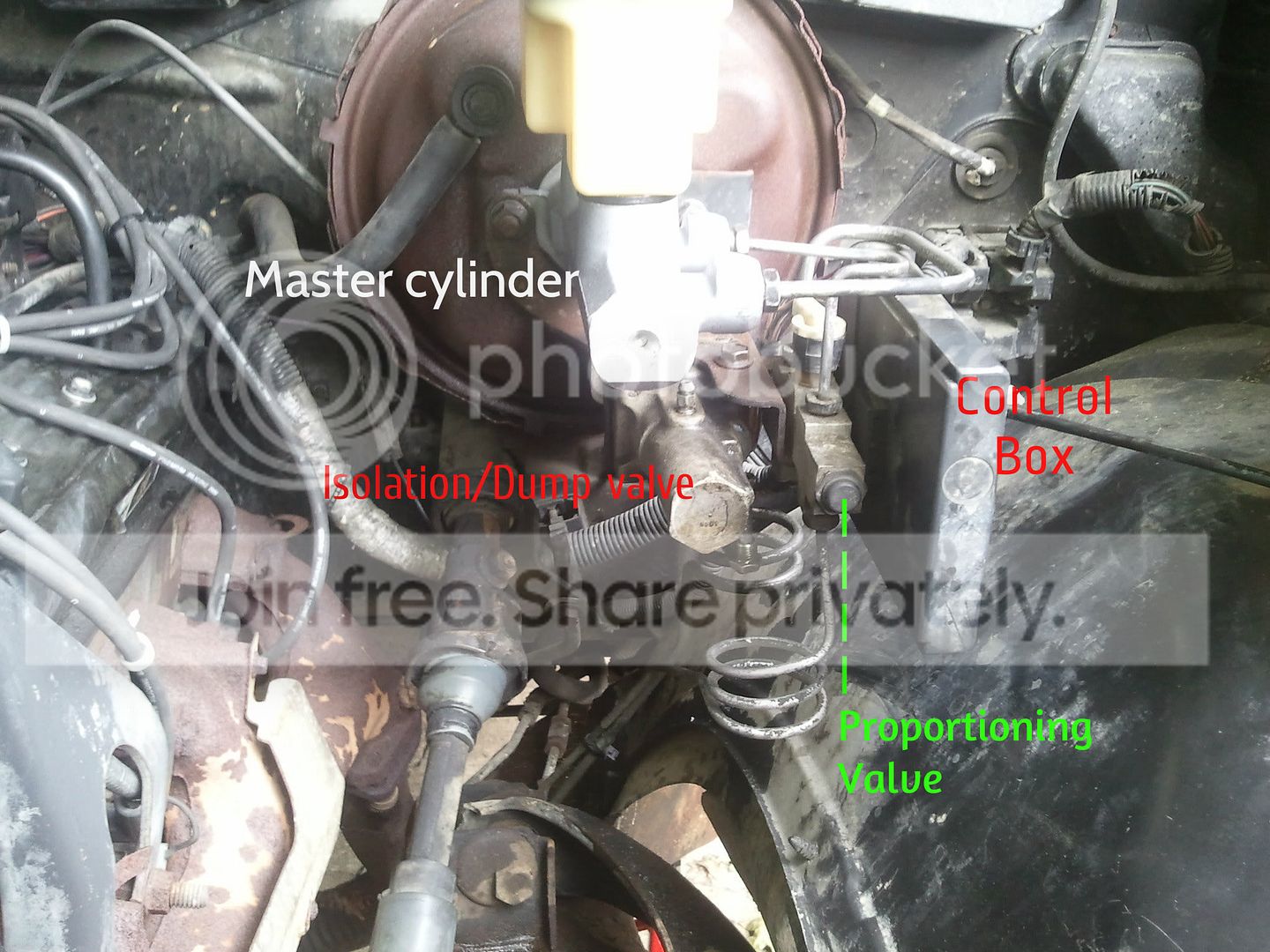
That's the thing, ABS back then still had a prop valve on them. Mine did. All abs is doing is holding and releasing pressure on the rear line to limit lockup. AKA pumping the brakes like most of us got taught how to drive prior to ABS being mainstream. (I am dating myself here...) In reality, it's only going to kick in anyway if it sees the rear wheels actually LOCK UP. How did that system know? It didn't have individual wheel speed sensors at each wheel. They basically took the signal from the Vehicle speed sensor in the output of the T-case. So if you are hammering down on the brake pedal hard enough to make the rear brakes lock up you are probably in a bad situation to start with. It's not going to give you the "proportioning" you are looking for until it's already locked up. Not when you are gradually holding pressure as you descend a grade.

Your brake lockup isn't going to go away with RWAL ABS, the system is just going to pump for you when it does. Why not prevent the lockup by slowing the pressure to the bigger rear brakes?

I've gone from a 10b out back on mine with stock brakes to a 14b FF with large drums. I've not noticed the rears locking up first on mine after we deleted the non-functional RWAL ABS. We did replace the ABS prop valve under the master with one from an earlier 3/4 ton Suburban back in the normal location on the frame near the steering gear. I might have got lucky that the junkyard I called to get the prop valve and lines and got the right valve since the 3/4 ton burb had the larger rear brakes to start with. If I did have a problem I would have put in the adjustable prop valve in.
 

They were complaining of lack of ABS. The braking section is pretty funny. And rear seat access is great!?!?!??!?!?
 
Anybody ever retrofit one of those adjustable prop valves that ties to the axle? I've seen them in late 80's 3/4-tons and such. As the back end squats, the rear brakes get more pressure. I think that's a good part of the problem in a short wheelbase K5 (especially lifted) - as you hit the brake hard it leans forward a lot. Although maybe 4 Rough Country springs would help?

My dad had an International with anti-lock brakes. No matter how hard you pushed the pedal, they would never lock. Now go through a deep puddle and they were practically anti-brake brakes.
 
There's your problem right there. Chances are the brake drums are bigger on the 14b than the 10b was. That alone is going to mess with your stock prop valve. You are getting the same brake pressure as you had with the smaller brakes and it's applying on a larger more effective set of brakes out back. Hell yeah they are going to grab harder. Get an adjustable prop valve and run it in the rear line. Dial it in so that it the fronts lock up just before the rear.

That's the thing, ABS back then still had a prop valve on them. Mine did. All abs is doing is holding and releasing pressure on the rear line to limit lockup. AKA pumping the brakes like most of us got taught how to drive prior to ABS being mainstream. (I am dating myself here...) In reality, it's only going to kick in anyway if it sees the rear wheels actually LOCK UP. How did that system know? It didn't have individual wheel speed sensors at each wheel. They basically took the signal from the Vehicle speed sensor in the output of the T-case. So if you are hammering down on the brake pedal hard enough to make the rear brakes lock up you are probably in a bad situation to start with. It's not going to give you the "proportioning" you are looking for until it's already locked up. Not when you are gradually holding pressure as you descend a grade.

Your brake lockup isn't going to go away with RWAL ABS, the system is just going to pump for you when it does. Why not prevent the lockup by slowing the pressure to the bigger rear brakes?

This is one of the things I wondered...without wheel sensors, how the heck would ABS know the brakes were locking up?

Any idea when ABS got "good" on the trucks? Obviously not "squarebody", but would be interesting to see feasibility on retrofit.

I had thought of the rear proportioning setup, but as I recall, setting them up was kind of a hassle. I can see both the pros and the cons of that setup. Great if it's "calibrated" to the brakes and weight, probably not real good if just randomly throw on a different brake setup and different weights.
 
You're thinking to use the early 90's RWAL?

2012-06-09120715b.jpg


It doesn't know which rear wheel is locking - it only knows the rear end is locking. Even if it knew it was the left or right rear wheel it wouldn't matter - there is only one brake line to the rear axle. In a lot of situations that's probably good enough to avoid the situation you described. We've already established that it won't be equivalent to a more modern 4-channel system. You'll have to find the wiring diagram for the kind of system you want to install and figure out how to route vehicle speed to it.

2011-05-20_194605_rw.gif


Looking at this one, it seems it doesn't compare front wheel speed to rear wheel speed, so how does it work? Just a large negative change in speed triggers the dump valve? Kind of looks like the whole thing is disabled in 4WD.

With the height sensing prop valve, you could tune it somewhat by changing the length of the lever and angle it's mounted at, but I suppose it would still be trial and error.
 
You're thinking to use the early 90's RWAL?

Kind of looks like the whole thing is disabled in 4WD.

That's why it's called "Rear Wheel Anti Lock", it only works in 2WD, and only in 2WD High, to boot.

(This is because it would think the wheelspeed was twice as high in low gear. I guess putting the speed sensor on the transfer case would be too easy? :dunno: )

-- A
 
The GMT800 trucks had a true 4 wheel 4 channel abs system. The problem in retrofitting is GM never made a solid front axle with ABS sensors. You'll have to adapt some way to get a wheel speed reading from each front wheel. The rear would be easy enough, just use a 10bolt or 14 bolt from the GMT800 truck as they would have the individual wheels speed sensors in place. The other thing is the wiring from each sensor is run in a "twisted pair" in a shielded conduit to protect from RFI.

Part of the issue, is as the systems got smarter and worked better, they integrated more with other systems on the truck. They started incorporating stability and traction control systems that are all functions of the ABS module with the added yaw rate sensor. The ABS interacts with the Engine control module in low traction events to tell the ECM to back off on the throttle request if the engine is overpowering the available traction. Run without the added interface through the serial data and codes will set in the ABS module that will possibly inhibit all ABS functions until the fault is fixed.

Doing a little surfing found this from Dynatrac:
http://www.fourwheeler.com/how-to/0905or-dynatrac-abs-retrofit-kit/

An article from Hot Rod about retrofitting ABS to earlier muscle cars.
http://www.hotrod.com/articles/hrdp-1108-abs-for-hot-rods/

It's not to say it can't be done. Just the way to do it right with a later system is going to be complex and expensive to do. Again, based on your current setup, your components are mis-matched. It can be fixed by lowering the pressure to the rear brakes to start with.
 
Yeah, not impossible, but for the gain it doesn't seem worth it in my application. Now if going LS anyway...lol.

The height adjusting proportioning valve for the rear does seem like the easiest retrofit, however what happens on bumps and what not while you are moving fast? Wouldn't it be possible to end up with varying rear braking? Worse with trailer? Probably not likely, potholes I'm assuming would be unlikely to "activate" the height adjusting, it would be interesting to see exactly how these work internally. I'm assuming it's just an orifice that is more or less blocked off based on where the lever arm is located.
 
Top Bottom