CK5
Register an account today to become a member! Once signed in, you'll be able to participate on this site by adding your own topics and posts, as well as connect with other members.

Rear power window motor upgrade?

TheRealJimmy

Registered Member
 Premium
Joined
Dec 17, 2021
Posts
58
Reaction score
41
Location
Dawsonville, Ga. 30534
Is there a way to rewire the rear power tail window so it works better? Or is the Nu-Relics 1973-1991 Blazer/Jimmy Tailgate part number 17383-1 the only rear fix?
 
I haven't seen anything lately. I thought someone was selling stronger motors at one point, but what you posted is the most current offering I've seen of any upgrade.

It's pricey, but if it keeps from ALL the hassles of getting a finicky rear window to work (mine hasn't responded to any fixes I've tried, I'm tired of screwing with it) it's probably worth it.

I AM somewhat skeptical of what will fail next if brute force is the answer. But at this stage, I'd be willing to find out. As with everything, would be nice if that was cheaper, but being a different design, the price is understandable.
 
This is also true. I just find myself using the automatic portion quite a bit. If it's hot out I can roll it down while driving. If I need to get something out of it, I can roll it down before I stop. If someone needs to put something back there, I dont have to get out to open it for them.

Honestly I think if that rear window consistently worked very well (quick) no one would convert. The other problems they have are minor, the huge one is the speed and strength of the stock setup. I mean it's a repurposed windshield wiper motor from like the 50's iirc...of course it wasn't destined for greatness in another application.
 
Can’t imagine using mine, 87, without a functional electric rear window. I’m in and out of the back every trip to camp and back and stopping to pick up groceries, whiskey and ice. The rear works better than the the driver and passenger side windows. I think a shot of silicon lubricant is overdue.

Not sure if it helped but when I worked on mine, instead of using whatever it is they line those window channels with, I used adhesive backed velcro as the original channel lining was dried cracked and falling apart. I can’t remember if I used the loop side or the fuzzy side. Seems like the loop side would give you less friction, but to be honest, I can’t say it was a concern when I did it 6 years ago. I did spend significant time adjusting the tailgate latches for alignment. I recall being disappointed until I hit it with the lube. Had all new rubber at the time. Still has the original motor from what I could see.
 
The last set I got from LMC, which was from Precision, sure looked like the fuzzy side of velcro.
 
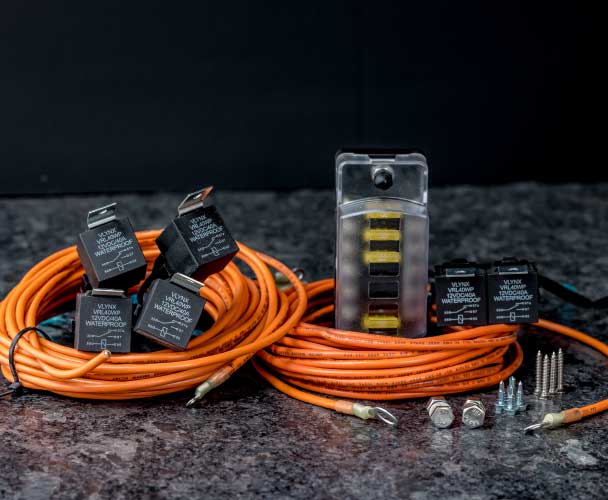
K5 Squared offers a full power relay for the rear window as well as the door windows (like LMC offers for the Doors). I have been thinking about upgrading to this to add the additional umph ... necessary on the power.

I like the LMC Relay Kit for the windows since you can purchase additional relays to go in the harness ...

K5 Squared appears to be direct wire to the relays and not via a harness.

K5 Squared is the only one I have found for the rear window relay upgrade. You can purchase the Doors Only, Rear Windows Only, or the full set as shown :


Report back if you try this ...
Thanks,
 
We've talked about putting relays in the rear window for years, but I see here someone with a success story.

https://ck5.com/forums/threads/tailgate-relay-modification.324454/#post-3602306

Just like the side windows, this would work even better if you ran a heavy power wire to the back. It would be cool to try a DC-DC converter back there and give that motor like 15V fixed, no matter what voltage drop is going on.
 
The relay upgrade IMO is questionable. If the switch was the limitation, it would trip the breaker or melt (See: high speed fan switch) Thus I don't see how a relay helps. Just run heavier gauge wire (which admittedly would be much easier with relays lol) The assumption (?) is that there is significant voltage drop through the switch. I find that hard to believe, again, because even when the motor stalls, the switch doesn't get hot or melt that I've seen. It's not the limiting factor in the circuit IMO. The length of the wire run isn't going to change massively by using a relay, so voltage drop would be more easily reduced by running a thicker wire, regardless whether you use a relay or not.

From the quick check of an amp/wire guage chart I did, shortening the wire length by 10ft with the same gauge wire (assuming you shorten it that much with a relay setup) would be the same as running the stock setup but stepping up to the next wire gauge. I don't think you'll save 10ft by going to a relay, but I could be wrong. FWIW I want to think that motor is on a 30A breaker, but at that wire length, the chart indicates the wires should be 6AWG. What is it stock, 10AWG at best?

I think some people have luck when the stars align (I have two K5's, the bone stock one the rear window works great) and the beat up tailgate on the other truck doesn't work properly no matter what I do. I have new motors for it, I'm to the point of throwing one of them in just to see what that will do. I can see the voltmeter drop significantly when the "old" motor is working.
 
Last edited:
The two biggest problems are the old switches and that the power is coming from the fuse block. The fact you see the voltmeter dropping proves the supply there is not very stiff.

I posted up numbers back when I did my side windows. https://ck5.com/forums/threads/power-window-idea-it-works.206618/page-3#post-2465480. The motor got 63% more power and moved 41% faster. 10AWG is about an ohm/1000', so at the length going to the back window it could be something like 1/2V (I don't know what gauge it is), but not the biggest contributor.
 
The two biggest problems are the old switches and that the power is coming from the fuse block. The fact you see the voltmeter dropping proves the supply there is not very stiff.

That is fair. The fuse block is a variable. I'll have to play around with the voltmeter at various spots, since my alternator tends to run at fairly high voltage, it will be interesting to see what it looks like through that whole circuit.
 
Top Bottom