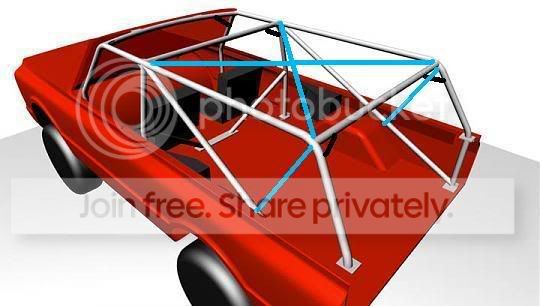
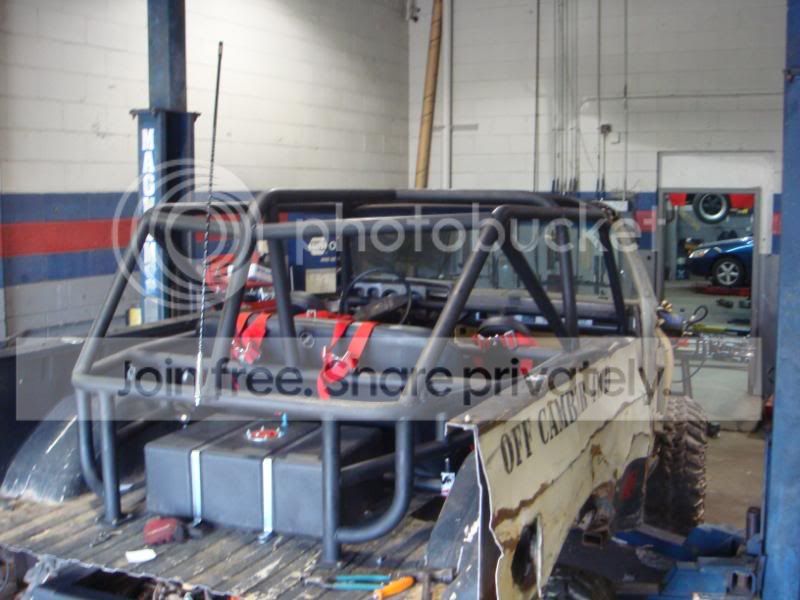
I would also put some kind of X in the rear rectangle over head. That would help with tieing it all together better. Have you ever made a rectangle out of wood using just nails? Something like 1 foot wide by two feet tall for an example. It has allmost no side load strength, and supports very little weight without colapsing. It wants to fold and break at the joints and colapse.
It only has strength if you lay it over on it's edges and put weight on the top opposite edge. But standing up it's weak when pushed side to side in one direction or the other. If you put one leg of an X brace it's strong in one direction. If you push sidways from the side with the X brace leg at the top, it's strong, but not as strong if pushed from the oppisite side. Put an X brace corner to corner, in BOTH plain's and it's strong as hell in ANY direction of force.
Same principle as leaning two playing cards together at equal angles to each other, Because their at an angle they have Triangulated structure. Try putting a card across two playing cards standing up vertically, there is no way they will stand up. Even in a side flop, that design if it took a hit at a corner would rack very easily without triangulation.
Putting an x in the roof isn't going to add strength in any relevant way as far as a roll is concerned. It'll keep the roof tubing from collapsing, but that's about it. The a and b pillars can fold over just as easy, hence the way I suggested adding gussets before. Adding bracing to the roof is simply adding tubing in the wrong plane.
The best place to put an x is between the two sides of the b-pillar, but of course this severely limits passenger entry.
Look at it this way, consider each bend and node (a node is a place where two pieces of tubing come together) as a hinged joint.
See this drawing of a plain b-pillar (circles model the bends/nodes as hinges):
This will fail quite easily when hit from the top or side, its not a stable structure. The force is able to use the maximum amount of leverage from the mounting point and the weakest part of the structure (the bend) will fold over relatively easily.
Its easy to tell if a structure is stable or not (which basically determines if it has sufficient triangulation) by modeling with hinges like this, if the structure would fall over by looking at it (like this one would), its not stable.
By adding gussets, the structure becomes stable. The lever arm is reduced and the weak point in the system (the bend) is eliminated. I'm not going to do the calculations but I bet those two 6" pieces of tube increase the strength of this structure by 30-50%. Here, the failure point would be just below the gusset which would require much more force.
The strongest way to do it is with a cross like this, at this point the tubing would have to fail in compression (never going to happen, at least in a situation that a person might survive).


 I'm sure you know what up with that stuff.