CK5
Register an account today to become a member! Once signed in, you'll be able to participate on this site by adding your own topics and posts, as well as connect with other members.

TBI won't fire up

Just FYI. I had a weird issue once. TBI wouldn't start, everything checked good. I got pissed one day and just layed on the starter and kept cranking it then she fired up and ran fine. Didnt have too much problems starting it until the next morning then same thing.
Turns out it was a bad Oil Pressure switch. It would not allow the vehicle to start until the oil pressure built up to close the switch.
Interesting. I'm confused about the purpose of the oil pressure switch. I've read two things: (a) It cuts off fuel if the oil pressure is low, maybe to stop pumping after an accident, and (b) it is a backup so that if the main fuel pump relay fails, fuel will continue as long as there is pressure. In one case it's AND and the other case OR with respect to the main fuel pump relay.

Anyone know for certain? I suppose I could go find the schematics and figure it out.

Your case would be consistent with (a).
 
If its got spark, and fuel, and in time. It should start.
That's why I said to use Cosby sauce. It's the no start, starting answer
 
It's actually running fine now. I'm not happy that it wouldn't last week and I don't know why. Ticking time bomb.
 
The oil pressure switch does cut off the fuel relay if it sees no pressure. Check your harness back there- mine was rubbed through on the firewall and caused all sorts of headaches until i figured it out.
 
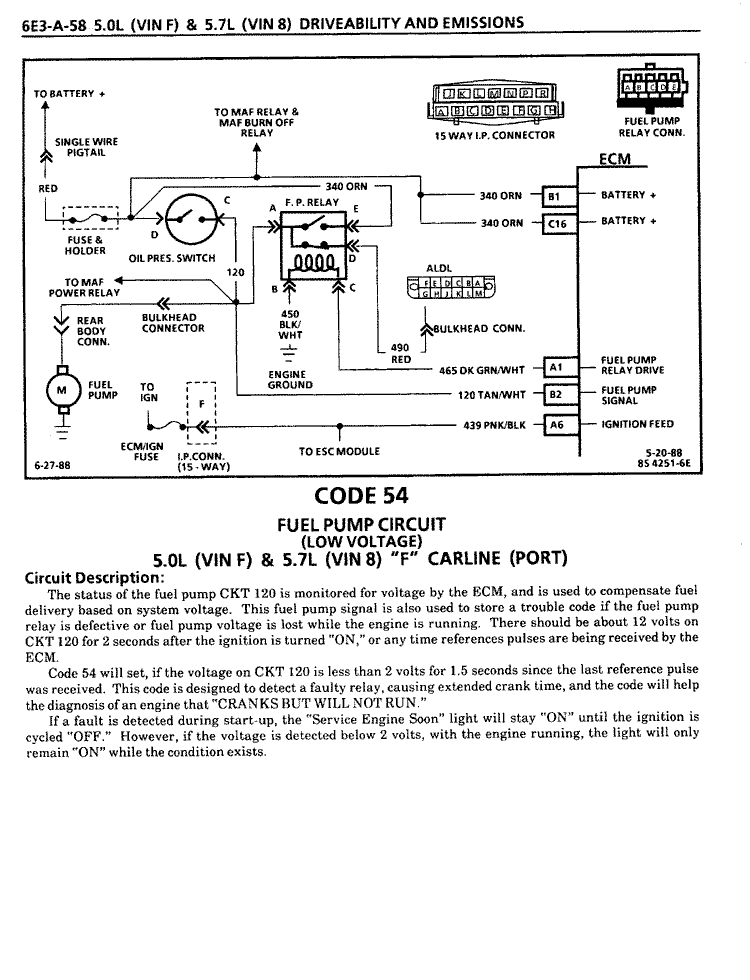
The oil pressure switch is parallel to the relay. It is nearly an identical circuit for every OBD1 GM TBI/TPI vehicle I have knowledge of. Thankfully wiring diagrams are quite clear.

full
 
Last edited:
The oil pressure switch is parallel to the relay. It is nearly an identical circuit for every OBD1 GM TBI/TPI vehicle I have knowledge of. Thankfully wiring diagrams are quite clear.

full
That diagram appears to be from TPI. Are you sure it applies to TBI?
 
That diagram appears to be from TPI. Are you sure it applies to TBI?
Absolutely, 100%.

The difference I see is that on the cars I guess they didn't want the techs to get dirty, so the single red wire hanging off the truck relay, went to the ALDL connector in the cars.

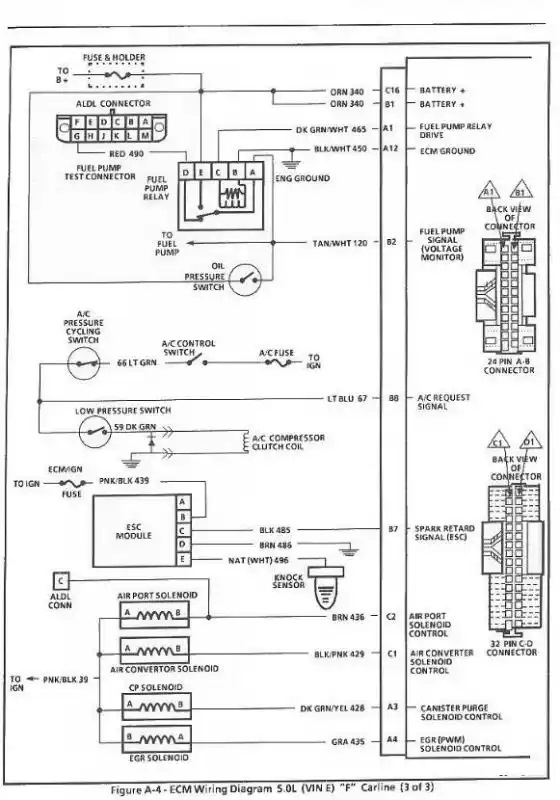
Don't forget, there were TBI cars too. Took me some time, but here we go....
TBI F-Body:
full


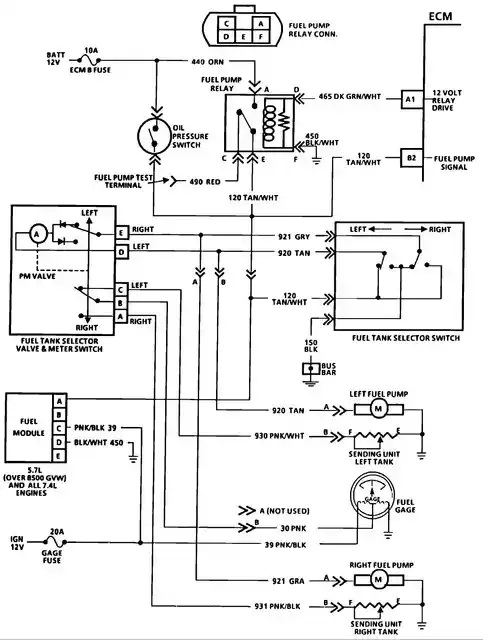
TBI Truck:
full


As you can see, the relay and switch are ALWAYS wired in parallel.
 
That's interesting. How would you ever know if the oil pressure switch was bad? It appears to be totally superfluous under normal conditions.

Also, do you think just cranking on the starter provides enough pressure to trigger the switch? In that case, the main relay could be bad and you would not know either. Well, if you are like me and turn the key and listen for the pump, that would tell you...
 
Youd only know if the oil pressure switch was dead if the relay died and it still wouldn't start, or if you unplug the relay while it's running and the truck dies.

Cranking definitely will close the switch. Believe I posted it earlier in this thread, although it's also referenced in the second paragraph on the tpi f-body code 54 page above ("causing extended crank time"). At 4psi the oil pressure switch closes.

It's in the truck service manual as well, to the effect of "if the relay fails, longer crank times will result".

My mistake, it was in the other thread...

"*** UPDATED BY TSB 893206E, DATED OCTOBER 90

When the key is first turned ON, without the engine running, the control module will turn the fuel pump relay ON for two seconds. This builds up the fuel pressure to normal operating pressure. If the engine is not started within two seconds, the control module will shut the fuel pump OFF and wait until ignition reference pulses are present. As soon as the engine is cranked, the control module turns the relay ON, which powers the fuel pump. The control module continues to power the fuel pump during engine operation. If the fuel pump relay fails, it is backed up by the oil pressure switch, which continues to operate the fuel pump as long as oil pressure remains above 28.0 kPa (4 psi)."
 
Last edited:
Good to know. Many of us could be driving around with one or the other dead. I know my main relay is good, but who knows about the pressure switch.
 
With the plethora of junk aftermarket parts and counterfeit parts from china, I see the oil pressure switch as a potential liability.

I had a "Delco" (full disclosure, purchased a number on eBay before I knew counterfeit parts were a thing) oil pressure switch/sender fail within five years, and the next one has failed a couple of times staying closed...which means the fuel pump runs until the battery dies.

Personally I think anymore it may be just a good idea to eliminate the switch if it goes bad, and carry a spare relay to swap out in case there is a no start condition. You can bypass the relay by running 12v to the single red wire, even that is technically unnecessary, you could just jumper the battery feed to the fuel pump feed wire on the relay connector.

I've got my electric fans running off the same relays, mainly for swapping reasons in case of failure.
 
Yikes. I don't even know where the various relays are located on my setup, since it's sort of a cobbled together retrofit. I have two relays simply attached to the side of the ECM. I suppose one would be the pump relay. Not sure what the other one is. Possibly just ECM power engaged by the key switch.

Where is the oil pressure switch located? Hmm. Would my carb vehicle even have had one originally (can't think of a reason with mechanical pump)? If not, I must have installed it along the way, or the dude who made the harness just bypassed it.
 
Oil pressure switch was used with carbed vehicles that had electric chokes so the choke coil only worked when the engine was running.

Only two common places for the oil pressure sender/switches, that's beside the distributor on the driver's side, or above the oil filter. AFAIK on the SBC setups, the oil pressure switch/senders were always next to the distributor. The tap above the oil filter is a different diameter.

There were two designs, a separate switch and sender (switch two wires, sender one wire and bell shaped), or the later design which is a three wire setup, cylindrical black plastic piece.
 
Ok guys, give me some ideas. Once again the truck randomly wouldn't start up today. It turned over like crazy (dual batteries, well charged) and simply no sign of firing. I sprayed throttle body cleaner in there and still no sign of starting, so I'm thinking spark... I checked that +12 was going to the coil, then pulled a plug wire and held it to some metal while my wife cranked. At first, there was no spark, or barely visible and weak. Then the damn thing fired up and the spark was strong! Totally random for it to start after all the cranking I did prior to that.

Something is very intermittent here, but what? I'm tempted to throw a new coil at it and see if I get lucky. Is it possible for it to come and go like that? Once it fired up, it was totally fine and I drove it around the block no problem.

Or I could just spring for a whole DUI setup with distributor and coil, but that would be a pretty big project I'd rather not bite off right now.
 
Swap the coil if all of he connections are good. Pick one up and one of these. https://www.lislecorp.com/specialty-tools/inline-spark-tester/
Put it between the coil and cap before changing the coil and watch what the spark is doing.

The coil on my forklift caused hard starts and running issues for months. Rebuilt carb, new points and condenser, swapped vacuum lines that looked marginal. Finally died. New coil brought it to life. Starts second crank every time now.
 
Swap the coil if all of he connections are good. Pick one up and one of these. https://www.lislecorp.com/specialty-tools/inline-spark-tester/
Put it between the coil and cap before changing the coil and watch what the spark is doing.

The coil on my forklift caused hard starts and running issues for months. Rebuilt carb, new points and condenser, swapped vacuum lines that looked marginal. Finally died. New coil brought it to life. Starts second crank every time now.
I could put that tester before a plug, but since I'm coil-in-cap I couldn't isolate the coil with it.
 
That would not work. I use it on spark plugs frequently. Quicker than pulling a spark plug on anything to check spark.
 
You can test the coil, but as with many electrical components, being intermittent, going to be very hard to diagnose as you'd have to catch it in the act.

Hate to say it, if the aftermarket parts store distributors come with the coil, as I said earlier, I'd probably go that route. Swapping just the coil off the new distributor for testing would at least let you know you solved the problem or not.
 
Makes sense. A whole distributor would cover the coil, module, pickup and whatever else. My complication is that I have a non-factory coil in cap version of truck TBI. I'm not sure if there's anything I could buy off the shelf and just drop in. I think there's some difference between car and truck applications that prevents me from just using a car coil in cap setup. Anyone know for sure?
 
Can someone explain the two connections on this coil? I'm thinking about what wiring changes would be needed to switch from coil-in-cap. I assume one connection comes from the 2-pin connector on the distributor, and the other is for +12 and tach. Are the connectors different/keyed to prevent crossing them (looks like it with the rounded corner I suppose)? Anyone happen to know part #'s or sources for the connectors?

1662397014301.png

1662396998830.png
 
Top Bottom