CK5
Register an account today to become a member! Once signed in, you'll be able to participate on this site by adding your own topics and posts, as well as connect with other members.

The explosion furnace

Blue85

Yooper
 Premium
GMOTM Winner
Joined
Jul 26, 2000
Posts
16,764
Reaction score
9,778
Location
Keweenaw
I was shopping marketplace for garage heat solutions this winter and thought I wanted something like a Mr. Heater ceiling furnace. Solid fuels are out due to insurance and electric is out due to $.22/kWh. I finally decided only closed combustion would make me happy, but found that the vent pipe and required stack cost more than a used furnace. So I decided to go 90+ and vent with PVC.

After finally finding a "running" propane high efficiency unit (NG is way more common) and dragging it home, I realized it was not like any furnace I'd seen before.

It's a Ramjet!

6fa6d9ff257f415272d59a33a310115b.jpg
 
Last edited:
It has a weak draft motor to purge and get the combustion started. Once it's firing, the spark stops and draft motor stops - it just runs on it's own with the flappers and explosions moving the air/fuel.

The first issue is that it's labeled as NG. Normally when a unit is converted it gets a tag to indicate. Unable to get answers from the seller, I started taking it apart to check. Someone had clearly been in there before and the orifice stamped "106" was about right for the 60,000BTU rating on LPG (this furnace runs at 9"W.C., where most are at 11. I don't know why). It was also clear someone had opened up the retainer behind the spring that gets changed. So....propane, I guess.

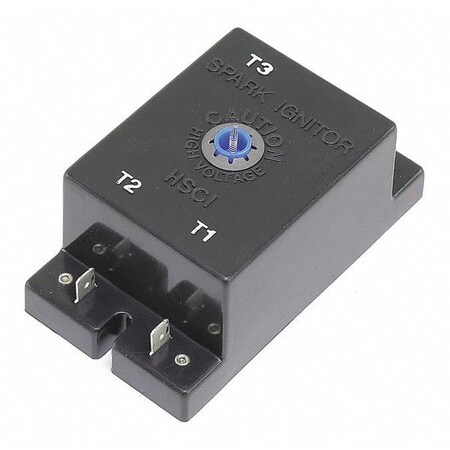
Next up was basic functional check, by running a cord to it and bypassing the broken door switch. Draft motor and gas valve cycling, but no spark. I disassembled the module to see no obvious problems, but a conformal coated board is not fun for rework. I just want to see if everything else will work, like the flame sensor, the gas check valve, air check valve, etc. Everything I took apart seemed to be in good shape. Fortunately I have my DIY hat and engineering skills at my disposal, so I spent like $25 on a timer relay and a Carrier spark module to make my own ignition system. A 10k resistor from the drawer gives it about 10 seconds of spark. Wired them to the gas valve.
.
Z_pxyzhcpIx_.JPG


TSD2.png
 
Makes me wonder when will they start emission controls on furnaces?
 
I picked up a couple of adapters from the hardware store to connect a hose from a propane construction heater to the 1/2" pipe inlet (because it already has a regulator) for testing purposes.

The propane company will lease me a tank for dollars a year and that saves me from running like 100' of black pipe, fittings and a manifold from the far end of the house, for the same rate as the house tank.

 
Last edited:
Makes me wonder when will they start emission controls on furnaces?
They haven't made these for a long time, so it's kind of irrelevant, but there sort of aren't any more efficient units out there today. The earlier ones were recalled for cracked heat exchangers, but these apparently run forever if you can get parts, know how to tune and can live with the noise.
 
The problem with the Lennox pulse is parts. They are discontinued. I replace a few a year, there are not many left out there.
 
Lennox is a pain for parts. All the other mfgs are decent and most parts houses can get parts for practically anything. Not Lennox, they have their own parts service and I had to provide licence info just to be able to buy parts. The parts are usually pretty expensive compared to other brands. Lennox used to be top tier but I don't see anything better about their equipment these days.
 
$0.22/kWh? That's crazy (double what we pay here). These days you and I would both be pulling baseload from the same power plant (Weston), and at roughly similar distances. Until recently UPPCO (I'm pretty sure you're in their district) was a branch of our utility (WPS).

So we're buying the same power from the same plants via what used to be the same utility company.

Weird.
 
$0.22/kWh? That's crazy (double what we pay here). These days you and I would both be pulling baseload from the same power plant (Weston), and at roughly similar distances. Until recently UPPCO (I'm pretty sure you're in their district) was a branch of our utility (WPS).

So we're buying the same power from the same plants via what used to be the same utility company.

Weird.
I just double-checked and I'm paying about $0.20. I know of others nearby at $0.24 from UPPCO. For some reason we're serviced by Ontonagon REA, even though we're basically surrounded by UPPCO. I think it really is a hindrance to business in the area. They claim it's the transmission costs and how spread out everyone is.

Just running some numbers:
  • Electricity is 3412BTU/kWh, so $5.86 for 100,000BTU
  • Propane is $1.69/gallon, so $1.84 for 100,000BTU, but buying ahead this should go down
  • Propane in a BBQ tank (like I did this winter) is $4.00/gallon, so $4.36 for 100,000BTU
  • Seasoned hardwood $250/cord, so $1.04 for 100,000BTU
  • Natural gas (can't get) - now $9.39/1000ft3 , so $0.90 for 100,000BTU
In all cases I'm not counting the electricity to run the blower.
 
Lennox is a pain for parts. All the other mfgs are decent and most parts houses can get parts for practically anything. Not Lennox, they have their own parts service and I had to provide licence info just to be able to buy parts. The parts are usually pretty expensive compared to other brands. Lennox used to be top tier but I don't see anything better about their equipment these days.
You can still get flappers! But yeah. Don't know how long I can keep it running. Just wanted to make sure it works before running all the plumbing.

The other thing I worry about is a condensing furnace in a space that could freeze. Even if the condenser in the bottom drains well, there's supposed to be a water trap on the outlet. I guess using clamps and rubber caps on the ends will help compared to glued/threaded fittings. Typically it does not freeze, but somebody could leave the door open.
 
I picked up a manometer and confirmed it's at about 9" W.C. in the manifold (Yes, most LP furnaces are set to 11" W.C., snippet from the manual below). The readings are all over the place due to the air pulses, but seems to average something like 9. When the valve is open but it hasn't lit yet, it's right on (even though the manual tells you not to measure that way).

Pulse pressure.png
 
Last edited:
For an intake filter I got lucky and found a 16x25" slides in the internal track (right next to the blower) and touches the floor, front and back wall insulation. So my intake is that simple, with just hardware cloth screwed over the intake hole cut in the cabinet (don't need mice chewing through the filter and the blower shooting rank mouse nest into the condensor coil).

What I need advice on is the air outlet. The simplest solution would be a grate over the top and call it done, but I fear a lot of dust would fall in and possibly small objects. This will be in the corner with workbenches on 2 sides, so grinding dust, etc. I don't need ductwork, per se, but maybe aim the heat out of the corner. Furnace outlet is 18"x19".
  1. Find sheet metal and that S-lock stuff and fabricate a plenum/duct. Would pick up one of those sheet metal corner benders. Simple heat grate on the front. This should be the most durable and probably most professional looking, but where do I get this sheet metal? It's probably $70 from a place like onlinemetals. Pre-made plenums seem to be $150+ and I still have to add to it. An option would be wrapping the outside in some sound insulation. Could I buy the round pipe sections that come almost flat, flatten them and use that?
  2. Fabricate out of duct board, but use common tools instead of spending $300 for red tool, blue tool, square, etc. It's about $50 for two 2x4' sheets of the stuff, but I may be able to minimize the design for 1 sheet. This has the benefit of reducing noise. I don't know how much noise is affected by a 1-2' duct, but I'm sure having the air make a turn inside it will help. But will this get destroyed out in the open? Is it crazy to put some kind of frame inside for reinforcement? Do I have to use those special connectors with the tabs for my outlets? Will it turn out like garbage without doing proper miter and shiplap cuts?
  3. Find one of those premade cold air returns that holds an air filter and slap that over the top. Can a regular air filter hold up to the heat? This has the advantage of being the least work and simplest. Drawback is it doesn't kill any noise from the combustion chamber right below it.
  4. Find a pre-made plenum that's similar enough in size it can be reworked to fit. So far no luck with this.
  5. Am I overlooking some other obvious materials that could work?
 
I'm guessing you don't have any Ma and Pa heating shops in your area that could fab you a plenum that would fit it if you drew up something. I would think a small shop could do that for $150 -200. If I was closer I'd make you one, just to help you out as a fellow CK5er. (I'm located near Madison Wi) Ideally a lined plenum would kill some noise but the Pulse furnaces are just noisey. They actually had a special muffler that they put in the exhaust PVC to quiet it down. I don't think I would add a filter to the supply it will just add restriction and probably won't really quiet much. A plenum elbow or just a plenum box with some holes cut in it pointing in the directions you want with some cheap supply grilles. If its a 60,000 furnace its probably just a 1200 cfm drive.
 
With no scientific basis, I was guessing a filter on the outlet (18x18×1) would be no worse restriction than a normal whole house supply/return ducting system. That's assuming one of those twisty metal media ones, not a super HEPA anti-allergy restrictive type.

Not for noise, just to keep dust and bees out of the heat exchanger. After all, the shop will get way more use in the weather where the furnace doesn't run. It's not like I don't have an air compressor across the room.

I do have a Lennox muffler for it. I plan to use it on the exhaust. The installation instructions call for one on the intake as well, but I'm figuring it's not a big deal. Just getting the pipes through the wall should help a lot.

I may call some local places, but my experience with all HVAC stuff is that nobody local will sell unless you have a license.
 
You want 26ga galvanized sheet metal. Its running almost $70 a sheet now. When I set up temporary furnaces for job sites, I will build a plenum box and either 1 big opening with some hardware cloth or some heat registers pointing in a couple directions. You don't want to restrict the airflow too much or it will overheat and trip the upper limit.
 
I scored a 3' x 4' sheet of galvanized 26 from guys at the back door of an HVAC shop for $20. Then I bought a pair of these gravity shutters online and went to work with snips, cutoff wheel and pop rivets. So far, no bleeding! The idea is that these will stay shut when the unit isn't in use and keep debris out. Box is 19"×18"×15"h, basically the height of the vents, so they became structural and 1/3 of the sheet metal is left over. Hardware cloth is to detur vermin.20220614_201458.jpg20220614_215203.jpg

Almost done. With everything metal, temps don't matter. Airflow should be way better than it ever had in a house install. I need to get some aluminum tape.
 
There's a floor drain in the center of the room and I'm trying to figure out routing condensate to it. There's a stress relief cut running right to it. If I let the water run down that crack, will it damage the concrete over time? I don't want to have tubing on the floor. Routing that outside seems like a poor option for freezing and also having to run through cement block.
 
Condensate is mildly acidic. Consider a pump if you have another drain option. They work well and are not very expensive.
 
Top Bottom