CK5
Register an account today to become a member! Once signed in, you'll be able to participate on this site by adding your own topics and posts, as well as connect with other members.

The Green Grendel

Peninsular?

Scat quoted me $3200 for a billet one. Seems reasonable.

David

Yep, I bought it about 9 years ago. It'll definitely make it into another build. I just didn't have the budget to do another big right now.

That's actually a pretty good price for a billet part of that shape and size.
 
Last edited:
So is this the suspected failure mode? Turning the journals leaves the crank weak for #7 and #8. The crank wears there leaving the bearings loose. Rod knock ensues but a 6.2L always sounds like that. The looseness causes continuous flexing in the crank which causes stress cracking to start.
 
So is this the suspected failure mode? Turning the journals leaves the crank weak for #7 and #8. The crank wears there leaving the bearings loose. Rod knock ensues but a 6.2L always sounds like that. The looseness causes continuous flexing in the crank which causes stress cracking to start.
Yes.
The first thing I learned about 6.2 diesels is that the crank is nitrided when I bought an 82 gmc van with the diesel and it had a bad rod knock.
I went to talk to machinists and they quoted me a stupid ridiculous number to get it turned and nitrided.
Then i checked my crank and that rod journal had completely finished the rod bearing and eaten more than 40 thousandths off the crank so I scraped the whole thing and started buying good running engines and nice squares to put them in.
That was 2001.
I had at one time 35 vehicles in different stages about 25 were squares
 
So is this the suspected failure mode? Turning the journals leaves the crank weak for #7 and #8. The crank wears there leaving the bearings loose. Rod knock ensues but a 6.2L always sounds like that. The looseness causes continuous flexing in the crank which causes stress cracking to start.

That's my guess. The rod bearings felt tight to my fingers, but all of them were badly scraped. I didn't hear a knock (aside from what I listed earlier), but I did start feeling minor vibrations through the clutch linkage. It bothered me but I'm not sure what I could have done differently. :dunno:
 
That's my guess. The rod bearings felt tight to my fingers, but all of them were badly scraped. I didn't hear a knock (aside from what I listed earlier), but I did start feeling minor vibrations through the clutch linkage. It bothered me but I'm not sure what I could have done differently. :dunno:

Sadly there isn't anything you can do other then pull it and see if it's rebuildable. Usually though once it's started its done for, the crank at least.
 
Sadly there isn't anything you can do other then pull it and see if it's rebuildable. Usually though once it's started its done for, the crank at least.

That's what I did. I just waited until after the failure to start the examination. ;)

I still can't get over the lack of symptoms. You'd think I'd at least have an audible rod knock. The engine's not THAT loud & clattery... :dunno: :1zhelp:
 
That's what I did. I just waited until after the failure to start the examination. ;)

I still can't get over the lack of symptoms. You'd think I'd at least have an audible rod knock. The engine's not THAT loud & clattery... :dunno: :1zhelp:

Mine made no noticeable sounds either. What's really crazy about mine is that about 10 minutes or so prior to its failure I had run it up to redline doing some stop light racing. It popped when I was barely on the throttle. It would of been a spectacular failure if it had broke at 4000 rpms :yikes:! I'm happy it did at a 1000 rpms.
 
Mine made no noticeable sounds either. What's really crazy about mine is that about 10 minutes or so prior to its failure I had run it up to redline doing some stop light racing. It popped when I was barely on the throttle. It would of been a spectacular failure if it had broke at 4000 rpms :yikes:! I'm happy it did at a 1000 rpms.

I was just rowing gears on the road. Ya know how the NV4500 has a wide gap between 3rd and 4th? Turns out it's large enough to swallow an entire crankshaft! :eek1: :rolleyes:
 
I would submit that your crank was weakened from factory condition and prone to failure. Note the marking that the mains and rods were both turned .010/.010, eliminating the factory nitro-hardening, which only penetrates to .005 or so. What’s under that is soft ductile nodular iron, and very susceptible to failure without the hardened bearing surface.

I looked again at the crankshaft stub sitting on the shelf. In the middle of the shaft, between the two con-rod journals, is a slight ridge, just enough to catch my fingernail on. I don't have equipment good enough to measure it, but the wearing surfaces have worn away relative to this small gap between them. :thinking:

You can see the band in this picture from the other day:

IMGP0083.JPG

I noticed that the con rods on the new engine could slide fore & aft freely, while the con rods on the old engine were firmly locked into their grooves. Maybe that's another piece of the puzzle? :thinking:
 
I forgot that Wifey came out to watch us being stupid. But the plus side is that all of you can also watch us being stupid.


20180820_171428.jpg


It snagged on the fuel pump (which sits inside the frame rail). We wound up removing the pump to make extraction easier.


20180820_181538.jpg
 
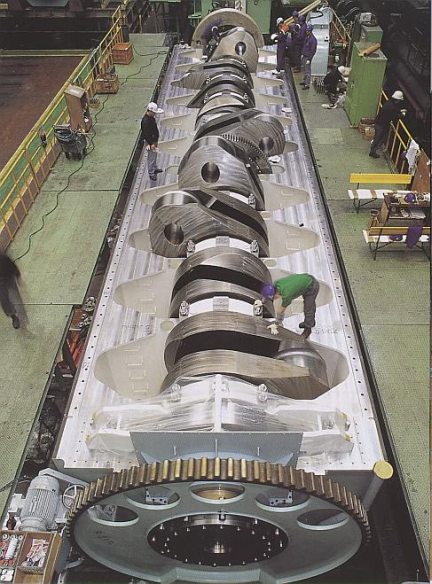
You could try replacing the crank. This one won't break since it's rated for 5 million lb-ft:

big_engine_rta96c_crank.jpg
 
Top Bottom