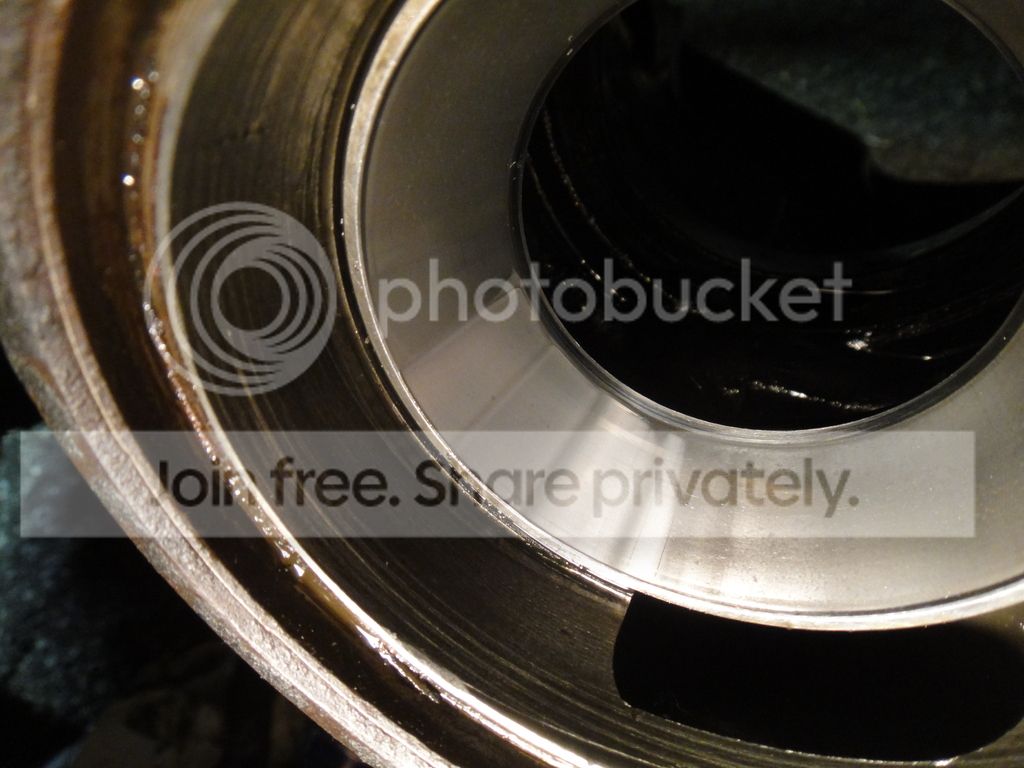
There ARE several ways this could be fixed. But none are cheap fixes.
1) It could be sleeved but would require machining of the axle housing to bore it oversized, then a sleeve would need to be machined that would press fit into the over sized bore. Then the ID of the sleeve would have to be bored to factory spec. It would also have to be a decent wall thickness to not over heat from being too thin and deflect or move in any way.
If you tried to bore the ID to size, then press fit it into the axle the ID would go undersize for sure. You would have to have to have a decent press fit off no less then .0008 min. to .0012 max press fit. The bore would have to have a good finish on both bores. Too rought and the bore size would range from the peakes and valleys of the roughness too much and a bore reading would be very inconsistant.
Too smooth a finish and it could not have course enough peaks and valleys for the bonding to bite into. You'll want to use cylindrical bonding loc-tight spicifically for this type of application. It's for bonding cylindrically round parts with nothing other then the bonding fluid and press fit, or, bonding fluid itself to hold it in it's place from being forced out or rotated. It is very good stuff.
2) It could be sent to a shop like I worked at last, a custom coating shop. There it would be machined over sized. Grit blasted, coated under sized, machined back to factory spec. And it could be coated with a material like stainless steel, tool steel, carbide or any other super hard coating of your choice, or of course we had engineers that could best tell you what you should use for a fee.
3) It could be welded and re-bored to spec. Just like you weld a crank thats been scored and is undersized. You weld it up and re-grind it. This will require machining at a cost. Machining is not cheap at any shop.
4) Say there is enough of the diameter still good to chance running it. You could run the bonding compound here too. I wouldn't.
5) Replace the axle. My first choice.