
I'm putting a new clutch and rebuilding the drivetrain behind my 400sbc. Well I decided to resurface my own flywheel and I was told to turn it down till the hot spots are gone. I have turned down around .150" to .200" off this thing and the hot spots seem to be going away but it looks like i need to take around .100" more to finish. 2 questions: Am i going about this the right way? and when is it too thin? I don't believe this flywheel to have ever been turned before.
CK5

You are using an out of date browser. It may not display this or other websites correctly.
You should upgrade or use an alternative browser.
You should upgrade or use an alternative browser.
Turning a flywheel
- Thread starter 80blazek5
- Start date

Wow, .300" sounds like WAY too much to me. I don't know the spec for minimum thickness of a SBC flywheel but that seems like way too much.

JEBSR
1/2 ton status
There should be a minimum thickness number stamped on the flywheel. My concern other than the thickness is how your turning it. If make low spots in it by taking more out in one area than another it will shutter like a SOB when you start to engage the clutch.

actualy when thay cut them its setup like decking a head or block but with a good polishing job. thay dont take a whole lot off them when thay cut them. i do know racers cut them real thin to cut down the spinning weight.
I'm turning it in a lathe so no low spots. Runout was very minute when I checked it, somewhere around .003". So am I just supposed to turn it down till it cleans up or till the hard spots are gone? I figured if the hard spots were in it then the flywheel would not wear in correctly.

cegusman
3/4 ton status
I got mine turned to where it was just smooth again and have not had any problems

A lathe is the wrong way to do it. The Flywheel needs to be ground on a surface grinder. The last one i got done cost me $30 and was ready in 45 minutes...
Here is a pic of mine...you can see a swirl pattern rather than the finish you're getting on a lathe.
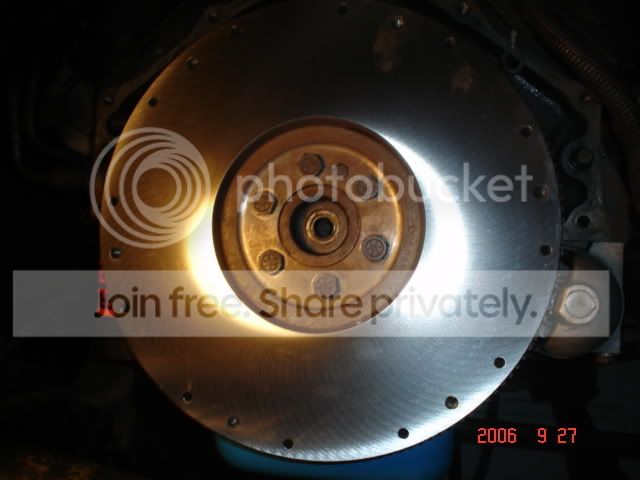
I think this promotes better grip with the clutch disc than a lathe finish...plus it more accurately trues the surface up.
Rene
Here is a pic of mine...you can see a swirl pattern rather than the finish you're getting on a lathe.
I think this promotes better grip with the clutch disc than a lathe finish...plus it more accurately trues the surface up.
Rene
tRustyK5 said:A lathe is the wrong way to do it. The Flywheel needs to be ground on a surface grinder. The last one i got done cost me $30 and was ready in 45 minutes...
Rene
x2 for me.


tRustyK5 said:A lathe is the wrong way to do it. The Flywheel needs to be ground on a surface grinder. The last one i got done cost me $30 and was ready in 45 minutes...
Here is a pic of mine...you can see a swirl pattern rather than the finish you're getting on a lathe.
I think this promotes better grip with the clutch disc than a lathe finish...plus it more accurately trues the surface up.
Rene
Actually, when a flywheel is new they are turned on a lathe. However it is VERY important that the face be parallel to the crank mounting flange. When a flywheel is machined in the aftermarket world it is done on a surface grinder rather that a lathe.
If you've taken that much off you've no doubt ruined that flywheel. There is no minimum thickness on a flywheel other than when the springs in the clutch disc hit the flywheel bolts the flywheel is junk. There are exceptions to the rule though and those have to deal with hydro clutch set-ups on some stuff.
Well now thats confusing. I've talked to about 3 other machinist around here and they said they have been doing flywheels like that forever. I'm a machinist but I build aircraft parts (whole different world) From the looks of th pic, your flywheel was done with a rotary surface grinder. That means the surface finish is a 60 or better. My flywheel is close, around a 125. The flywheel might have been junk from the start as it was beat on pretty bad. The original surface was pretty scared up with a big step in it. I dunno what to do. I hate to buy a new one at $250 from centerforce, haven't checked autozone tho
Flywheel resurfacing machines are there for a purpose. In the old days before there was a specific machine dedicated to machining flywheel people machined them on a lathe. However if you don't indicate the flywheel in properly from the crank mounting flange so that the clutch disc surface is parallel to the flange surface you will get one hell of a clutch chatter.
EDIT: here is a link to the brand of machine i use at work. http://www.dcm-tech.com/dcm_products/flywheel_grinders.php
EDIT: here is a link to the brand of machine i use at work. http://www.dcm-tech.com/dcm_products/flywheel_grinders.php


