The Mule said:
Is it strong enough to pull my truck that is totally stuck in this deep Michigan mud??? thnaks guys
Well to help figure out what it will take to recover a vehicle this might help!
First you need to be absolutely sure that EVERY single piece of equipment used in the task is strong enough and will not fail and thereby endanger life and limb. Hooks should be pointing up that way if they come off they go down. Realize, that for reasons of practicality and economics, your 4x4 recovery equipment is almost certainly undersized.....you can still do the job, using the correct techniques, but you will be much SAFER if you keep this in mind.
[FONT=Arial, Arial, Helvetica]1) Most people are terrible at actually estimating the gross weight of their rig as it sits on the trail, full of gas, tools, equipment, food, camping gear, people, the dog...everything. Heck, in some cases the real figure can actually exceed the GVWR of the vehicle. Simple advice here - either err WAY on the heavy side, or get your rig weighed in trail trim.[/FONT][FONT=Arial, Arial, Helvetica]
[/FONT][FONT=Arial, Arial, Helvetica]
[/FONT][FONT=Arial, Arial, Helvetica]
[/FONT][FONT=Arial, Arial, Helvetica]
[/FONT][FONT=Arial, Arial, Helvetica]
2) More importantly, the "effective weight" of a "stuck" 4x4 is very often FAR more than 1.5 times the GVW. The following data on how to more accurately estimate the "effective weight", is taken from the world of professional heavy recovery - the guys that recover Tractor-trailers that have flipped on their side for instance, as well as U.S., Canadian, and UK Military recovery manuals.
[/FONT]
[FONT=Arial, Arial, Helvetica]
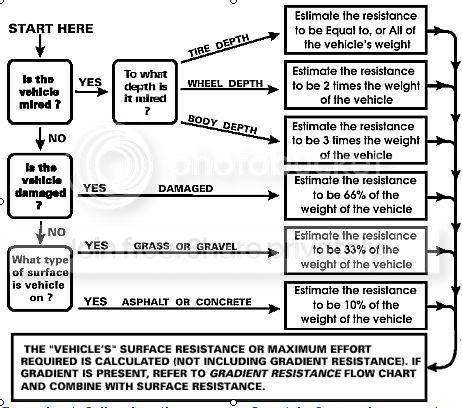
Once you have accurately estimated or measured the trucks loaded weight (LW) you can calculate the resistance to be overcome in any recovery situation (this is commonly known as the ROLLING resistance). There are 4 types of resistance that must be accounted for to accurately assess the resistance that must be overcome. These are surface resistance, damage resistance, mire (stuck) resistance and grade (slope) resistance. Calculate them all as follows:
[FONT=Arial, Arial, Helvetica]Surface resistance
[FONT=Arial, Arial, Helvetica]A pull of 1/10 LW will cause a free wheeling truck to move on a hard, level surface.[/FONT][FONT=Arial, Arial, Helvetica]
A pull of 1/3 LW will cause a free wheeling truck to move on a softer surface, such as grass or gravel,
[/FONT]
[FONT=Arial, Arial, Helvetica]Damage resistance:[/FONT]
[FONT=Arial, Arial, Helvetica]A pull of 2/3 LW will be required to move if the wheels cannot rotate (as if the brakes were fully applied), the pull required to overcome the resistance (drag) the truck id 2/3 or 67% of the LW. Damage resistance includes surface resistance (i.e. you only use one or the other)[/FONT][FONT=Arial, Arial, Helvetica]
[/FONT]
[FONT=Arial, Arial, Helvetica]Stuck (mire) resistance:[/FONT]
[FONT=Arial, Arial, Helvetica]A pull of 100% of LW will be required if the truck is stuck to a depth of the sidewall on the tires.[/FONT][FONT=Arial, Arial, Helvetica]
A pull of 200% of LW will be required if the truck is stuck to the hubs.
A pull of 300% of LW will be required if the truck is stuck to the frame..
Mire resistance includes damage resistance (i.e. you only use one or the other)
[/FONT]
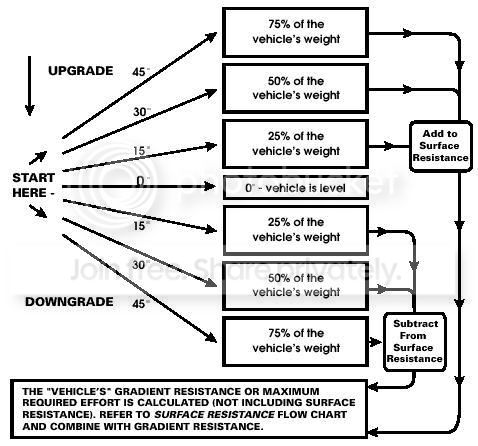
[FONT=Arial, Arial, Helvetica]Grade (slope) resistance:[/FONT]
[FONT=Arial, Arial, Helvetica]Upgrade (vehicle has to be recovered up a slope or grade)[/FONT]
[FONT=Arial, Arial, Helvetica]
15 degrees - add 25% of LW
30 degrees - add 50% of LW
45 degrees - add 75% of LW
Vehicle recovery on level ground - no correction
Downgrade (vehicle has to be recovered down a slope or grade)
15 degrees - subtract 25% of LW
30 degrees - subtract 50% of LW
45 degrees - subtract 75% of LW
[/FONT]
[FONT=Arial, Arial, Helvetica]Final figure:[/FONT]
[FONT=Arial, Arial, Helvetica]Add surface or damage or mire resistance and grade resistance, and this is your final figure or rolling resistance. This is the amount of pull the winch must apply in order to recover the stuck vehicle.[/FONT]
[FONT=Arial, Arial, Helvetica]
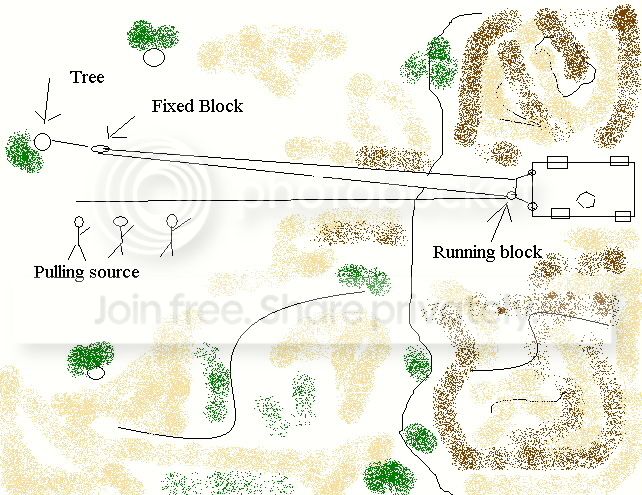
Here is the military approach.
The way to attack the situation. Using this method you can free a Hummer buried up to its axles Thanks to Mike Rowe and Dirty jobs.
If you want to read on recovery operations go here
http://www.steelsoldiers.com/index.php?module=pagesetter&type=file&func=get&tid =1&fid=file&pid=11
FM 9-43-2, Recovery and Battlefield Damage Assessment and Repair.
[/FONT]
[/FONT][/FONT]