CK5
Register an account today to become a member! Once signed in, you'll be able to participate on this site by adding your own topics and posts, as well as connect with other members.

Working on a 30hp phase converter

m4

1/2 ton status
Joined
Sep 26, 2004
Posts
286
Reaction score
0
Location
Texas
I got a little side tracked and worked on the 100 amp circuit. The disconnect didn't land where I wanted it to, I need the disconnect out further so I can run conduit to the idler. Never worked with conduit so any help here would be great.

100_4716.JPG

100_4717.JPG

100_4719.JPG

100_4721.JPG
 
I will help any way I can, but to be honest, I don't understand the question. It looks like you are using PVC conduit.
If so, then its just cut and glue. Works exactly like water pipe. You can buy 90s and 45s to bend it around corners.

If you get a 90, get what is called a sweep. Most all conduit type PVC 90s are sweeps.
It just means that its a gradual curve instead of a hard right angle like water pipe.

Makes pulling wires much easier.

There are also junction boxes that act as angles but have removable tops or sides so you can get to the wires easier.

There is a limit to how many wires you can run in one conduit and what current due to inductive heating or resistive heating, but just get conduit big enough for the wires to be really loose, and you should not have a problem.

If you are going to run many circuits in one, let me know and I can look up the code.

Otherwise, just run the conduit where you need it.

If you have to go down through that beam that the box is sitting on, you might cut a slot or hole in it, or just rerun he wiring to the box so that its below the beam.

You can just take the wires out, cut the PVC back in the wall somewhere, attach a sweep and come out below the beam.

If all else fails, go to Home Depot, or Lowes, and check out their selection of conduit fittings.
There should be enough there to give you plenty of ideas.
 
I'm not 100% on my plan yet, thinking about using this Nema #3 contactor in the starting circuit. If I do I'll need the two panels flush to run conduit to each one.:dunno:

The only main panel knockout I could reach is the top left so that's the one I used, more to follow. I guess I could push the large panel back.

PANELS.jpg
 
When I built mine, I used a NEMA enclosure like you show, but without the disconnect. My old 5/10/15 staged converter was built with Furnace contactors, fuses, and A/B switches (on/off/5hp/10hp) plus 3 surface mount volt meters, all in the single NEMA box. The whole rig was on a crappy shop scrap built dolly like affair with both Baldor idlers on bottom and the box on top. Pig-tail with 50A NEMA 3 conductor "welder" plug on the input side, and 60A? (don't recall spec or number) NEMA 4 conductor receptacle on the 3 ph side. My shop 3ph circuit had a suitable pig-tail, making it easy to wedge the convert in behind the mill out of the way, and roll it out to work on it, or out onto the apron to run/test some new piece of machinery when it came in.

My current 30hp CNC rated converter (like Phase Perfect, different company) is also contained in a box like you show. Shop power is dedicated 250A main box, breaker (don't recall rating off the top of my head) to the NEMA converter box, then to a 3ph breaker box feeding (IIRC?) 7 circuits around the shop.
 
Heat the red circled area of the straight pipe up with a heat gun and slowly pull outward with it. that will angle the pvc enough to get it out far enough. make sure NOT to kink it though. makes it hard to get wires through:rolleyes:

:waytogo:

PANELS.jpg
 
Change two, I moved the disconnect to the left side of the beam, it already had the knockout out of the right side, so I used it. I picked up a few 45 degree pieces of PVC and everything fits.

100_4729.JPG
 
Last edited:
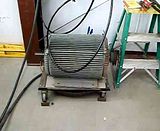
Here's the 30 hp idler running. Click on the pic for the video.

 
We checked out the inrush amp on the 30hp idler. The Craftsman DMM showed 292 amps, the Fluke? 319 amps.:whistle:
 
If you are starting that motor with a static phase converter, then the current draw is not going to be a clean sine wave, and meters are going to have problems measuring it accurately.

In general, the Fluke is probably going to be closer to right. Especially if it says "True RMS"

Also, remember that a motor has two current ratings.
FLA and LRA.

Full Load Amps is the current that motor is supposed to draw at the rated voltage when under full load.

Locked Rotor Amps is the current the motor draws when the shaft is stalled and not turning.
Which happens every time when the motor starts.

Its not unusual for the LRA to be 6 times FLA or more.

Look on the motor plate to see if it shows LRA. Probably going to be in the 3 to 400 amp range.
That is why they make time delay fuses and heater type overloads because they don't respond fast enough to fail under LRA loads for the few seconds that they normally occur.
 
The CM is new, I don't know about the Fluke, I pre spin the idler with a gas motor before starting.:eek1:
 
Top Bottom