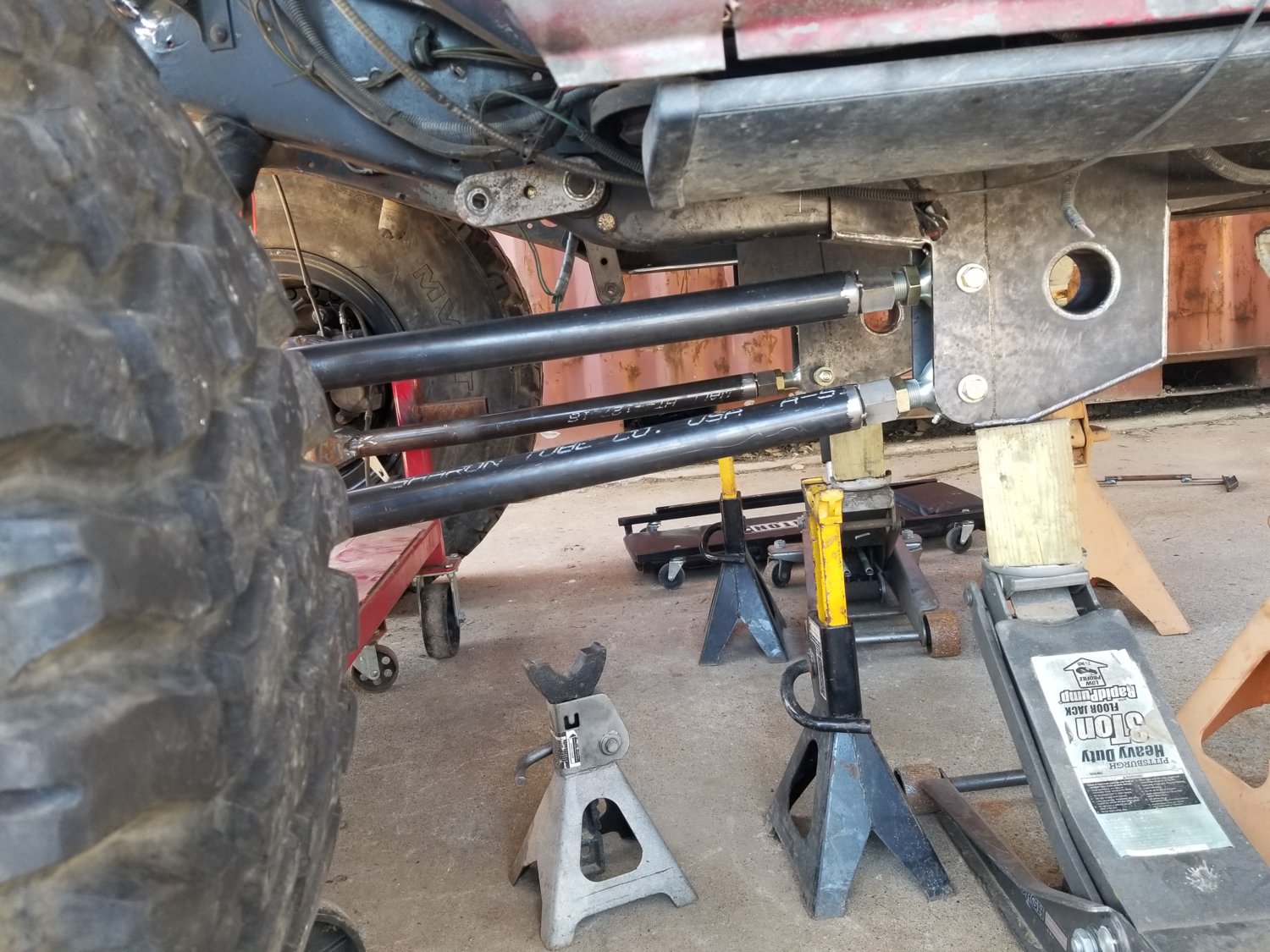
Stephen, thanks for the input. When you guys were designing your 4 link system what were the deciding factors (if any) to go 4 link and not radius arm? It looks like due to my lift height my frame side bracket will have to be about the same height whether I go with 4 link or radius. Can you see any reason why the handling on a setup like your 4 link would change a lot if i were to use the F550 axle with the radius arm bushings on the axle side?
The specific answer is pretty easy, we put a radius arm setup on my '88 burb with some deaver bronco/F150 coils and the thing would try to kill you. I've driven some crappy handling stuff with full hydro steering and even with a box that burb was a handful. It was about 4" of lift, reasonably long arms (40" or so) that were attached right to the bottom of the frame all fresh joints, crossover, proper panhard setup, etc. The rollsteer was bad enough that a sudden jerk on the wheel at any high speed involved a lot of catching up with the truck. You could corner the truck by flicking the wheel to initiate body roll and then straighten the wheel while the axle steer kept you cornering. We fixed it with a big swaybar and that made it something I would let just about anyone drive but that bar was big enough I wouldn't want any part of it being connected offroad.
We put a relatively short arm 4 link system on the same truck with a longer travel coilover running softer spring rates and it was super solid with no swaybar at all. Rollsteer is the key.
So, now we get to learn about roll steer or axle steer. It's really as simple a concept as it sounds, when the body rolls, the truck steers itself. With a radius arm that is totally flat in cornering your outside wheel moves back as the suspension compresses and the inside wheel moves back as the wheel droops. Both wheels moving back equals no axle steer or very little anyway. Now lift that truck 4" so that the arms are at an angle down to the axle. When the outside wheel moves up (body rolls down on top of it) the wheel will move forward relative to the truck. The inside wheel will move back as that wheel droops. When you look at this from a top view the axle is steering into the corner. The problem is that it's an unstable feedback system because the body rolls and makes the truck corner harder which makes the body roll more which makes it corner harder, etc. Then you have to steer out of the situation and any over correction sends you the other way.
This is roll oversteer. The opposite and desirable situation is roll understeer which you can find in a lot of leaf spring suspensions as an example. With a leaf with any arch to it, you steer into the corner and the outside compresses and pushes the tire back. The inside unloads and pulls the tire forward. This steers the axle OUT of the corner so you actually have to add steer angle to hold it in the corner. This is a stable handling feel. Basically the truck is trying to fix itself. Body rolls one way and it tries to steer that same way to drive under itself. The lifted radius arm example above would have the truck trying to drive away from the body.
Flat radius arms are good but flat means the frame side pivot bolt is inline with the center of the axle tube so ground clearance is terrible. The only thing that matters with radius arms is where that frame side pivot is in comparison to the axle center. You can mount all the links on top of the housing but it won't matter. It's all about where it ties to the frame.
With a 4 link you have a lot more leeway in where you put the joints to make a difference in how much it will steer under body roll. You can put a little more angle on the links for ground clearance and still keep the roll steer under control. A good example of this is our convertible truck. It has a REAR swaybar which really helps emphasize that the front isn't a problem because the rear bar makes the front move even more. It's about 4" of lift with 36" arms frenched into the K30 frame to match mounting height on a 1/2T frame. Handling is great, no weirdness at all.
In the course of several suspensions under my K5 "Wally" and our U4 car we picked up a lot of info about tuning 3 and 4 link systems for handling. Both rigs ended up with full hydro steering which tends to take the worst things about a vehicle and make them worse. Kind of like that one buddy in college... Anyway, they were good learning platforms because the steering made them sensitive to changes. As we learned more, both rigs were changed for less roll steer with pretty dramatic results. Wally went from a pretty tense drive to being able to talk on the phone. Not like driving a car but WAY better and pretty good for a buggy. The racer went from running a giant swaybar to keep the handling decent in the desert to a much milder bar, more wheel travel and a suspension that tries to fix itself when you mess up rather than try to roll you for a mistake.
Another truck that taught us 4 link vs. radius arm stuff was Willard. The green version was a short arm 4 link that worked just fine but we wanted more ground clearance so we tried a radius arm system when we changed it to orange for the '08 UA trip. We had to monkey with bushings a few times to get enough motion to let the axle articulate freely and then the axle control wasn't great (axle could wrap). We started out with a pretty stiff bushing setup and ended up putting in softer bushings at a couple mounting points so it could move more freely. It drives OK for what it is but it has a relatively low CG so body roll isn't too bad. Actually it's been a long time since I spent much time in it so it might be worse than I remember.
This brings us to another fun point of radius arms vs. 4 link: joint flex vs. articulation ability. In a strict engineering model, a radius arm system with hard joints (heims) at all the locations on the axle end cannot articulate. One side is trying to tip the pinion up and the other side is trying to tip the pinion down. It can't do both at the same time. These systems tend to keep the axle parallel to the vehicle. If you want articulation you have to add some freedom. You can remove an arm or make a collapsible/telescoping arm or run bushings with some flex at every joint location. This is the swaybar effect people talk about which is fine but you can't have your swaybar and articulate too unless you change something.
I've never liked having to make a bunch of changes to the truck to change from street mode to trail mode. Part of this is where we live as the lines get blurry sometimes for where "offroad" really starts. Is it when you get on the gravel road? Or when you pass the parking lot where everyone parks tow rigs? Or when you get to a hard rock crawling section? I've been around vehicles that had a handful of things to mess with when you hit the "trailhead". Disconnecting suspension parts, unhooking swaybars, change this, tweak that and then you're ready to go "offroad". I don't even like having to air down and lock the hubs. Part of this is the Ultra4 model too. We take the cars from running high speed desert to some pretty gnarly rock crawling and just shift the transfer case. Super versatile that way. You don't have to worry about handling when running a long gravel road after you put everything in "rock crawler" mode earlier in the day.
Can radius arms work? Yes, but there are a lot of nuances. Like I mentioned before, CG height and roll center, what joints you use and how you expect it to articulate, swaybar or not and how big, actual angle on the arms, spring rates and shock valving, etc. all play in. These factors are less important with a linkage system that doesn't have as much rollsteer.
Is a 4 link perfect? Nope, there are still a lot of tuning details but as a system it's more forgiving.
In the OPs particular situation, it's a tall heavy truck that could end up with a pretty good angle on a radius arm. That all equals some bad roll steer potential. It should end up with swaybars front and rear but why make the truck dependent on the swaybars for it to be reasonable to drive?
There's a book about that, hope it helps!