I wouldn’t even mess with a 6.0L for a tow rig. Not so sure I would mess with a 6.0L, or any LS engine, for that matter for use in any 4x4 project. While 6.0L engines are rock solid durable and make awesome HP they don’t make any torque or HP until you spin the piss out of them. Not sure about you guys, but prefer high torque/low RPM engines.
I bought a 2001 2500HD ECSB 4x4 with an 8.1L and 6 speed manual brand new and still have it (she only has 55K miles). A few years ago I also bought a used plain-Jane WT 2005 2500HD SCLB 4x4 with a 6.0L and 4L80E slush box that was in shambles but I got it for a steal of a deal. I bought it for the purpose of fixing and flipping, which I did and made decent money on it. For the 2 years I had the 6.0L Silvy I was always impressed with how athletic it felt running around town. Both trucks have 4:10 gears. From stoplight to stoplight the 6.0L/Automatic would whipazz on the 8.1L/6 speed but in town fuel economy was no different between the 6.0L vs. the 8.1L. I am of the opinion the 8.1L is slower around town partly due to the horrible shifting ZF S6-650 6 speed manual and the fact he 8.1L is extremely neutered in stock form in the way of torque management and tight emissions calibrations. Much more neutered than a small block.
One you hook up a trailer behind either of these trucks would really separate the straw from the manure. The 8.1L comes alive and doesn’t care what is being pulled behind it while the 6.0L felt extremely labored, slow and even gobbled much more fuel than the 8.1L. Not saying the 8.1L will outperform a Duramax or Cummins in a tow test but for a gas, it is the only gas engine worth owning for towing or large 4x4 rigs. The longest towing job for the 6.0L was towing a ’98 Jeep Grand Cherokee down from Denver on a heavy car trailer. A week later I made the same tow job with the same trailer but pulled a ’01 Dodge ECSB 4x4 with a Cummins (dead lift pump that ate the injection pump). The 8.1L truck had a heavier load to pull and still out pulled the 6.0L and drank less fuel while doing so.
My feeling is the 6.0L is a high RPM HP engine and the 8.1L is a torque engine. The 8.1L is already cranking out over 100 lb. ft. of torque at idle with a stock torque certification of 450 lb ft @ 3200 RPM while the typical 6.0L makes around 350 lb ft of torque at 4400 RPM. That said, the 6.0L has to work its ass off to build any torque. Torque gets the job done, not HP.
All of the above comments were based on a stock 8.1L with stock calibrations. I also have a stock 8.1L with tweaked calibrations in my K10 along with a bump in fuel pressure and it runs entirely different than the 8.1L in the Silverado. The Silverado 8.1L pulls well but the tweaked calibrated 8.1L is an outright animal. It is amazing what a difference a tuned ECM can make in the performance of a stock engine. The K10 even gets pretty good fuel economy for what it is… The last big trip we racked up 1,555 miles over 8 days roaming around Utah and Colorado, highways, dirt roads, desert running, climbing mountains, etc. The truck averaged 11.72 MPG over the 1,555 trip. Not bad for weighing over 8,000 lbs., 35” tires, 4:56 gears and the aerodynamics of a Drive-in Movie Theater screen.
If looking to swap something in, the 8.1L is the one to look for as it is a much easier swap than a 6.0L. The 8.1L is a direct bolt from any old big block or small block. Same mounts and any old BB exhaust manifold or header will bolt right up to an 8.1L whereas a 6.0L people play hell finding manifold/headers that fit old truck correctly. The 8.1L also runs on the easier to tune and procure P59 ECM (0411) whereas the later LS engines are running E38 and E78’s that are more complicated. Then there is the A/C to deal with. The 8.1L has other bracket alternatives from RV’s and commercial trucks in order to move the A/C compressor up high and out of the way so you don’t have to hack up the frame to make room for the compressor. The only advantage I see of a LS engine is the huge array of aftermarket support. Personally, I don’t care about aftermarket support because I like to leave engines (hard parts, not calibrations) in stock form for durability and reliability for the long distance runs I subject this truck too.
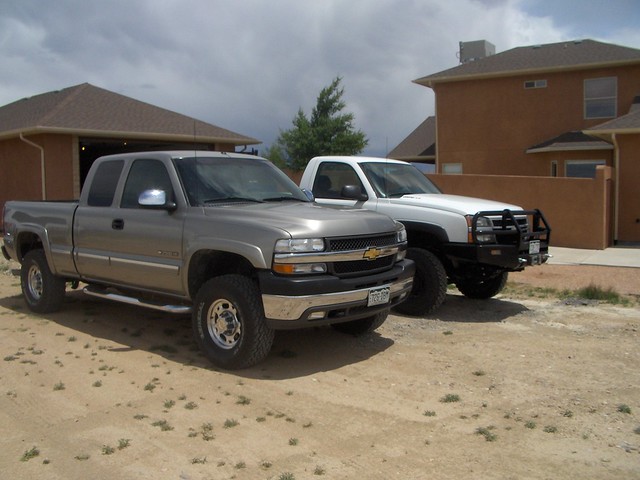
Pewter truck is the 8.1L while the white one had the 6.0L




 . The thing runs great, the Allison is indestructible under "normal" conditions, and with the 4.10s it keeps up with a few slightly built Cummins and likewise Duramaxs all day on our way to Missouri pulling my almost 7000lb Suburban. The diesels do get better fuel mileage, but thats the trade off.


 Hehe, I have lots of experience with 4.8, 6.0 and 8.1L engines as the company I work for (spun off division of GM) has built hundreds of thousands of RV chassis with 8.1L engines as well as tens of thousands of UPS trucks with 4.8 and 6.0L engines along with a few thousand 8.1Ls. Yes, there are big brown trucks rolling around the country with 8.1L's! All are great rock solid reliable engines but the 8.1L always rises to the top when the need arises for diesel-like toque without the BS of owing a diesel. It is a hoss of a gas engine and durable as an anvil. Our average RV chassis once bodied come in around 22 to 26,000 lbs. That is a big coach for an 8.1L to move around and it does it well. Research the RV articles and see how well the 8.1L beats the Ford V10 right into the ground. Problem with a lot of RVer is they don’t understand torque vs HP either and fall for the marketing BS where the V10 has a higher HP rating over the 8.1L. That is true, the V10 does have more HP ONCE YOU SPIN the POS to 6,000 RPM but the 8.1L has more usable HP and more importantly torque.


