CK5
Register an account today to become a member! Once signed in, you'll be able to participate on this site by adding your own topics and posts, as well as connect with other members.
As usual your stuff is so pimp as to be depressing for the rest of us :haha:

The Legacy stuff, though -- that's "Flexzilla", right? -- is the shiztnit though. Somebody here turned me onto it, and it is AMAZING airhose.

-- A


Yep, Flexzilla.... Not a fan of the neon color, but the hose is really soft and flexible. Liking it so far. Having dry air finally is a huge upgrade. :waytogo:

what's the reel next to the air reel Greg?

Just a cheapie cord reel. Not my usual strategy...it was an impulse purchase at a local auto parts place a couple years ago when I'd finally "had enough" with tripping over regular extension cords every time.

Now.... On with the show:

-G
 
2013.01.02 - UPDATE! - THE MISSING LINKS...

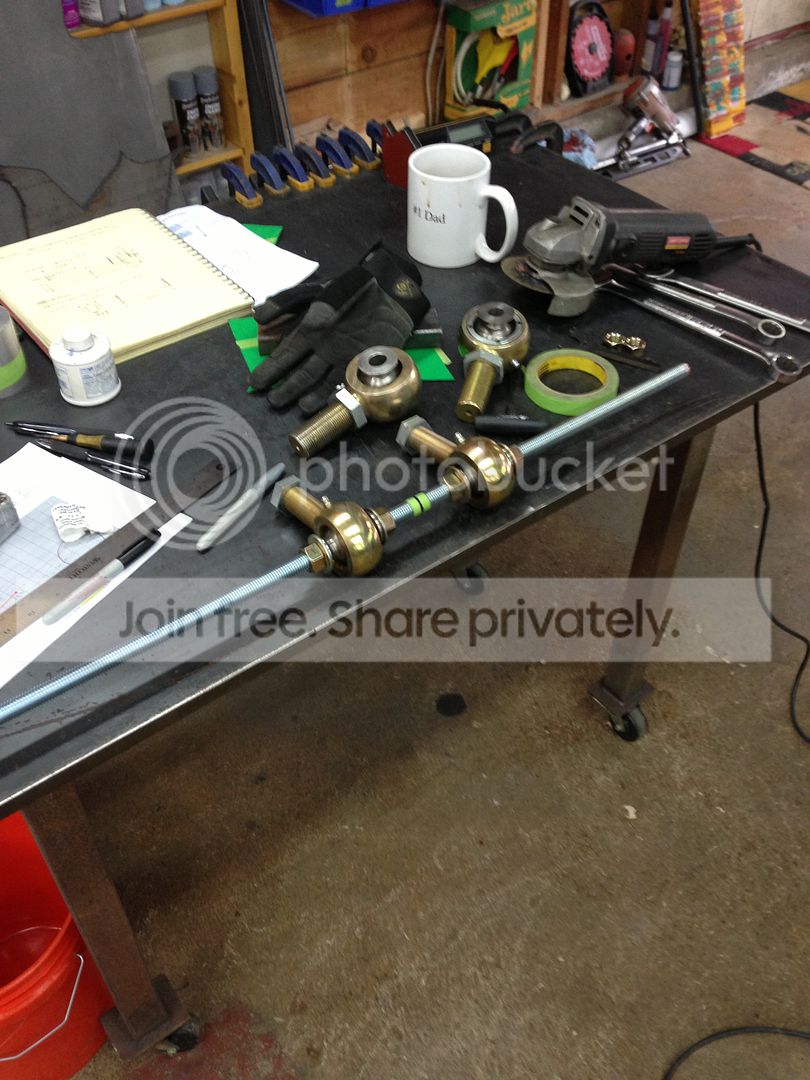
When things left off, I had the upper link mount mocked into place, so today I wanted to get some lower bracketry installed. I had an idea that turned out to be a super speedy way to take care of the frame-side link mounts and give my some quick adjustability for link separation if I need it. Threaded rod to the rescue again! :D

null-43.jpg


Since the upper mount z-height was 26" I was able to wedge the rod between the framerails and tack it into place. The nuts allowed me to set the heim spacing at 6"apart for starters.... Though as you'll see later there may be some transmission pan clearance issues with such tight spacing.

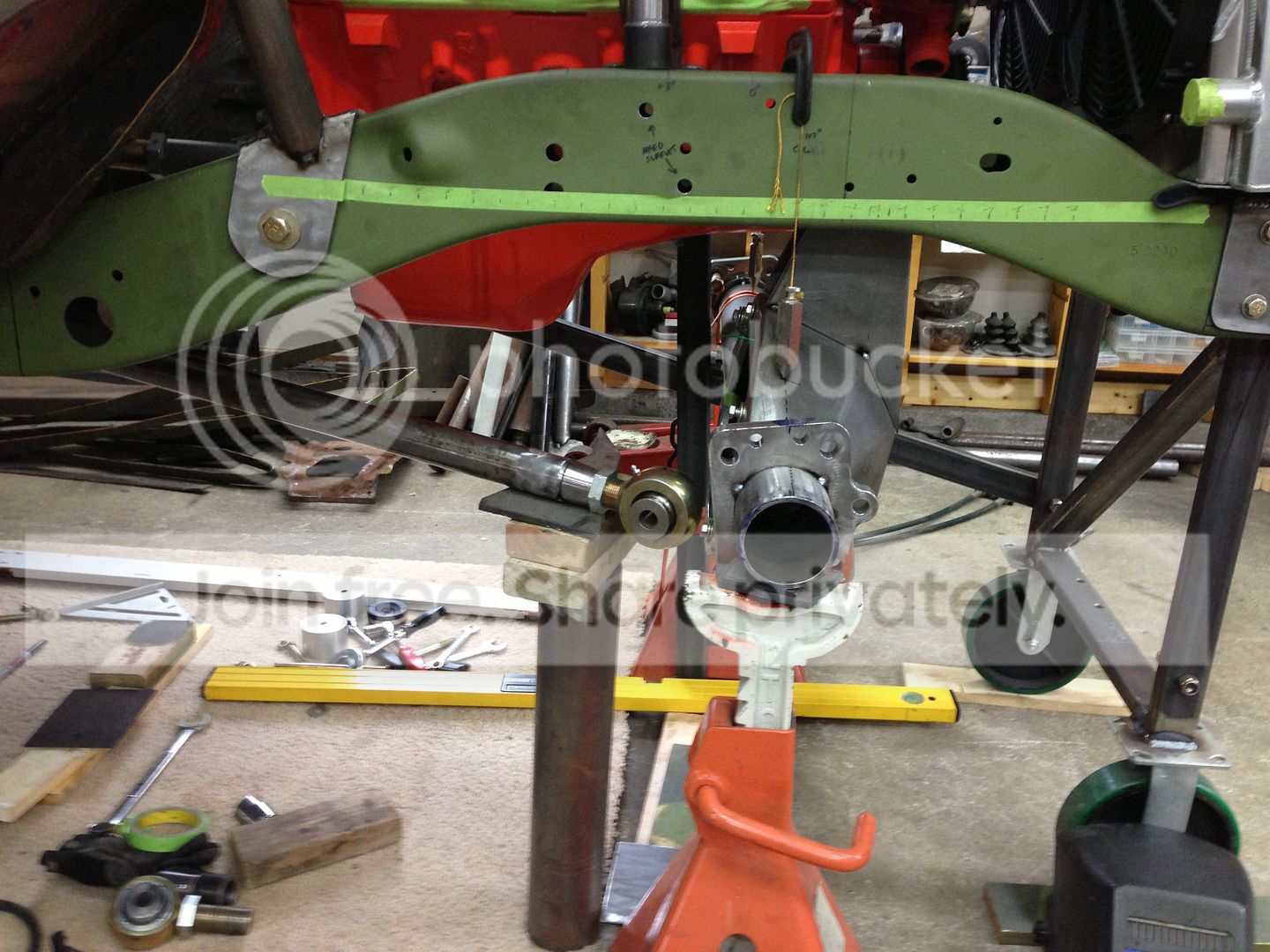
For the axle side lower mount, I wanted to keep them as far to the outside of the axletube as possible, and slightly below the axletube centerline.

null-44.jpg


As if it weren't already becoming obvious from my passenger-side motor mount creation, this photo of the drivers side header clearance (HA!) should remove all doubt that outboard headers are probably in my future. That's about 1" of clearance between link and the header. (Kert, I'll give you a call sometime for tips... :deal:)

null-46.jpg


Fixed the upper link mount which was off by 3/4"... Larger spacer took care of it.

null-47.jpg


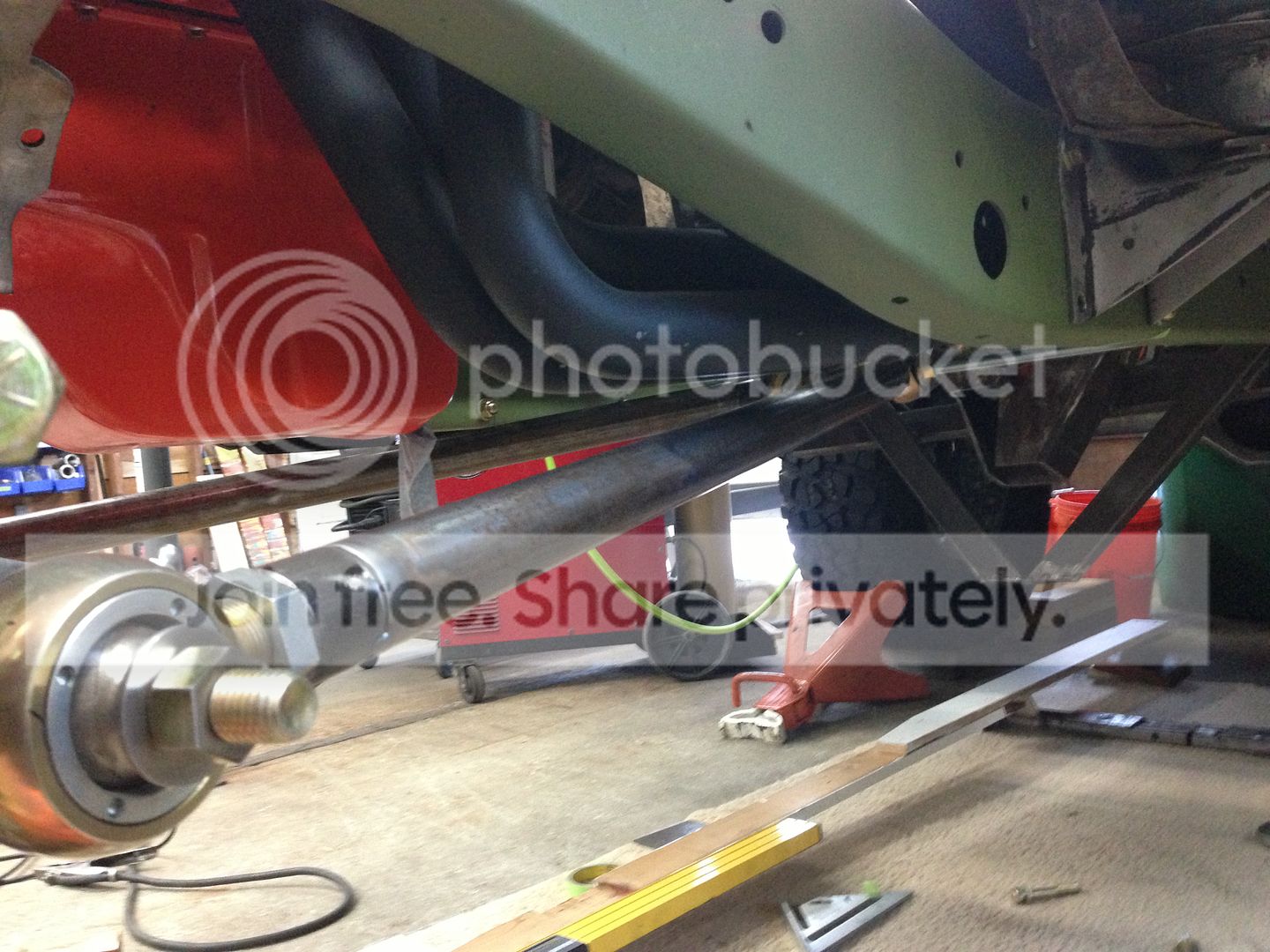
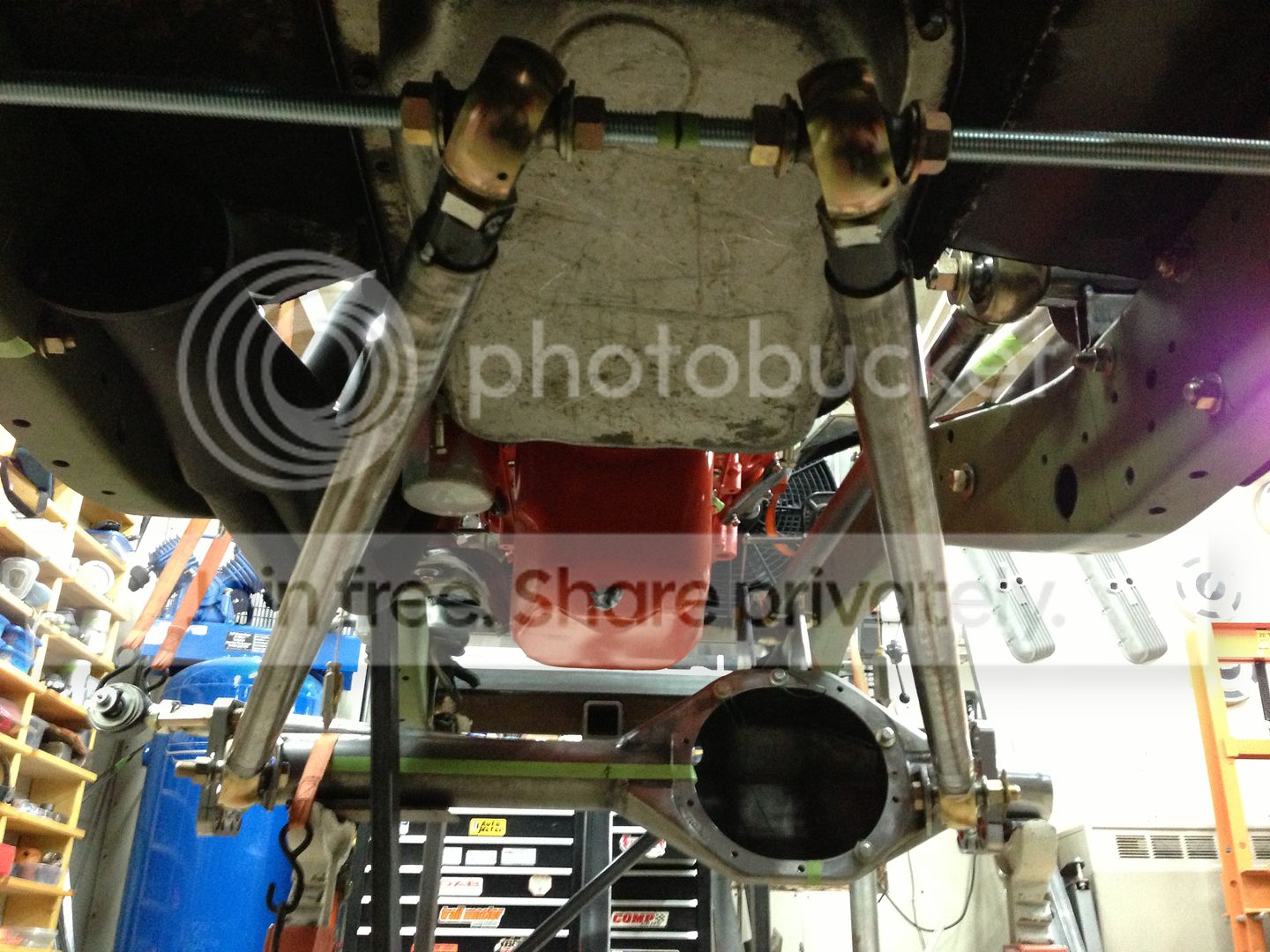
Underside shot of the lower links to show position relative to transmission pan.

null-48.jpg


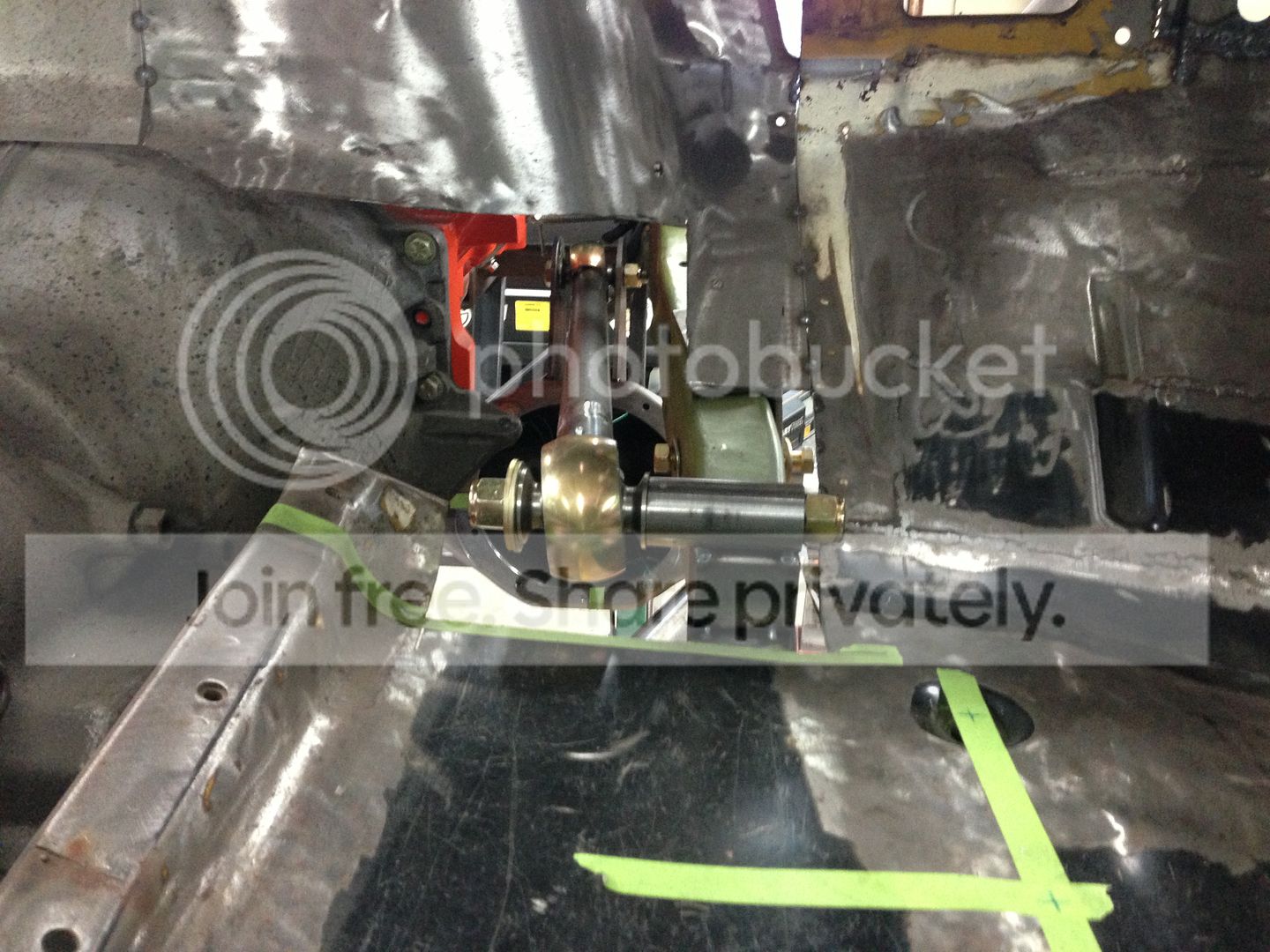
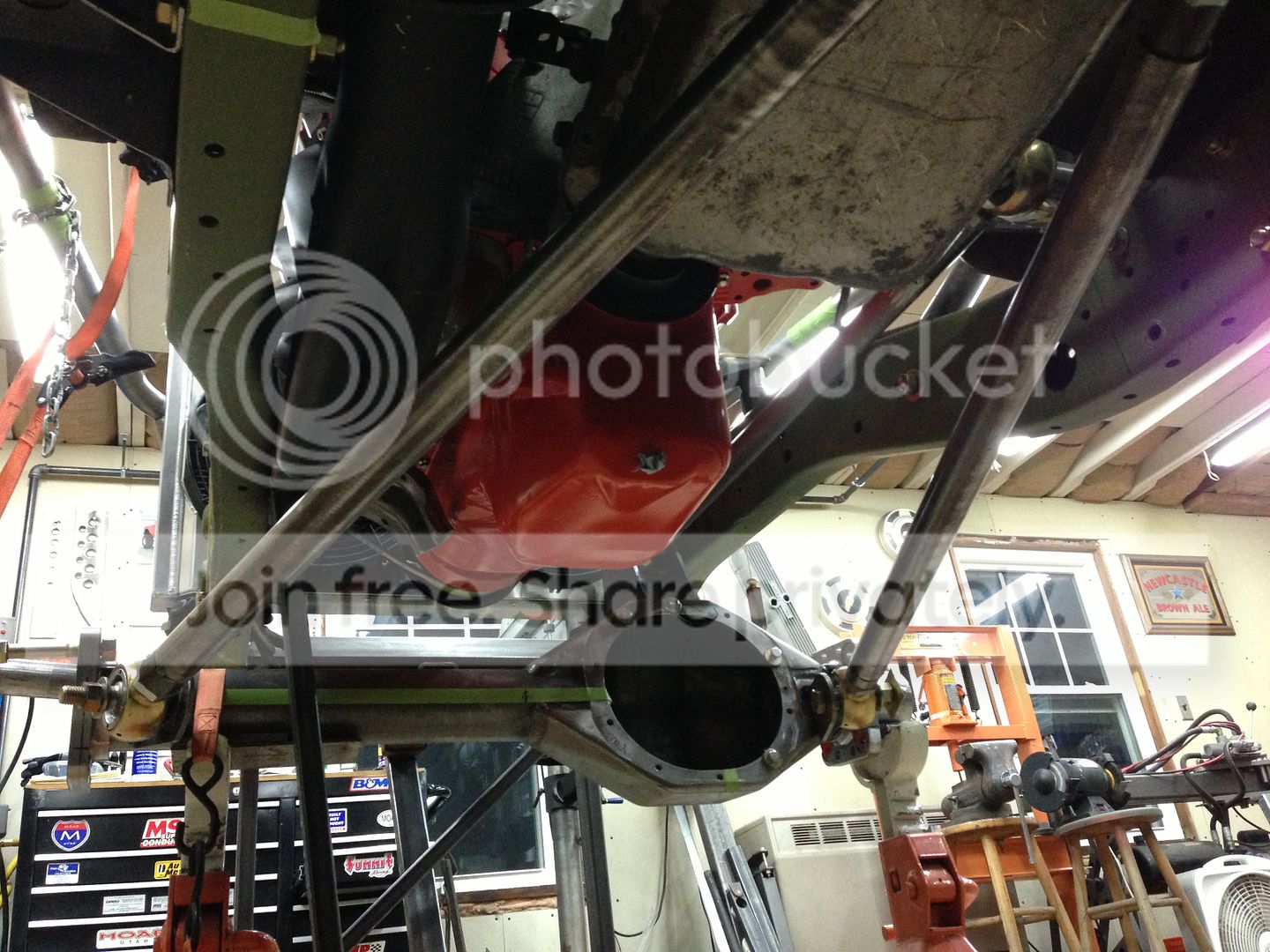
This is the best shot I could get to show the lower links AND the upper link in the same photo.

null-49.jpg


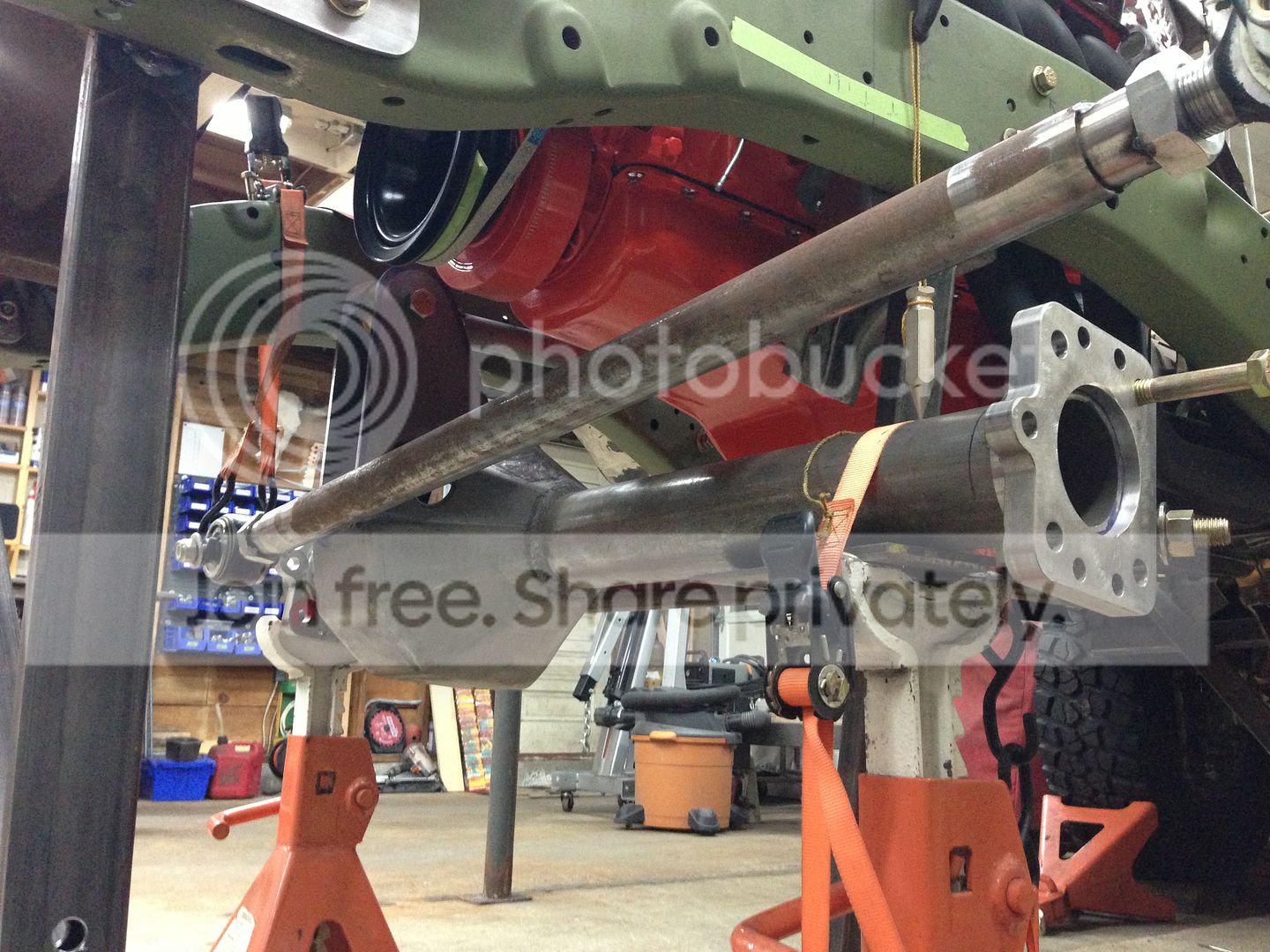
I had a little time left, so I tried to set the panhard rod into position...

null-50.jpg


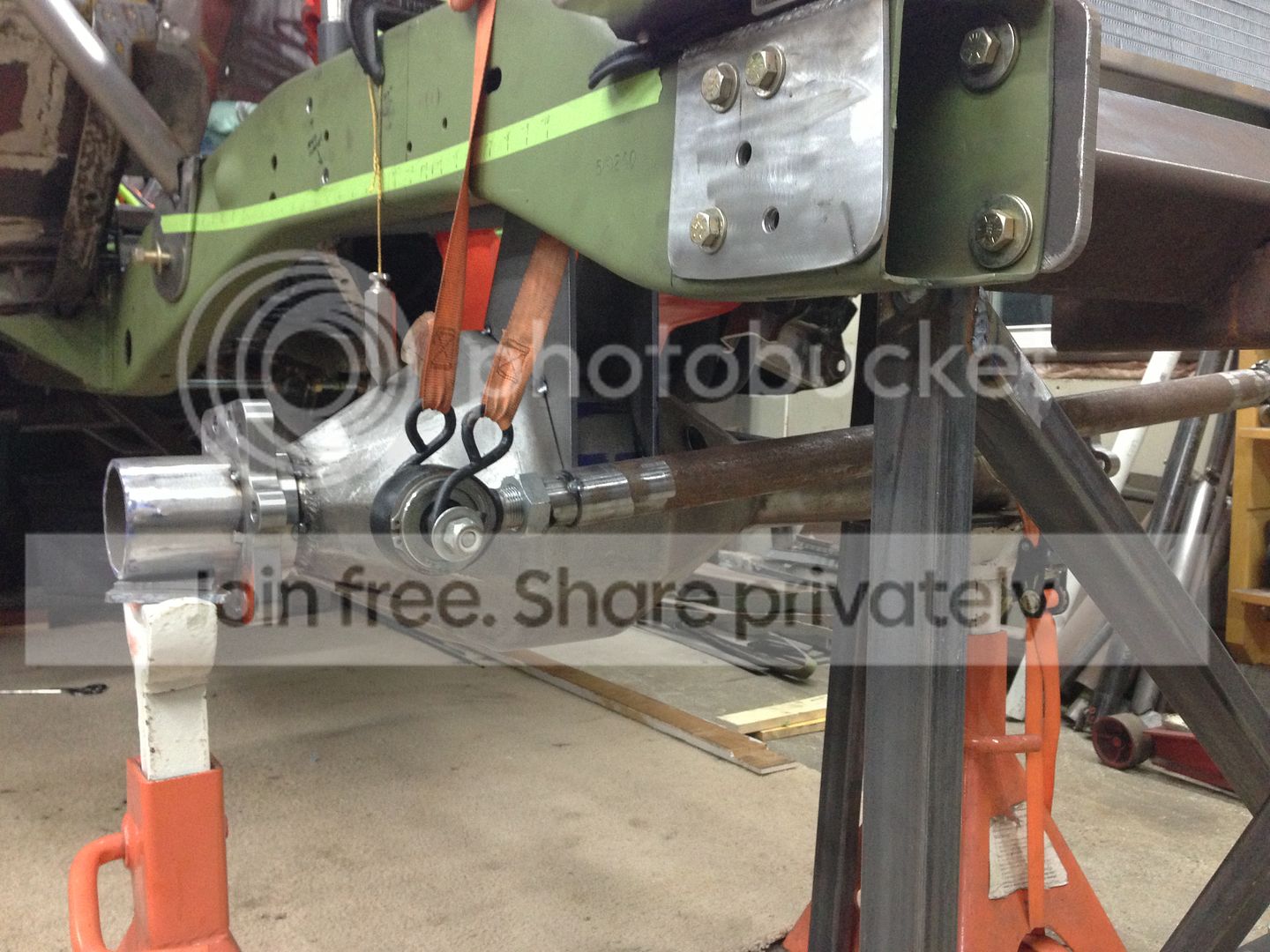
...and from the passenger side.

null-51.jpg


I'll admit I started out with no idea how long to make the panhard rod, and I was overly optimistic about how long I could make it. I tried for 44"' but it's going to be way too long. I don't think it's even possible to place the axle side of the panhard any further than the steering knuckle pivot... And even that might not be possible. :thinking:

Need to study panhard bar stuff a little more before Friday (my next shop day). :waytogo:


-G
 
Last edited:
So with the front suspension being a total compromise as you are learning.

Why did you decide to triangulate the lowers so much?

Just looking at what needs to be done with the headers and stuff it seems like putting the bottom links under the frame ( or slightly frenched in) would alleviate a whole lotta problems
 
So with the front suspension being a total compromise as you are learning.

Why did you decide to triangulate the lowers so much?

Just looking at what needs to be done with the headers and stuff it seems like putting the bottom links under the frame ( or slightly frenched in) would alleviate a whole lotta problems


The wise one (Brandon) advised that converged lowers help to improve high-speed stability so I tried to pay attention to that.... Especially since this truck will see substantial highway duty.

The nice thing about that threaded rod, is that I can easily move the links apart more to get clearance. The tradeoff is that's will lose negative roll axis as I spread those frame-side mounts, and I was trying to keep a few degrees of negative roll axis (understeer) it the final design. :thinking:

-G
 
Last edited:
So my question is why not build a set of radius arms like a F150 runs. Seems it would solve a ton of issues with clearance and fitment and still basically achieve a good front suspension.
 
Most people agree they radius arms have too much bind in articulation...

For simple up and down stuff (both wheels in same direction the radius arm stuff works fine, especially with highly compliant rubber bushings)

-G
 
What about a design that resembles ORD's front coil conversion. It works really well and uses a stock frame locations.

I look at the clearance issues that you are going to have and think :eek1: that is going to take a long time to figure out and they may not even get to be figured out.

I was thinking radius arms with rod ends not rubber ends. Not sure if it would work though.
 
There really isn't any "magic" answer. You just need to spend time with the calculators (3-link & 4-link) to see what is likely to work and what has horrible tradeoffs..... Then when you have a design you like, try to actually place it into the truck. Typically it won't fit the way you had planned.... Make a few revisions, make sure the numbers still look good and try again. There will probably be fewer issues the second time, but there's bound to be more stuff to solve...

Brandon commented recently that even the ORD front link design was far from perfect. They had to balance the packaging of the links with some inevitable tradeoffs...it's really hard to make a "generic" link suspension package when you realize how many considerations there are. Every step of the way, you have to choose between one attribute vs. another... Perfect example, if I move those converged links even a few inches further apart (more parallel) I lose a couple of degrees of negative roll axis. I gain the clearance at the tranny pan, but give up some hard-fought understeer that I was trying to preserve.

Remember too, that with portal axles my axle tube is 5.5" higher than normal 1-ton stuff so I can't just "copy" an existing Chevy link design and transfer it to this truck. The lower links would end up WAY below the axletube, and the uppers might also end up below the axle centerline.... It would be weird to say the least...

In a lot of places, I'm trying to be as flexible as I can to allow the suspension design to succeed even when it requires substantial rework or fabrication. I've already moved one motormount to allow for the suspension uptravel, and I've committed to building outboard headers so that the lower links can stay long and flat. If I shorten them, my anti-dive goes sky-high unless I'm also willing to drop the frame side mounts (which I'm not willing to do).

You really need to consider the complete truck design and goals, and then decide what areas are 100% non-negotiable in terms of design. For me, once I decided to go with portal axles my biggest priority was massive ground clearance at the center of the truck with a completely FLAT belly pan, and reasonable ride height. There was no point going with portals if I was going to give up underbelly clearance anyway. The current front and rear suspension designs support that well by not hanging any frame-side links below the frame and having very shallow link angles (lower links are around an 8.5* slope). I also had to raise the entire driveline a couple of inches at the transfer case to make sure I wasn't dangling that Atlas down below the framerails either.

I'm pretty stubborn about wanting to get good suspension numbers on paper. At least then I'll know that the truck "should" perform well and I'm not handicapping myself right from the start with a flawed design that won't ever work right no matter how much tuning I do later on...

Tomorrow I'm back in the shop and I'll tackle that panhard bar mounting. Once that's in place I can FINALLY cycle the suspension and see how badly I've messed up! :D


-G
 
Last edited:
Greg

If you can widen the lowers at the frame end and still have a few degrees of roll under-steer go ahead and do that. It will make bracing up the cross member that much easier. BUT I think it's worth the headache to keep a few degrees of roll under-steer even if you have to keep the frame end narrow like it is shown.

Keep in mind that with a link suspension you don't need clearance to things like you do with leafs. That 1" of clearance to your header at what I am assuming is full bump is about 15/16" more than you need. Keep in mind in articulation that link will actually be lower even with that side tire at full stuff. To make you feel better, we have clearances on things that rub paint off but never leave a mark in the metal:confused: not saying it's right but it works.

You can't just arbitrarily put a track bar on there, you need the steering box mounted and the knuckle on there with a mock-up drag-link to start with the track bar. That gives you the angle and length you are shooting for, then you can play games with those two things to come up with the best mounting locations for the track-bar.

If needed you can bend your upper a bit to clear the motor mount, but it looks like you have plenty of room. You will also be able to guide the axle up into that pocket fairly well with the trackbar. The one thing to remember is that with the upper mount above the axle that much it will have a lot of side to side movement under articulation, this means that it needs some room side to side but, you get the added advantage that with it inboard it is highest at full bump both sides and get lower with articulation no matter which tire is up.

Clear as mud yet:haha:. Keep at it it's only hard for a bit then gets harder.:whistle:
 
Ugh! :doah:

This IS going to be a pain after all. I don't have a steering box yet, I was going to order one from HOWE since I already have their pump and wanted to build something that will work well together. I have no idea what kind of pitman arm I will use of what sort of length will be required.

At the very least it looks like I'll have to mount up the steering knuckles so that I can start looking at my Ackerman angles..... For those of you that don't know, Unimogs have the tie rod behind the axle, not in front of it. For correct Ackerman I may be forced to do the same thing.... There may not enough clearance to put the steering arms in front without hitting the inside of the tires. :dunno:

If the steering arms end up behind the axle, then the steering box will probably end up closer to the firewall than normal. Haven't even started thinking about all the "fun" that might be created with a change like that. :eek1:


EDIT: Brandon, the images I'm posting are not at full bump... Those are at normal ride-height. Now that I have a few links installed (and have some constraints to keep the axle from just flopping all over the place) it probably makes sense to move the axle up 5 -6" (my best guess for bump travel maximums) and continue the build in that orientation?


-G
 
Last edited:
Ugh! :doah:

This IS going to be a pain after all. I don't have a steering box yet, I was going to order one from HOWE since I already have their pump and wanted to build something that will work well together. I have no idea what kind of pitman arm I will use of what sort of length will be required.

At the very least it looks like I'll have to mount up the steering knuckles so that I can start looking at my Ackerman angles..... For those of you that don't know, Unimogs have the tie rod behind the axle, not in front of it. For correct Ackerman I many be forced to do the same thing.... There may not enough clearance to put the steering arms in front without hitting the inside of the tires. :dunno:

If the steering arms end up behind the axle, then the steering box will probably end up closer to the firewall than normal. Haven't even started thinking about all the "fun" that might be created with a change like that. :eek1:


EDIT: Brandon, the images I'm posting are not at full bump... Those are at normal ride-height. Now that I have a few links installed (and have some constraints to keep the axle from just flopping all over the place) it probably makes sense to move the axle up 5 -6" (my best guess for bump travel maximums) and continue the build in that orientation?

Yes it does.

-G

You can start getting a good idea of things without the steering box but you won't be able to finalize things just yet. Since it sounds like you are thinking of custom steering box location you have a bit of lee way with the track bar as well.

You are in the middle of the "well if I move this here then that can go there then this goes there and OH sh!t! that would have to go there, that doesn't work. Now what if I do this?" part. Once you go in circles about five times you will figure out what one component the is the pivot man in the circle jerk and be able to start getting things nailed down and finalized.

Keith
Radius arms suck.:popcorn:
 
Looking at your numbers even with the arms out a bunch you still can get roll understeer.

I also think you have to reconcile the fact that when Brandon is talking about high speed stuff he is talking about through the desert, where the wheels are bouncing around alot. Brandon can correct me if I am wrong. That is much much different than a highway. If you tires are dancing around in the desert over a rough surface and then all of a sudden that surface smooths out then it will calm stuff down.

So going across the desert is going to accentuate all the bad points of everything and force you to do something more drastic to fix it.

I assume the Howe box your looking at is still based off a saginaw box? Correct. Get a saginaw box gut it hang it on there and that might help.

It worries me you have as little of your axle built as you do. A dana 60 sure thats easy everyone knows where stuff goes and how it works. But that mog is got things on so many different levels than a 60.

I just think that you are making life much much much harder for yourself for a stability factor ( high speed off road) you may never use.
 
I was thinking radius arms with rod ends not rubber ends. Not sure if it would work though.

You can't use radius arms with all rod ends in a wheelin' rig, it would turn the axle into a giant sway bar and allow almost zero articulation. At a minimum you need at least 2 flexable bushings at the axle end.

Greg

You can't just arbitrarily put a track bar on there, you need the steering box mounted and the knuckle on there with a mock-up drag-link to start with the track bar. That gives you the angle and length you are shooting for, then you can play games with those two things to come up with the best mounting locations for the track-bar.

I agree, you need the steering knuckles and steering box/pitman arm at a minimum, with that you'll figure out your draglink. Once you have the draglink, then you can make the trackbar to work with it.

I think you need the shocks and bumps too to be honest.(or at least something to mimick them. Fitting it all in there on the passenger side under simultaneous articulation and steering requires more space than you think.

Ugh! :doah:

Now that I have a few links installed (and have some constraints to keep the axle from just flopping all over the place) it probably makes sense to move the axle up 5 -6" (my best guess for bump travel maximums) and continue the build in that orientation?

-G

You can cycle it up to full bump to check for clearances which you will need to do, but unless your trackbar is exactly the same length as your draglink, I would put it parallel at ride height, it will reduce the bumpsteer the most under the more common conditions.

Now, as Brandon said, you could offset the axle at ride height to provide needed clearance somewhere at full bump, but I am guessing your OCD won't allow that, so I would continue setting it up at ride height, and then cycle it to full bump whenever you need to check for clearance in case you need to move the upper link sideways a little or something.

I like where you are going with it, you'll need a lot of compromise on the floor and exhaust, but it looks like it should work well.
 
Looking at your numbers even with the arms out a bunch you still can get roll understeer.

I also think you have to reconcile the fact that when Brandon is talking about high speed stuff he is talking about through the desert, where the wheels are bouncing around alot. Brandon can correct me if I am wrong. That is much much different than a highway. If you tires are dancing around in the desert over a rough surface and then all of a sudden that surface smooths out then it will calm stuff down.

So going across the desert is going to accentuate all the bad points of everything and force you to do something more drastic to fix it.

I assume the Howe box your looking at is still based off a saginaw box? Correct. Get a saginaw box gut it hang it on there and that might help.

It worries me you have as little of your axle built as you do. A dana 60 sure thats easy everyone knows where stuff goes and how it works. But that mog is got things on so many different levels than a 60.

I just think that you are making life much much much harder for yourself for a stability factor ( high speed off road) you may never use.

Actually the handling is the most important to me on hard flat surfaces like Highways. With our old front link geometry we had like 6 degrees of roll steer and 3 or less degrees of caster. With the new front end geometry we have 2 or 3 degrees of roll understeer and like 8 degrees of caster. It gets a bit squirmy at about 80 but clears up around 95 and by 100MPH it feels good enough that you can one hand it.

When bombing through rough terrain things are moving so fast and the car is reacting to each hit enough that you are always driving it so the geometry is nice to have good but isn't as "noticeable"

Until we changed the front geometry driving the race car at anything over 60mph wasn't fun, especially on the highway. It was terrifying at times actually, dirt roads were better because there was the factor of the surface traction being lower so the tires move around and make you mentally drive the vehicle.
 
Actually the handling is the most important to me on hard flat surfaces like Highways. With our old front link geometry we had like 6 degrees of roll steer and 3 or less degrees of caster. With the new front end geometry we have 2 or 3 degrees of roll understeer and like 8 degrees of caster. It gets a bit squirmy at about 80 but clears up around 95 and by 100MPH it feels good enough that you can one hand it.

When bombing through rough terrain things are moving so fast and the car is reacting to each hit enough that you are always driving it so the geometry is nice to have good but isn't as "noticeable"

Until we changed the front geometry driving the race car at anything over 60mph wasn't fun, especially on the highway. It was terrifying at times actually, dirt roads were better because there was the factor of the surface traction being lower so the tires move around and make you mentally drive the vehicle.

So you started with 6 degrees of roll steer and went to negative roll steer. Thats a large change cause your going from positive to negative.

According to Gregs link calculations from before if the arms are moved out further than they will still have almost 2 degrees of roll understeer. Which is still not bad. If he can mantain a couple degress of roll understeer and move the arms out of the way of the exhaust than I think that is the way to go.

Greg what Brandon said though demonstrates what I have been trying to say. It gets a bit squirmy at 80 or so but clears up by a 100. I am not saying you are never going to go that fast ( I would with your motor just cause I could) but the point being that everything is a compromise and you are just trying to get everything to work together as best as possible.

Its all about coming up with the best compromise for everything.

Although i will be honest here you are talking to a guy that will spend an entire day on something to get an extra half inch of clearance.

So I certainly respect the no compromise attitude.

I would also compromise a small amount of engine power for a very very good suspension, vs no engine power for a just a good suspension
 
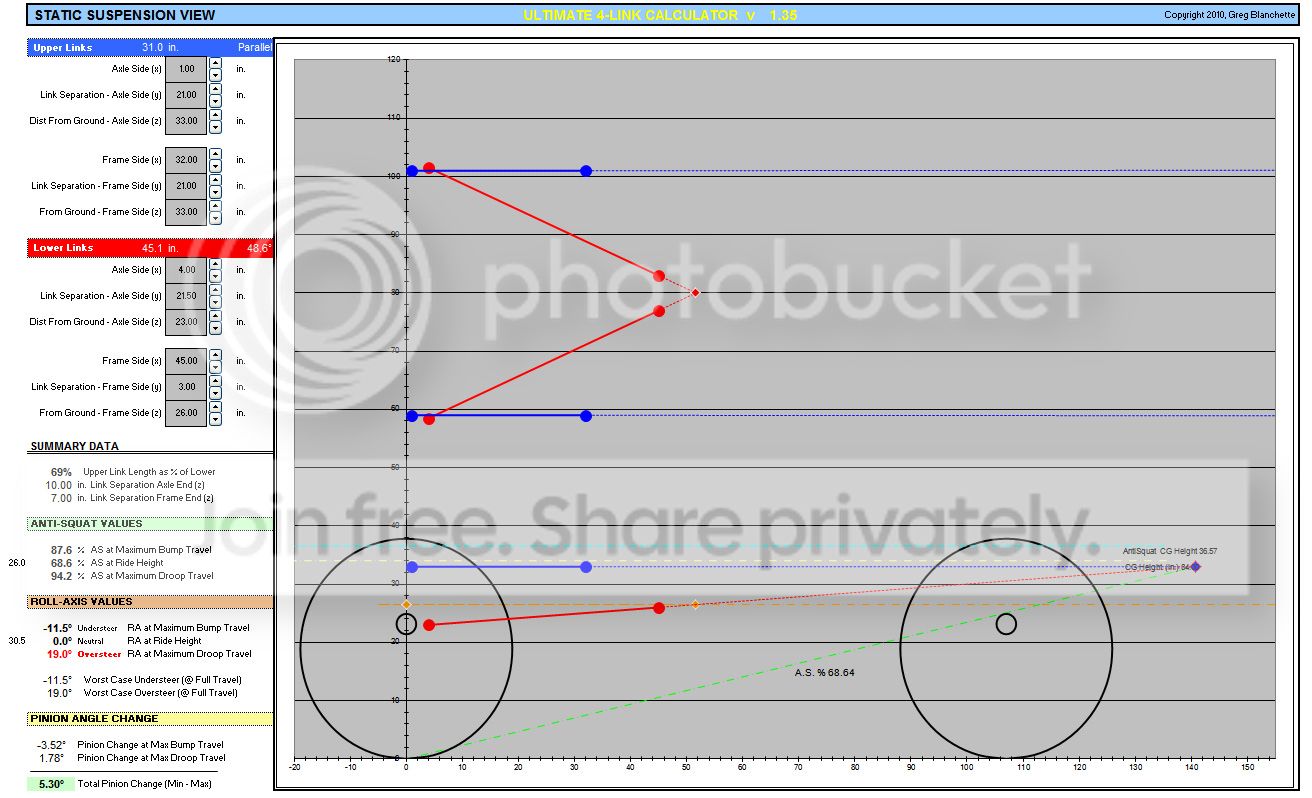
Greg what are your rear numbers?

Let me know if this is too fuzzy...

EDIT: replaced incorrect image.....

RearFinal.jpg


Neutral roll axis, low As%... Pretty nice, but the rear is a cakewalk compared to the front. :whistle:


-G
 
Last edited:

Latest Posts

Top Bottom