CK5
Register an account today to become a member! Once signed in, you'll be able to participate on this site by adding your own topics and posts, as well as connect with other members.
View attachment 166777

This was my original Buggy axle, I believe the front and back tabs to be 3/16" material, one bent for the back and the other I think stands straight up off the axle tube. Of course the side plates for the links are 1/4" material and are the beef of the mount. This is what the early versions of the ORD rear 4 link kit did to solve your issue. YOu can snoop around and probably find some pictures of my buggy from the back before we cut it up and made it all desert racer cool. It worked well for a good rec. crawler and was really only changed to get 20" of rear wheel travel.

Keep the bottoms as wide as possible and lay the top in, a few degrees of angle isn't going to hurt in full bump situations and will help make the strut progressive in full articulation situations.

Here is a link to the Fox chassis when ORD did it years ago. Basically his rear axle was a copy of mine, you can see shock mounting locations for side to side reference. http://coloradok5.com/uav.shtml

Thanks Brandon,

I spent about an hour trying to drill into the ORD site to find a decent photo... and never did find anything clear enough to be helpful.


Why not run a small spacer instead of moving the mounts again? Looks like your off maybee an inch or so?

That's pretty much what's going to happen up top. A longer DOM slug will be all that's needed. The lower mount needs to go in a bit more too. If for no other reason than it blocks the bolt access to attach the portal to the backing plate in the upper corner. I found that out last night when I could only get 7 of the 8 perimeter bolts installed for my flex tests!!! :whistle:


-G
 
Your speaking to one of the writers of the 4 link calculator, he probably knows exactly what his roll steer is.

......


But to be fair, even my spreadsheet failed to calculate the "one wheel up, one wheel down" type suspension movements. The wheel travel and associated roll-steer calculations were all based on simple wheel travel (both wheels up or down simultaneously). It's better than nothing, but it also doesn't tell the whole story for a 4x4 rockcrawling application..... this corner-case, max bump/droop stuff just isn't part of that software.


-G

Call it roll-steer there, we call it flex-steer here......same thing. On paper, a lot of sh!t looks mighty fine and you can calculate until hades is covered in ice but.
I've WATCHED rigs on the trail that wouldn't stay on the line because the ass end kept going sideways when one side was up and the other side down.
Just sayin.:whistle:

Albert Einstein — 'In theory, theory and practice are the same. In practice, they are not.'
 
Last edited:
Call it roll-steer there, we call it flex-steer here......same thing. On paper, a lot of sh!t looks mighty fine and you can calculate until hades is covered in ice but.
I've WATCHED rigs on the trail that wouldn't stay on the line because the ass end kept going sideways when one side was up and the other side down.
Just sayin.:whistle:

Albert Einstein — 'In theory, theory and practice are the same. In practice, they are not.'

We are looking at real world stuff here, not paper. I'm trying to say Greg is aware of roll steer or flex steer or whatever you prefer to call it.

Also, I'm not saying it doesn't exist, I'm just saying it's unlikely that is what is causing his tire to hit the rock slider. Greg doesn't give himself enough credit, that is what roll steer is, how much the axle steers the rig with articulation. Yes the spreadsheet calculates roll steer at ride height and not full articulation, but it still gives you an idea. Some vehicles probably have it horribly, and some have zero, I am not surprised you have seen rigs that wouldn't go straight when they are leaning. If I remember correctly Greg's roll steer is pretty low, but if he does have any it is probably roll understeer, roller oversteer is what would cause the tire to want to hit the rockslider when stuffed.

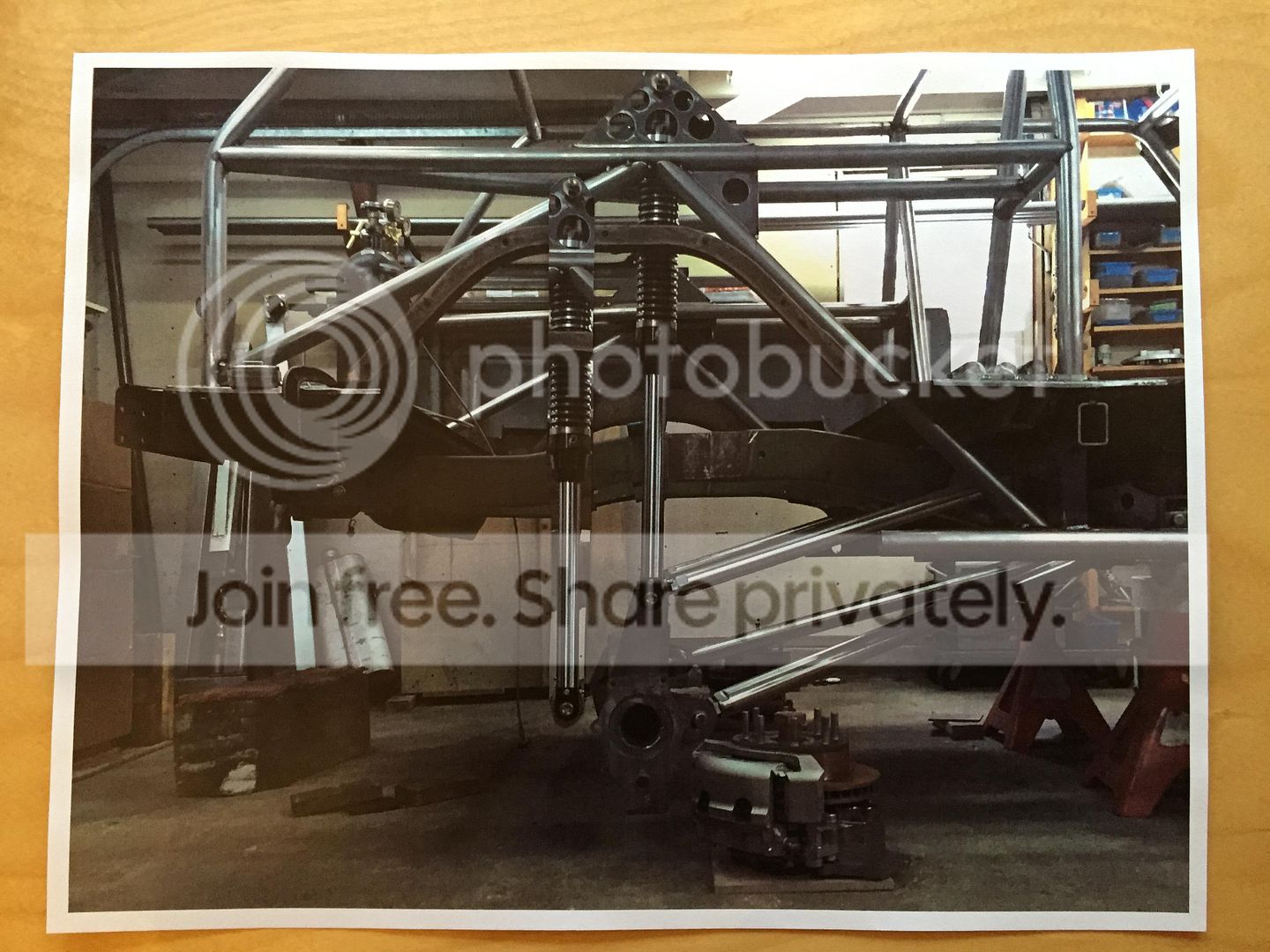
Either way, look at this picture below. You can see that the arms are all angled down from the chassis, so at full stuff the arc will carry the axle back, not forward. Now if you droop the other side, it will take the drooped side down and forward, moving the stuffed side further rearward asnd away from the rock slider (obviously it will go up, but back, not forward). This is roll understeer and will not move the stuffed side forward into the rock slider.

However, look at the length and angle difference between the upper and lower bars. The upper bars are different length and different angles, so as they cycle the pinion angle will change, and if the pinion angle points up more it will move the tires forward, because the portal axles move the wheel center off the axle center. Now, it's hard to see what would happen to the pinion angle when you articulate it, but I am sure Greg can see it when he does the cycling. Either way it's not a problem, just the way it is.

IMG_2357.jpg
 
We are looking at real world stuff here, not paper. I'm trying to say Greg is aware of roll steer or flex steer or whatever you prefer to call it.

Also, I'm not saying it doesn't exist, I'm just saying it's unlikely that is what is causing his tire to hit the rock slider. Greg doesn't give himself enough credit, that is what roll steer is, how much the axle steers the rig with articulation. Yes the spreadsheet calculates roll steer at ride height and not full articulation, but it still gives you an idea. Some vehicles probably have it horribly, and some have zero, I am not surprised you have seen rigs that wouldn't go straight when they are leaning. If I remember correctly Greg's roll steer is pretty low, but if he does have any it is probably roll understeer, roller oversteer is what would cause the tire to want to hit the rockslider when stuffed.

Either way, look at this picture below. You can see that the arms are all angled down from the chassis, so at full stuff the arc will carry the axle back, not forward. Now if you droop the other side, it will take the drooped side down and forward, moving the stuffed side further rearward asnd away from the rock slider (obviously it will go up, but back, not forward). This is roll understeer and will not move the stuffed side forward into the rock slider.

However, look at the length and angle difference between the upper and lower bars. The upper bars are different length and different angles, so as they cycle the pinion angle will change, and if the pinion angle points up more it will move the tires forward, because the portal axles move the wheel center off the axle center. Now, it's hard to see what would happen to the pinion angle when you articulate it, but I am sure Greg can see it when he does the cycling. Either way it's not a problem, just the way it is.

I understand totally.........the only thing I hadn't considered was the portal axles. I experimented a lot with different link set ups when I was big into wheelin' so I know how it works. The way we stopped the excessive "roll steer" was by triangulating top AND bottom links and keeping them as close to the same length and angle as possible with consideration to the other aspects of the suspension.
We had a good deal of success AND failure.....:waytogo:

In no way am I questioning Greg's ability and skills. His fervency, dedication, and diligence to his build is beyond reproach.
 
2014.12.18 - UPDATE!...THREAD CLOSED. SEE YOU IN 2015...!!!!

It's been a great year, and I've enjoyed sharing another 12 months worth of progress on the Might As Well Build with all of you. :waytogo:

As we head into the Christmas / New Years holidays, the focus turns to family and friends and it is unlikely that I will spend much time in the workshop..... It might happen, but it's certainly not a guarantee so I'd like to let everyone know to expect a couple of weeks of "radio silence" on this thread. Don't panic. I'll be back! :D

In the meantime, here are a few parting shots of the progress of a late night spent in front of the CNC mill getting parts completed for the 17" steel wheel & hubcaps initiative!

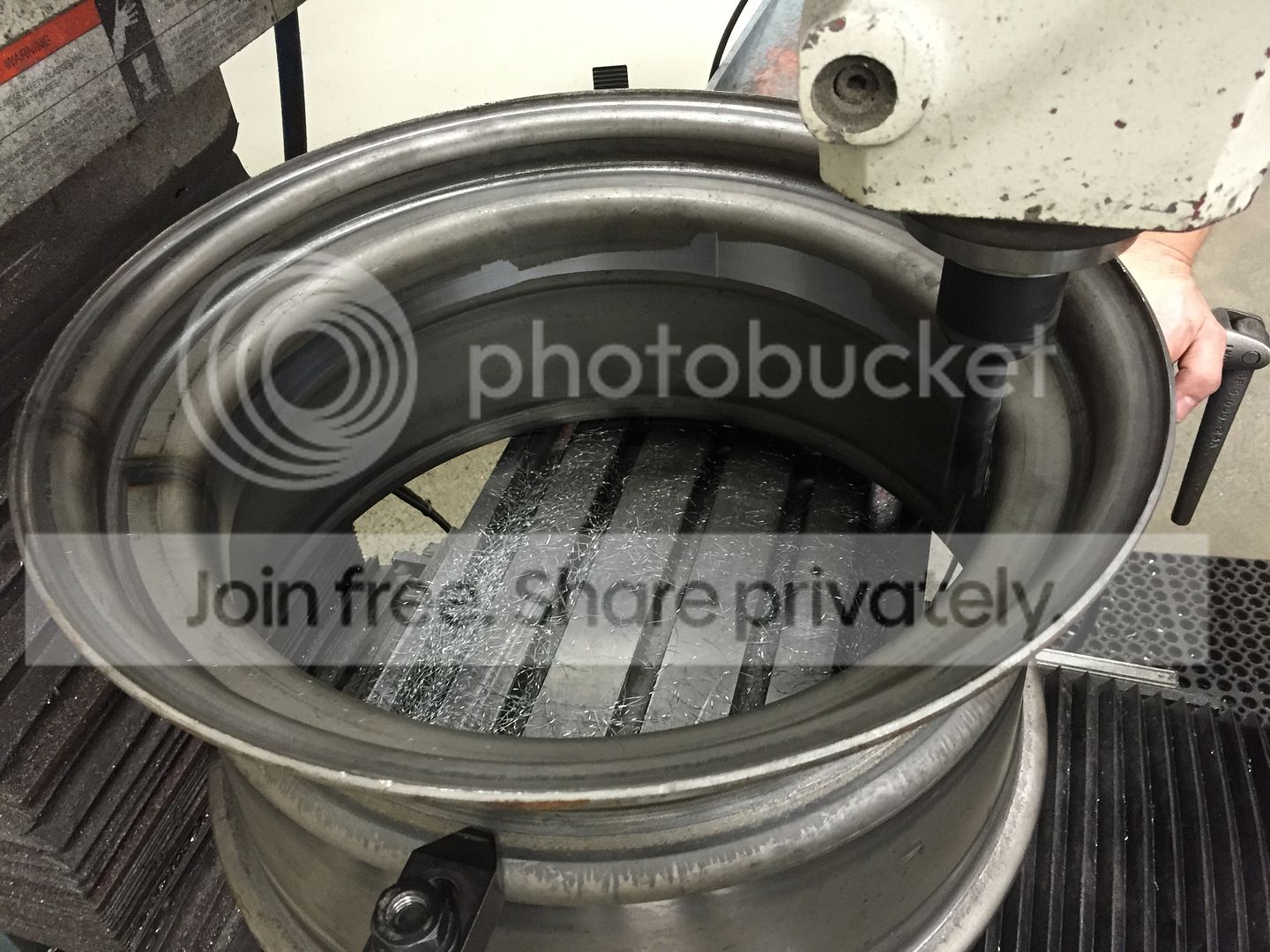
Step 1:

Clean up cut on the 17" hoops to prepare the mating surface for the new centers..... All we did was cut a few thousandths to make sure that the entire surface was flat and perfectly round....

IMG_2411.jpg


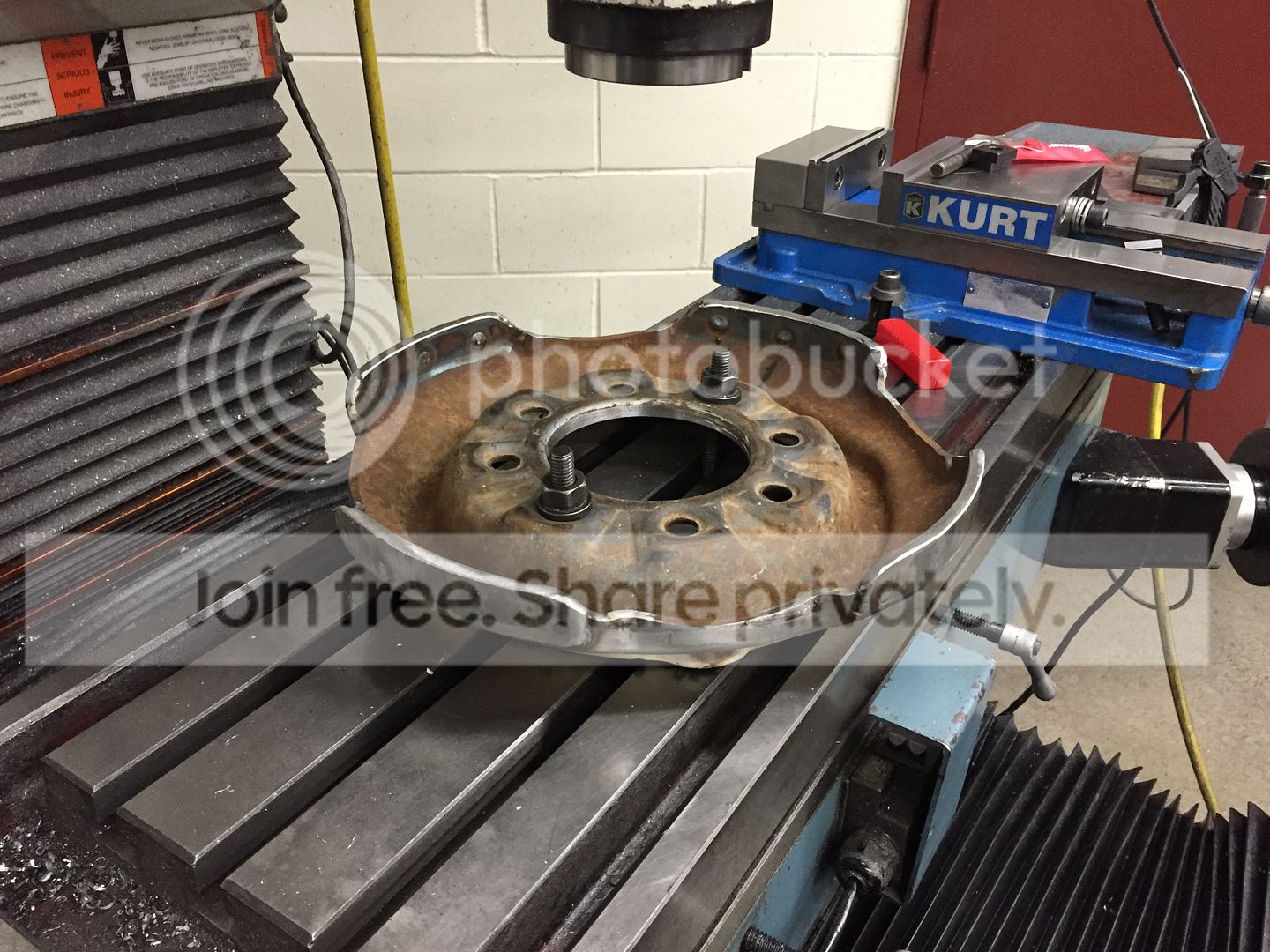
Step 2:

Mount the welded Chevy centers in preparation for the machining of the flanges down to the target diameter.

IMG_2412.jpg


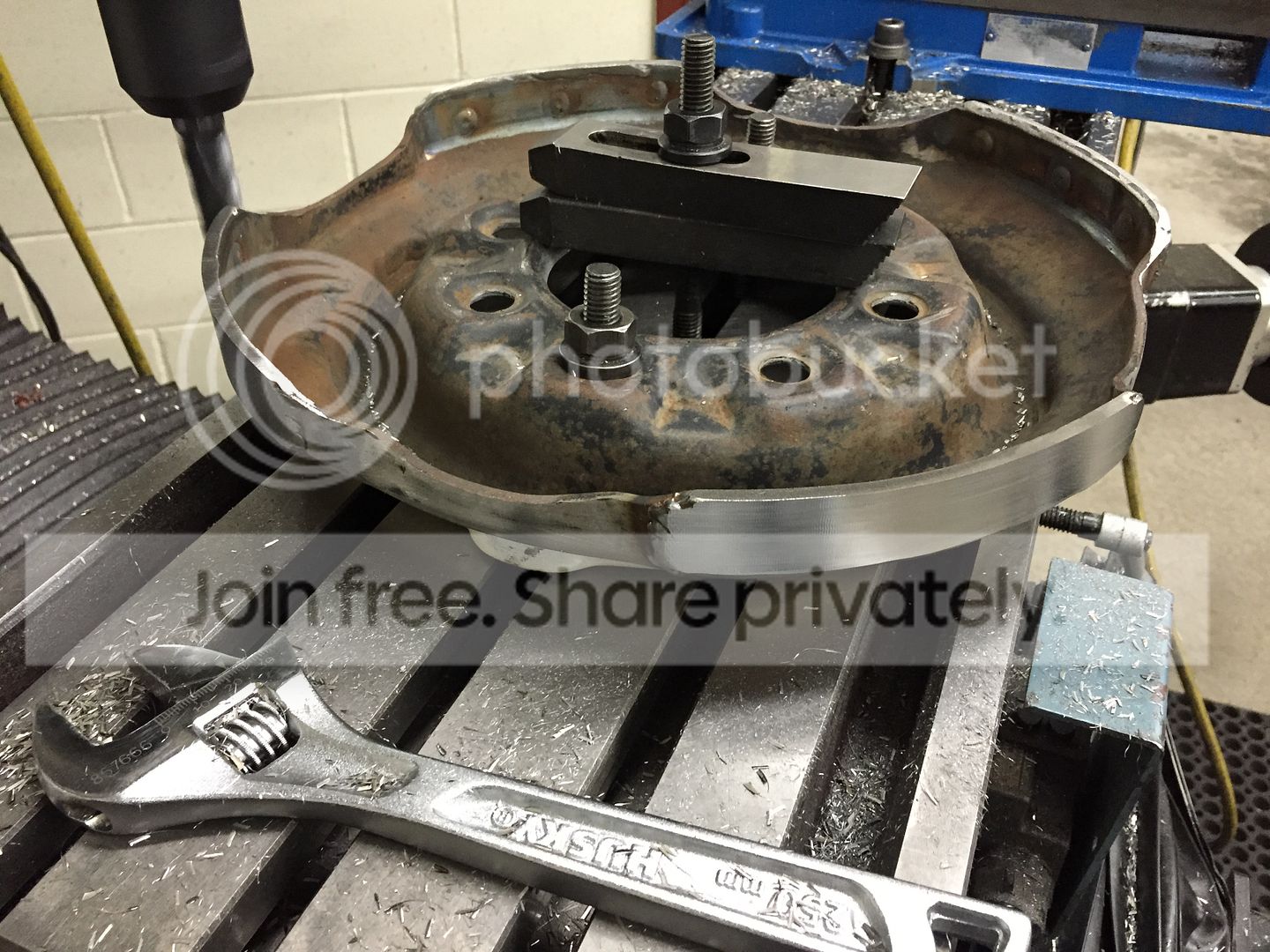
And here's a bonus video of the machining process. It was basically about 4 passes around, each one getting deeper until the cutter was touching the entire flange. The final pass shaved off the final couple thousandths, and had a slower travel speed to create a really smooth, finished part...

This video shows the one of the initial passes to remove most of the "extra" flange thickness and gets the part in the ballpark for correct diameter and roundness....


And here's the finished product after about a 15 minute automated machining process:

IMG_2421.jpg


Like everything I seem to do.... it took longer than expected. The "prototype" from a few weeks ago (which is the spare tire wheel) took all night to do.... but we got 4 done last night in about 5 hours. It ended up being a late night / early morning... but it's awesome that ALL of the wheels are not completely machined and ready for assembly and finish welding! :waytogo::bow:

Stay tuned..... those updates will be coming in January 2015.

:D


-G
 
Last edited by a moderator:
Looks good!

How much of the plug weld "mushroom" was removed? Are you worried about strength there at all?

Not sure exactly what you mean by "mushroom"? :dunno:

The inner lip was untouched, we only machined the outer flange surface where it will contact the wheel hoop.

Keep in mind, there are no less than 9 plug welds per flange (36 total per wheel center) and each of those plates was also fully perimeter welded to the flange. Overkill on top of overkill.... for a part that will then be a press-fit to the hoop....... and then welded together, with at least 3 bolts through both the flange and the wheel hoop (12 bolts total) all torqued down and then welded to prevent air leaks.

Strength issues? I think not. :D

A factory wheel was only held together by 12 rivets... and survived for 40+ years before I started drilling and cutting them apart as donors to this project. I'm quite literally betting my LIFE on the safety of these parts.... so it's a pretty serious thought process.


:waytogo:


-G
 
Have a Merry Christmas and a Happy New Year Greg.


Thanks Heath, same to you! I appreciate all of your insightful comments over the past year to push me along in the right direction!! :waytogo:

With any luck, I will find a few hours of quiet time to start TIG welding soda cans together and learning a new skill. I found a local expert who has generously offered to show me a few basics to get me started off on the right foot..... all in exchange for a nice bottle of whiskey.

I'll take that deal every time! :deal:


-G
 
Enjoy the holiday Greg. Oh and love those whiskey deals. Usually those deals include you drinking some of the said whiskey. :D
 
You will like TIG welding. I just started it less than a year ago but it immediately intrigued me because unlike the wire melting in air as the arc heats it while it travels into the puddle, there is almost zero splatter because the arc is seperate directly into the base metal and you "dab" the filler metal into the puddle. Now I already knew this but had never experienced it myself, so what you will immediately notice is the smoothness and cleanliness of the process and the weld. Plus, the machines hum, especially on AC, gives you a satisfying sound, unlike the frying bacon sound you get with the MIG in the short circuit transfer method.

Your machine has more bells and whistles than you will ever use in your lifetime I bet, so try to stick to the basics for a while. I have heard of people getting the settings all out of whack and then having a hard time learning the basics.

Enjoy.
 
You will like TIG welding. I just started it less than a year ago but it immediately intrigued me because unlike the wire melting in air as the arc heats it while it travels into the puddle, there is almost zero splatter because the arc is seperate directly into the base metal and you "dab" the filler metal into the puddle. So what you will immediately notice is the smoothness and cleanliness of the process and the weld. Plus, the machines hum, especially on AC, gives you a satisfying sound, unlike the frying bacon sound you get with the MIG in the short circuit transfer method.

Enjoy.


I expect that I will.... :D

What about welding out-of-position? When it comes time to do all the finish welding of the rollcage, could I do it all in TIG and get good "uphill" welds? Or will they get runny and droopy like MIG?

If worse comes to worse, I could theoretically remove the entire cage and try to rotate it a jillion times to keep each weld "in position" for a better weld, but my hope is that TIG will allow me to leave the cage bolted down and just lay beautiful beads in all positions.

:thinking:


-G
 
If your welding just mild steel tubing I would probably still use MIG. And I realize the uphill welds do yield better penetration, but I don't think it matters much unless you start welding pretty thick stuff. For 1/8" wall DOM and up to 1/4" stuff I weld downhill and get a nice strong weld without the sagging.

As for out of position and stuff, I bought one of these kits...

http://www.usaweld.com/Stubby-Gas-Lens-Kit-TIG-Torch-p/sr1711stglc.htm

Not only does it add a gas lens, which allows you to have a larger distance from electrode to base metal and still have adequate gas coverage(like sharp inner corners, etc), but if you also switch the back piece is allows you to make your torch about 1/3 the length to fit into tighter spaces.

I still use the regular setup most of the time so I don't have to shorten the tungstens or daamge the gas lens becuase I am still learning and occasionally contaminate the tungsten and splatter stuff.

Also, pick yourself up some 2% lanthanated tungstens and don't look back, should be all you need for about anything with no risk of the controversial radiation topic. 3/32" will cover most stuff. You don't need 1/8" for our 200 A machines.

This places can keep you busy reading and viewing for quite a while...

http://www.weldingtipsandtricks.com/

Also, here is the video on the stubby gas lens torch...

http://www.weldingtipsandtricks.com/tig-torch-tip.html

Here is the vid about the tunstens...

http://www.weldingtipsandtricks.com/tungsten-electrodes.html
 
Greg


YOU SUCK :flipoff11:


Just kidding!!!

I am jealous of that TIG welder. Did you get the DX model with the pulse feature? Did you give Santa the money, or was that a surprise from your other half (you are married right?)?

I would love to have the Dynasty 280DX, but my wallet isn't that fat, so I use a 1965 Miller Goldstar 330abp.

It takes a lot of practice to get decent at TIG weding, especially with an old transformer machine, but I am sure you will post back in January with some expert welds, based on the quality of all your other work.

Have fun and have a Merry Christmas.
 
Greg


YOU SUCK :flipoff11:


Just kidding!!!

I am jealous of that TIG welder. Did you get the DX model with the pulse feature? Did you give Santa the money, or was that a surprise from your other half (you are married right?)?

I would love to have the Dynasty 280DX, but my wallet isn't that fat, so I use a 1965 Miller Goldstar 330abp.

It takes a lot of practice to get decent at TIG weding, especially with an old transformer machine, but I am sure you will post back in January with some expert welds, based on the quality of all your other work.

Have fun and have a Merry Christmas.


Thank you....I think. :haha:

Yes, I got the 200DX... It is a rediculously nice machine from everything I've read. The only thing it gives up to the larger 280DX is the duty cycle, but i think that only really becomes an issue when welding thick materials. Besides, I'd already spent enough of my own money (Santa didn't actually help out on this one) just to get into the 200DX model.... And it's totally overkill for the typical hobbyist like myself.


-G
 
QFT. Get out of here with this typical hobbyist **** lol.


From my vantage point, that's what I am.... There is still a whole magnitude of obsessiveness (and metalworking skills) beyond what I am capable of.

Part of the disease I suppose, is convincing yourself that you are "typical"... And it's those "other guys" who are always taking things too far.


:D

-G
 

Latest Posts

Top Bottom