CK5
Register an account today to become a member! Once signed in, you'll be able to participate on this site by adding your own topics and posts, as well as connect with other members.

Any ALDL and ECM experts on here

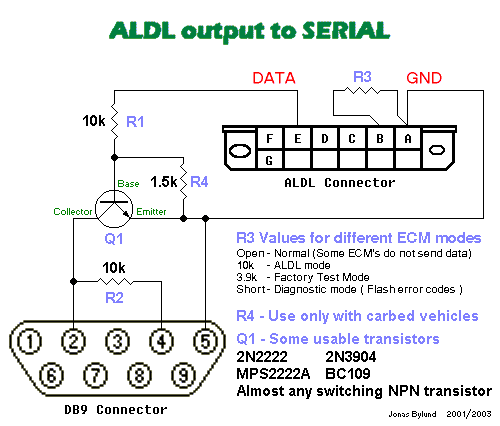
When I built my cable I used a serial connection instead of a USB port. I wired it using the diagram below.

interface.gif


DSC01338.jpg


Did you have your computer connected to the cable for a 12 volt power source when it went into limp mode?
 
Last edited:
When I built my cable I used a serial connection instead of a USB port. I wired it using the diagram below.

Did you have your computer connected to the cable for a 12 volt power source when it went into limp mode?
USB is 5 volts not 12. But no I didn't have the cable plugged into my computer. Maybe that is what I was doing wrong but I think I tried plugging it into the computer first and then into the aldl connector and it made no difference. BUT it could be that plugging it into the ALDL port first hoses the cable up and causes the resistance to get stuck at 1.2k ohm between A&B. So pluging it into a USB port afterwards won't work.

This is a very valid possibility!!!! I wish I knew what circuitry they are using in there. Cause I remeasured the cable the following day and it had the correct resistance. It must somehow be storing a charge somewhere and causes those connections to get stuck at the wrong resistance until it bleeds off which takes more then 8 hours doh!

I debated making my own cable but none of my computers have a serial port. I no longer have the USB cable I sent it back. Waiting on a new one to be mailed to me.

After I get my new cable and finish my data logging I may try this experiment just to see if indeed this is what's wrong. It will be helpful for anyone else that might stumble upon this thread in the future. If this is what's wrong they should revise the design of that cable.
 
Last edited:
Don't forget you are not dealing with a simple data transfer here. Back when most cables were ALDL to RS232, you could often get away with just hooking the data out line to the data in of the computer port.
If not, then the simple transistor circuit you saw would act as a buffer.
Since RS232 data voltages were valid from about +3 to +25, the +12 from the port fit in just fine.

But USB is another kettle of fish.
Not only are they limited to approx. 5 volts, but its not just a simple 1 and 0 being different voltages.
It uses a differential transmission pair for data. D1 and D2 have to see voltages referenced to each other.
A simple buffer or resistor setup will not do.
That cable you had pretty much had to have a microprocessor in it to decode the data and re-encode it to something that USB would recognize.

This is why you don't see any schematics for those cables. Everybody probably uses a different processor and program. I suspect that there was a capacitor in it for a filter, which kept things hot for a while but gradually bled off.
That is why the resistance changed. It varied depending on whether or not the processor was running.

Interestingly, there seems to be some RS232 to USB adapters that will work. Just build the RS232 cable and plug it into the adapter.
 
Don't forget you are not dealing with a simple data transfer here. Back when most cables were ALDL to RS232, you could often get away with just hooking the data out line to the data in of the computer port.
If not, then the simple transistor circuit you saw would act as a buffer.
Since RS232 data voltages were valid from about +3 to +25, the +12 from the port fit in just fine.

But USB is another kettle of fish.
Not only are they limited to approx. 5 volts, but its not just a simple 1 and 0 being different voltages.
It uses a differential transmission pair for data. D1 and D2 have to see voltages referenced to each other.
A simple buffer or resistor setup will not do.
That cable you had pretty much had to have a microprocessor in it to decode the data and re-encode it to something that USB would recognize.

This is why you don't see any schematics for those cables. Everybody probably uses a different processor and program. I suspect that there was a capacitor in it for a filter, which kept things hot for a while but gradually bled off.
That is why the resistance changed. It varied depending on whether or not the processor was running.

Interestingly, there seems to be some RS232 to USB adapters that will work. Just build the RS232 cable and plug it into the adapter.


It didn't actually change depending on if some usb to serial chip was running (which is what I suspect is in there). It changed after plugging into the ALDL port first and then got stuck there. Regardless of if I unplugged it and then plugged it into USB first. Even completely disconnected the impedence was stuck for many hours. I suspect the same as you a capacitor or transistor with a large gate is storing a charge and causing the impedence to get stuck until it bleeds off.which is why I wish I knew what was in there. I dont want to say the design should be changed without knowing the way it has been designed. But clearly it should be changed :)

I think on this cable the usb to serial chip is probably actually in the USB end of the cable. the ALDL end probably just contains just the ALDL specific parts.

I purchased the cable to save time. I like things to be robust and having a bunch of open circuits isn't really robust and adapters never work right and are just an added hasle. If the next cable ends up like this one I may break down and just build one.
 
Got my new cable in the mail today. I'll be trying it out after I get off work hopefully it works.
 
Top Bottom