
CK5
Register an account today to become a member! Once signed in, you'll be able to participate on this site by adding your own topics and posts, as well as connect with other members.

Anyone know the Gauge of LMC Floor Panels? Welding Qs..

Dabba

1/2 ton status
Joined
Jul 27, 2007
Posts
1,839
Reaction score
2
Location
Long Island, New York
Yeah, just picked up my first MIG welder. Its a Licoln 125HD, and i just picked up two small sheets of 22 gauge sheet metal to screw around with, and i think it's really too think to weld (For a beginer) It's really easy to burn through and i don't even see a setting on the label on the welder, so makes me think its too thin?

Anyway, ive been progressivly been getting better at welding but I have a lot of beads and spaces, the welds stick but its not a solid weld, just a ton of beads along the track :\. Ill try to hone my skills but I'm hoping the sheet metal is a higher guage, thicker metal seems easier to weld on.
 
you need to practice on thick stuff initially.. get some 1/4, 3/16, etc, turn the machine all the way up and start laying some bead right down the middle of it.. make sure it's got a fresh clean grind to it...

but as mentioned, thin floor panels you'll need to stitch weld when ya go to do that...
 
Ahh, so looks like little hits at a time, not a constant hit? I was going to try to weld the new panels in via a lap joint, and thats what ive been practicing on first, i understand that butt joints are harder because its easier to loose material, esp on the thin metals. Should i try getting some thicker stuff and practicing both? With lap joints do you want full penetration on the lower peice when you weld? Thanks for the video.
 
So I got the floor from lmc, I think butt joints would be best but I can't see myself pulling it off... I was just going to go with lap joints, that okay? Was just gonna cut the new metal slightly bigger than the old and throw it on top..
 
the right way to do that is to "step" the panel edge.. but youcan get away without it... you can also drill a bunch of holes on the edge of the top panel and just plug weld it, a poorman's spotweld, to the bottom...

just make sure to buy some weldthru primer and coat the sandwich with it prior to welding it in...... then when done, drag some seamsealer across the exposed joint...
 
the right way to do that is to "step" the panel edge.. but youcan get away without it... you can also drill a bunch of holes on the edge of the top panel and just plug weld it, a poorman's spotweld, to the bottom...

just make sure to buy some weldthru primer and coat the sandwich with it prior to welding it in...... then when done, drag some seamsealer across the exposed joint...

Step? How do you mean? And why would you plugweld as opposed to spotting? Weldtru primer? So when i clamp the peices together in a lap joint.. coat it with that first? Or coat both sides then place the metal? What does it do? Seamsealer is for after grinding to plug the holes that may be left? Sorry I'm new to this, and youre a big help. The welds dont need to be pretty, just sealed from the envirorment and effective. A coat of cheap paint is going over the top of it.. then rhino lining the inside of the cab. So like i said, doesnt need to be pretty and smooth haha
 
you make a step with a flange tool


TAIA0295.jpg


it makes a recessed lip for the panel to fit down in, so it's all flush... you can see the step portion of the tool in the upper left here...


%21Bp9vVrw%21Wk%7E$%28KGrHqIH-CoEu%28i866PPBLtpU-bv-w%7E%7E_35.JPG


the bottom part of that tool is a hole punch for putting holes along the edge of a panel..

like i said, you don't have to make a step.... but as opposed to trying weld the panel edge, i suggest you drill holes every couple inches in the top panel at the edge and do plug welds... far easier than trying to edge weld.... just make a mig puddle in the middle, till it fills the hole up.. it's called a poorman's spotweld.. it has nothing to do with stitch welding an edge..

you put weldthru primer on the sandwiched surfaces before clamping it in place... so it's between the 2 pieces of metal.. if you sandwich raw steel like that without it, it will rust out in no time...

once welded, and yes, you may wanna nip the plug welds with a grinder, tho when done right you don't even need to grind em, throw some paint or primer where the seams are top and bottom. once dry, put a bead of seamsealer along it, top and bottom, then recoat with paint...
 
You always come up with the coolest freakin' tools that I have to add to my wish list. :bow:
 
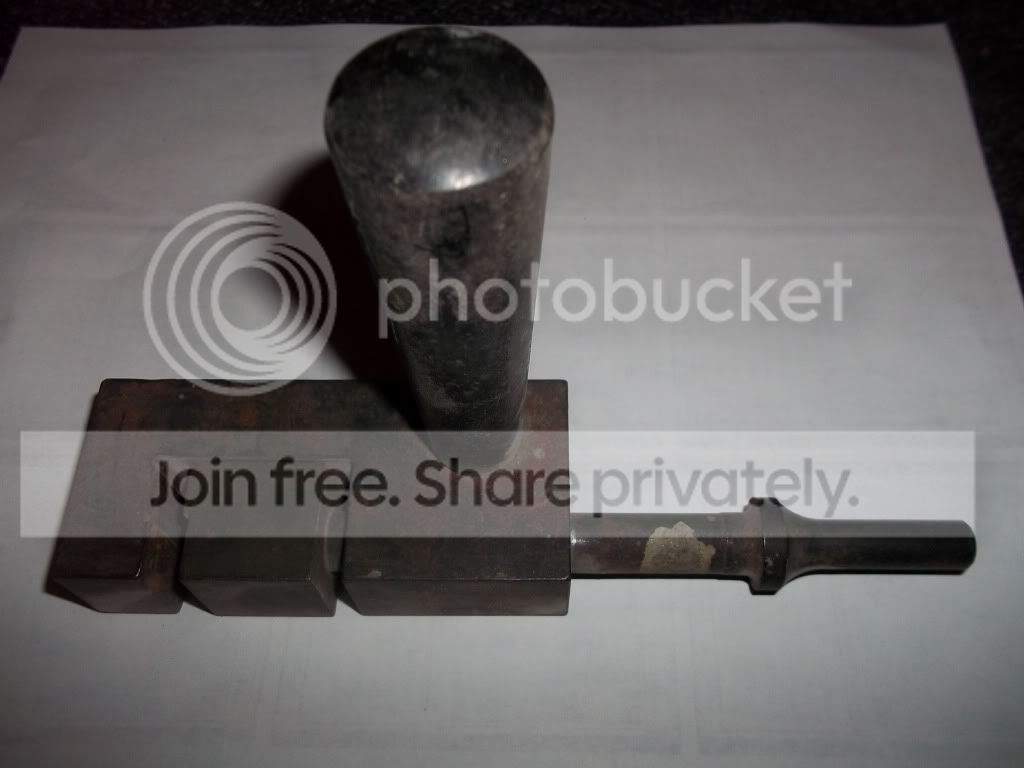
i actually own 2.. that one, and an older style that's actually an air hammer bit... it's snap on, not even sure if they make it any more... it's gotta be 20 yrs old..

it goes in an air hammer, then there's a handle off the side of the tool you hold.... it can be quite interesting to use! ;) there are occasions i prefer that one to the one i pictured above, but not often.... i'll have to dig it out of my box and snap a pic of it...
 
Ahhhh, i get it. Thanks man. So with those plug welds.. I dont even need to weld the entire panel? Just plug weld and use a sealant? I was picturing myself having the weld the entire peices after the spots.. Cool. Thank you!
 
it works well

stepping will also make it somewhat stronger. You can use the spot, but I'd still lap the edge- now you have more material as well to do it with.

Watch the fumes of the weld through primer- still nasty stuff, and switch to .23 wire.
 
Thank you ryoken!

I'm looking into getting my self a welder for Christmas so I can do my rockers and floors. I'm scared to pull the carpet up. I find this thread fascinating and informative, please continue.
 
Ahhhh, i get it. Thanks man. So with those plug welds.. I dont even need to weld the entire panel? Just plug weld and use a sealant? I was picturing myself having the weld the entire peices after the spots.. Cool. Thank you!


yes, you can just do the plug welds, just make sure to do a fair amount, every couple inches minimum.. on sheetmetal thickness, the plug hole doesn't need to be big... 1/4" is fine.. just start a puddle in the middle and work out in a circle motion till the puddle is catching the top piece...

the seamsealer is just to keep moisture out of the joint...
 
why .23 wire? Whats the difference? Sorry like i said im new :(

.023 is just thinner and is a bit easier for sheetmetal work, as it's a bit "daintier" of an arc... little more controllable and less likely to burn thru..

if it's relatively easy to set yourself up with, it's nice.. but not required... i just do everything with .030.. mainly cuz i'm too lazy to change my machine up...
 
I'm looking into getting my self a welder for Christmas so I can do my rockers and floors. I'm scared to pull the carpet up. I find this thread fascinating and informative, please continue.


the "rust bullet" thread has a ton of bodywork tech in it too in the garage...


btw, here's that other flange tool i mentioned...


5cfbe53f.jpg
 
I like the other one better. That seams (get it :haha:) a little too old school for me.
 
oh, it'll kick your arse if not careful.... :haha: but it was a fair amount cheaper too...
 
Ah yeah. I had some small 22ga metal i was practicing on and it was burning through easy. Right now Im using 16ga stuff and it seems to be doing just fine. Right now it came with .35 wire. I was thinking of doing the holes every 2 inches then. And the sealer.. Just inside after the weld, or should i get under the truck and get the bottom too? Gonna paint both sides of course..

Edit. Comparing it the sheetmetal i got from lmc, its 16ga.
 

Latest Posts

Top Bottom