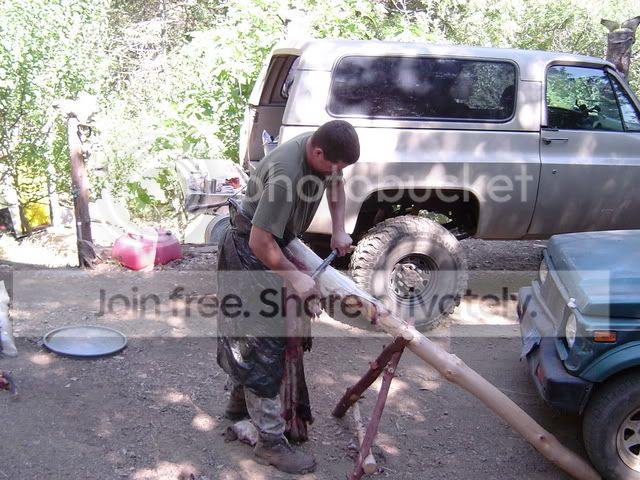
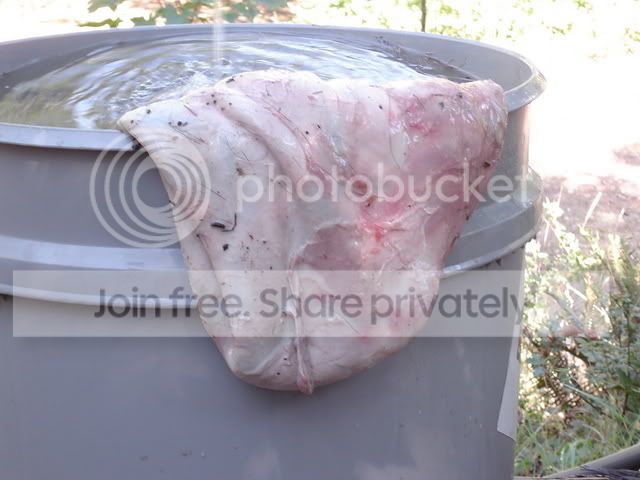
'Fumes asked for a writeup on how to make your nasty bloody, hairy, slimy deerskin into a beautiful, soft, supple buckskin. I do it the 'primitive' way, not with the chemicals that modern tanneries use. Cromate tanned skins are succeptible to rot and will start falling apart after a few years. Braintanned skins are extremely durable, soft, and can be washed without stiffening up when they dry. I learned from a book and it's companion DVD. The book is called 'Deerskins into Buckskins' by Matt Richards. The DVD goes by the same name. You can buy thenm together on Amazon. If you really intend to do a buckskin yourself, I HIGHLY recommend, at the least, the DVD. Matt shows you, from start to finish, how to braintan a buckskin. Definitely visit his site www.braintan.com and read up.
I had a deer hide frozen from two years ago, I had always wanted to brain tan a hide with the hair on, but everything I read about it made it seem to require a LOT of time and effort, and the results were not guaranteed. Later, I learned that a hair on deer hide is really only good for a wall hanging, deer hair is hollow and becomes brittle over time, eventually breaking and falling out if worn as a garment, or as a blanket or pillow covering. So it stayed in the freezer. Then based on other books I had ordered on Amazon, one day athey recommended that I might like "Deerskins Into Buckskins". The reviews on Amazon and elsewhere on the web were nothing short of excellent, so I bought it and the DVD. I put the DVD in and began thumbing throught the book. At every different step on the DVD, I was saying to myself, "That doen't look difficult at all". So I made myself a fleshing beam, and a scraper and pulled the hide out of the freezer to defrost.
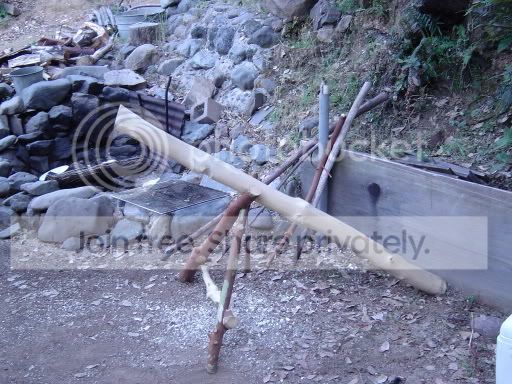
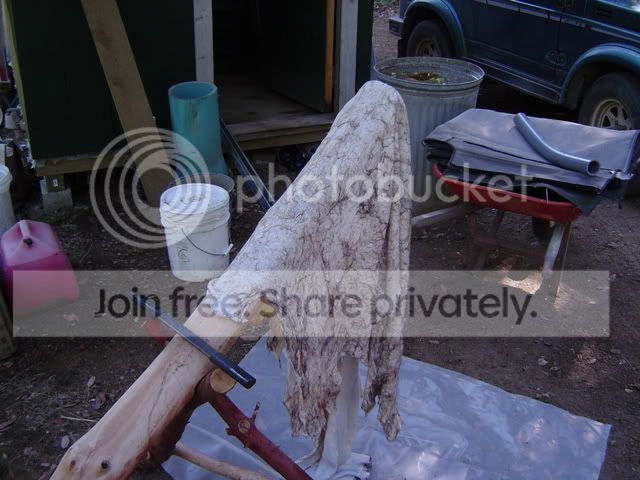
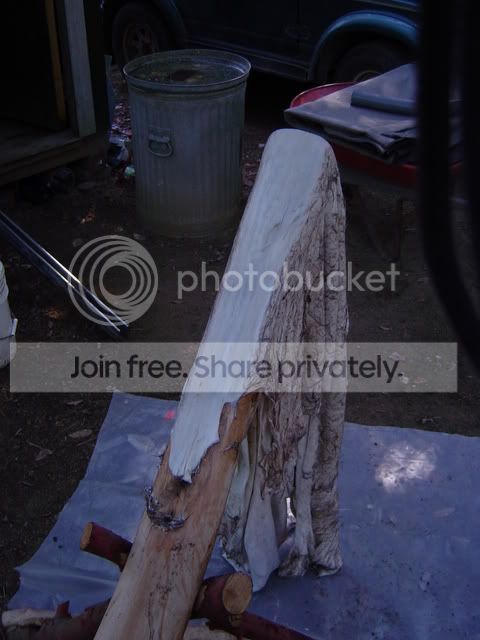
This is my fleshing beam, made out of Madrone. All you need is something round, 6-8 inches in diameter, propped up at one end to hit you right above the belt. The longer it is, the less steep the angle will be, and your back will thank you. I have a piece of 5" PVC in my backyard at home for a scraping beam, the PVC works REALLY well.
You will need to make a scraper, or buy one. If you live near a lumber mill, and can get a used planer blade, the kind they use to make 2 x 12"s, that's the ticket, but anything with an edge will do, even a piece of 1/4" by 1 1/2" flat bar. It's 90* edge is just fine. Make sure the edge is distinct but not SHARP. If you use a planer blade, you'll need to dull it with a few passes of a sharpening stone. A tip I have read is, if it's sharp enough to nick your thumbnail, it's too sharp. Put some comfy handles on it, you will need them. My scraper is 14" pice of 1" half round stock. I ground an edge perpidicular to the flat side, and then dulled the very edge with a sharpening stone. The scraper is used to separate the layers of skin where there is a natural separation, there should be no cutting into the skin at all.
Now, you got your tools, lets get started. I am assuming that you have a fresh deerskin in hand. You need to remove all the flesh from the hide Put it on the beam, hair side down, and use the scraper to 'bulldoze' the flesh off the hide, get all the muscle and fat off. This step is pretty easy, and will get you ready for the real scraping you'll have to do later when you remove the hair and top layer of skin from the other side. So, get allthat flesh and fat off. Here's a photo of a hide midway through the process:
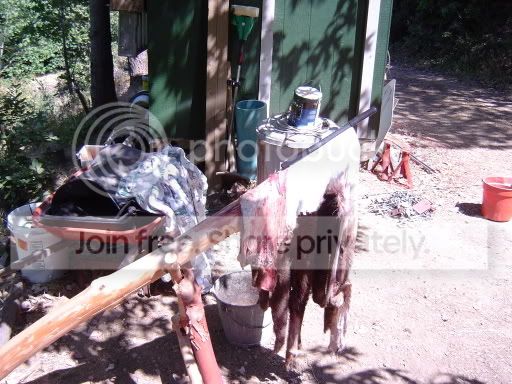
You can see my scraper settin on the end of the beam, not a very good picture, but there it is.
If you need to store your hide for whatever reason before you can get around to tanning it, here's what to do. You can freeze it, lay the hide out on the ground, flesh side up, and fold it over, flesh to flesh, then fold or roll it upinto a neat package, put it in a plastic trash bag, get the air out, and seal up the bag, then pop it into the freezer indefinitely. The other method is to 'wet-salt' it. It is best to flesh it first, get the fat and flesh off as I have heard that the fat can 'burn' a wet salted hide, resulting in holes and weak spots. Anyhow, lay the fleshed hide out on the ground, flesh side up, then pour a couple of handfulls of salt into the middle of it. Now use your hands to push the salt all the way out to the edges. Make sure you go ALL the way to the edges, ALL around, leave no skin exposed. Then fold flesh side to flesh side, and make a neat package and put it in a plastic bag and loosely seal it. After a week, pour off the liquid that has accumulated and then seal it up tight. A five gallon bucket with a tight fitting lid is perfect. It will store for over a year like this. When you are ready to tan it, take it out and soak it in plain water for a day or so to rinse off the salt, then proceed as usual. What you DON'T want to do is salt your hide and then let it dry, as it will never rehydrate to the way it was when it was fresh, and tanning will be considerablt harder.
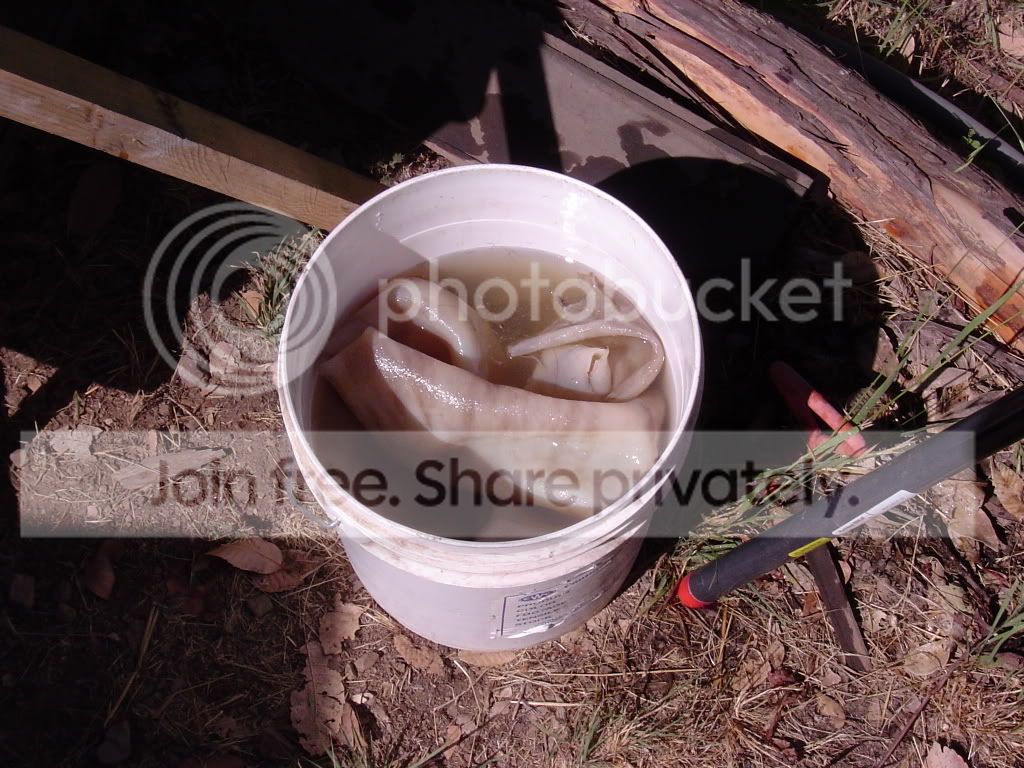
After you have it fleshed, the next step is 'Bucking'. We are going to soak it in a lye solution to loosen the mucous that is trapped in the skin. There are a whole bunch of hows and whys to this process, but I won't get into it. (Get the book) Soaking in the lye solution will also swell the 'grain' which is the next layer of skin we will scrape off. I mix a 1/4 Cup of KOH (Potassium Hydroxide) with 5 gallons of water, mix it up well, and put my fleshed hide in. Let it soak for 3 to 5 days, up to ten days.
In primitive and pioneer times, a soultion of hardwood ash and water was used. Wood ask contains KOH, and I used it on my first hide, and it worked really well, but the hide might stain from the ash. To test for the proper ph, a fresh egg was put into the solution. If it floated with an area the size of a quarter to a fifty cent piece above the surface of the solution it was good to go. Specific gravity and whatnot, smart fokkin' pioneers...
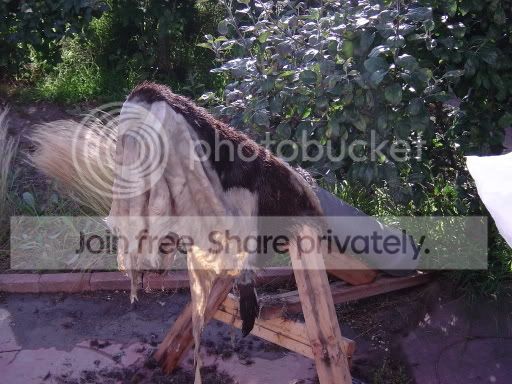
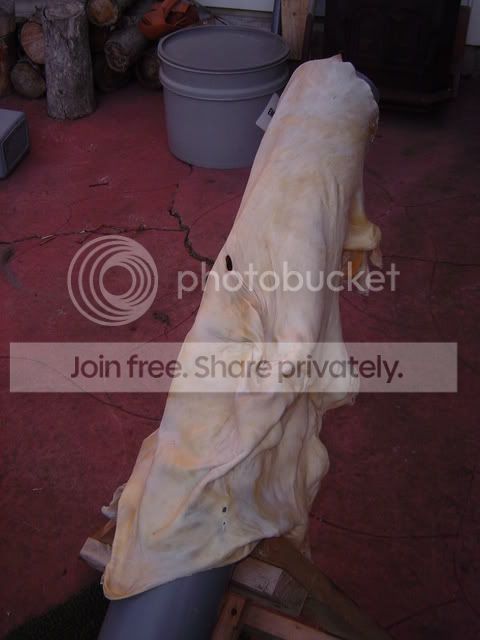
We are ready to move to the next step when the whole hide takes on a swollen, tawny appearance. Put that fokker on the beam, hair side up, and scrape down, through the hair and the top layer of skin, which is the grain layer. You are looking to remove all the grain. This is the hardest step to get right, and very hard to explain. It's best to watch the DVD or have someone there telling you, "this is grain, this is not." Luckily, after bucking, the grain is swollen and is easier to distinguish from the part of the skin we want to keep. Dont worry about goung too hard with the scraper. If it is properly un-sharpened, it will not cut the hide, no matter how hard you scrape (except the thin parts around the groin and armpits, go with a little less gusto in these areas.) Try and scrape in the direction the hair grows, or sideways to it. If you scrape against the hair, it will cut off instad of pull out, leaving roots in your hide. The neck is really tough to grain, and you will have to scrape against the hair in one or two spots, c'est la vie. Heres a pic of a partially grained hide on my PVC beam in my backyard (my neighbors probably think I'm nuts):
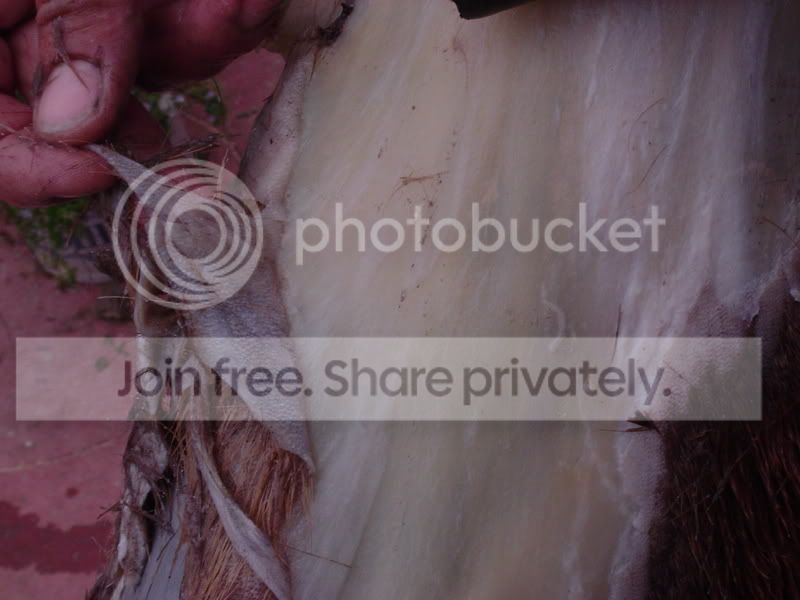
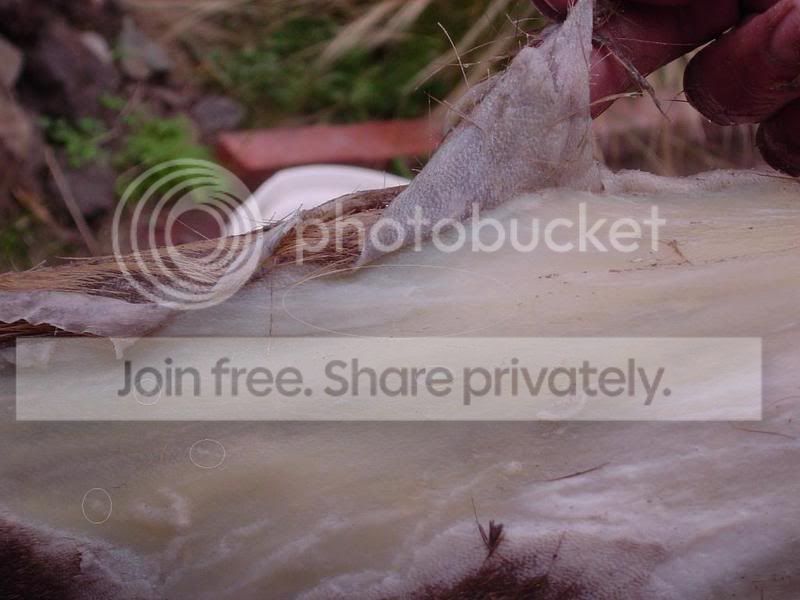
Here's a good pic of the grain. You can also see a few little spots of grain I missed, and will go over with the scraper. Generally I'll grain a patch about 4" wide or so, and however long (12-18") then I'll go over the spot pretty vigorously with the scraper to get all those little patches that escaped. This is an elk hide, which turned out to be quite a bit harder to grain than the blacktail hides I've been doing.
I had a deer hide frozen from two years ago, I had always wanted to brain tan a hide with the hair on, but everything I read about it made it seem to require a LOT of time and effort, and the results were not guaranteed. Later, I learned that a hair on deer hide is really only good for a wall hanging, deer hair is hollow and becomes brittle over time, eventually breaking and falling out if worn as a garment, or as a blanket or pillow covering. So it stayed in the freezer. Then based on other books I had ordered on Amazon, one day athey recommended that I might like "Deerskins Into Buckskins". The reviews on Amazon and elsewhere on the web were nothing short of excellent, so I bought it and the DVD. I put the DVD in and began thumbing throught the book. At every different step on the DVD, I was saying to myself, "That doen't look difficult at all". So I made myself a fleshing beam, and a scraper and pulled the hide out of the freezer to defrost.
This is my fleshing beam, made out of Madrone. All you need is something round, 6-8 inches in diameter, propped up at one end to hit you right above the belt. The longer it is, the less steep the angle will be, and your back will thank you. I have a piece of 5" PVC in my backyard at home for a scraping beam, the PVC works REALLY well.
You will need to make a scraper, or buy one. If you live near a lumber mill, and can get a used planer blade, the kind they use to make 2 x 12"s, that's the ticket, but anything with an edge will do, even a piece of 1/4" by 1 1/2" flat bar. It's 90* edge is just fine. Make sure the edge is distinct but not SHARP. If you use a planer blade, you'll need to dull it with a few passes of a sharpening stone. A tip I have read is, if it's sharp enough to nick your thumbnail, it's too sharp. Put some comfy handles on it, you will need them. My scraper is 14" pice of 1" half round stock. I ground an edge perpidicular to the flat side, and then dulled the very edge with a sharpening stone. The scraper is used to separate the layers of skin where there is a natural separation, there should be no cutting into the skin at all.
Now, you got your tools, lets get started. I am assuming that you have a fresh deerskin in hand. You need to remove all the flesh from the hide Put it on the beam, hair side down, and use the scraper to 'bulldoze' the flesh off the hide, get all the muscle and fat off. This step is pretty easy, and will get you ready for the real scraping you'll have to do later when you remove the hair and top layer of skin from the other side. So, get allthat flesh and fat off. Here's a photo of a hide midway through the process:
You can see my scraper settin on the end of the beam, not a very good picture, but there it is.
If you need to store your hide for whatever reason before you can get around to tanning it, here's what to do. You can freeze it, lay the hide out on the ground, flesh side up, and fold it over, flesh to flesh, then fold or roll it upinto a neat package, put it in a plastic trash bag, get the air out, and seal up the bag, then pop it into the freezer indefinitely. The other method is to 'wet-salt' it. It is best to flesh it first, get the fat and flesh off as I have heard that the fat can 'burn' a wet salted hide, resulting in holes and weak spots. Anyhow, lay the fleshed hide out on the ground, flesh side up, then pour a couple of handfulls of salt into the middle of it. Now use your hands to push the salt all the way out to the edges. Make sure you go ALL the way to the edges, ALL around, leave no skin exposed. Then fold flesh side to flesh side, and make a neat package and put it in a plastic bag and loosely seal it. After a week, pour off the liquid that has accumulated and then seal it up tight. A five gallon bucket with a tight fitting lid is perfect. It will store for over a year like this. When you are ready to tan it, take it out and soak it in plain water for a day or so to rinse off the salt, then proceed as usual. What you DON'T want to do is salt your hide and then let it dry, as it will never rehydrate to the way it was when it was fresh, and tanning will be considerablt harder.
After you have it fleshed, the next step is 'Bucking'. We are going to soak it in a lye solution to loosen the mucous that is trapped in the skin. There are a whole bunch of hows and whys to this process, but I won't get into it. (Get the book) Soaking in the lye solution will also swell the 'grain' which is the next layer of skin we will scrape off. I mix a 1/4 Cup of KOH (Potassium Hydroxide) with 5 gallons of water, mix it up well, and put my fleshed hide in. Let it soak for 3 to 5 days, up to ten days.
In primitive and pioneer times, a soultion of hardwood ash and water was used. Wood ask contains KOH, and I used it on my first hide, and it worked really well, but the hide might stain from the ash. To test for the proper ph, a fresh egg was put into the solution. If it floated with an area the size of a quarter to a fifty cent piece above the surface of the solution it was good to go. Specific gravity and whatnot, smart fokkin' pioneers...
We are ready to move to the next step when the whole hide takes on a swollen, tawny appearance. Put that fokker on the beam, hair side up, and scrape down, through the hair and the top layer of skin, which is the grain layer. You are looking to remove all the grain. This is the hardest step to get right, and very hard to explain. It's best to watch the DVD or have someone there telling you, "this is grain, this is not." Luckily, after bucking, the grain is swollen and is easier to distinguish from the part of the skin we want to keep. Dont worry about goung too hard with the scraper. If it is properly un-sharpened, it will not cut the hide, no matter how hard you scrape (except the thin parts around the groin and armpits, go with a little less gusto in these areas.) Try and scrape in the direction the hair grows, or sideways to it. If you scrape against the hair, it will cut off instad of pull out, leaving roots in your hide. The neck is really tough to grain, and you will have to scrape against the hair in one or two spots, c'est la vie. Heres a pic of a partially grained hide on my PVC beam in my backyard (my neighbors probably think I'm nuts):
Here's a good pic of the grain. You can also see a few little spots of grain I missed, and will go over with the scraper. Generally I'll grain a patch about 4" wide or so, and however long (12-18") then I'll go over the spot pretty vigorously with the scraper to get all those little patches that escaped. This is an elk hide, which turned out to be quite a bit harder to grain than the blacktail hides I've been doing.
Last edited:
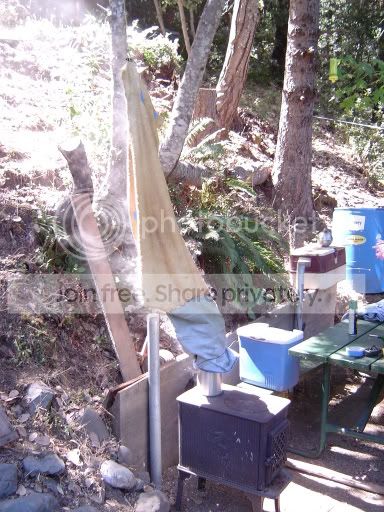
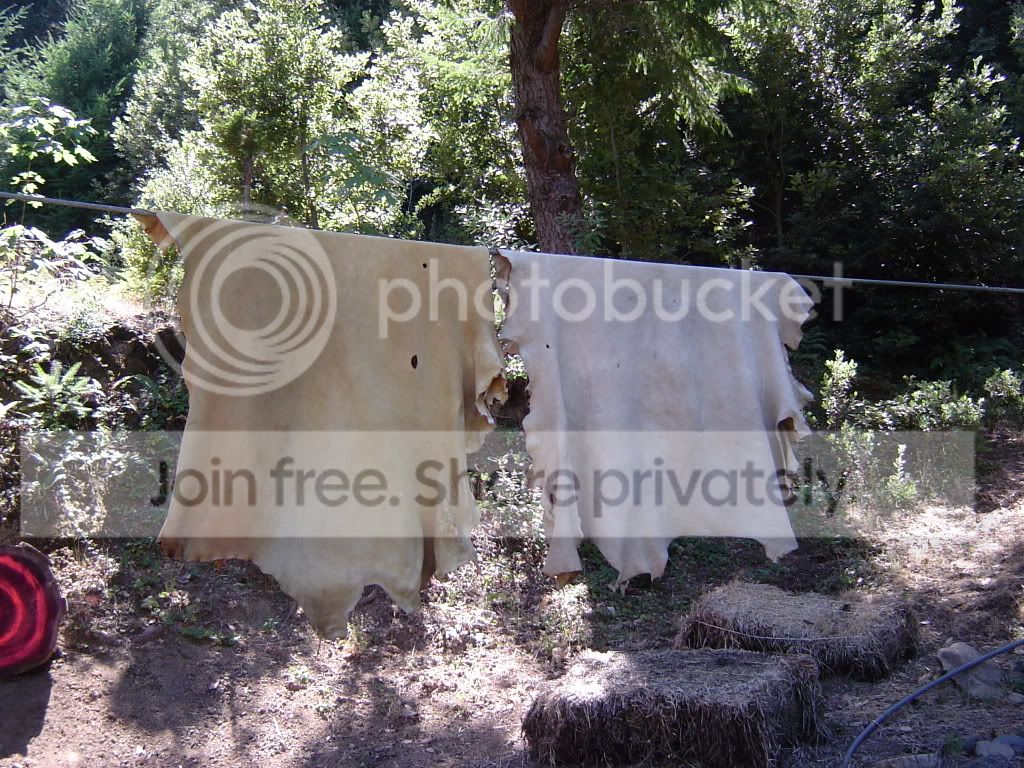


 Sometimes the hides from the high country weigh over 100 lbs! Anymore than 5 miles from a road, and you just gotta bone them out and pack the meat. Seems like a waste to always leave those hides there like that, I'll bring one home one of these days.