CK5
Register an account today to become a member! Once signed in, you'll be able to participate on this site by adding your own topics and posts, as well as connect with other members.

brake bleeder not holding vacuum

Rugby_7

1/2 ton status
GMOTM Winner
Joined
Oct 22, 2013
Posts
799
Reaction score
758
Location
Glenwood Springs, CO
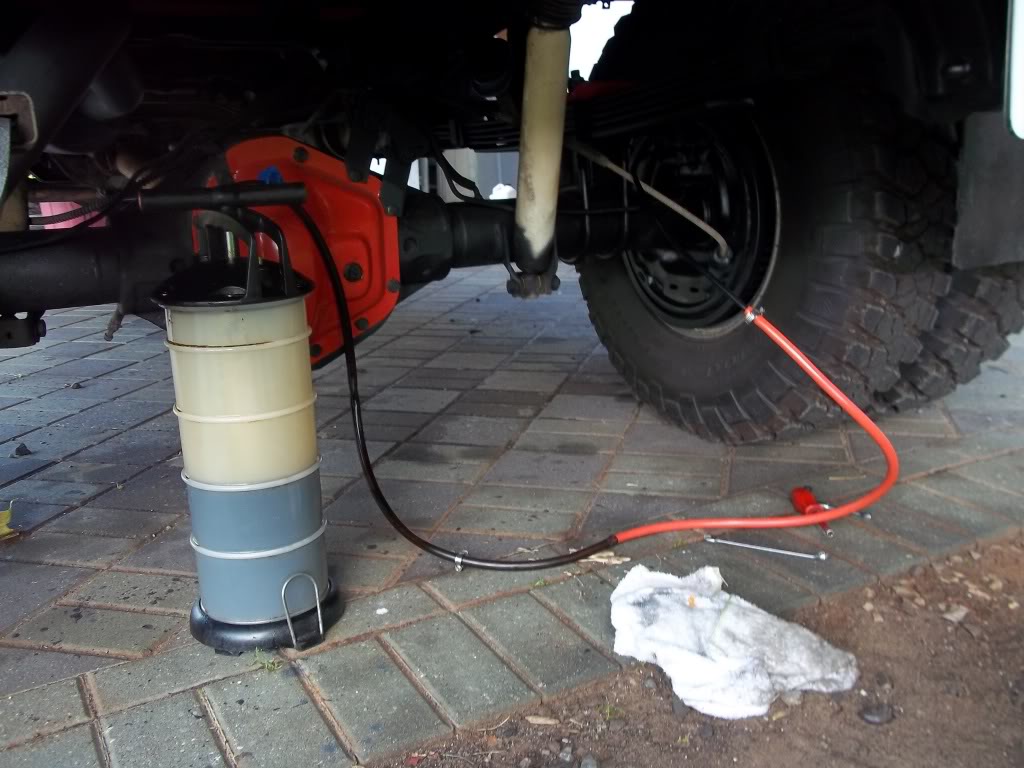
So I'm stumped on this one. The brake bleeder is not holding vacuum with my vacuum bleeder on one of my calipers when closed. The other three were fine, all held vacuum when the bleeder was closed, so its not the vacuum bleeder. Tried replacing the bleeder, didn't work. Tried different size bleeders, didn't work. Tried new brass bushings and brake line bolt, didn't work. Finally bought new caliper, same results.

The k5 has all new lines, master cylinder, booster, rotors, calipers, brakes, etc. It is the rear passenger on a disc brake swapped 14 bolt.

Could it be just bad luck and a second defective caliper?
 
Change brands/source of caliper. Had three right sides that leaked at piston,switched and no leak.
 
Look closely at the taper of the bleeder and the taper of the seat in the caliper
 
you are saying it wont hold a vacuum draw ?

if so the bleeder is not ment to hold vac . its tapered seat is for closing off pressure . when you open the bleeder its job is to let fluid pass out and thats it . if one hold vac then thats a bonus for that style of bleeding job your trying to do .

the bleeder has the seat at the bottom NOT the threads job to seal off .
 
you are saying it wont hold a vacuum draw ?

if so the bleeder is not ment to hold vac . its tapered seat is for closing off pressure . when you open the bleeder its job is to let fluid pass out and thats it . if one hold vac then thats a bonus for that style of bleeding job your trying to do .

the bleeder has the seat at the bottom NOT the threads job to seal off .

I have to agree here. Does it leak fluid when closed and you stand on the pedal? If not, You're done. Go wheelin.
 
I heard that the trick is to put a little anti-seize on the threads to help seal them. Doesn't hurt to keep them free as well, IMO..
 
I heard that the trick is to put a little anti-seize on the threads to help seal them. Doesn't hurt to keep them free as well, IMO..
to keep brake bleader screws from rusting tight its super simple . . . . put the rubber cap on the tip . . . . keeps water out that rusts them solid from the bottom up .

98% of bleaders i have played with up here in the rust belt with the rubber cap on them pop right loose no problems.
 
With the bleeder closed I can't hold vacuum. So it isn't getting enough pressure to draw out air for when I open up the bleeder.
 
you are saying it wont hold a vacuum draw ?

if so the bleeder is not ment to hold vac . its tapered seat is for closing off pressure . when you open the bleeder its job is to let fluid pass out and thats it . if one hold vac then thats a bonus for that style of bleeding job your trying to do .

the bleeder has the seat at the bottom NOT the threads job to seal off .


If he is trying to pull a vacuum on the bleeder screw with it closed--air can still sneak past the threads ,as noted above--the tapered seat where it seals against the caliper is lower than the hole in the side of the bleeder screw..

I've had good luck getting bleeder screws loose if they still had the rubber cap on them--others without then usually snap off when you go to loosen them..I put anti-seize or teflon tape on the threads and some grease inside the bleeder screws hole too,if I do not have any of the caps for them...a piece of vacuum hose with a screw in one end can be used as a cap..
 
So it could be still sealing the lines while the bleeder is closed but letting air in outside of the brake system? Would the best way to bleed be the two man method for this scenario?
 
i have no fuggin clue what the problem is here..... confuddled... if the bleeder is closed, how does vacuum have anything to do with anything? i vac bleed my brakes every time........ as mentioned if you are trying to vac bleed, take em out, put grease on em, reinstall, and put vac to it and crack em... if that isn't what your talking about, i have no idea what your asking..
 
Prior to opening the bleeders I can't get it to hold enough pressure for the vacuum bleeder to draw air/fluid out when I crack open the bleeders. It's sucking air as fast as I can pump it.
 
;)


full
 
Probably--but if you have no one around to help (or they fail to grasp the proper procedure--pump it up,"hold it down","UP.etc ),it can be frustrating to do with 2 people..they goof up once and air gets pulled back in and you have to start all over..

I bleed brakes alone by using engine vacuum ,all you need is a long enough hose with a 3/16" I.D. to reach all 4 wheels,another piece a few feet long to hook to an engine manifold vacuum source, and a glass or thick plastic jar with a metal screw on lid,and 2 short pieces of brake tubing 3/16" diameter..clear vinyl hose is cheap and perfect for this application..

You poke 2 holes in the metal jar lid,stick the 2 pieces of brake tubing thru it--one goes right to the bottom of the jar,the other one you only want to just go thru the lid about 1"...you can use glue,J-B Weld or solder to secure the tubing in the lid and make it air tight...add enough brake fluid to the jar to cover the longer tube ,you only need an inch at most..just to keep air from being able to sneak back the other way..

You then hook the shortest tube to engine vacuum,and the longer hose to your brake bleeder--I used vise grips on the hose from the bleeder as an on-off valve..hook up the long hose to the bleeder,start the engine,open the vise grips,and watch the fluid get sucked into the jar..when you see no more bubbles coming out of the hose on the bleeder,close the bleeder,pinch the hose off with the vice grips,and move on to the next bleeder..

In a pinch you can bleed brakes this way without the jar--all you need is the long hose and vise grips--you risk sucking some brake fluid into the engine this way if you leave vacuum on it too long,but it wont hurt it any,it'll just make smoke,possibly foul a plug,but if you watch the fluid in the hose you can stop it from ever reaching the engine--takes quite a bit of fluid to fill that length of hose..

This method has worked to bleed stubborn clutch master and slave cylinders too....only bummer is it wont work on my diesel pickup--no vacuum on a diesel engine,and the vacuum pump on it is not suitable to use for this process ..
 
Prior to opening the bleeders I can't get it to hold enough pressure for the vacuum bleeder to draw air/fluid out when I crack open the bleeders. It's sucking air as fast as I can pump it.


well, than you need to clamp the hose to the ball, or wire tie it.... put grease on the bleeder, and just crack it, not 2 turns. if there's nothing wrong with the system, gravity bleed it... fill mc, leave open, open bleeder, and come back in an hr, I guarantee you'll have a puddle....
 
Top Bottom