CK5
Register an account today to become a member! Once signed in, you'll be able to participate on this site by adding your own topics and posts, as well as connect with other members.

Broken winch rope.

1-tonmudder

1/2 ton status
Joined
Apr 24, 2005
Posts
3,052
Reaction score
0
Location
In a junkyard somewhere
So a couple of weeks ago we went to Harlan KY for the fall crawl. On the last trail of the day I had to winch out of the end of it and a solinoid on my winch stuck and it kept pullin in even after I was up against the bank.The rope broke about six feet from the end.I was still in the truck holdin the brake and they had the hood up tryin to get the battery cable loose so I didnt see exactly what happened.I dont know if it was cut in 1/2 on a rock or if it just pulled in half.So has anybody had one relaced/repaired and if so who done it??? The rope is about 5 years old and I cant remember what brand it was,it might just need replaced.
 
They can be braided together or you can braid an eye back into it. I would braid a new eye, Since you only broke off a couple of feet. It is an art to it though. My Lt on the Fire Dept. is supposed to teach me how before long.

I did the same thing last year. I added a master switch inline from the battery so I could kill the power to the winch in a hurry.
 
is it a rope or the cable? just to make sure we're all on same page.
either way make sure you take your time with it, or have someone else do it. given that situation i'd probably just end up buying a new one. not the kind of thing you want projectiling if you dont do it correctly.
 
It's synthetic rope.I still have the steel cable that came off it,just really dont wanna go back to cable and cant really afford a replacement right now.I'm gonna put a switch on mine also.The hell of it all is I put four new solinoids on it and this was only the fourth time the winch had been used.
 
From Stu offroad


Trail Fix for Synthetic Winch Line


Things usually go wrong at the least convenient time....or so it seems. You can prep your Jeep as much as you want but sometimes things will break on the trail. Nothing is bullet proof and everything can break. It may have nothing to do with a missed maintenance schedule....but it may have everything to do with poor inspection practices. Or....it could be that you didn't heed the advice about making sure your winch plate opening didn't have any sharp edges on it.
Whatever the reason, this write-up runs through a repair scenario for your winch line. Jon, owner of Winchline.com, did a number of these repairs at the WERock event in Globe, Arizona this past month. He did a few on the TXT Racing vehicles and spent some time showing me how it is done. I've done one since then and it worked just like it was suppose to.​
Note: This technique is for Amsteel Blue 12 strand line, which is used for making Viking winch line.
trailfix-1.jpg
So.....the line has failed near the end where your winch hook is attached. It looks pretty ratty at this point and reattaching the thimble and hook at this point wouldn't be a good choice. You will have to go back down the line until you get to a point where the line is in better condition.​

trailfix-2.jpg
Work your way back from the end of the line until the line quality is looking better. Cut the line at this point and discard the cut off portion.​

trailfix-3.jpg
A metal blunt pointed fid is used to splice the line. For 3/8" line, it is about 8" long. If you don't have a fid with you, a BIC ball point pen will work as a suitable substitute....most are about 2" shorter than the fid so keep this in mind if you use it for making your measurements. Measure back one fid length from the end of the freshly cut line and mark it with a Sharpie marker.
trailfix-4.jpg
At the mark you just made, mark three pairs of strands in the line, as shown above. Once, marked, you will cut them and then pull them out of the line. The point in doing this is so that the end of the line becomes tapered for its insertion into the line in the following steps.
trailfix-5.jpg
OK....you have them marked so let's get going. Using a sharp scissors, snip each of the 6 strands and pull them out of the line. To clarify, you are pulling 6 strands, each one about 8" long, out of the rope.


trailfix-6.jpg
Using the fid as a measure stick, measure 3 fid lengths from the end of the line and again put a mark on the line using a Sharpie marker or piece of electrical tape (our marker died so we started using tape). We'll call this mark #2 (for future reference).
trailfix-7.jpg
It is time to attach the loose end of the rope to the end of the fid. We used some electrical tape although duct tape (everyone has that in their Jeep, right?) would work just as well. This would be the equivalent of "threading a needle" except that the rope is a bit too big to thread into the fid so we'll tape it to the end which will be just as good.
trailfix-8.jpg
If you intend to use an abrasion guard at the very end of the winch line, now would be the time to thread it onto the rope before you thread the rope through the thimble eye. It may be necessary to put a couple of snips (using the scissors) at the end of the guard in order to get it to over the rope....it can be a very snug fit.
trailfix-10.jpg
Thread the fid through the thimble eye and back out the other side of the eye. The thimble eye shown in here is a tube type and provides better winch line protection than a regular thimble eye.
trailfix-11.jpg
Pull the line through the eye until mark #2 (electrical tape we put on earlier) just comes out of the eye. The end of the line (about 3 fid lengths long) will now be threaded down the center of the rope.


trailfix-12.jpg
Push the end of the fid between the strands of the rope and start it down the center of the winch line. You are now going towards the winch, so to speak. If you bunch of the winch line a bit, it is easier to get the fid to find its way down the middle of the winch line. Take your time as you fish the fid through the center of the winch line. You don't want the fid's point to "pop out" between the strands.....keep it totally within the center of the winch line.
trailfix-13.jpg
Work the fid down center of the winch line while you slide the winch line along the newly inserted rope. Having an extra hand or two, while not necessary, can come in handy.
trailfix-14.jpg
Continue to smooth the outer line over the newly inserted piece until all of the line has been ran down the center of the winch line. You should be able to see the #2 mark just buried at the point where it goes into the main line. Push the fid out of the side of winch line, remove the tape, and then smooth everything back into place. The end of your line, where it attaches to the thimble, will be a little "fatter" for 3 fid lengths. This stuff works like the old "Chinese finger pull". The winch line, when put under tension, squeezes down onto the inner line and grips it firmly in place.

trailfix-15.jpg
Since this was a trail fix, we didn't stitch the end of the line together, which Samson requires for the Amsteel Blue rope. Their web site shows how to stitch the line (easy enough to do).
 
Solenoids usually weld for one of three reasons.

Contamination: Not likely in your case since they were new. But if you get grease or oil on the contacts, sometimes it will cause them to arc and burn. Thus welding them together.

Or you might have gotten a bad one.....

Too much load: Also unlikely, since if you bought the right ones, they would be rated for the load.
Solenoids will carry more current after they are switched on then they will actually switch.
Its during the actual switching that they are prone to arc and weld. So, since a stalled motor draws more current than a running one, its possible that if you turned the winch back on while it was already under a heavy load, it might cause a problem.
But I have done that hundreds of times without a weld, so I'm going to call it unlikely as well.

Low actuation voltage. The stronger the actuation voltage and current applied to the coil, the faster and harder the contacts slam together.
When you are turning on hundreds of amps, you need a lot of surface area. Most solenoids have two copper contacts with a large copper disk that shorts them out.
Its sorta floating on the armature that pulls it against the contacts, and its not unusual for one part to touch before the whole disk.

If there is any delay in the rest of the disk coming on down and making contact, or if it is not pressed down really hard, you get arcs and welds.

If you have a long remote control wire, or if the control wire is fairly small, you might try measuring the voltage at the control contact with them pulled in.

If its less than battery voltage by a signifant amount, you need to check wiring.
Also, measure the voltage from the case of the solenoids to the battery ground terminal with them pulled in.
You should have 0 volts. If you see any amount over about a 1/2 volt, you have a bad ground somewhere.
 
From Stu offroad


Trail Fix for Synthetic Winch Line


Things usually go wrong at the least convenient time....or so it seems. You can prep your Jeep as much as you want but sometimes things will break on the trail. Nothing is bullet proof and everything can break. It may have nothing to do with a missed maintenance schedule....but it may have everything to do with poor inspection practices. Or....it could be that you didn't heed the advice about making sure your winch plate opening didn't have any sharp edges on it.
Whatever the reason, this write-up runs through a repair scenario for your winch line. Jon, owner of Winchline.com, did a number of these repairs at the WERock event in Globe, Arizona this past month. He did a few on the TXT Racing vehicles and spent some time showing me how it is done. I've done one since then and it worked just like it was suppose to.​
Note: This technique is for Amsteel Blue 12 strand line, which is used for making Viking winch line.
trailfix-1.jpg
So.....the line has failed near the end where your winch hook is attached. It looks pretty ratty at this point and reattaching the thimble and hook at this point wouldn't be a good choice. You will have to go back down the line until you get to a point where the line is in better condition.​

trailfix-2.jpg
Work your way back from the end of the line until the line quality is looking better. Cut the line at this point and discard the cut off portion.​

trailfix-3.jpg
A metal blunt pointed fid is used to splice the line. For 3/8" line, it is about 8" long. If you don't have a fid with you, a BIC ball point pen will work as a suitable substitute....most are about 2" shorter than the fid so keep this in mind if you use it for making your measurements. Measure back one fid length from the end of the freshly cut line and mark it with a Sharpie marker.
trailfix-4.jpg
At the mark you just made, mark three pairs of strands in the line, as shown above. Once, marked, you will cut them and then pull them out of the line. The point in doing this is so that the end of the line becomes tapered for its insertion into the line in the following steps.
trailfix-5.jpg
OK....you have them marked so let's get going. Using a sharp scissors, snip each of the 6 strands and pull them out of the line. To clarify, you are pulling 6 strands, each one about 8" long, out of the rope.


trailfix-6.jpg
Using the fid as a measure stick, measure 3 fid lengths from the end of the line and again put a mark on the line using a Sharpie marker or piece of electrical tape (our marker died so we started using tape). We'll call this mark #2 (for future reference).
trailfix-7.jpg
It is time to attach the loose end of the rope to the end of the fid. We used some electrical tape although duct tape (everyone has that in their Jeep, right?) would work just as well. This would be the equivalent of "threading a needle" except that the rope is a bit too big to thread into the fid so we'll tape it to the end which will be just as good.
trailfix-8.jpg
If you intend to use an abrasion guard at the very end of the winch line, now would be the time to thread it onto the rope before you thread the rope through the thimble eye. It may be necessary to put a couple of snips (using the scissors) at the end of the guard in order to get it to over the rope....it can be a very snug fit.
trailfix-10.jpg
Thread the fid through the thimble eye and back out the other side of the eye. The thimble eye shown in here is a tube type and provides better winch line protection than a regular thimble eye.
trailfix-11.jpg
Pull the line through the eye until mark #2 (electrical tape we put on earlier) just comes out of the eye. The end of the line (about 3 fid lengths long) will now be threaded down the center of the rope.


trailfix-12.jpg
Push the end of the fid between the strands of the rope and start it down the center of the winch line. You are now going towards the winch, so to speak. If you bunch of the winch line a bit, it is easier to get the fid to find its way down the middle of the winch line. Take your time as you fish the fid through the center of the winch line. You don't want the fid's point to "pop out" between the strands.....keep it totally within the center of the winch line.
trailfix-13.jpg
Work the fid down center of the winch line while you slide the winch line along the newly inserted rope. Having an extra hand or two, while not necessary, can come in handy.
trailfix-14.jpg
Continue to smooth the outer line over the newly inserted piece until all of the line has been ran down the center of the winch line. You should be able to see the #2 mark just buried at the point where it goes into the main line. Push the fid out of the side of winch line, remove the tape, and then smooth everything back into place. The end of your line, where it attaches to the thimble, will be a little "fatter" for 3 fid lengths. This stuff works like the old "Chinese finger pull". The winch line, when put under tension, squeezes down onto the inner line and grips it firmly in place.

trailfix-15.jpg
Since this was a trail fix, we didn't stitch the end of the line together, which Samson requires for the Amsteel Blue rope. Their web site shows how to stitch the line (easy enough to do).


Thanks for the info.That led me to this.
http://www.samsonrope.com/12-strand-class1-eyesplice.cfm
 
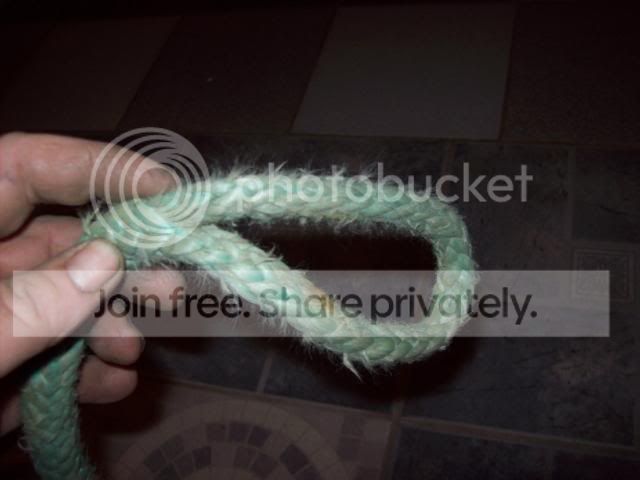
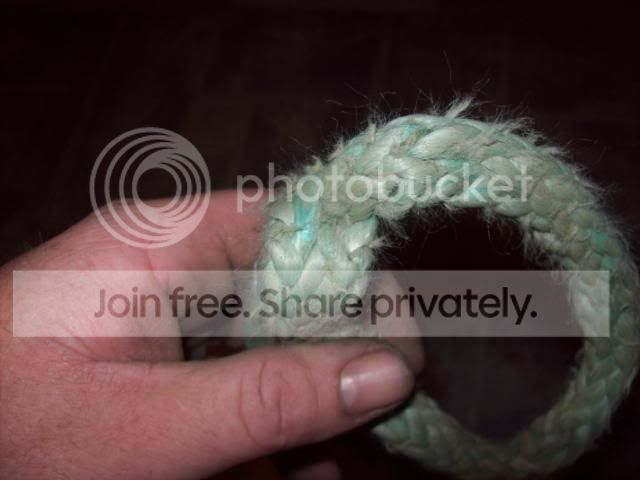
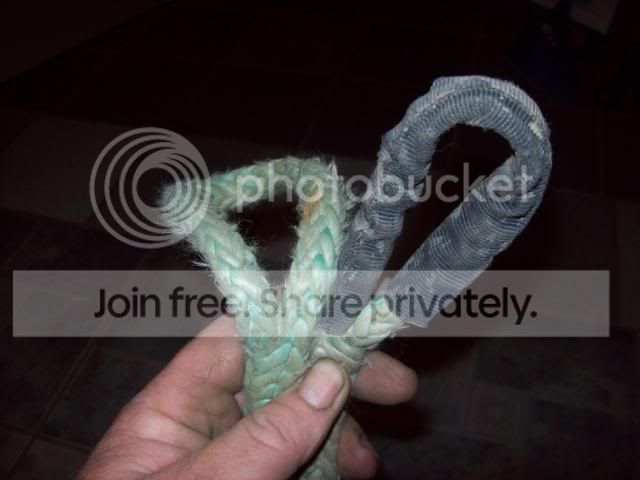
Ok so I went out and got the broken end of my winch rope after about 10-15 came up w this.
030.jpg

034.jpg

037.jpg


I did'nt do any measuring or marking since I was experimenting w the broken end but I did cut 1/2 the strands off,mine was 12 strand.I used a ink pen,does anybody where to get a fid at????
 
Certex or any industrial rope, sling, and wire rope dealer / distributor should have them available as well. We use this stuff at work all the time. The Certex in Birmingham also offers a "certification" class just for this type of thing (of course for heavier rope, but same process).
 
Top Bottom