CK5
Register an account today to become a member! Once signed in, you'll be able to participate on this site by adding your own topics and posts, as well as connect with other members.

Building a mobile York compressor **DONE! Final movie on post 45**

Avery4jc

1 ton status
GMOTM Winner
Joined
Oct 24, 2005
Posts
10,790
Reaction score
164
Location
Fresno, Ca.
Happy Thanksgiving everyone! :popcorn:

So I've been gathering parts knowing someday I wanted to put this together and it's time to make it happen.
I have a CO2 setup and it works ok but not great. I'm running the PolyPerformance fixed regulator and it doesn't flow that well and freezes up. It's fine for emergencies and when we're on the trail but for Pismo I want more.
I typically need to air up a lot of tires from very low pressure to 55-60psi so I needed something that could keep up and not have to stand there for 45 minutes waiting for CO2. They sell nice regulators for over $200 that would work better than what I have but so far I have zero out of pocket into this and I think it'd be cool so here we go.

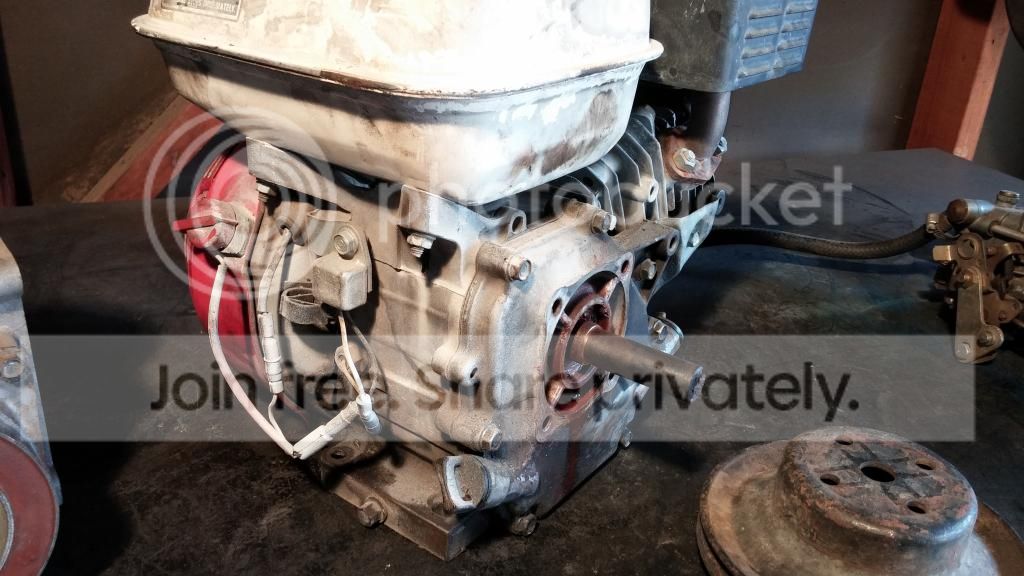
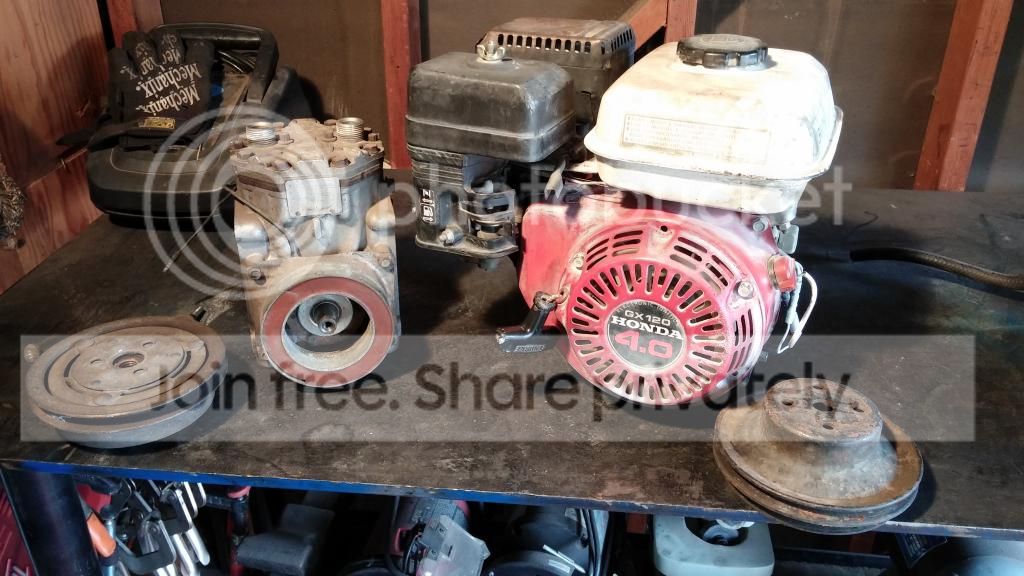
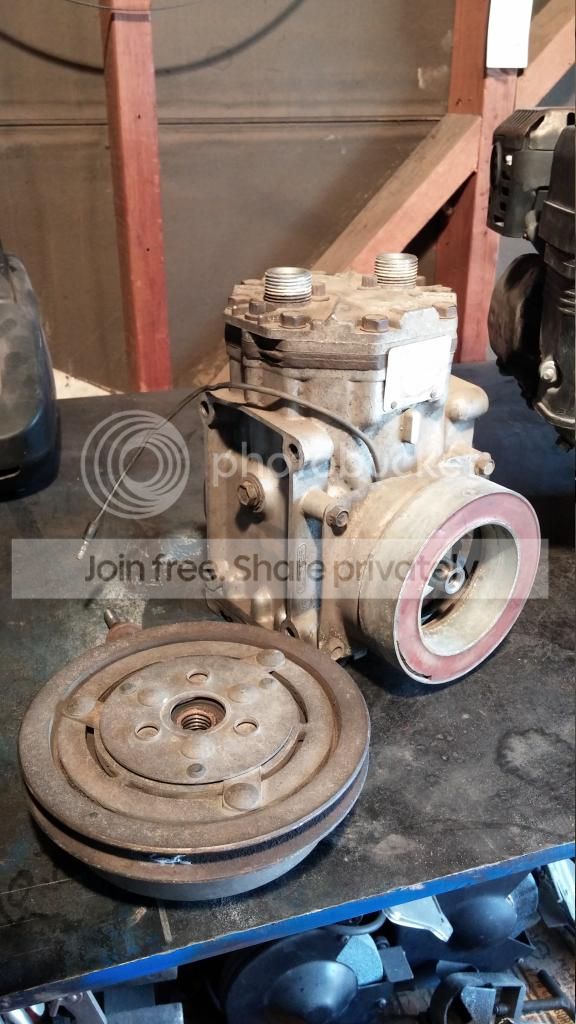
I have a York 210 (the big one) with clutch and a friend just gave me this little 4hp honda engine that runs like a champ.

So here's where the decision making comes into play. I can either buy a continuous run unloader valve which is what they run on gas powered compressors with no clutch. It has a check valve and unloader that would bleed off the output from the York when the high side pressure is reached and close the valve to continue filling when the low side pressure is reached. It's simple and would work great. About $50-60.

OR

I was thinking of utilizing the clutch that's already on the York but this would require a 12 volt source of some kind which means a little battery and a charging system. A simple pressure switch could engage and disengage the clutch. Does anyone know anything about the electronics on these little Honda engines? Is there a way to set it up to trickle charge a tiny ATV battery?

Pics of what I'm working with...

 
Last edited:
Mount a small altenator to run on the belt also?

Thought about that but the extra weight, cost and complexity killed it. At that point I'd just pony up the $60 or so on a continuous run unloader valve and not have any electronics involved. I was more trying to figure out if the existing ignition on the little Honda could somehow be setup to charge a tiny battery. I think I'm answering my own question here though. :)
 
Happy Thanksgiving everyone! :popcorn:

So I've been gathering parts knowing someday I wanted to put this together and it's time to make it happen.
I have a CO2 setup and it works ok but not great. I'm running the PolyPerformance fixed regulator and it doesn't flow that well and freezes up. It's fine for emergencies and when we're on the trail but for Pismo I want more.
I typically need to air up a lot of tires from very low pressure to 55-60psi so I needed something that could keep up and not have to stand there for 45 minutes waiting for CO2. They sell nice regulators for over $200 that would work better than what I have but so far I have zero out of pocket into this and I think it'd be cool so here we go.

I have a York 210 (the big one) with clutch and a friend just gave me this little 4hp honda engine that runs like a champ.

So here's where the decision making comes into play. I can either buy a continuous run unloader valve which is what they run on gas powered compressors with no clutch. It has a check valve and unloader that would bleed off the output from the York when the high side pressure is reached and close the valve to continue filling when the low side pressure is reached. It's simple and would work great. About $50-60.

OR

I was thinking of utilizing the clutch that's already on the York but this would require a 12 volt source of some kind which means a little battery and a charging system. A simple pressure switch could engage and disengage the clutch. Does anyone know anything about the electronics on these little Honda engines? Is there a way to set it up to trickle charge a tiny ATV battery?

Pics of what I'm working with...


You will need to activate the clutch regardless. Also keep in mind it doesn't require much to keep the clutch engaged.
 
I can think of 8 reasons.:D
Avery, will this thing be doing time on a trailer? I was just thinking if it was and the trailer had a winch w/ a batt....:dunno:
 
You will need to activate the clutch regardless. Also keep in mind it doesn't require much to keep the clutch engaged.

Why? If I go with the continuous running unloader valve I'll just machine a coupler and go crank to crank. Or if I used the belt and pulleys I could just tac weld the clutch on the York. Or am I missing your point?

What's the reason for not putting it under your hood?

I want it to be mobile and not stuck with one vehicle. Plus I really don't want to mount it on my Cummins. I've seen a write up of a guy who mounted one on his 3rd gen and it was a headache.

I can think of 8 reasons.:D
Avery, will this thing be doing time on a trailer? I was just thinking if it was and the trailer had a winch w/ a batt....:dunno:
I will have my trailer with me but it doesn't have a battery on board. I have long leads on my trailer winch that run all the way to the front of the truck when I use it.
 
There is probably a charging coil/stator available for those engines that were used on snowblowers & tractors that had electric start and headlamps..but buying the parts and converting it would not be cheap unless you find a used donor that has what you'd need on it..

I would add an alternator--your only talking another 5 lbs or so,they are not that big,you can use one off a import car if a GM one is too bulky,though those will not be as easy to hook up...you can use a small ATV/motorcycle battery to energize the field ,and re-charge the battery,and power the clutch on the compressor--it could also be used to boost your truck's battery too...

I put a 63 amp GM alternator on an old pressure washer engine,the pump on it froze and cracked,so my friend was going to scrap it--I simply removed the pump and put a pulley on the engine and mounted the alternator to the cart,so I can wheel it around--I have used it to boost the batteries in my diesel pickup when it refused to start on sub zero mornings,and I leave it in the bed when I go plowing ,just in case I need a "jump" ...

I tried using it full fielded as a welder too,it does work,but isn't powerful enough to weld anything much thicker than 16 gauge...but a 100+ amp one would,and would not weigh much more..probably need dual v-belts though,a single one slips and squeals when you try welding.
 
I have thought about doing something similar. I have a starter generator off a golf cart that is v belt driven. it would work great for that, and it would give you electric start.

know anyone with golf cart parts?
 
I built something like that on a cart using a 2HP lawnmower engine. Everybody said it wouldn't have enough oomph to turn the York, but it does with sufficient torque multiplication (small pulley on motor, large pulley on York, like gears in a differential.) I think even on your 4HP motor you'd want some multiplication, so no shaft-to-shaft.

On mine I did an alternator off a Honda at the pick-n-pull and a yard-garden U1 battery to run the electric clutch -- and yes, the little motor does spin them all. It is more work to build than a purely mechanical system as you discuss, and prolly slightly more cost. I'd go with the unloader valve and post pix and details when you're done!

BTW, I'm jealous, as having a compressor on the trailer that isn't reliant on the truck is epically useful. Clever!

-- A
 
If you put an alternator then you could use a power invertor for a makeshift generator if you want to run a grinder or something.
 
I'd go with the unloader valve and post pix and details when you're done!

The more we discuss all this the more I'm thinking that's still the best route. I can get it built, fire it up and make sure it functions like it should and then buy the unloader valve to make it work without having to babysit it.

what size tank are you looking at?

Well I have a 5 gallon I'm not using and I have (4) 2.5 gallon tanks plumbed together already on my Dodge. I've also heard with enough rpm guys use these things tankless for just filling tires which is all I'm building it for.

I thought about building it tankless with quick connects in the bed of my dodge to use the tanks already mounted under the truck. Most of the time I'll be using it right there by the truck but if a situation came up where I wanted to take it somewhere else I could. I could also mount the 5 gallon tank in the toolbox of my trailer and do the same thing.

Then since it's me and I like to try new stuff that usually ends up backfiring I've also thought about making the square tube frame and "carry handle" I'm envisioning all this being mounted to out of tubing and use that as the tank.

If you put an alternator then you could use a power invertor for a makeshift generator if you want to run a grinder or something.

True, but I'm really just wanting fast compressed air out of this setup. Small, simple and as compact as possible. It really only needs to serve one purpose for me and that's filling up tires at the dunes.
 
I built something like that on a cart using a 2HP lawnmower engine. Everybody said it wouldn't have enough oomph to turn the York, but it does with sufficient torque multiplication (small pulley on motor, large pulley on York, like gears in a differential.) I think even on your 4HP motor you'd want some multiplication, so no shaft-to-shaft.

Hmmm, I was trying to get away with a 1:1 ratio. I looked up the specs and they recommend running this engine between 2-3,600 rpm and peak HP is right about 3,000rpm.
I've read these yorks are good up to about 6,000rpm so if I could get it to 3,000rpm I figured it would be happy and have decent output.

I can set them up side by side on their mount and utilize pulleys and a belt so if 1:1 works, cool. If not then I can just swap pulleys until it's happy and not have to re-design the whole thing.
 
If you put an alternator then you could use a power invertor for a makeshift generator if you want to run a grinder or something.

It's possible to full field the alternator and get 110V DC from it,which will run most tools with universal motors (with brushes) and lights,and some other things,all by itself...the inverter allows AC only things to be used too though,which is nice if you want to recharge a cell phone,run a computer,etc..
 
Hmmm, I was trying to get away with a 1:1 ratio. I looked up the specs and they recommend running this engine between 2-3,600 rpm and peak HP is right about 3,000rpm.
I've read these yorks are good up to about 6,000rpm so if I could get it to 3,000rpm I figured it would be happy and have decent output.

I can set them up side by side on their mount and utilize pulleys and a belt so if 1:1 works, cool. If not then I can just swap pulleys until it's happy and not have to re-design the whole thing.

Well, I'm no small-engine expert and I'm guessing as I don't know the minimum HP requirement to turn the York. I do recall that my little motor takes a while to warm up, so I had to feather the throttle while it warmed up and only then could I engage the York clutch.

You might want to keep some sort of clutch, whether electric or mechanical, for that reason. :dunno:

Anyway, just thinking out loud and trying to be helpful. You get to decide whether it is or not :haha:

-- A
 
Hmmm, I was trying to get away with a 1:1 ratio. I looked up the specs and they recommend running this engine between 2-3,600 rpm and peak HP is right about 3,000rpm.
I've read these yorks are good up to about 6,000rpm so if I could get it to 3,000rpm I figured it would be happy and have decent output.

I can set them up side by side on their mount and utilize pulleys and a belt so if 1:1 works, cool. If not then I can just swap pulleys until it's happy and not have to re-design the whole thing.

Everything i've read said the York doesn't do anything more beyond 2500rpm
 
Everything i've read said the York doesn't do anything more beyond 2500rpm

Good to know.


There's not much info on a setup like this out there so I'm going to just get it put together and see what happens. I started on the tube frame this morning.
 
A few thoughts.
First, you are almost certainly going to have to get the load off the motor to crank it. That is where the electric clutch shines. Just leave it off until the motor gets going. Opening the output from the compressor to open air would probably do it too.

The little stator alternators that those small motors have on them would be iffy to hold the coil in and charge the battery up.
Some of them only put out in the 1 to 2 amp range. Enough to top off a lawn mower size battery after a crank, but not enough to run much else.
The capacity of the alternator increases with the horsepower of the motor. My 16 hp lawn mower will run two headlights, charge the battery, as well as run a large electric clutch for the blades.

If you go belt, consider a variable ratio adjustable pulley, maybe two of them one on each shaft. Not the spring loaded expensive speed control type, the cheaper type where you loosen a set screw and then screw the halves in or out to change the effective size of the pulley.
Cheaper than buying several pulleys, and lets you dial in the exact size you need instead of having to choose among standard sizes.

Also consider a centrifugal clutch. I would not buy one, you should be able to find something that will work off a go cart or some washing machines.
This would let you crank the motor at idle without the compressor turning.
Then the compressor would kick in when you rev up the motor.

This is what I am talking about.
http://www.surpluscenter.com/Power-Transmission/Clutches/Pulley-Centrifugal-Clutches/

A little too expensive to buy new though.

And this is a picture of what I meant by an adjustable pulley.

http://www.directindustry.com/prod/maska/adjustable-pulleys-11939-638058.html
 
Top Bottom