Good article on pirate:
http://www.pirate4x4.com/tech/billavista/PR-shaft/index.html[FONT=Arial, Helvetica, sans-serif]
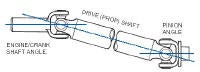
[/FONT][FONT=Arial, Helvetica, sans-serif]Note that in the standard single-cardan shaft "match the angles" geometry the angles do not have to be the same "sign". THIS IS A COMMON MISCONCEPTION. Certainly, the most common method of achieving proper single-cardan shaft geometry is to set the transfer case output and pinion shaft centerlines parallel, thus achieving equal angles between each end of the driveshaft (pic at left). [/FONT]
[FONT=Arial, Helvetica, sans-serif]Normally, this is done by rotating the axle housing (with shims in a leaf-spring suspension, or with relative lengths of upper and lower control arms with a link suspension). This is because the transfer case output is usually considered pretty fixed - the only way to adjust it is to either lower the transfer case (an all around bad idea and bad deal - I speak from experience) or to tilt the engine up (raise the engine mounts) again - not a good idea).[/FONT]
[FONT=Arial, Helvetica, sans-serif]

[/FONT][FONT=Arial, Helvetica, sans-serif]However - this is not the only acceptable method of achieving the proper matched-angle geometry. The angle between the driveshaft and pinion can be opposite to the angle between the transfer case and driveshaft - as long as they are equal. Note that they must still be in phase. This unusual configuration is called "Broken back" or "W" geometry (see pic at left ), and is common on agricultural equipment, marine drives, some tractor-trailers that use stub-shafts between front and rear of a tandem assembly, and most often on power-takeoffs like hydraulic pumps and PTO shafts. [/FONT]




