CK5
Register an account today to become a member! Once signed in, you'll be able to participate on this site by adding your own topics and posts, as well as connect with other members.

Dual battery setup question - starting from aux battery...

Well it will charge them both but it will just charge them both, if one for some reason has a lower voltage it will just charge them both, where a isolator will charge them evenly to their needs. It will work and charge eaither way.
kgblazerfive,

not sure what you mean by ''if one for some reason has a lower voltage it will just charge them both". Are you saying that it has the potential to over-charge the one that doesn't have lower voltage?

Again, I'm assuming i should wire directly from the alternator to each battery. I would like to know how the alternator knows...

William
 
isolator

I have one deep cycle and one "normal" car battery. As I've read, it seems there are two different purposes for dual batteries - to isolate and run accessories without draining down the main cranking battery OR, to wire them in parallel to run a winch (which is what i want to do).

I planned on connecting my winch to my new deep cycle aux battery but having them in parallel i thought would provide some extra umph so to speak.

After the last post by kgblazerfive and royken - specifically about charging both batteries from one alternator, both guys suggested an isolator be added to the system.

Is the isolator just for charging or can i still wire them in parallel for winching and use the isolator to manage the charging?

Sorry to be so slow on this. It has been a process of discovery which is great. Also i read where the alternator needs to be connected to a power source or it won't charge. The isolator that the local RV dealer carries is a 120 amp 3 post isolator. (one post for the alternator and one for each positive post on the batteries).

Will i need to do anything special to energize the alternator?

Thanks again for your help.

William
 
if the alternator will not charge more than one battery at a time, should i connect the alternator directly to each battery? Otherwise it seems the alternator would just see one battery (when connected in parallel).

William

I never said an alternator won't charge more than one battery at a time, i said "it won't charge more than one battery at the SAME RATE". This means that it will charge both batteries but one will be getting more charge rate the the other, the lowest voltage battery will get more of the charge rate than the other.
 
The isolator that is used depends on the style of alternator you have. Some alternators require an external excite wire to make them work so you may need a 4 post isolator instead of a 3 post.

Also you either run an isolator or the solenoid but not both.
 
The isolator that is used depends on the style of alternator you have. Some alternators require an external excite wire to make them work so you may need a 4 post isolator instead of a 3 post.

Also you either run an isolator or the solenoid but not both.
How can i find out if I need a 3 post or a 4 post?

Is there any problem in running a excite wire from my ignition to the back of the alternator to wake it up?

Is there any problem in have deep-cycle and a non deep-cycle batteries connected in parallel while the vehicle is running (alternator is charging)?

thanks for all the help,

William
 
pic of mine
Kgblazerfive,

Referencing your drawing, did you have to run a separate wire to your alternator to provide power to it to wake it up? If so, could that come from my ignition that is already energizing my solenoid?

Also, you have two solenoids in your drawing. Could I run my primary batter to the hot side (starter side) of my single solenoid and run my second battery to the other side and therefor not need two solenoids?

thanks for your help

William
 
you can take your excite lead right from the main charge post on the alt... just piggyback it...


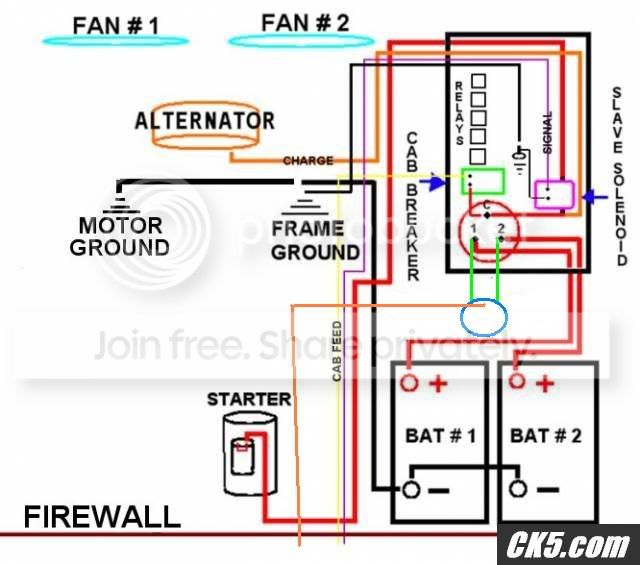
here's my 1/2 done diagram of mine.. the red circle is my marine switch. the blue circle below it is the ACR, the orange wire coming off it is the parallel trigger running into the cab to a parallel switch......

you can use either bank as a primary with the marine switch, both charge all the time as needed due to the ACR.. they can be paralleled with either the parallel switch from the ACR or by putting the marine switch to all...

the slave solenoid is what many refer to as the "remote Ford solenoid mod"


diagram.jpg
 
Latest image

Ryoken,

Check out this latest diagram. I added an isolator to control charging but have retained the solenoid to parallel the batteries when the truck is running and disconnect them when the ignition is turned off.

Since the charging post of the alternator is no longer hot due to being connected through an isolator (instead of the + post of a single battery), it doesn't seem like i can jumper off of it to excite the battery...

2 questions:

#1. Can I draw power to excite the alternator from the ignition wire used to control the solenoid?

#2. Is it a bad thing to have a deep cycle battery and a non-deep cycle batter connected in parallel while the alternator is charging but disconnected when the truck is off?


Thanks again for your help.

William

battery isolation diagram.jpg
 
i would just pull the 12v from the permanently hot side of that solenoid, or get a 4 post isolator... like this....

3356.jpg


and no, you wont have any issues with the deep and cranking in parallel as far as charging goes.. as long as they are within reasonably the same condition..
 
isolator voltage drop

Ryoken,

I've continued to read about voltage drop when using isolators. Is that a concern?

I don't see an isolator in your setup. What controls the charging of your batteries?

William
 
voltage drop can at times cause some issues, it reduces the voltage available to the batteries, which can inhibit a full charge and diminish battery life..

some of the better isolator systems, such as Hellroaring's newest setup, don't have the voltage drop.. Generally you get what you pay for...

What I use instead of an isolator is what I talked about earlier.. an ACR (alternator charging relay)... ends up about the same cost as a GOOD isolator system.. and imo, simpler and more bulletproof..

16580SM.gif


it simply hooks between the 2 positive posts (in my case, between the #1 and #2 posts of the marine switch), senses battery voltage and closes to allow charging to both as needed... it also has a built in paralleling trigger post. run a switch to it and parallel them whenever you want...

http://bluesea.com/category/2/productline/overview/389

heres a good overview of isolators and ACR's

http://bluesea.com/viewresource/58
 
ACR - alternator

Where does the alternator connect? I don't know that i want to put in a marine switch.

In the earlier diagram i did, i assume i would replace the isolator with the ACR and put in a parallel switch but I'm not sure where to connect the alternator.

Thanks again for the help.

Once i finish this I'll create a final (better) diagram for posterity...

William
 
my alternator charges at the "in" side of the slave solenoid, basically the "common" output of the marine switch... it's the orange "charge" wire on my diagram...

with an ACR, in your case, you would just run a charge wire to the primary battery, or to either side of the ACR..

tho with an ACR, your diagram would be MUCH simpler, you wouldn't have that solenoid over on the side, the ACR would be your solenoid..


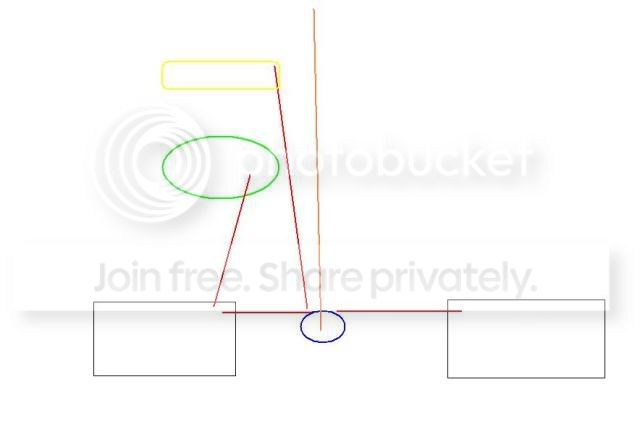
ok, here's a quickie diagram of roughly how simple that could be.. the blue is the acr. the orange wire off it is the parallel trigger.. the green is the alt, it can charge either to the battery, or that coresponding post of the acr... the yellow is your starter, it can be fed from that side of the acr, or that primary battery...

wire.jpg
 
new dual diagram

That sounds great. I can take the solenoid back since i won't need it.

That's a very clean simple design that i was looking for. I'll get this set up and then post a new thread with a condensed version of this discussion for anyone in the future that want to create a very simply dual battery solution.

Do you have an opinion on any specific switch for parallel mode?

Thanks again,

William
 
Why run an ACR when you can buy a quality isolator for about half the cost and according to the link you put up an isolator is slightly better than the ACR?
 
I know you love to disagree with me Scott, but where did you perceive that an isolator is superior? I'm just giving him another option, whether he chooses that or oldschool isolator tech, I could care less.. I've built and installed full systems with both, serviced both, have you?

And whats not "built" about that system? certainly not anything anyone in this freakin place was doing.
 
I'm not doubting that an ACR is a good option but i read one of the links you posted and it stated right there in black and white that an isolator is slightly better than the ACR. Guess i'm just a little confused. I currently have a Surepower isolator and in the past i have run the continuos duty solenoid. From reading the link you posted i believe that the ACR is capable of running the batteries in parallel whereas an isolator you cannot so that's the only benefit i see. If i'm missing something somewhere please let me know.
 
thanks......

well yes, that is one advantage, the dual purpose...

the other advantage I feel is the way it's failure is tied into the system.. in other words, the way it's tied into a system lends itself to leaving you with a better result.. if it fails, you will always be charging one bank, whereas I've seen isolators completely fail..

now we both know that a failure can, and is, most of the time due to another issue... The isolator, to me, is more easily affected imo...

Tho we butt heads on occasion it seems to me, I always respect your opinion... Maybe, I persuade you, maybe not, thats cool...

one other thought... I know everyone here always has a budget of some sort in mind, but I don't always look to "cheapest avenue".. If I feel something is a trick approach, I'll promote it... always good to dream... I'd rather start with the best in mind, than back peddle where need be... meaning, yeah, in a pinch you can get this done with a $20 isolator, whereas I invested 200 in an ACR and marine switch, and glad I did... guess it depends on funding for the month! :D
 
Yes i agree. There are pros and cons about each system. However i already have an isolator and until it fails me (almost 7 years running now) i'm not going to switch to an ACR. Until you started talking about them several years ago (when i first seen you posting about them anyway) i had never heard of them before (learn something new every day). I also agree that i don't usally go for the cheapest route to getting something done but like you i rather spend extra money up front for a superior item and probably not have to worry about it in the future like you might with a cheaper version of whatever. Actually you would be money ahead to buy a quality part (more money usually) than have to install the cheaper part just to have it fail and THEN have to buy the more expensive part anyways.

I will definately be doing more reading on the ACR and see if it's something i may want to run in the future. :thumb:
 
Top Bottom