CK5
Register an account today to become a member! Once signed in, you'll be able to participate on this site by adding your own topics and posts, as well as connect with other members.

Ignition issues on a rather strange setup

NotLaw

Registered Member
 Premium
Joined
Oct 15, 2007
Posts
91
Reaction score
190
Location
Cedar City, Ut
So, I've got a very frustrating ignition issue on a rather unusual setup.

First off, some basic engine and car specs:
The car is a 1967 Ford Fairlane (in my profile pic)
2.79:1 diff ratio with a Toploader 4 speed
Engine is a rebuilt 302
Comp Camps Nostalgia+ flat tappet cam
Some cheaper full roller rocker arms
Basic home port job on the 80's 302 cylinder heads
Full length headers
Summit Racing intake manifold
and a 1983 Quadrajet on top (since it works so well on my 84 K5)

Spark plugs and wires were replaced at the rebuild, and gapped at .040"
Distributor is a Skip White HEI conversion distributor, first installed into my old 298 engine in August 2013. Power is supplied to it by using the original ballast wire to trigger a relay, sending +12v direct from the battery along a 14 gauge wire. This is the same setup that has been on the dizzy since almost day one.
The ignition module is a replacement Autozone one, replaced about 1.5 years ago.
Coil is the original Skip White coil, and the cap and rotor are of course, new.

I do have a build thread for this car on another forum that goes into much more (pic heavy) detail, this is where the new engine stuff really starts although the distributor stuff is a bit earlier


Anyways, the problem:
About a month ago, I had an issue where I was accelerating, hard, onto the interstate (talking WOT, 6000 rpm shifts, etc) and at approximately 5200 RPM in second gear, I got a hard judder from the engine, like the ignition was cut. It sounded like I had slammed into a rev limiter at full chat. Repeated hard ignition cuts. I backed off for a moment, and got right back into it and it was smooth up to my 6000 rpm shift.


I never had the issue again, and a little poking around in the ignition and fueling system revealed nothing. I could not reproduce it, so I shrugged it off. After all, a problem that cannot be reproduced is not a problem.

About a week after the initial issue, I destroyed the Pinion input shaft on my 8", and I have spent the last month fixing that. I got it back on the road last saturday.


On my first test drive of the diff, the problem came back and in full force. The difference is this time, It did it while I was cruising at 75 mph on the interstate. Almost felt like the engine tried to stall at 2800 rpm, flutter, rough hesitations, something that felt like a massive back-fire, the lot.


I checked my spark plugs and they told me that I was running ultra lean, (and a check of the Adjustable Part Throttle screw in the Q-Jet confirmed this, it was practically bottomed out) so I fattened up the mixture a bunch, and went on another test drive.
I also checked and confirmed the ignition timing at 14° initial advance, and 30° mechanical advance all in at 2500 rpm or so. I also discovered at this point that my vacuum advance appears to be working, as I forgot to remove the vacuum line when I first put the timing light on, and I saw north of 50° advance at 2500.


No change.


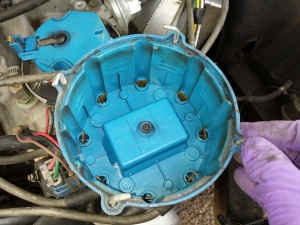
Sunday morning I pulled the distributor cap off, and found this:
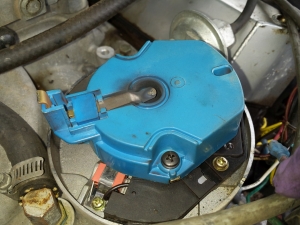


It didn't really look too nice in there at all. This is was the original Skip White cap and rotor that came with my dizzy when I bought it somewhere around 20,000 miles and and engine ago.


I replaced the cap and rotor with good Napa parts, then filmed the following video, which starts in 2nd gear, cruising at about 40 mph, just after I put my foot to the floor:


Going back out to the car later, I noticed this:

about .125" of up/down movement in the shaft. Is this normal? could it even cause this kind of issue?

I pulled the dizzy out of the engine and looked over it, I did not see any unusual wear on the shaft, gear, or housing. Everything looked OK.

I also recorded this video, which shows that under no load, the ignition system works just fine.

I topped out at ~4700 RPM or so, per my Innova digital timing light. The engine was not hot anymore (having been about 4 hours since the last drive) but it was not cold either.

I can consistently reproduce the issue by putting the engine under heavy load in any gear, though I cannot say I have ever noticed it under 1900 RPM. The temperature of the engine does not appear to make a difference as I was able to reproduce the issue within 5 minutes of starting the engine this morning.

I replaced the ignition module this afternoon with an O'reillys part, and it made not one bit of difference.

Thoughts? I'm starting to run out of ideas unless plugs or wires could cause a engine load based firing problem...

I will say, throughout the entire last month of issues with both this Fairlane and some subsequent problems with my commuter car, a '90 Saab Turbo, My K5 has remained a pinnacle of oil burning, smoke blowing, fuel consuming reliability :pimp:
 
Last edited by a moderator:
I had a consistent problem on my old firebird. Kept failing emissions due to HC (bad ignition). Changed out everything and went w/ a crane hi-6 ignition w/ uprated coil. Still had a problem. Turned my alt regulator had bit the big one and was putting out 19v. Changed that out got a good 13-14v and problem went away....

I guess that's the long way to say try checking your voltage...

Josh
 
Could be the coil failing under a load..they usually wait till they get hot to act up though...also the pick up coil in the distributor might be failing..

Maybe your relay is crapping out and failing to deliver the full 12 volts ?..
You could run a hot wire right to the cap to power the HEI and see if that helps..

I think that is a bit much as far as the end play--should be barely any--but the rotor would push down on the shaft and keep it from going up that much..maybe the spiral cut gears would make the shaft climb up,but I would think it would misfire at no load too if that was causing it..
 
The heavy load part is not a surefire......Yeah, I went there....... Indication, but it does lean (sorry) towards a fuel issue instead of a spark.

Take it out, run it up fairly high in a lower gear to see if it starts cutting out. If so, ease back slightly, and you should be able to go from good running to cutting out and back over just a few RPMs.
Spark problems will do that too, of course, but I think you are just running out of fuel.

The thing to watch for, is that a spark problem will usually stay constant at a certain RPM. Fuel will run out, catch back up when you back off, and then let you slightly faster before it runs out again as the fuel supply catches up.
Spark will usually die at the same place each time.

Float problems, fuel filter, or pump pressure or volume problems will all cause that.
 
I'll need to double check the voltage on the alternator.
Bypassing the relay entirely was a thought that had occurred to me, but I haven't done it yet, I'll try it after work tomorrow.


Fordum, Fuel was one of my first thoughts too, hence my checking of the plugs and subsequent fattening up of the mixture.
In my testing today, I did take it up to 4000 rpm or so in first gear, (using reasonably light throttle, no more then 40% at any point) and it ran smooth as silk. I should have hit it hard at that RPM to see how it would behave, but I was on main street at the time, and I'm not sure it would have been much appreciated, I was getting enough attention as it was screaming down the road at 4 grand :whistle:

The car does have an electric fuel pump, mounted pretty much right at the tank, and at the bottom of the tank. there's a pre-filter on the fuel pump, and a filter at the carb as well. I can check those and try running the pump with the line disconnected to check flow...

I should mention that before I put the Q-jet on the car, I completely disassembled it and went through it with a fine tooth comb. I made sure there was not one spec of foreign material in that thing before I rebuilt it 100% with a Cliff Ruggles rebuild kit (and using both of the main Q-Jet books)

That was over 1.5 years ago now though, and the car has sat off and on for about half of that time. I hate to tear into a carb that's not leaking at all, but I will if i can find any sign at all that this is definitely a fuel issue.


I also did some testing of the vacuum line situation on the car. I've only got two, the ported line to the distributor, and another line off the back of the carb (normally for the power brakes I think) that I feed into my vacuum gauge.

I blocked off both of those ports, and triple checked all my caps on the other lines (they were good still) and went for a test drive. No change. Missing under load, over 1800 RPM.

I also tried wiring the secondarys shut, no change; and switching the vacuum advance to manifold vacuum, which if it changed anything, just made it very slightly worse.


I also picked up some Autometer wideband Air/Fuel ratio gauges that I was going to install just before I exploded the diff a month ago. The bungs are in already, so all I need to do now is install them. If I can find a spot to get the car up in the air, I'll do that tomorrow as well. More info won't hurt.
I'm still a college student living in an apartment and they are repaving the parking lot at the moment, so all my work has been in the street lately :doah:


What gets me the most about this issue is that if I drive around "normally", never really getting into it, just accelerating normally, everything is fine. The car runs much the same as it has ever since the rebuild. It's only when I try to cruise on the interstate at speed, or have a bit of fun that it misbehaves.

BTW, not sure how relevant it is, but water temp holds fine at 195° (my T-stat setting) and oil pressure is excellent at around 50 psi when hot and not idling. Engine vacuum also holds fairly normal for this elevation (5900) at ~8-12 inches at idle (cam's got a fair bit of overlap), 14" at light cruise, and 24" when coasting.
 
For today's update, I started by hooking up my Autometer Air/Fuel ratio gauges that I had purchased just before I exploded the diff a month ago (one for each bank, with O2 sensors installed in the header collectors, parallel with the ground.
The gauges showed that I was still running stupid lean at idle, which I quickly adjusted to a less retarded mixture of 13.5:1, from the 18+:1 that I started with.
A quick drive round the block showed that I was cruising around town at ~13:1, and WOT at 2000 rpm in 2nd dropped the mix to 10:1, and immediately induced my popping misfire issue.

Despite the gauges saying that I was running rich in at least one situation where I could cause the issue, I pulled my fuel line off and ran the pump. Fuel flow was good, no air or anything in the line, but pressure was rather low. I could hold my thumb on the end of the fuel line and barely even notice the pressure (note: the fuel line in this car is 5/16)

I thought carbs were supposed to only be 4-7 psi anyways though?
I'll see if I can't rent a pressure gauge of some kind from one of the parts stores tomorrow anyways, be good to have an actual number.
If the gauge doesnt reveal anything, or if I can't get one, I do have a spare new fuel pump I can swap in. I still need to check the filters too.

Anyways, Even with the possibility of not enough fuel pressure, I find it hard to wrap my mind around the idea of borderline lack of fuel (or even absolute lack of fuel) causing this harsh, sharp, stuttering misfire in a carbonated car. If it was fuel injected, that makes sense, but with a fuel bowl providing at least a small buffer, I would expect a different feel of misfire. I've run the fuel bowl dry before (accidentally leaving the pump off will do that after all) and it's never felt like this.

I also ran the fuel bowl dry so i could take the fuel line off for my test today by way of running the engine with the fuel pump off. While it was draining away, I let it idle for a time, as well as brought the RPM up a bit. As rather expected, as the fuel level in the bowl dropped, the AFR for both banks got increasingly lean, until it stalled out from lack of fuel.


Another test I ran was to hook the +12v of the dizzy straight to the battery with a new wire, no change.

I checked the voltage output of the alternator as well. 12.7 at idle, which is not unusual for a old car that is still externally regulated like mine (though i did replace the regulator with a electronic one ages ago)

I get 13.8 or so if I give it basically any throttle though, right on the money as far as I am concerned.

I also checked some resistances on both the HEI coil, and the pickup coil in the dizzy.

Per this post I found via google there should be more than 0 ohms, and less than one ohm between Tach and Batt terminals on the coil, I read 1.8 Ohms.

He also says there should be between 6000 and 30000 Ohms between the Batt terminal, and the carbon pickup inside the cap. I read a dead open, but I am inclined to think this is a method or tools issue, as the car does still run, just not right in every situation.

I also checked between the pickup coil's two leads and ground, per this site and it was dead open, as it should be. I started running out of light before I could complete the tests on those two pages, but I will continue in the afternoon tomorrow. I also plan to take the coil down to one of the parts stores so I can compare side by side Ohms between my old coil and a new one.
 
I had a similar, although not as severe scenario with a 355 many years ago. I swapped carbs, rebuilt the dist, new vac advance can, new coil on the HEI, new cap, new rotor, new plugs. The usual shotgun approach...:doah:

A couple of months later while wheeling my battery hold down broke, the batt rolled into the alt and sprayed batt acid all over my newish Accel wires.

I replaced the batt, fixed the hold down, and bought a new set of MSD wires. Suddenly the loaded miss disappeared and the damn thing ran better than it ever had.

How are the wires? My "newish" Accel wires were crap right out of the box apparently.
 
That sounds correct for a fuel issue. Remember, Carbs suck fuel out of the bowl at a rate determined by the size of the jets and the amount of vacuum.
For the system to work, it depends on the only main variable to be the vacuum. The size of the jets do not change normally while running.
And they depend on a constant level of fuel in the bowl.

As the fuel level drops, the amount of fuel delivered per amount of vacuum changes and the engine leans out.
At idle, an engine will run fairly good lean, but under load, you get the misfire, backfiring those kind if things.

As I mentioned in another thread, many pumps will flow the rate amount under no load but not develop enough pressure.
The hole in the float valve is tiny, and it takes a certain amount of pressure to force gas through it at a rate fast enough to keep the bowl full.

Too much pressure can override the float and cause it to flood out, which often happens when someone puts on an electric pump that is not designed to regulate the pressure or does not have a built in regulator.

Sounds like you did it right, but now I think you are not getting the amount of fuel you need.
If you want to keep testing things, a pressure gauge T'ed into the fuel line so you can watch the fuel pressure as the problem occurs might be easier than pulling the fuel pump and filters right now.
 
I'll add that I've had more than one set of plug wires that were junk right out of the box in the past--and I've had some Accel parts like plugs, wires and ignition modules that were NFG too,and so have several friends ..

The way the engine cuts out in the video sounds like a sudden loss of spark issue to me...:dunno:..
 
If you were running 10:1 under hard throttle it sounds like you may have been rich even - but safe so I kinda doubt it's a carb problem...

Wonder if the spark is actually weak - and not firing under the higher cyl pressures. Do you have a spark tester?

Josh
 
Before you go any further I'd recommend pulling the distributor and checking the mechanics. .125" of endplay while sitting in the engine seems excessive to me. Our Ford distributors have between .025" and .035" endplay.

I'd be afraid with this much movement that you have excessive gear wear and that the bushing on the shaft that rides under the aluminum housing may be digging in to the housing.

If the shaft moves up and down that much under hard acceleration it could affect timing and rotor phasing which might explain the carbon buildup in the cap. Rotor phasing is the relation of the rotor to the terminal on the cap. If phasing is off from the shaft moving it forces the spark to jump the large gap using up your high voltage and leaving little power to jump the plug gap in the cylinder.

I'd check this next before going any farther. I may be overthinking this but it seems logical in my mind.
 
I did have the dizzy out the other day, I didn't see any abnormal wear though. I will check with my local stores and see if they have any shims (or even enough of them, .125" is a lot)

I'll also contact the vendor for my dizzy and see what they have to say.


The plug wires are actually from when I swapped in the dizzy to the old engine, 2 years ago. They are not very high quality either. At the time I was limited in the time I had available to work on it, and my old wires would not work with the new distributor, so I had to scramble for a solution. They could probably do with replacing to a quality set...


As for todays investigations so far, I rechecked all the timing per a request I got on another forum I've posted this too,
14 initial
32 all in at 2500 (and I checked, it held 32 up to at least 3800)
52 with vacuum by 2500, holding steady up to 2500.

I also checked the fuel pressure. Between 5 and 6 psi constantly under all loads. It flutters a bit while the issue is occurring.
 
Well, the problem is very much not solved, but I am 98% sure I know what the problem is.

I noticed yesterday as I was driving back to Oriellys to return the fuel pressure gauge I rented that the misfire problem seemed to be getting worse. It was now happening with even moderate throttle, and accelerating up a even a slight hill was enough to induce it.
While I was in Oreillys, I saw the MSD cut to length plug wires, and decided that since I've rather intended on going that kind of route anyways ever since I redid the engine a year and a half ago, that I would just bite the bullet and buy them.

When I got the new plug wires in, there was actually, for the first time in this process, an improvement.
The misfire went from happening even with moderate throttle (I'll assign an arbitrary 50%) to only happening with a little heavier throttle (say, 65%)


With this little sign of improvement, I went looking for spark plugs.

I asked for Autolite 26's, since I've been running Autolites in this car since the day I bought it, and it turns out they were on sale.

When I pulled the old plugs out, they were gapped between .032" at the smallest, and .045" for the biggest, though the majority were right around .040" ±.002

There was no visible damage or issues with them

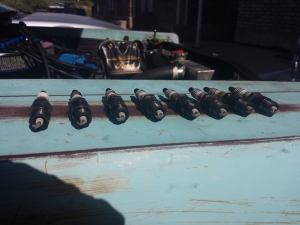
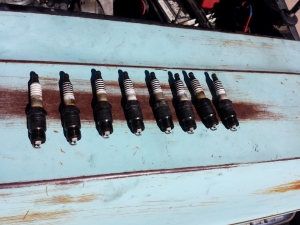
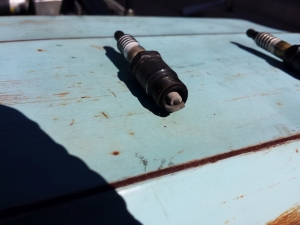
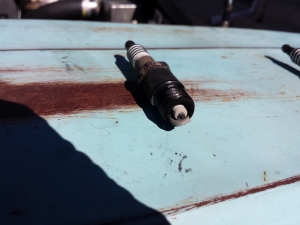
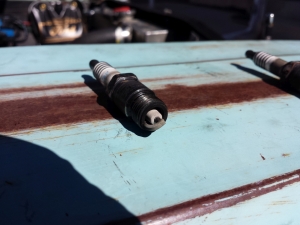
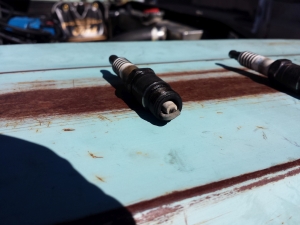
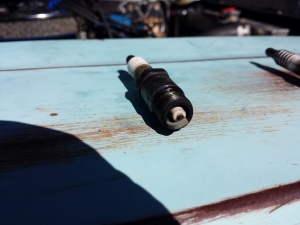
Overall shots of the old plugs. All 8 are in order, right to left.


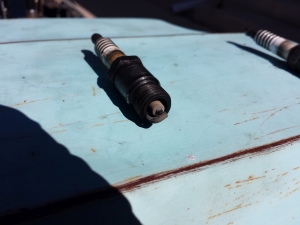
And individual shots of the old plugs
1. 2. 3. 4.
5. 6. 7. 8.


I installed the new plugs today after gapping them to .040, which is a bit more than my ford book recommends.

After installing the new plugs, there was a marked improvement to the issue. Now I would only get misfires at much heavier loads and I could even go WOT, for a short time, before inducing the misfire.

This is what gave me an idea. I retarded the initial timing to a silly number, only 3°.

The problem went away. :pimp:


I pulled 1st gear up the steepest hill in town all the way to 6100 RPM. Smooth as silk.

Of course, with only 3° of initial, the engine is not very happy during transitions, particularly from idle to moving. there's a bit of a bog. It actually reminds me of the turbo lag in my Saab. I clutch out and start moving, and it slowly accelerates, then all of a sudden wakes up and grabs your balls lol.
I suppose the bog could have something to do with how rich my idle is at the moment too. That fluctuates between 12.5 and 13:1 AFR...

Ever since I discovered the large amount of endplay in the distributor, I have been wanting to contact Skip White (the vendor) and see what they have to say. I've always been too busy during the day with work, and by the time I get off work and remember to call them, It's been after their hours. I was able to call today though, and while none of their techs were still there, I found out that they'll be in tomorrow, so I'll be giving them a call for sure.

I'm finally on the trail of this damn problem. :pimp:
 
Well, the problem is very much not solved, but I am 98% sure I know what the problem is.

I noticed yesterday as I was driving back to Oriellys to return the fuel pressure gauge I rented that the misfire problem seemed to be getting worse. It was now happening with even moderate throttle, and accelerating up a even a slight hill was enough to induce it.
While I was in Oreillys, I saw the MSD cut to length plug wires, and decided that since I've rather intended on going that kind of route anyways ever since I redid the engine a year and a half ago, that I would just bite the bullet and buy them.

When I got the new plug wires in, there was actually, for the first time in this process, an improvement.
The misfire went from happening even with moderate throttle (I'll assign an arbitrary 50%) to only happening with a little heavier throttle (say, 65%)


With this little sign of improvement, I went looking for spark plugs.

I asked for Autolite 26's, since I've been running Autolites in this car since the day I bought it, and it turns out they were on sale.

When I pulled the old plugs out, they were gapped between .032" at the smallest, and .045" for the biggest, though the majority were right around .040" ±.002

There was no visible damage or issues with them

Overall shots of the old plugs. All 8 are in order, right to left.


And individual shots of the old plugs
1. 2. 3. 4.
5. 6. 7. 8.


I installed the new plugs today after gapping them to .040, which is a bit more than my ford book recommends.

After installing the new plugs, there was a marked improvement to the issue. Now I would only get misfires at much heavier loads and I could even go WOT, for a short time, before inducing the misfire.

This is what gave me an idea. I retarded the initial timing to a silly number, only 3°.

The problem went away. :pimp:


I pulled 1st gear up the steepest hill in town all the way to 6100 RPM. Smooth as silk.

Of course, with only 3° of initial, the engine is not very happy during transitions, particularly from idle to moving. there's a bit of a bog. It actually reminds me of the turbo lag in my Saab. I clutch out and start moving, and it slowly accelerates, then all of a sudden wakes up and grabs your balls lol.
I suppose the bog could have something to do with how rich my idle is at the moment too. That fluctuates between 12.5 and 13:1 AFR...

Ever since I discovered the large amount of endplay in the distributor, I have been wanting to contact Skip White (the vendor) and see what they have to say. I've always been too busy during the day with work, and by the time I get off work and remember to call them, It's been after their hours. I was able to call today though, and while none of their techs were still there, I found out that they'll be in tomorrow, so I'll be giving them a call for sure.

I'm finally on the trail of this damn problem. :pimp:

That satisfaction when you start making progress on a problem is great. I remember when I had an issue with stumbling and stuttering, and I was chasing down everything from vacuum leaks, to carb issues, to ignition and spark plugs. Eventually it turned out to be one plug wire that had seen too much heat and started to fall apart internally, resulting in an intermittent issue.
 
Before you go any further I'd recommend pulling the distributor and checking the mechanics. .125" of endplay while sitting in the engine seems excessive to me. Our Ford distributors have between .025" and .035" endplay.

I'd be afraid with this much movement that you have excessive gear wear and that the bushing on the shaft that rides under the aluminum housing may be digging in to the housing.

If the shaft moves up and down that much under hard acceleration it could affect timing and rotor phasing which might explain the carbon buildup in the cap. Rotor phasing is the relation of the rotor to the terminal on the cap. If phasing is off from the shaft moving it forces the spark to jump the large gap using up your high voltage and leaving little power to jump the plug gap in the cylinder.

I'd check this next before going any farther. I may be overthinking this but it seems logical in my mind.

I have to agree with you and still feel the problem is in the distributor...
 
Well, Time for a status update on this.

Long story short, I replaced the fuel pump, re-jetted the carburetor, and replaced the distributor with a new Pertonix unit, and this car is still broke to **** :angry1:


My conversation with Skip White's shop indicated to me that they feel having .125" of end play in the dizzy is not unusual for one of their (admittedly very cheap) dizzys, and while in hindsight I now know that the end play was definitely not the problem, at the time I was not particularly happy with this answer.

They did offer to replace the dizzy for me if I wanted to send them in my old one, but I did not want to wait a week and a half or more to get a new dizzy that may or may not have fixed the problem.

So, I chose instead to accelerate one of my future upgrade plans, and go to a quality aftermarket small cap dizzy. (the small cap is absolutely necessary for another future upgrade; space reasons:whistle:)

I went with a Pertronix Flamethrower and E-Core coil from Summit.

Once It came in, I got it all installed, timed to 36° all in mechanical timing at 3000 rpm, and went for a test drive.

At first, everything seemed OK, I made a WOT run all the way up to 5500 RPM, and all was well.

The next time I got into it though, at around 3500 RPM, the problem came back in full force, and everything went downhill from there.

At this point, I was absolutely crestfallen... and Pissed lol

With no obvious direction to go, I went down the other path of fueling.

I knew that I was running very rich (10.5:1) at WOT, and that needed to be fixed regardless, So I ran some numbers and picked some new primary jets and secondary rods that should have brought my WOT fueling back to where it ought to have been.

The car had #73 jets in it, 49M Primary Rods, and DA Secondary rods.
The numbers showed me that these were around 16% too big, so I backed off to #68 jets, and DH secondary rods.

I installed these at the same time as I replaced my fuel pump with a new one (my spare ended up being a old pump, i had already used the spare to replace the electric pump on the K5, oops)

The new fueling and pump brought my AFR at WOT closer to where it should have been, but it was hard to get my cruise AFR into spec, (primary rod is too big now) and it also induced a lean spot at 2500-2800 rpm.

So, I picked the wrong parts, not unusual for someone who is still gaining experience in tuning Q-jets, but did it fix the problem?

Of course it didn't

No change to the problem, but at this point, my friend told me that he thought it felt more like a backfire then a misfire, and after further thought, I think I agree with him.

Right now it feels less like hitting a rev-limiter, and more like hitting a damn brick wall.

With the fueling obviously not effecting the backfire, I went back at the timing, and brought my all-in timing down to 30° and disconnected the vacuum, advance, as this at least covered up the problem before.

This time? it made it worse of course.:dunno:


So, that bring the tale up to last week. This last Tuesday, I rented a compression tester and started testing the engine. The results were as follows:
Code:
[U]Cyl #     |   Pressure (PSI)
   1      |      105        
 [B]  2[/B]      |      [B]5          [/B]
 [B]  3 [/B]     |      [B]35         [/B]
   4      |      105        
   5      |      115        
   6      |      115        
   7      |      100        
   8      |      115        [/U]


Keeping in mind that on the SBF, the cylinders are counted as follows:


I put some oil into cylinders 2 and 3, and compression only increased perhaps 2 or 3 psi, not enough to indicate a failed ring or scored cylinder wall in my opinion.

This morning, I pulled my passenger side valve cover, and then all the offending rocker arms (one at a time) and inspected things.

I found no issues, and there is perhaps a .030" variance between the closed valve heights (measuring from spring cap to spring seat)

That is a small enough variance for me to attribute to inaccuracies in measurement methodology or differences in the cut of the valve seat.

My current popular theory is a fractured or cracked valve, which is closed and mostly sealed up on a cold engine, and opens as things get hot, but I am not sure this theory adequately explains the intermittent-ness of the problem, nor the fact that it happens at different RPM's, and adjusting the ignition timing also effects it.


Another issue I take with this whole damn thing is how can an engine with so obviously low compression on two cylinders run so smooth? My old engine in this car had little to no compression in two cylinders too, and that thing ran obviously rough.

I'm baffled, and while I really, really would like an explanation that does not require me to disassemble the entire damned engine, it's looking like that might be the next step.

Maybe I'll have to accelerate my head upgrade that I was planning on doing in a few years...
 
Last edited:
Swap in an LS and be done.

Sorry I don't have any advice but I sure hope you get it running without just replacing every part.
 
I thought GM used the firing order to identify the cylinders..?

The #1 cylinder is the drivers side front most one,,followed by #3,#5,#7..
Passenger side front to rear, is #2,#4,#6,#8..

So,your 2 cylinders with low compression are #4 & #6 ..could be the head gasket is blown between the 2 cylinders and only "leaks" compression,(and no coolant) when it gets warmed up..?..
 

Latest Posts

Top Bottom