CK5
Register an account today to become a member! Once signed in, you'll be able to participate on this site by adding your own topics and posts, as well as connect with other members.

Illustrated Hydroboost swap

Blue85

Yooper
 Premium
GMOTM Winner
Joined
Jul 26, 2000
Posts
16,772
Reaction score
9,791
Location
Keweenaw
I know there are many threads about the vacuum to hydro booster swap, but I haven't found one that shows it concisely with pictures. So I'll start one as I do the swap, get suggestions and have a chance to ask questions. In this case, parts were pulled from a 1987 1-ton dually 2WD to swap onto a 1985 K5.

boosters.jpg

First, why is swapping pedals recommended? Note the difference in pivot to pin distance. This reduces the pedal travel and increases effort, presumably because the hydrobooster provides more assist and/or the brakes are bigger, requiring more fluid. The bracket that pushes the brake switch(es) is also different to account for this:

Pedaldifferences.jpg

Also, notice the tab for the pedal return spring on the hydroboost pin, which the vacuum setup does not use. This attaches to the column and pedal mount bracket. The hydro setup has a little bracket to cover that spring - probably to keep the column wiring out of the way. In this case, the holes for the spring and 2 bracket screws were present on the host vehicle, so the column/pedal mount bracket (below) was not required from the donor vehicle. This spring and bracket can be swapped over.

Columnandpedalbracket.jpg

Also shown in the picture above are the two studs pressed into the bracket of the hydro truck. The booster mount has 3 pairs of holes, which all get studs. The top studs all come through the firewall and the bottom studs are pressed into the bracket on all setups. The placement differs on the middle set - vac has them coming out of the firewall, while hydro has them pressed into the booster mount. So swapping onto a truck that came with a vacuum booster is easy. You just pound out the two studs in the hydro booster mount:

Roddifferences.jpg

If you were swapping a vac booster onto a vehicle previously fitted with HB, you would have to add the two studs in the middle holes or run bolts all the way through the firewall. This wouldn't be too bad if you already had the studs you pulled from the HB bracket. Maybe you could even run them backwards, as working the bolts is much easier underhood than under dash. I suppose you could also weld nuts to the booster bracket.

PICT0367.jpg

Booster and Master installed:

PICT0369.jpg

I'm not sure this master is correct for a 1987 - I believe it is 1 5/16" bore and maybe from 93+?

PICT0399.jpg

More edits to come.
 
Last edited:
So I have this hose for the pump to booster connection:
4


And a TPI-style serpentine setup. This hose doesn't seem to fit on the pump. I don't think there is a stock application for TPI + hydroboost, so I had to make due with what I got.

Here's the standard TPI setup:

TPIpumphoses.jpg

I can't figure out where all this mud comes from - all the serpentine stuff was cleaned and painted last summer.

So the hose was reworked "perfectly" from the 180 degree truck bend to this:

Revisedhosecomparison.jpg

I have the standard TPI reservoir, with only one return line - which I teed for the two returns, but it's hideous. Maybe I'll think of something better. I don't think I can use the hydroboost reservoir with the TPI brackets. And I can't use the TBI brackets with TPI. For anyone running V-belts or Truck serpentine, they can skip all this. So it all fits like this:

HideousTeesplice.jpg

With the reservoir lower than the hydroboost unit, how does the fluid not run back and overflow it? I see some setups with remote reservoirs, but others with just the pump-mounted one.
 
Last edited:
Subscribed!

I just retired one of my 1 ton dallies from being a former service rig to a Parts truck!

It would be nice to swap the Hydro boost into the Sub!

Nice detail so far!:waytogo:
 
I have a spare where can i get it rebuilt at ?
I searched high and low for a rebuild kit before I finally found one. Unfortunately for me I must have screwed it up somewhere. When I got everything back together and installed one push of the pedal was all I got. It locked the pedal to the floor and never released the pressure. :dunno:

I ended up having to just by a replacement from the parts store. :(
 
The brakes are working, but I still have the DF caliper to bleed. I'm not sure the pedal is as high as it could be. I've read about different rods between the booster and the master. I've also heard that the pedal rod can be adjusted. Rather than just trust everything was correct on the donor (some stuff was partially disassembled when I found it in the Pick-n-pull), what is the process to get all of this the best it can be?
 
Last edited:
Well I skidded the K5 down the road tonight, something I haven't been able to do in a long time. The pedal travel is much reduced from the vac booster, but still nothing to brag about. Overall braking power is much improved. I have 1/2-ton front calipers at all 4 corner with an adjustable prop valve on the rear circuit. All rotors are getting hot, but definitely hotter in the front.

I'm just not convinced the pedal is returning all the way to the top like it should. I read somewhere that restriction in the low-pressure return line is bad, so I swapped positions on the return Tee so the HB had the straight shot and the gear had the right angle turn. No real difference. I've also read that excess flow/pressure from the pump can make HB self-engage. The output fitting on my pump has been drilled out a little.

And what of the "quick-take-up" valve? Is it helping or hurting?
 
I'm having problems with pedal return. With the engine off the pedal springs tight at the top of travel. With the engine running the pedal only returns most of the way, causing the brakes to drag (and keeping the brake lights on). If I pull the pedal up with my toes it stays there. I pulled the pump to add a second return nipple, which will eliminate the brass tee in the line. If that doesn't work I have to separate between too much pump flow and a bad booster. The pump output fitting is drilled a little oversize and I don't have a stock one to try.
 
OK, this works.

First let me explain why I can't just grab a pump/reservoir out of a hydrobost truck. Because I have TPI, I can only use serpentine brackets for a TPI car. This requires the TPI reservoir, which "clocks" it to the side a bit. The pump itself is the same, but the reservoir is different in a few ways:

Pumpcomparisonfront.jpg

Pumpcomparisonrear.jpg

So I took the return nipple off the old V-belt reservoir and added it to the TPI reservoir. I located as low as I could to make it closer to the stock truck setup. This let me get rid of the silly loop of return hose I'd been using since the serpentine swap.

PICT0038.jpg

TPIpumphoses.jpg

So it's much cleaner, but the best part is that now the pedal returns like it should.
 
Last edited:
glad you got that cleared up Luke...I used my 99-2500 as an example when I set mine up...I used the system from a diesel K5, and had to make a pushrod because the master cyl I used wasn't the same as the core I turned in and it was 2 days before leaving for Moab in 2011 on a labor day w/e....buddy made a pushrod, and we had good brakes!
 
Did your brake lines connect up to the master cylinder the same as before, without having to swap from-for-back?

In my case they are reversed, but mine's older (pre-80) and uses the cast one-piece master, instead of the one you show with the separate plastic reservoir.

Also, are yours both 9/16" fittings at the master? Mine originally had two 9/16" fittings, but the hydroboost master has one 9/16" and one 1/2", which means either replacing ends or using adapters to change 'em around.

-- A
 
I had been using an Eldorado MC with the vacuum booster. When I swapped to this one the lines transferred right over. Both use the two different size fittings. It seemed right because the front reservoir (for the rear brakes) was the smaller one. I always hear of this swapping front to back - maybe I did that years ago and forgot. I should trace with line goes where.

Actually I pulled the pump apart again because there was a leak. Now it is puking fluid out of the pump, the steering assist sucks and the brake pedal is staying down sometimes. Maybe I got some dirt in it or something.

EDIT: I put a quart of ATF in and flushed with new PSF (both return lines in bottles) until everything came out clear. Bled the system until no foam or noise. The pedal still only comes up about 1/5 of the time. I'm really hating it. The stopping power is awesome but even with the return hose in a bottle (least back pressure possible) the pedal doesn't always return like it should. I can't think of another course but to get another booster.
 
Last edited:
Anybody have pedal return problems that just fixed themselves after the booster burped some air or something?
 
Good info Blue85! :waytogo:

I had no idea the brake pedals were different. When I did my hydroboost swap in my ’78 K10 I did it at the same time as a NV4500 swap. While doing the NV4500 swap I also upgraded to a hydraulic clutch. Lucky for me I used a pedal box from an 89’ chassis cab (old square body style) that was equipped with hydroboost. Looks like that was just dumb luck on my part as I never knew the pedals were different. Good info to know when I convert my Burb to hydroboost.

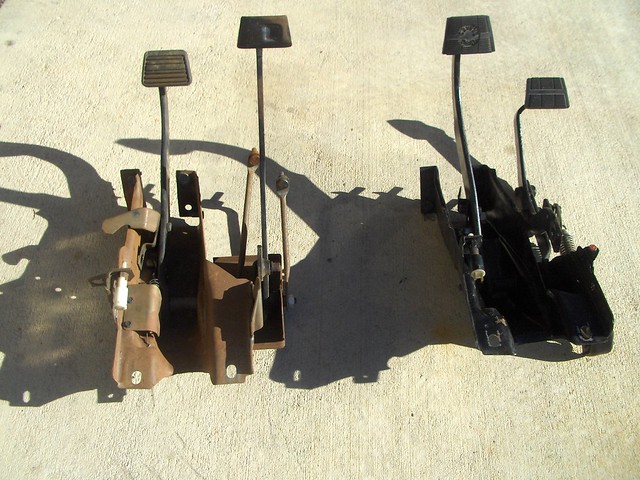
Here is another view of a hydraulic clutch pedal box for hydroboost (left) vs. vacuum brake/mechanical clutch
5226953763_273919943d_z.jpg


When doing a hydroboost swap it isn’t necessary to swap on a dual return port power steering reservoir. If you look back in GM truck history, G-van’s and P-chassis in the 70’s up through the 90’s (and some heavy and medium duty trucks still today) didn’t use a dual return port reservoir. They just used the tee fitting to tie all of the return lines together. That said, there is nothing wrong with using a tee fitting rather than going through the hassle and expense of adding a dual return port reservoir.

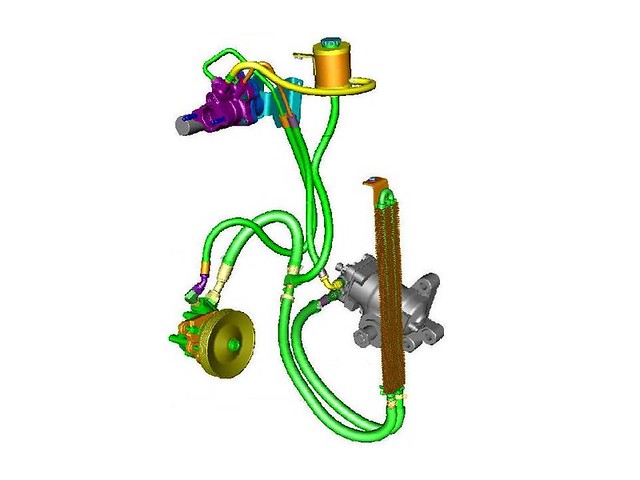
When I did my swap I did exactly what GM (and Workhorse) did for the return lines as well as cooler plumbing. Here is a CAD drawing of a late model medium duty truck where all of the return lines tie together as there are no dual return port provisions on the large ZF power steering pumps that the big trucks use.
5240138026_38807a5462_z.jpg


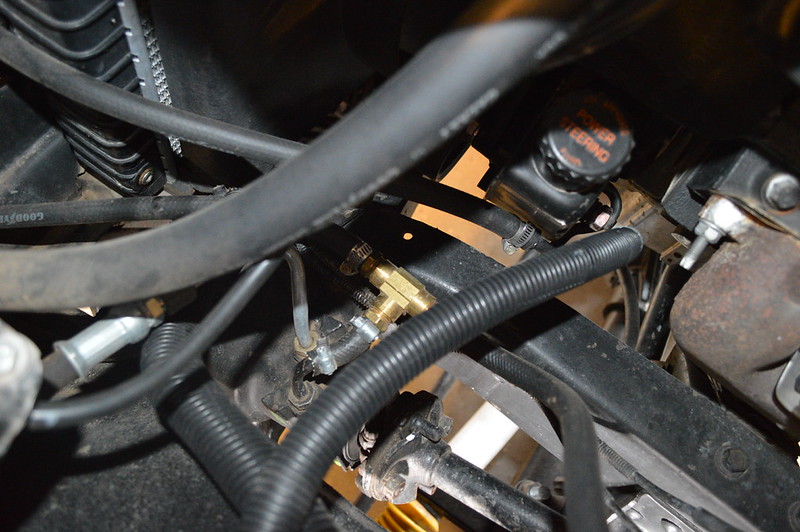
Here is my tee fitting near the return port at the steering gear. Return fluid comes from the booster to a tee fitting at the steering gear return then goes out to the cooler then back to the power steering pump reservoir. I had originally planned to use the ZF power steering pump like in the CAD above but it wouldn't fit in between the the bracket and ORD steering box brace :doah:so I had to stay with the Saginaw pump.
8658983580_de57a5ed8e_c.jpg


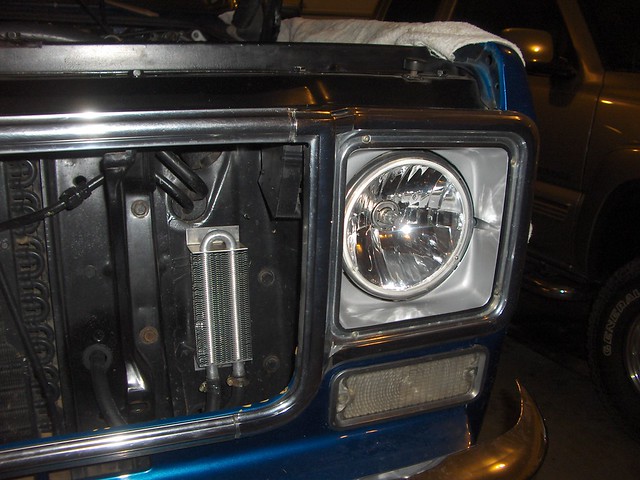
The other side where the return lines come to the cooler. From the cooler, the return goes to the reservoir.
5282045108_390faf88c6_z.jpg


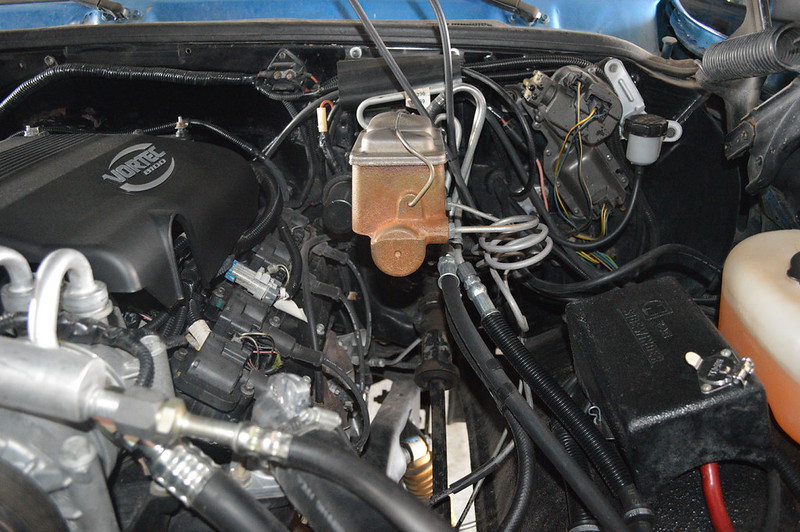
Like dremu, I too had to reverse the brake line positions on the new master cylinder. Many people do not replace the master cylinder when doing a hydroboost swap. I am a believer that if you install a hydrobooster, the correct hydroboost rod and master cylinder should also be used. Otherwise, goofy idiosyncrasies with pedal positions and stopping performance pop up.
8658986214_180393b3f5_c.jpg


I’ve been running mine like this going on 3 years and about 20,000 miles with no issues. Even at 8,000 lbs. the truck will lock up all four tires while still being able to steer.

Anybody have pedal return problems that just fixed themselves after the booster burped some air or something?

Yes, I do believe it is possible for a problem to cure itself if there was an air bubble trapped in the system someplace. I been in the service engineering side of automotive/truck manufacturing industry for 17 years and when I started my career I worked at GM’s Technical Assistance Center in Detroit where we used an alternate bleed procedure on vehices equipped with stubborn hydroboost or hydromax brakes.

The alternate bleed procedure is to raise the vehicle, engine off, reservoir cap removed, grab the wheels and slowly turn the wheels from side to side 15 to 20 times. What is different about this procedure is the fluid is being moved around by the input at the pitman instead of the steering shaft. This causes the fluid flow differently and will get out any stubborn air bubbles the standard procedure won’t. In fact, when I personally open hydroboost systems I always bleed the system this way rather than the typical turning of the steering wheel procedure as I have found turning the steering wheel with the engine running turns out to be a waste of time where the system is still noisy, steering and brakes work spotty afterwards while it takes some drive time to get the rest of the bubbles out.

GM’s bleeding procedure from their service manual.

If equipped with hydro-boost, fully charge the hydro-boost accumulator using the following procedure:

Start the engine.
Firmly apply the brake pedal 10–15 times.
Turn the engine OFF.

Raise the vehicle until the front wheels are off the ground. Refer to Lifting and Jacking the Vehicle.
Key on engine OFF, turn the steering wheel from stop to stop 12 times.

Vehicles equipped with hydro-boost systems or longer length power steering hoses may require turns up to 15 to 20 stop to stops.

Verify power steering fluid level per operating specification. Refer to Checking and Adding Power Steering Fluid.

Start the engine. Rotate steering wheel from left to right. Check for sign of cavitation or fluid aeration (pump noise/whining).

Verify the fluid level. Repeat the bleed procedure, if necessary.
 
I'm sorry, Larry. Were you saying something useful? I couldn't stop staring at the clean engine compartment and 8.1.

Seriously, I didn't know to "pre-charge" the booster or that turning the wheels could work better. Thanks for the ideas.
 
It turns out this was a simple issue of mechanical interference. The bolt through the brake pedal that holds the switch bracket on was hitting the steering column. There is just enough play in the top pivot bushing that whether or not it got caught depended on how I had put my foot on the pedal. I added a washer under the bolt head and now it works great. So no need to reduce the pump flow and no need for a reman booster. All of the pick-n-pull parts are good.
 
It turns out this was a simple issue of mechanical interference. The bolt through the brake pedal that holds the switch bracket on was hitting the steering column. There is just enough play in the top pivot bushing that whether or not it got caught depended on how I had put my foot on the pedal. I added a washer under the bolt head and now it works great. So no need to reduce the pump flow and no need for a reman booster. All of the pick-n-pull parts are good.

Cool! Cheap and easy fix :waytogo:
 
Top Bottom