CK5
Register an account today to become a member! Once signed in, you'll be able to participate on this site by adding your own topics and posts, as well as connect with other members.

Need help figuring out exact specs. on '90 Jimmy 1500

The Vortec heads will take any standard small block exhaust manifold or aftermarket header. Same port configuration as always. Here's an example of the intake.

8103n.png


Notice the center four intake bolts are gone. The remaning 8 bolts go in at a different angle than the original small block. They go in at a vertical orientation rather than perpendicular to the intake face on the cylinder head.

The pic shows a GM performance intake which is probably the most expensive choice for a TBI vortec intake. There are other aftermarket options out there that are less.
 
Thanks, That helps a lot. All I could see was me buying a set of headers, and other stuff, then something happens and I have to change out a bunch of stuff that I just bought.

I've got my '95 P/U sitting right beside it. I don't know where my mind has been. I have a set of jumpers made out of #2 welding lead about 15 feet long if I'm not mistaken. Where is the fuel pump relay/fuse located? If it's the engine is stuck, then I can get something in the cylinders. Before the multi-viscosity oils we would use a mixture of 30 HD and either Marvel mystery or Kryoil oil and squirt it all around the piston to get all of the rings. Is there something made spacifically made for this? I plan on putting some break-in additive (zinc?) in the new oil when I get to that point. We used to use Castroil. That's what we were using when the heads oil return holes clogged. Should I change? Regular oil or multi-viscosity, maybe 20w50 since there might be some turning it over before it runs. Any other suggestions, especially about the first oil I'm going to put in it? When I prime the lube system, how long and how high of pressure should I shoot for? I've never brought one back that's been sitting this long. Paul
 
I was thinking that since separating the exhaust from each bank would reduce the volume of gas through everything from the converter back and slow it down in pipe of 2 3/4 inchs. Duals with a slightly smaller diameter (about 2 inchs) would reduce backpressure and increase gas flow speed which would help scavange each side, wouldn't it?

One thing that hasn't been brought up: is the reduction in back pressure going to be a problem?

it looks like that they could have atleast joinded the two exhaust pipes at an angle. Nothing fancy, just an angle so the exhaust would at least be pointed in the right direction.

I'm planning on getting the prom done, but shouldn't I wait until I get close to the final configuration? I know a guy that I used to work with that can write the chips, he just doesn't know cars at all and he's a real jerk and that's being nice. I probably know some others, but there again, they don't know anything about cars.

There are a LOT of physics to exhaust. Do they matter for an engine making ~215HP? Pretty much no. Cost and complexity are far more worthwhile considerations on a low RPM truck motor. One exception is headers IMO. 15-25HP from a swap that simple is hard to pass up, and long tubes help torque production, which is important.

Check this chart out: http://www.exhaustvideos.com/faq/ho...ing_wp_cron=1482100822.5520339012145996093750

Read this. Vizard is a pretty smart guy: http://www.superchevy.com/how-to/exhaust/0505phr-exh/
http://www.superchevy.com/how-to/exhaust/0505phr-exh/
Generally, you are wasting time with anything downstream of the headers. The cost of making improvements isn't worth it, unless you are measuring hundredths of a second in a quarter mile. Your exhaust pipe theoretically should be necked down as it gets further from the engine, as the gas cools and takes up less volume. This would help velocity. No one I know of has the tools to accurately determine where you'd want to reduce diameter, so we compromise. This is why GM spent little time making the exhaust "perfect". The MPG or power gain coming from spending $10 more per vehicle wasn't/isn't worth it.

Here is something that explains why the myth of backpressure necessity is exactly that: http://www.gomog.com/allmorgan/exhaustbackpressure.html

I would agree with waiting on the chip, but you aren't going to be able to have someone burn one for you that doesn't know cars, unless you provide them all the data and know what needs "fixing". I believe Howell burns chips after you provide them data.
 
Having owned the exact combo the thought that I keep coming back to is this. Get it running correctly, and go from there.

It hasn't run in 8 years. No point talking about modifying something that doesn't run. Exhaust theory...really? Cylinder head flow characteristics? Again...really? Custom PROM chip, for a non running 350?

Do all the diagnostic stuff first, like a compression test, leak down test, oil analysis. If those tests look good do all the tune up stuff. Plugs, wires, cap, rotor, coil, fuel filter, timing, and get it running. Check for codes. Once you get it started maybe aim a temp gun at the catalytic convertor. A plugged cat can kill power like nothing else, and maybe that's what happened 8 years ago.

Get it back to tip top shape and stock. A TBI 350 isn't gonna "do wheelies" but it isn't anemic at all. It made at least 50 hp more than the 4 bolt main 4 barrel 350's found in trucks of the early 70's until the middle 80's.
 
You're right, I'm a creature of habit. In a group of comparable size/weight cars my view changed constantly. The numbers that are being done today really makes the cars of yesterday that we had to do all kinds of things to just to turn a high 12 or a low 13 seem extreme. I'd hate to say what I had tied up in mine. The creature of habit thing is that if I go at something, I don't know how to go less than 110%. If I'm not that interested, if I start it, I'll quit and sell it or give it away. So, I've got to start thinking this thing through. I haven't read the stuff that you listed, but you can bet that I will.

The exhaust thing has always been a place for cheap horsepower or more bang for the buck. I don't know that any of this is cheap. I understand that the longer primaries on a header help torque and scavaging, but at the lower rpm's that I'm anticipating using can't it bite you by the lower volume from lower rpm's, and the same with the rest of the exhaust system. It's probably not feasible, but I'd like to run an exhaust like I used to. Fenderwell headers with 30 inch (?) primaries, 3 1/2 inch collectors, about 2 feet of 3 inch (?) pipe, muffler (large oval) about 18 inches long and a 45* mandrel angle that dumps out right in front of the rear tires. Little or no back pressure.

And I'm back in my earlier days again, insert profanity here.

I think that I might try to see if it's stuck tomorrow. Where are the fuel pump relay and fuse and are there any backdoor circuits that can still let the pump come on?

What about the oil and I'm planning on a zinc additive for start up, just to be sure, unless somebody has a better suggestion. I know that there's probably something better and newer than what I know about, so, y'all tell me what's out there and works.

Thanks, Paul
 
See if it's stuck before you worry about oil or additives. If it is stuck, oil quality won't be your first concern. :deal:

There is a backdoor for the fuel pump, you can apply 12V to one of the pins in the ALDL (OBD1) connector for testing purposes. But that won't interfere with what you're doing unless you supply the 12 volts.
 
The oil and additives suggestions are for if it turns. If it doesn't, what do they use now for the penetrating oil in the cylinders. Surely you would want an oil heavier than a regular penetrating oil so when/if it broke loose there would be some real lubricant in the cylinders. I was also thinking about a zinc additive. That cam has been sitting with the lifters on it under pressure for a long time. Better safe than sorry. It can't hurt anything, can it? Like I said earlier we mixed some oils and if it didn't turn immediately then we would let it sit and then break it loose in a day or two.

The oil and additives I'd like to know what to pickup because I don't live in the city, so I try to plan my trips.

I guess that I should explain what I mean by a back door circuit. I can't remember the brand/model, but if your buddy left you in the car and went somewhere and took the keys. You could turn the radio on, turn on the wind shield wipers and the safety flashers or turn signal (can't remember which) and you could listen to the radio. It did go up and down some but you could listen to it. There were others that I can't remember, some were dangerous. The odds of it happening was remote to say the least.

Good night, thanks, Paul
 
If the engine is seized plain old diesel fuel works to get them unstuck. pull the plugs, squirt in some diesel...let it soak for 24 hours. Gently try to turn it, if it doesn't want to go, add more diesel to each hole. Wait another 24 hours. Lather, rinse, repeat. The 261 cid six cylinder in my 57 Pontiac took 5 days of soaking to break it free.
 
Good Mornin' Y'all, I've heard y'all each time I've been told to get it loose first. I fully plan to. I might put some oil in the cylinders first to try to keep the scarring to a minium, but I have to go to town to get most anything other than regular oil and a lot of that is for tractors/diesals and I know that it will work for a little while. I'm the type that has to make a plan for each contingency. So, I am planning on breaking it loose first. It might not be stuck, but I think that I might like some oil or something so the rings aren't dry, it's been 8 years or more.

tRusty, thanks, I don't know why I haven't thought of that. I've seen diesel and oil used to start a tractor. Don't know why they added oil unless they were trying to get a little more compression.

Ok, I'm now past getting it turning first. Now I'm back to the oil and possibly additive like zinc unless y'all can come up with something better. Which brand of common oil that I can get most anywhere would you suggest. I like Royal Purple and we also used Wolfs Head but, I can't find that in the country. I'm a little skittish of Castroil even though it's been years since the heads clogged. I may eventually go to a synthetic blend or possibly full synthetic down the road. I want to take one step at the time.

Now, what sooper dooper additive, preferably with a self sacrificing material like zinc for things like the cam that's been sitting for so long. It probably wouldn't hurt the oil pump gears either.

I'm just going to see it move a few degrees then do the oil and filter. STP had a filter that the core was like it was wound with several layers of yarn and filtered very well, but would clog up because it was filtering so well. I haven't seen that filter in years, so what is the latest greatest thing in filters?

Thanks again everybody, I really do appreciate all of the help and jogging my memory too, Paul

P.S. If some of this doesn't exactly make sense, I haven't had my first cup of coffee, YET!
 
Didn't read close, but what makes you think it would be 9.5:1 compression?
 
I went trying to find the site and can't. I looked at several looking at different combinations of long/short blocks, heads, etc. I knew that it didn't seem right. I guess that I must have gotten the compression ratio for a rebuilt engine. I think that I wrote earlier in this thread that it seemed high and I was expecting the original engine to have 8 to 8.5 compression ratio.

I'm thinking that it was my mistake. If by chance that I find a site that claims that that engine originally came with 8 or 8.5 compression, I'll post it. I'm really thinking that it must have been my mistake.

What are the compression ratios for std. new engines and the high performance ones like the manufacturers and the aftermarket builders (Shelby, Rauch, etc.) are putting out?

Paul
 
Excuse the mistake: If I findthe site that says that engine originally came with 9 to 9.5 compression, I'll post it. I'm really thinking that it was my mistake.

Paul
 
Good Morning Everybody,
I got all of the OEM owners manuals, maint. schedule, warr. etc. and no where in them, owners manual especially is there a fuse that says fuel pump or relay that I can find. In the owners manual the fuses are on pages 5-28 and 6-6. There's not a relay, fuel pump fuse or any other listing that I can find for dis-able the power to the fuel pump. Would someone please tell this old blind man where one or the other or better yet both are located. I do have a fairly new pair of wire cutters and connectors or a soldering iron and solder. All jokes aside, this is why I asked about hidden power paths, I've been through something similar before. I do know that I can dis-connect the battery.

Looking for education, Thank You, Paul
 
Good Morning Everybody,
I got all of the OEM owners manuals, maint. schedule, warr. etc.

Ahh...but you don't have these? http://67-72chevytrucks.com/vboard/showpost.php?p=5621043&postcount=1 Make sure the ones you download are correct for your truck though. I noticed one of the '87-91 R/V manuals was actually for the C/K series (1988+ IFS trucks) after download. Any of the R/V manuals for the '87-91 trucks are going to be pretty spot on, however you are better off sticking with the '90-91 manuals, since the speedometer/VSS setup on the 90/91 was different than '87-89.

The parts and illustration manuals often come in handy for me as well.
 
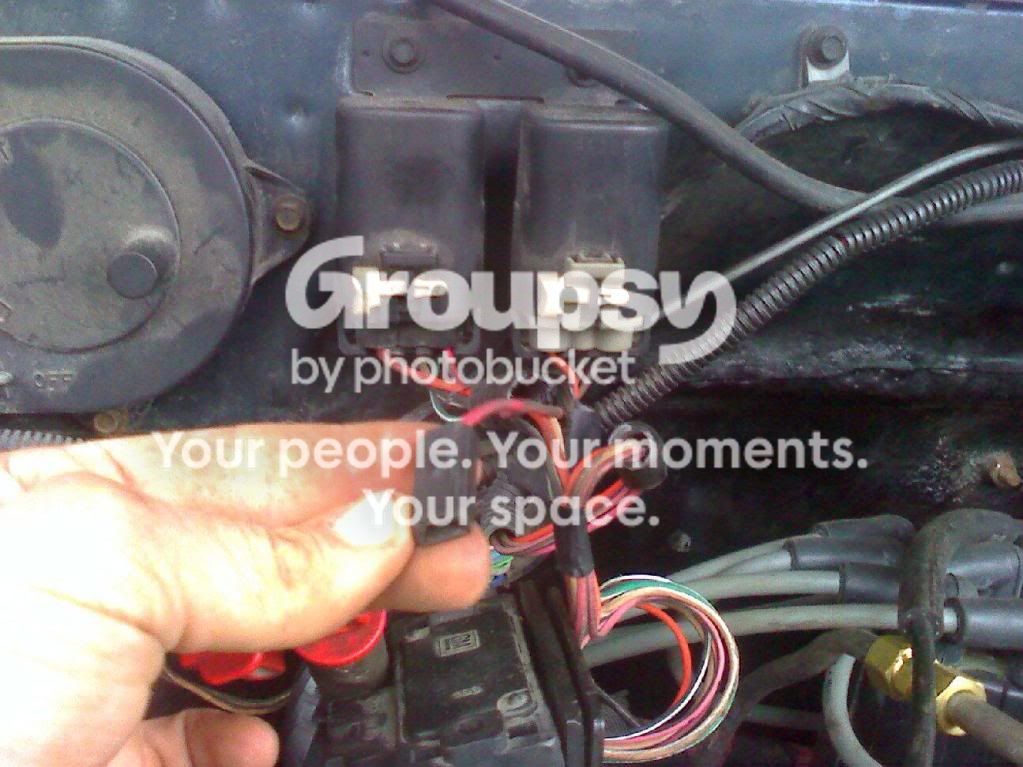
Relay is mounted on the firewall, passenger's side. Should be a jumper to let you test the pump.

unknownwire.jpg
 
Thanks Blue, I'm not worried about checking the pump. I do not want it to come on for any reason. The tank is about 1/2 full of 8 year old something. I don't want to take any chance of pumping it into the fuel lines, clogging the pump or strainer or if there's any scum/scale in the fuel line, I don't want to push it into the TBI. I'm going to drain the tank and pull it for inspection. I found some stuff called Evapo-Rust that works. It has instructions on the jug about cleaning and de-rusting a fuel tank.

Doesn't it strike anyone other than me strange, that there isn't a fuse, atleast not labeled, for the fuel pump or the power to the fuel pump relay? The fuel pump relay has got to have a fused power source, doesn't it? It's got to be coming through a fuse . Does anyone know which one. Another perfect example of GM having a "Backdoor or Unmarked" power source for something.

In the pic you say that the relay on the left is the fuel pump, what is the one on the right because it looks like some of the wires are common?

Thanks again Blue, Paul
 
Blue, I was going through the sales brochure on this site when I found the 9.5 to 1 compression by accident. I did make a mistake, it actually says 9.3 to1. The note at the bottom of the colom says: vehicles of 8500 lbs or below. I haven't looked, but this thing can't weigh over 8500 lbs. can it? I have my doubts about several specifications for this vehicle.

Later, Paul
 
That could be CVWR, meaning it's rated to tow like 3000 or 3500 lbs.
 
With this OLD, piece/junk computer, and I use the term loosely, very loosely, the resolution and my eyes (glasses) it's hard for me to see. For some reason I can't get this thing to enlarge. I even got the magnifying glass and still can't tell. I'd never heard of CVWR before now.

The table that I'm looking at is in the '90 brochure at the top of the power section. I think it's the first first vertical line. The note at the base has the info that I thought said 9.3 compression. Somebody look and tell me what the notes say. I'm sure that y'all are right. I had said on Monday, Dec. 2nd that if I found the place where I read it that I'd post it, that's what I did.

I should quit with this thing and stop embarrassing myself, but I do like making people laugh, even if it is at me!

MERRY CHRISTMAS, HAPPY HOLIDAYS
TO EVERYONE,
PAUL
 

Latest Posts

Top Bottom