Break-in for a roller cam is about seating the rings like
@Bent77 mentioned. You need to drive it. The keys are to avoid excessive idling and vary the engine load and speed. This is the recommended break-in for mine from ATK:
- First 200 miles:
- Vary speeds and load.
- Occassional full throttle rolling start from 2000 to 4500 RPM
- At 200 miles:
- 5 to 6 medium throttle acceleration to 4500 RPM, let off and coast down to 20mph and repeat
- Couple of hard throttle accelerations to 5000 RPM, let off and coast down to 20mph and repeat
- At 500 miles:
- change oil and filter. Use mineral oil with zinc additive
- 500 to 1000 miles:
- normal driving staying below 5000 RPM. No hard use, heavy loading, or extended idling.
- At 1000 miles:
- Change oil and filter. Use mineral oil with zinc. No synthetic until 4000 miles.
So you can drive it, just need to do a couple of things for proper break in of the rings.
Some interesting info about break-in regarding piston rings from Amsoil
https://blog.amsoil.com/why-you-should-be-wary-about-using-break-in-oil-in-powersports-equipment/:
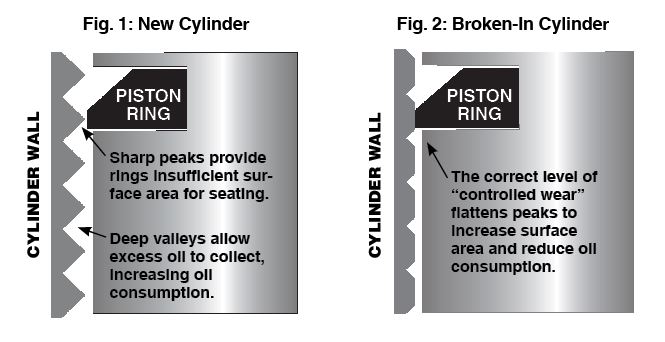
Sealing the piston rings when breaking in an engine requires allowing the rings and piston skirt to carefully wear down the peaks (called asperities) on the cylinder wall.
The images show what we mean.
Although a new or freshly honed cylinder appears smooth to the naked eye, it contains microscopic peaks and valleys. If the valleys are too deep, they collect excess oil, which burns during combustion and leads to
oil consumption.
The sharp peaks, meanwhile, provide insufficient area to allow the rings to seat tightly. That means highly pressurized combustion gases can blow past the rings and into the crankcase, contaminating the oil and taking potential horsepower with it.
“Controlled wear” helps flatten the cylinder-wall asperities, providing increased surface area for the rings to seat tightly. The result is maximum compression (i.e. power) and minimum oil consumption.