CK5
Register an account today to become a member! Once signed in, you'll be able to participate on this site by adding your own topics and posts, as well as connect with other members.

Panhard with leaf springs?

sled_dog said:
btt, looking for other constructive advice on this subject.
The advantage of a front Track Bar/Panhard Rod is axle stability under lateral forces, primarily while cornering, and especially on lifted rigs. They make for a much safer and controllable ride on the road that I’m sure all of you would agree is desirable. The concern is that offroad performance will suffer. This same argument has been made for anti-sway bars, and there is a readily accepted solution being commonly used: Quick Disconnect Links. Anybody’s gears turning now?

A couple of ideas:
1. A two piece slider Panhard that can be locked. It could be as simple as one tube inside another that are drilled through so the can be “pinned” to lock them together. There are tricks to making it easy to line up the holes for pinning, but a better solution could be a clamp system.
2. A hydraulic system that can be put in hydraulic lockup. If your gears are turning now, I’ll leave you to imagineer the design, I’ve got my design. :thinking: :screwy: :dunno:
 
Mountain Offroad has a bar they call the slip lok (I think) for yj's. I know the guy that developed it a few years back and it works OK but it's one more thing to "adjust" when you hit the trail and I'm not fond of adding things to adjust when you get to the dirt. They use a clamp system. I have another friend that mounted a stiff shock as a panhard bar and it seemed to work OK but of course on a sweeping corner it would move and your funny steering persists. And I imagine it would add some to the over damping.
One problem with that is at what point do you call it a trail? Some roads ease you into the hard stuff, so if you stop and disconnect everything at the 1st sign of dirt you're going to have a lot of sloppy handling on the gravel road to the obstacles. Same thing with the fun higher speed stuff between hard spots.

I have some methods for letting you run a panhard with leaves and not bind up but I'll have to run some numbers to see if it's something that would be anywhere near commercially viable. It could be a bunch of work to do and some expensive parts to buy to do something simple and maybe not worth the effort.
 
In genral questions

Just asking, about the front shackle setup,
But has anyone tried welding a plate between the shackle plates, or would that cause way to many other problems?
would this at least lessen the damage to the bushings?
I have the same problem. I've got the BBC, d60, moved the shackle mount forward, crossover and hydro assit,I used to trash bushing everytime out, I added the hydro assit and now it's about every forth or fifth trip.
I also went with the most backspacing I could get, cause, doesn't the center of the tire further from the kingpins mean that the tire is now turning on more of an elipsis than a single point, or smaller elipsis?
Doesn't that cause more leverage against the steering box?
Meaning that the steering is trying to push the tire out instead of turn the knuckle because the tire is so far from the pivet point?
James
 
Btwn the plates of the same shackle, or btwn the inside plates of both shackles? Both have been done in some form or another.
Btwn the inside plates was done by IHC on the front of later Scout II's to gain some roll spring rate (swaybar effect).

The distance from the point where the steering axis hits the ground and the center of the tire's contact patch is called the "Scrub Radius."
In high speed uses this can be a bad thing b/c rocks more easily deflect the tire b/c of the increased leverage distance.
In crawling uses it can by a good thing. The steering axis is at an angle to the ground so turning from straight ahead casues one side to raise up and the other side to lower down. We've all seen people 'Hunt" for traction by turning one way and then the other. This is the mechanics behind why that works. Weight shifts from the "lowering" tire to the "raising" tire, causing it to have more traction.

Even though the tire rotates around the steering axis in a circle, b/c that axis is at an angle to the ground the marks made by the tire will be slightly elliptical. It's like cutting a round rod at an angle, the actual shape of the end of the rod is an ellipse.
 
I think the bar is needed with a rear set-up like my springer set-up...however i allways tweak the bar and end up bending it straight so i am thinking of doing limiting straps.

Doug W.
 
I did the SAS thing, and I don't have the panhard on, and other than no sway bar, it drives fine. Don't need one.
 
Seems to me that a pretty effective use of a panhard would be to set up the springs for max flex. Open the clamps, shims between the leaves, long springs, long shackles, etc, stuff that is going to make it handle better slow and worse fast. Then you get travel/flex and having the springs all long and loose means they won't fight/bind with the panhard when it arcs. Panhard being as long as possible to reduce arc of course.
 
My .02 is that a pan hard rod works well enough...keeping in mind that leaf springs are not the perfect ideal setup. My rig not a 90s body sas, but has 52" springs. I had to run a pan hard b/c at the time, my bushing were worse than shot.

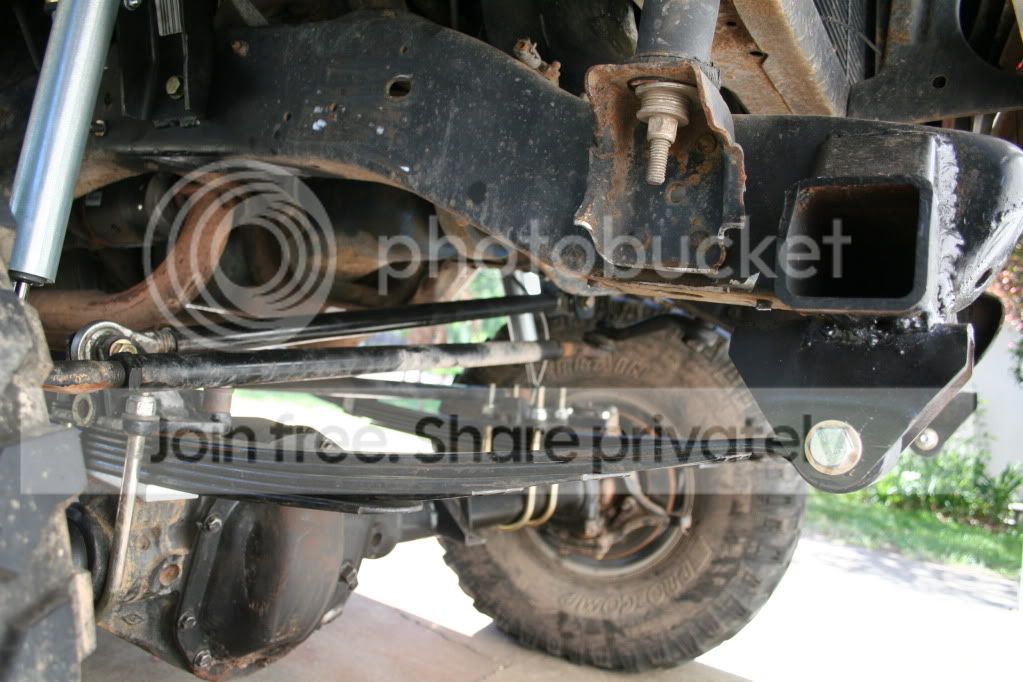
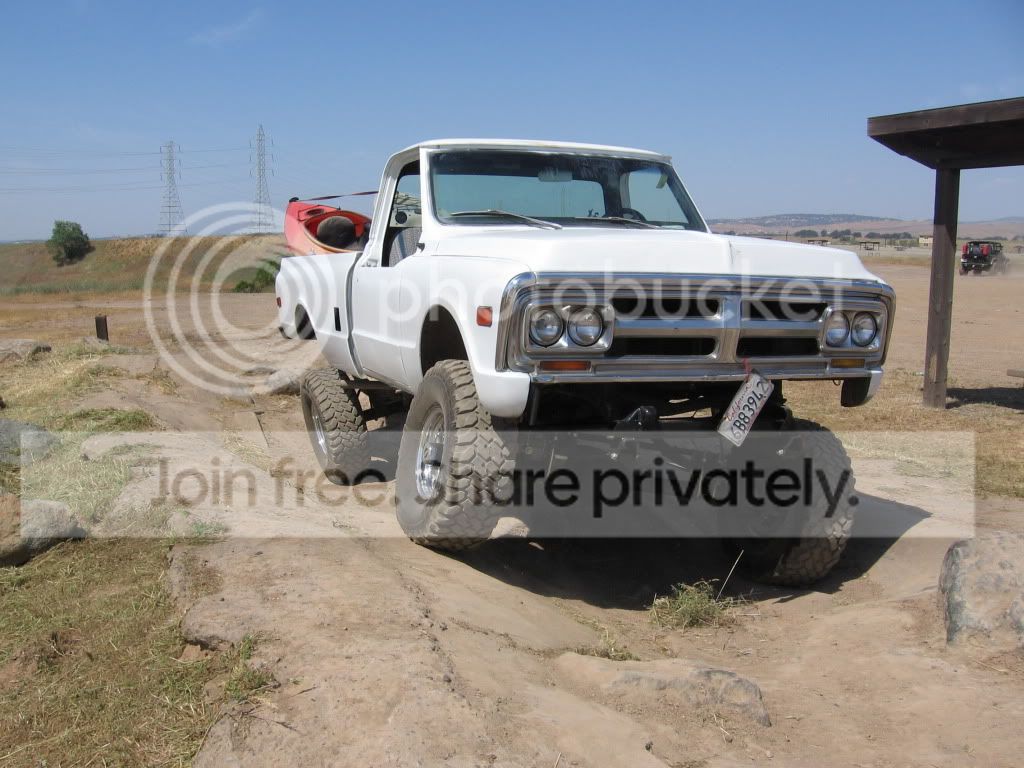
Here was my old setup (bad welds and body lift are now fixed)
Picture051.jpg


here you can see that my springs flexed just fine. The pan hard did not limit flex. (Front flexes good, rear flexes good, frame flexes great) I kept my drag link and pan hard nearly the same length and slightly different angle. Surprisingly it didn't have hardly and bump-steer.
sacramento2008020.jpg
 
Last edited:
Top Bottom