CK5
Register an account today to become a member! Once signed in, you'll be able to participate on this site by adding your own topics and posts, as well as connect with other members.

Pinion Angle Shims Question

paratrooper307,
I have a set of aluminum but don't want to add them because I have heard that they will compress at the least and fly out at the worst. Don't buy cheap at JCWhitney! Lessen learned!
Wes
 
I've got DIY4x 8* shims on mine. I don't know that I'd want that on top of blocks. As has been said, re-welding the perches is the best long term solution and I plan to get back to that eventually. Even though I have a good welder, I don't know if I trust myself with this job since it's critical. I like the idea of getting it all set up and then tacking it, but don't you still need to get the perches in the right spot left to right? I know when I install my springs I sometimes have to give them a yank in or out to get them into the perch. Also, how much risk is there to warping the tube or something with too much heat?
 
Mastiff,
Measure from the backing plate to center of perches and it will get you back to center every time. As for the welding, just don't go full hog on the welding and take it in steps and it will be fine. Those tubes are beefy and can take some heat but still go slow with it.
Wes
 
The tubes are very thick. Welder won't hurt them. The aftermarket perches are thinner than the tubes. As pierce said, measure from backing plate. If your total perch distance is a 1/4" off, but they're the same distance to the backing plates on both sides, your axle will still be centered.

If you go 8 deg shim, just make sure they're steel.
 
Chris,
I have a 4 degree shim already installed and the angle is still visibly off. Used an inclinometer on the shaft and the differential and it says they are still about 4 degrees off.
Wes
This implies you're doing it wrong, because you said you got rid of the C/V shaft. The pinion should be parallel with the T-case output with a standard shaft. The driveshaft angle can only be adjusted by changing the amount of suspension lift or altering the wheelbase (or lowering the T-case to a lesser extent). Getting the angle out of the rear U-joint is for a C/V shaft. Make sure you're looking at the right angles before buying shims - but ESPECIALLY before cutting perches.
 
Blue85,
I must have misspoke somewhere along the line because I have a C/V drive shaft installed. The 10 bolt I had in it when I bought the Blazer was shimmed 4 degrees with the C/V drive shaft. After I swapped in the 14 bolt, I kept the same drive shaft and 4 degree shim but it vibrated horribly at highway speeds. I re-measured everything with the old setup and discovered the new 14 bolt needed an additional 4 degrees of shim to get the pinion at the proper angle.
All of this is about to go out the window anyway because I just ordered a DIY4X4 shackle flip kit and new perches to get it done RIGHT this time. :)
Wes
 
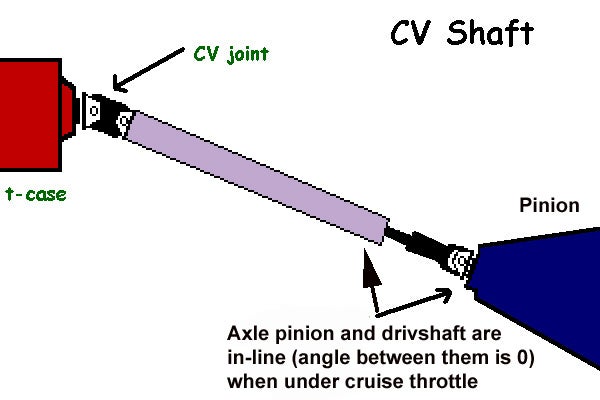
If you're running a CV shaft the pinion should be pointed at the T-Case.

degreecv.jpg
 
^This. You also need to make sure the CV can handle the angle without hitting it's stops. With just 4", you should be fine. Also, depending on which online tech article you read, you should point the pinion down 1-2 degrees from the driveshaft. Under cruise speed, the torque will rotate the pinion up to straight with the driveshaft. I split the difference and set it at 1.5 degrees down.

Also, when you get to that point, it's hard to find a good surface to measure the pinion angle. The most precise method I found - Measure driveshaft angle with it bolted up, then remove the shaft at the pinion yoke and measure vertically on the yoke surface the straps bolt to. Add or subtract 90 deg and you'll have an exact measurement of the pinion angle.
 
Rebelgregory,
I'll be sure and remember to measure it that way. Not sure how to measure to keep from bottoming our the slip yoke, but I only have 4 inches of lift.
Wes
 
Someone may chime in with a better number, but mine has about 1.5" from bottoming out. The driveshaft will obviously swing in an arc under suspension compression, but so does the axle since the front spring eye is fixed. I don't believe the difference in these two arcs is more than 1.5". Before I moved my axle back 1", I had like 1/2". That wasn't enough for my taste. But I've never done the geometry math.

Maybe one day, I'll get a SYE and it won't be an issue.
 
Someone may chime in with a better number, but mine has about 1.5" from bottoming out. The driveshaft will obviously swing in an arc under suspension compression, but so does the axle since the front spring eye is fixed. I don't believe the difference in these two arcs is more than 1.5". Before I moved my axle back 1", I had like 1/2". That wasn't enough for my taste. But I've never done the geometry math.

Maybe one day, I'll get a SYE and it won't be an issue.

I think the slip length is not much of an issue in the rear. The axle moves forward as it goes down, so there is little change in driveshaft length. The front is a different story, since the shackle is fighting you and making the extension situation worse. When I get around to ordering my front shaft, I'll probably spend the money for the extra long splined section, just to be safe.
 
Blue85,
I must have misspoke somewhere along the line because I have a C/V drive shaft installed. The 10 bolt I had in it when I bought the Blazer was shimmed 4 degrees with the C/V drive shaft. After I swapped in the 14 bolt, I kept the same drive shaft and 4 degree shim but it vibrated horribly at highway speeds. I re-measured everything with the old setup and discovered the new 14 bolt needed an additional 4 degrees of shim to get the pinion at the proper angle.
All of this is about to go out the window anyway because I just ordered a DIY4X4 shackle flip kit and new perches to get it done RIGHT this time. :)
Wes

OK, this all sounds good then. Running a C/V and shackle flip go well together because of the angles. Usually with a K5 the 4" flip puts it pretty close - you might decide not to cut the perches after it's done.
 
So I made it back into town last week from work. My DIY4X4 shackle flip kit was waiting on the door step. After tearing down the rear end completely and shelving the 4 inch lift blocks, I started the daunting task of taking the old leaf spring hangars off the frame. Hammer chisel was going slow so I started to use the 4" angle grinder. After getting covered with sparks and having the gas tank so close to the work, I changed my mind and went back to the hammer chisel. After 2 hours, the hangars were on the ground. I fit up the new hangers and noted that my Class 5 trailer hitch was in the way. I ended up removing the rear bumper also to get better clearance from the rear of the truck frame. My Dad showed up and helped me work on the hangars and since I was trying to get the frame brackets in on the inside of the frame without dropping the gas tank (which was 3/4 full), he suggested in his infinite wisdom that it would be really easy to get to the brackets if the gas tank was lowered. So, the gas tank came down and after working the brackets for about an hour they finally were bolted in. I went to bolt in the Class 5 trailer hitch and noted that the front mounts were on top of the new shackle flip brackets. I am going to have to drill through the bracket in order to finish bolting in the Class 5 hitch. Also, the drivers side emergency brake line had to be re-routed over the leaf spring due to it being in an extreme bind under the leaf spring. With the leaf springs, 14 BFF axle, and drive shaft all mocked up but not bolted together, I had the full weight of the blazer on the axle and took new angle measurements. I was 5 degrees too far down. Out came the old steel 4 degree angle shims and I got it to 1.5 degrees down. Not quite the 2 degrees that I wanted, but should work. Also, the slip yoke on my cadillac double cardigan driveshaft only has about an inch and a half space from bottoming out. That may be a problem if I do some serious wheelin', but I only plan on driving it mildly for right now till I get it fully tested. The new perch springs are still sitting on the shelf in case I get the urge to get rid of the 4 degree angle shims later.
 
Good job getting it done. Have you had a chance to drive and check for vibrations?

The caddy C/V slip yoke isn't splined all the way through, so it does need to be set a little deeper in the T-case than a standard slip. You should be able to do a little math to see if it can hit. You may need to set the bump stops accordingly.
 
Funny how things escalate isn't it? Always the snowball effect.

1.5" might be a non-issue for the rear driveshaft since the axle moves forward as it comes down. I suggest you try to jack up the frame in back and see what hits first. You might be surprised. In my case, the shocks hit way before anything else in the rear :doah:, and the driveshaft bound up on the exhaust crossover pipe in front :doah:. The only good answer is that the springs stop flexing, or you are stopped by limiting straps.

EDIT: Oops, I was thinking about droop, but you were talking about compression...
 
Blue85 - The driveshaft vibration has virtually went away unless I am driving 75 to 80 then it I can feel it a little bit. But I won't be driving it that fast too often to worry about it. No bottoming out the driveshaft during normal driving. Haven't had a chance to flex it to see how it acts though. That will be later. Now I am having another problem with ratcheting noises coming from the rear end. I am thinking that it is my Grizzly trying to lock and unlock while driving straight. Weak spring I am thinking? That will be another thread I am starting.
- Wes
 
Top Bottom