CK5
Register an account today to become a member! Once signed in, you'll be able to participate on this site by adding your own topics and posts, as well as connect with other members.

School me on transmission and oil coolers. (Few questions)

shady

1 ton status
 Premium
Joined
Jul 31, 2010
Posts
21,290
Reaction score
28,345
Location
iowa
I believe that the plate style is the preferred type. Is that right?

I'm looking to do an oil cooler on my LS swap. And figured maybe upgrade the trans cooler at the same time.

With the oil cooler, is there a such thing as too big? My truck had a decent sized one in it. But it's full of nasty ass diesel oil. And I broke it getting it out lol.
Was thinking go bigger since I have to replace it. Right now it's a plate style about a foot tall and 10" wide.


And with the trans cooler. The one I have is after the internal radiator one.
I know that's done to heat it up faster in colder areas.
So if I go through the radiator first, and it heats up to 195-210, whatever LS's run at, then through the aftermarket cooler with a fan. The fan would pretty much run all the time :dunno: . They all have a 175-180* temp switch.
Or should i just run one without the extra fan?
I have the older 4l80e with both cooler lines in the front of the case. So I'm trying to give it all the help I can.
 
Theoretically both could be too big, but I suspect practically it's nearly impossible to have such efficient auxillary coolers as to never get above a temp that condensation is evaporated. Exclusively driven short distances of course is a problem no matter what kind of cooling you have.

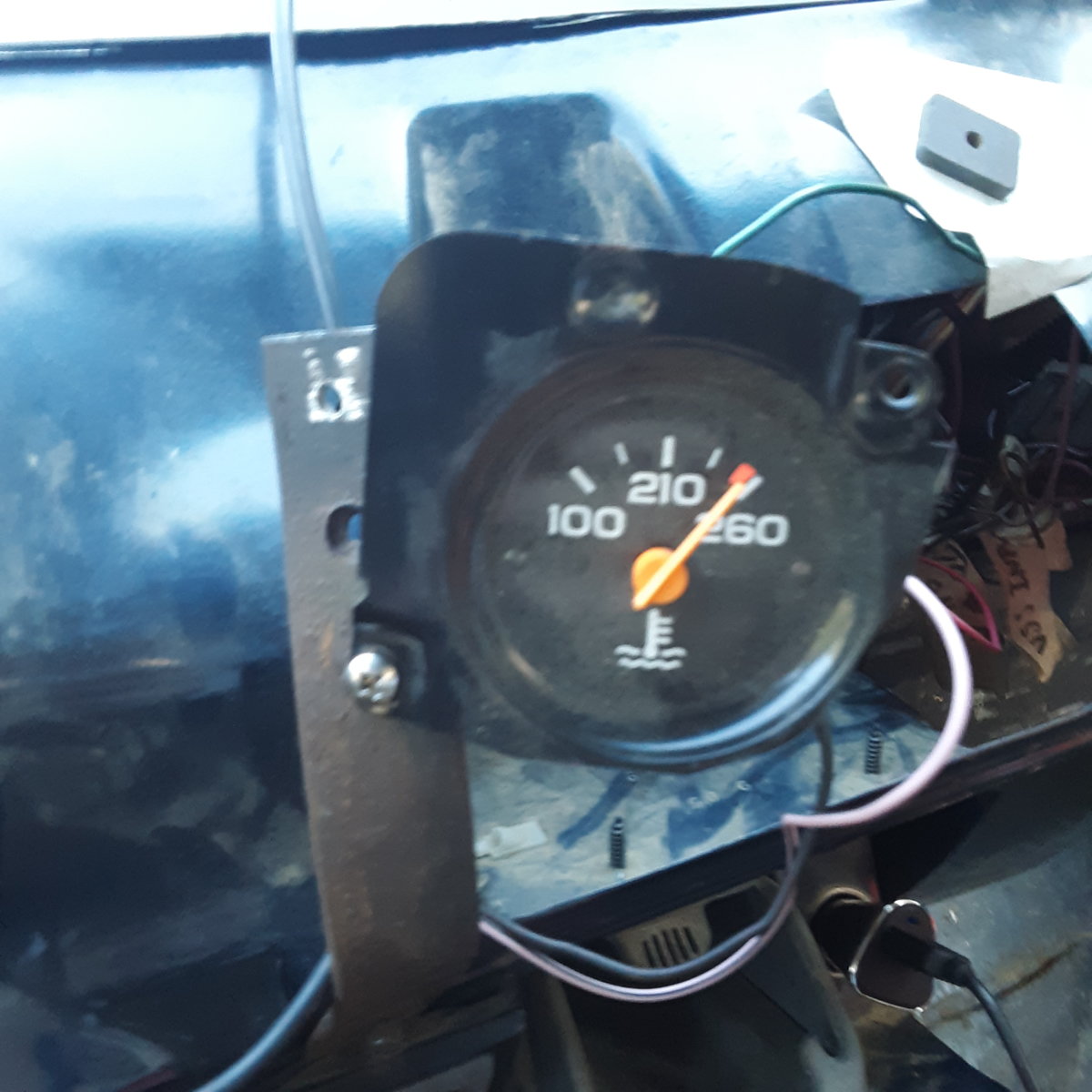
My notes for this pic: "Oil temp after pulling a 2000lb trailer at 65MPH up a mountain pass for about 15 minutes. Ambient temp 40-33* from bottom to top." That's with the K5 at roughly 5200lbs, Vortec 350 long block, manual trans, new radiator, approx 2250RPM. 5qt oil pan, HV/HP melling "big block" (the one made for the SBC though) oil pump, factory gm oil cooler, oil temp sender in pan sump. Coolant temp showed 210* at the same time. FWIW unloaded, but slowly crawling logging roads in freezing temps, the oil read the same temp.

full


At some point I intend to try and replicate conditions with and without the cooler to see if I can quantify a difference in temp.
 
Oil coolers for be never dealt with before. Looks like anything I do there will be better than not having one.
I know trans temps have to be in a sweet spot to be right. Such a thing as too cool, and too hot. Wasn't sure if oil was the same way.
Probably 70% of my driving will be. 13 mi one way, to work and back. Then around town. But there will be occasional road trips. And some general tire floggin here and there lol.
I'm going to try towing with it. If it seems ok ill be towing my crew cab with it a few times a year.
 
Without gauges to monitor this stuff I think you'd be hard pressed to know how much the oil/fluid is being worked. Driving conditions obviously matter, oil temps shadow coolant temp for the most part, any conditions that force the coolant temp up will force oil temps up.

I'd definitely like to see the true efficiency or inefficiency of coolers in action...but obviously application, size, and design is going to make a difference. Personally I'd want to unburden the radiator as much as possible, so fluid cooling after air cooling, as long as the oil or trans fluid wasn't getting too hot being run that way. (In this case I realize oil is not a factor for the radiator)

Many will probably tell you the oil cooler isn't necessary, GM made how many trucks without them? But if mine gets up to 260* WITH a cooler, in near freezing temps and in what I'd certainly consider a very mild application, and (conventional) oil starts to break down at 275*, there isn't much of a margin of error...a cooler might very well make a significant difference. But looks like synthetics at a minimum handle 400*, which means a cooler is almost certainly unnecessary if you run those and that is a true number.

Edit: trans fluid indeed is listed at 170* before damage starts to occur. With a radiator dropping coolant temp down 20* (average) a 195* thermostat makes sense in terms of cooling a transmission. Either way air then liquid cooling makes more sense to me. Fluid heat exchange is far more efficient, the less heat going into the radiator, the more work it can do to cool the engine, and thus transmission, in a vicious cycle.
 
Last edited:
I do not like to run transmission fluid through the radiator. If the radiator transmission tub inside the radiator splits open, then there will be coolant in your transmission, and transmission fluid in your coolant system. This will lead to a major repair.
 
I've never seen that happen. But I'm sure it's possible. I know the trans fluid has to get to a certain temp before the trans acts right.
This one, my 6l80e, and my last auto that I believe was a 4l60e, wouldn't go into lockup until I get to a certain temp.
Usually about 1/3-1/2 of my way home from work.
They say the engine coolant helps it get to temp faster. Probably would be a big deal in like Arizona. But on 0* days maybe :dunno:
 
My understanding:

Auto trans - within reason cannot be tool cool, anything > 170F is too much long term. My 4l80Es won't lock the converter when it's really really cold but I suspect the computer is holding off for the engine temp to come up a bit not the trans temp.

Engine Oil - A byproduct of burning gas/diesel is moisture and some of that ends up in the engine oil. So with this in mind you want the engine oil to get warm enough to help evaporate this moisture off, modern oils can run at thermostat temps indefinitely (well past the normal oil change interval anyhow) without premature oil degradation. Also really cold engine oil is hard to pump and slow to drain back into the pan, so heat helps here also.
 
As someone that spent some years as an over-the-road truck driver, I have been to the Iowa-80 truck stop when it was 20-degrees below 0. In that kind of cold you probably do not need a trans cooler at all. You could just use a piece of trans cooler rubber line to loop the two cooler lines together. If you kept the steel cooler lines routed close to the exhaust manifold the heat transfer from the exhaust manifold to the steel cooler lines might be enough to heat up the transmission fluid.
 
I think I'll just try and find an oil cooler the same size as the one that came out. And the trans I'll just keep the stock aux cooler and add a fan later if need be.
I do want to add a trans temp gauge though.
Never had one until my 2015 Silverado. And realized how nice it was to be able to watch that while towing.
 
I do not like to run transmission fluid through the radiator. If the radiator transmission tub inside the radiator splits open, then there will be coolant in your transmission, and transmission fluid in your coolant system. This will lead to a major repair.
That won't happen, trans fluid will pump in the radiator due the higher pressure of the trans (40psi to 70 psi.)
Coolant is only 9 to 13 psi. I has this happen on a car once. Your trans slips and your dead in the water long before coolant get into the trans.
 
@bigblock454

Is right on the money. You can't have auto trans to cool.
The only function of heat that you need is to burn off condensation.

As far as oil cooling goes. You should definitely have one as well. Since you have an LS and need to Rev it 7 grand to make any power, (you know LS problems ;) )will be generating more heat.

As far as size goes, you still can go as big as you want to. Imo.

I have added a few over the years. I never found it to matter in cold weather much. If you want, there are always cold fronts to.
 
That won't happen, trans fluid will pump in the radiator due the higher pressure of the trans (40psi to 70 psi.)
Coolant is only 9 to 13 psi. I has this happen on a car once. Your trans slips and your dead in the water long before coolant get into the trans.
Welp, I've got a story for you. Coolant in the trans can happen. Just replaced an Allison behind an 8.1 for a customer in the shop for that exact problem.

You are correct with the idea of trans pressure being higher than the cooling system pressure while driving. But what about right after the engine is shut off and the pressure remains during heat soak and the trans isn't building any pressure since the engine isn't running? At that time now cooling system pressure is higher than the trans and fluid transfer goes the other way.

My customer had been nursing a loss of coolant for a month with no dripping on he ground and the engine not running hot. Only brought it over when the trans started acting up. When I checked the trans fluid it looked like a strawberry milkshake. Coolant looked similar.

We dropped the pan to find a semi-solid jello like mass that would not move with pressure in the lines from trying to flush. Trans was junk at that point and we had to move to phase two, replacement of the radiator and trans with pressurized flushing of the lines.

It's the first time we've seen an internal cooler rupture but it was the original radiator from 2001. Stuff breaks sometimes.
 
Welp, I've got a story for you. Coolant in the trans can happen. Just replaced an Allison behind an 8.1 for a customer in the shop for that exact problem.

You are correct with the idea of trans pressure being higher than the cooling system pressure while driving. But what about right after the engine is shut off and the pressure remains during heat soak and the trans isn't building any pressure since the engine isn't running? At that time now cooling system pressure is higher than the trans and fluid transfer goes the other way.

My customer had been nursing a loss of coolant for a month with no dripping on he ground and the engine not running hot. Only brought it over when the trans started acting up. When I checked the trans fluid it looked like a strawberry milkshake. Coolant looked similar.

We dropped the pan to find a semi-solid jello like mass that would not move with pressure in the lines from trying to flush. Trans was junk at that point and we had to move to phase two, replacement of the radiator and trans with pressurized flushing of the lines.

It's the first time we've seen an internal cooler rupture but it was the original radiator from 2001. Stuff breaks sometimes.
Anything can happen. Yes. The likelihood is rare.
The idea of worrying about not using a trans cooler in your rad, when almost every single manufacturer for over 60 years had used this system.... just saying it's not enough of a concern.
It's a very rare situation that a failure will happen.

When it happened to me I had a old buick and it basically lost the ability to move roughly the same time it was overheating.
I got it pulled over on the side of the road., a new radiator and a good engine flush and it was good to go. In the case of your customer, they weren't as in tune as usual gearheads and didn't check out a hot running engine.
Had they done that, my guess the trans would have been saved. Once again I think it's very, very, rare.
Guessing most ck5ers are a bit more on top of their game.
 
Last edited:
Anything can happen. Yes. The likelihood is rare.
The idea of worrying about not using a trans cooler in your rad, when almost every single manufacturer for over 60 years had used this system.... just saying it's not enough of a concern.
It's a very rare situation that a failure will happen.

When it happened to me I had a old buick and it basically lost the ability to move roughly the same time it was overheating.
I got it pulled over on the side of the road., a new radiator and a good engine flush and it was good to go. In the case of your customer, they weren't as in tune as usual gearheads and didn't check out a hot running engine.
Had they done that, my guess the trans would have been saved. Once again I think it's very, very, rare.
Guessing most ck5ers are a bit more on top of their game.
I agree it's pretty rare. The customer in this case "thinks" he is a gearhead, but never does any work himself. We had changed the oil a month earlier in that truck and he was clueless to the idea the trans fluid went through the radiator. He was trying to blame us for not telling him about the problem then. I know my guys and I'm pretty sure if it had the pink milkshake on the dipstick then, he would have been advised of it then. He's just one of those guys who always tries to get out of repairs. Then he blames the crappy accusations on his wife because she's questioning everything. I'm used to it from him as they do it all the time.

I wouldn't be afraid of having the trans cooler going through the radiator. Now installing an oil cooler if the truck is not getting heavy use towing/hauling is where I'm not sure I'd go through the effort installing one. Added complexity, added failure points for marginal gain. GM's cooler lines are notorious for leaks where the rubber is crimped to the metal hard line. I replace them all the time in and out of warranty. I even had to replace an engine last month under warranty where the rubber line popped off at the metal line. The guy driving it didn't have a chance when it let go. The engine locked up before he could pull over.
 
In 40 years of being automotive service industry, I have seen internal tans coolers fail twice. Not since the 80's. Neither time was the vehicle owned by folks that cared about spending money on maintenance. In an area will very hard tap water, so hard you couldn't/shouldn't drink it. I blame the water as well neglected maintenance.
 
I'm going to run the oil cooler maybe not because of the possibility of towing and long trips. That and it'll probably get flogged now and then lol.

I'm actually leaning towards the trans cooler with the fan and switch more now.
The fan may run all the time when it gets to temp. But I like the idea of keeping it down at 180.
That said, I could probably save money and use the trans cooler I have and add the switch/fan to it. It's factory from what I can tell and is surprisingly a plate style.

As for the cooler in the rad, I could see where the cars right before dex cool came out may have had issues.
The older style antifreeze, if not changed, would turn acidic and eat aluminum parts in the mid-late nineties gm cars.
If it'll eat an intake or head, I don't see why not the radiator parts too :dunno:

But with the newer fluids and such, I don't think it'd be an issue as much.
 
@shady I added the Derale cool pan to my 700r4 and it made a huge difference in temps, and added 2 quarts capacity. The Derale pan made the biggest difference.
Before the pan I also had 180* switched fan on a staked plate external cooler post in rad cooler with both 180 and 160 degree t stats. huge 4 core brass radiator. sever duty fan clutch. I would still see 200+ degree temps. That was last summer on a 117* day towing a boat in town. I added the pan in the fall so I haven't been in the similar situation with the pan installed. Even lower outside temps and not towing, I would see temps above 180 and get to 190, with the pan I rarely see 180, mostly 160 and lower. I will see this summer, I have high hopes this will keep my temps down.
 
The gm factory gmt400 auxiliary trans cooler is a pretty decent unit. I have pulled a few off from the yard for trucks that didn't have them. Most 3/4 ton, 1 ton stuff had them, since have a 3/4 ton burb, your set.
Go to the yard and find a 3/4 or 1 ton. Alot of them had fans to cool the power steering. Pull one of those and use it.
My 454 has all that factory.
 
My power steering cooler is an oblong coil of hard tubing bolted inside the end of the frame rail lol. Thought that was kind of weird.
I've been planning a yard trip for a while. But weather has blocked me a few times. And then the few times I had good weather, we did family stuff. So haven't made it yet.
I'll look at some of them.
 
Looking at the brackets I'm pretty sure the oil cooler was factory too.
The kid had upgraded the lines to some kind of really heavy duty braided ones. All premade and crimped on 10an ends. May clean those up and sell them too.
Kind of wish I could use them.
 

Latest Posts

Top Bottom