
CK5
Register an account today to become a member! Once signed in, you'll be able to participate on this site by adding your own topics and posts, as well as connect with other members.

Starter click, but no crank - 2 days left!!

pismorat

1/2 ton status
Joined
Oct 29, 2002
Posts
587
Reaction score
16
Location
California
On Friday I'm taking my truck up to the local mountains to leave it and offroad it for the rest of the year. The old starter had been clicking and not cranking over from time to time, so I decided to replace it with a brand new high torque one. I installed it today with a new "hot" wire from the main battery and cleaned all the terminals. It started so fast and perfect the first time, but then right after shutting it off (cold or not), the thing just clicks and clicks (like the old one would) when you turn the key. After you let it sit for 5 or so minutes it'll start right up again. What could be causing this? I have dual Optima dry cells that seem to hold a charge and a 120 amp alternator that is charging them when running. I have checked all grounds and they all seem good...please help!!!!
 
Install a ford starter relay. For the jumper wire use 10guage

FordSolenoid.jpg


Anouther option and works well

starter_solenoid.gif
 
What is the problem that I would need to do this, even with a brand new starter & solenoid?
 
Iirc the ford relay trick is to combat starters that get too hot from exhaust.
 
Why is it doing this?..could be several things,or a combo of more than one..
Probably voltage drop due to old corroded cables,wiring from ignition to starter solenoid,neutral safety switch,bad grounds...to name a few..cables often look perfect at the ends,but can turn to white powder somwhere inside along their length,or develop high resistance if they got overheated enough..you could use a jumper cable to bridge a suspect cable and see it it'll crank better with that hooked up along with it.

I think the Ford solenoid idea has merit,but should not be needed if everything is "correct",its a crutch instead of a fix in ways..you still rely on the GM solenoid to pull in the drive gear and carry cranking current..and the truck started fine as it was for years the factory wired way,so it still should!...maybe the batteries are low on charge or aren't being charged enough,after a start or two they are low enough to only make the solenoid click,after a few minutes they recover enough to crank it again...but I think you have a bad cable,ground, or wire somewhere..
 
I worked one that did that same thing. The ground wire to the block/alt bracket was bad in the middle. It got so hot cranking the first time, it had to cool to start the truck again.
 
Thank you for all the replies and help. I will work it this afternoon when I get off work and start checking all the grounds and non-replaced wires again.
 
Suggestions:

1. Check the grounds.

2. Have your battery tested just for fun.

3. Did you replace the starter solenoid as well? If not, there is a *tiny* chance the solenoid is not disengaging after you start your motor. What happens is the starter motor is then engaged and spun by the engine, which DRAINS your battery. But then you'd have a dead battery too. This happened to me a long, long time ago and was very hard to figure out.

Don't add another solenoid, that's just more problems to troubleshoot.
 
The solenoid in my 84 S10 was to close to the exhaust and would overheat causing the clicking issue. A heatsheild from the local parts store fixed it. Might be worth a shot.
 
If you jump the S terminal to the hot terminal on your solenoid with a screwdriver, that will be good voltage to the solenoid. If it spins - that points to voltage drop along the pink wire somewhere.

Also make sure the main ground cable from the battery to the block is in good shape, with clean connections. If it's bolted to an accessory bracket, make sure this is clean contact from there to the block.
 
Also clean the *positive* wire and check for tight connection. A loose, corroded or insulated corroded connection can work once, then stop working when heated up. Ask me how I know :doah:

-- A
 
all the above mentioned.. if the starter spins when shorted, check all your connections/cable...


as to the earlier "ford" solenoid pictures posted.. first, it's a slave solenoid, not a "Ford" :whistle: plenty of other apps that ran it way before it was found in Furds..
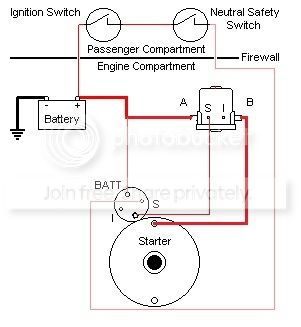
and second.. the first diagram is stupid.... it really doesn't give any advantage, whereas the second diagram is the proper way to wire one in.. with 1 wire to the starter, and just a small jumper from the main lug to the "s"...
 
Actually, both of those diagrams are wrong. The GM integrated solenoid can not be eliminated or bypassed because it's also the throw-out. The 1st diagram adds a second battery cable between the battery and starter motor, which is just extra voltage drop. Better to use a "Y". The second one eliminates the sync between throwing the bendix and cranking the motor. Could be hard on starter and flywheel teeth. It could also cause starter "run-on", as the spinning starter motor could generate enough voltage to hold the solenoid in after the remote solenoid turns off. How many people are actually running with that jumper wire? How's it working out?

I prefer this one:

starterrelay.GIF


Most times, once you get huge current to the integrated solenoid coil, everything works great. I've had 100% success with it, even using cheap reman starters that didn't work for squat with stock wiring. I've always wanted to try this other idea of mine, though:

remotesolenoididea.jpg


This ensures the timing, only routes high current through one set of contacts and keeps the solenoid cool. Even the crummy stock pink wire should pull the integrated solenoid hard enough to power up the remote solenoid. One potential concern is that the bendix will start to retract just before current to the motor is cut.
 
I've run that second way originally posted for decades with no issue and never a heat soak issue, flywheel, etc in any app... but apparently I don't know sh*t...
 
but apparently I don't know sh*t...
Me neither, since I'm doing it the "stupid" way (almost) that "doesn't give any advantage" (except that the truck always starts now...). :D
 
all the first one does is interrupt the signal wire, granted it may have less voltage loss if you have a healthy lead from the bat to solenoid...

but the 1-wire method not only does a better job of that with a jumper, but it keeps the starter from being "hot" all the time, thus saving the lugs/connections from excessive corrosion, etc...

and I've found that to be equally important over the yrs... but that also requires moving fusable link wires, etc off the starter, so some additional work, worth it imo tho...
 
The second one eliminates the sync between throwing the bendix and cranking the motor.

How does it eliminate the sync? The starter can't start spinning until the solenoid is fully engaged. In stock form the starter has power at that solenoid terminal all the time anyway.
Now if you put the main battery cable directly to the starter and not the main terminal on the solenoid then it would start spinning the starter before engaging the bendix.
apparently I don't know sh*t...

Me neither, since I'm doing it the "stupid" way (almost) that "doesn't give any advantage" (except that the truck always starts now...). :D


I'm with these guys. I've had my blazer wired this way for 3-4 years and it cranks over every time.

ryoken said:
that also requires moving fusible link wires, etc off the starter, so some additional work, worth it imo tho...

I never thought about this advantage. This alone would be reason enough IMO. I never liked the idea of all those wires that close to the exhaust.
 

Latest Posts

Top Bottom