

Nice! 


You're not fooling anyone with your claims of an underwater forest. We can see it's the reflection of the trees on the shore.
I've heard that the minerals in the water help preserve the fallen timber, but I'm sure the cold water also helps. Some of the trees have clearly been claimed by the sides of the pond sinking in, but the pond has hardly grown over the decades. I think a lot of them are just trees that have fallen in. This spring has been like this for as long as anybody knows. You would think if the main outlet of Indian Lake was dammed (into the Manistique River) that 10,000 gallons a minute would bring the water levels up pretty quickly, but I don't know much about watershed and if that's even a large portion of what the river is dumping into Lake Michigan. Apparently it was used as a dump back in the lumber days, so I've always wondered how they got it cleaned out. Maybe it was mostly biodegradable stuff, not all the plastic trash like we have today?
https://upsupply.co/places/kitch-iti-kipi
https://schs.cityofmanistique.org/the-history-of-kitchi-tiki-pi-big-spring/


You're not fooling anyone with your claims of an underwater forest. We can see it's the reflection of the trees on the shore.
I've heard that the minerals in the water help preserve the fallen timber, but I'm sure the cold water also helps. Some of the trees have clearly been claimed by the sides of the pond sinking in, but the pond has hardly grown over the decades. I think a lot of them are just trees that have fallen in. This spring has been like this for as long as anybody knows. You would think if the main outlet of Indian Lake was dammed (into the Manistique River) that 10,000 gallons a minute would bring the water levels up pretty quickly, but I don't know much about watershed and if that's even a large portion of what the river is dumping into Lake Michigan. Apparently it was used as a dump back in the lumber days, so I've always wondered how they got it cleaned out. Maybe it was mostly biodegradable stuff, not all the plastic trash like we have today?
https://upsupply.co/places/kitch-iti-kipi
https://schs.cityofmanistique.org/the-history-of-kitchi-tiki-pi-big-spring/

Second POI this time was Kitch-iti-kipi. The Big Spring, with some pretty cool water.
View attachment 319446
And a raft full of tourists.
View attachment 319447
And a hole placed strategically in the middle, so you can look down into the water and watch the fish and the submerged forest float by.
View attachment 319449
If you look past the glare, there's a whole forest preserved down there. @Blue85, these trees must not have always been submerged...did the trees fall in, or is the water line higher than it used to be?
View attachment 319448
And then, as the convoy rolled out, I turned the key and was rewarded with a dead solenoid click.I clicked it a few more times and it roared to life.
As a test, I shut the engine off at highway speed and tried to start it. Again, no dice (but I could pop the clutch easily thanks to my speed). So it's not just a freak occurrence.
Hmm...heading into the woods, with a failing starter motor. With 500 more miles to go. Zero parts stores along the route, and we're heading further away from the ones behind us. 6.2 diesel engines are hard to start on a good day, they do not tolerate weak starters.
View attachment 319450
Tune in next time to find out!


Being a Ham with a group of people who think CBs are good coms is the worst...
Looks like a fun time!

Looks like it was an awesome trip, minus the communication issue.
Groups getting broken up are why my friends and I started going in small groups of usually 6 rigs or less. Way to easy to loose someone in a large group.

Fun stuff Ethan!!!
Digging the trip. Sucks you all got split up but it looks like you made the best of it though. Keep it coming!
After 2 years of coming home on a flatbed, this year I'm actually riding on my own tires. At least, so far...



 ).
).
Some context on the Seney Swamp. The Eastern U.P. is largely sand/rock forest terrain, with lakes and swampy bits mixed in. The Western U.P. is similar, with more rock and less sand. Hills (Michigan tries to call them mountains), bluffs, and waterfalls roll throughout the region.
That's what makes Seney different. It's flat. Pancake flat. This former lake bed forms a continuous swamp that's about 30 miles squared, and the wildlife refuge ponds built by the CCC have made the region soggier yet.
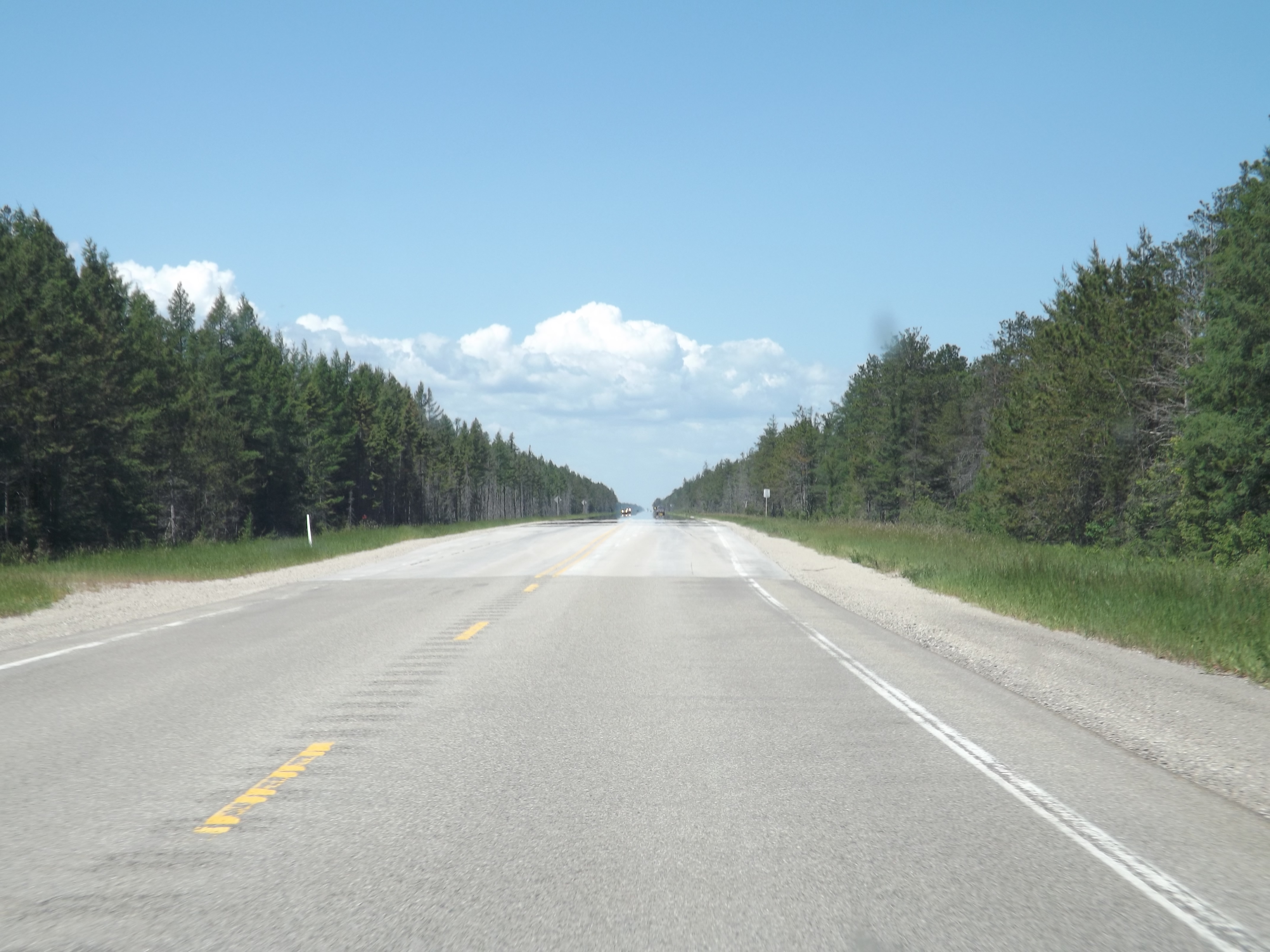
In the East-West direction, the only route through there is the main grade carrying M-28 and the railroad (Between Seney and Shingleton). Being a rail grade, it's perfectly straight and flat:
View attachment 321247
Travelers crossing the peninsula on the main highways drive through hours of curvy forest roads, which makes this 26 mile section of flat, straight road stand out.
The "town" of Seney (seen earlier) sits at the East end of this stretch, and makes a bit of a fuss about this dangerously boring section of road. Postcards say "I survived the Seney Stretch." This one promotes the stretch as a guaranteed cure for insomnia.
In reality, the 26-mile stretch is overhyped. As I've said several times, if you ignore the one turn at Perkins corner, M-35 between Esky and Gwinn offers a longer stretch of straight, flat, boring rail grade.
View attachment 321246
(that squiggle towards the North end is a realignment, the original straight grade is still there, if you want the full experience
@Monty5150, this is a segment we drove last year. Though you were probably too busy checking your engine to notice the scenery.
Anyways, that's why this section of U.P. geography is difficult to cross. There are only a few roads and trails through the Seney region, so we hafta either take what's available or avoid the region entirely.


