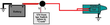
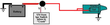
One of the repeated failure modes I've had is a slow-moving throwout arm causing arcing in the solenoid (which eventually fails). As this top-mounted solenoid is now inaccessible (due to the exhaust configuration), I installed a remote solenoid up on the core support. This allowed for easy hot-wiring if I were to encounter another solenoid failure. In order to keep the original solenoid from causing future problems, the remote solenoid fed power directly to the motor. I still needed the original solenoid to actuate the throwout arm, so it was wired in parallel to the motor. This mimics the configuration of an old recoil starter.
The problem, as you may have guessed by now, is that it
acted like an old recoil starter. It worked well for the first year. But the solenoid action gradually got slower and slower. By the time this trip rolled around, the motor would consistently spin up before the solenoid could engage the throwout arm. So the starter gear would bounce off of the flywheel teeth, and the motor would not start. That is the issue I was fighting on this trip. It would spin but not engage the teeth (aside from an initial hideous crunching noise as it tried and failed to mesh). The field solution was to continue cranking it until I got lucky and it engaged the ring gear. Far from optimal, but it got me home.
The 'fix' that I applied once I got home was to return to the stock solenoid configuration (no more bypass). This solenoid is fed from a relay, like you'd find on an old Ford truck. The theory here, as Luke posted a few pages back, is that direct battery power, fed through heavier-gauge wire, will actuate the solenoid more quickly than feeding power through the dash switch and its tiny wiring. This should prevent the particular failure mode that I was aiming for with the remote solenoid.
And, since I already had a remote solenoid installed, I opted to use that to feed power to both the solenoid and the motor. Yes, it's overkill. A Ford-style relay would have worked fine. But this way I have no hot wires loitering down there, which may be a good thing if that hot exhaust pipe ever succeeds in melting through my wire insulation.
If you have better ideas for getting these pigs started, let me know.




 I'd me more than happy to help out.


