I looked at some of your old logs and it is going up to 58 psi when you hit the higher boost, but that was when your target A/F was lower so slightly less fuel flow, also didn't check if the nitrous was on in that run.
This is going to be another long post, I can feel it

I went through a bunch of different logs and scaled the fuel pressure and boost pressure so the graphs were next to each other and should track along the same plot. What I found was interesting and confusing.
This is from the last run, you can see the pressure is keeping up until it hits 57psi and then it drops off (boost is blue, fuel pressure is red).

This next one is from Northern Michigan, the truck made 16.8psi of boost in that nice cool air and it was my quickest pass of the week. The fuel pump hit 60psi at the beginning, but did a much better job at keeping up throughout the run. Maybe because the fuel itself was cooler therefore more lbs/hr with the same flow rate??? I'm not sure. This was with a baby 25 shot jet. You can see the pressure seems to be unstable, but it's keeping up for the most part.

Now here's my last run at Firebird before we went to Michigan. No nitrous and only 11 lbs of boost because that set screw backed out. Once again, the fuel pressure doesn't keep up.

I even went back to when I took it to Firebird with the big pulley on. It peaked at 9 lbs of boost and I'm still seeing the fuel pressure drop.

Going back further than that for drag passes gets me to when it was on nitrous and the fuel pump tracks perfectly with a 300 shot. It's a bigger gap because the manifold is at a vacuum, but the pressure tracks perfectly.

Looking at street driving when I was testing the transmission after getting back from Michigan, the fuel pressure tracks perfectly.


So the problem only happens at the drag strip, and doesn't really seem to be related to fuel flow directly. I even looked at fuel level and battery voltage to see if I had something else going on, but I couldn't find a correlation.
That's somewhat true as it has more time to cool, but it's not much fuel you are talking about changing. If you really want a fuel solenoid I have them here and my solenoids use o-rings not pipe threads and have full flow for center or side exit. I feel I designed the best solenoids on the market.
I already have a fuel solenoid, but I'll keep you in mind if I decide to swap it out.
Glad you know the difference, most people mistakenly use IAT and MAT intercheably because most don't have both and most people are in the intake tract between the throttle and air filter. A true MAT would be inside the intake manifold after the throttle which is rare.
I've always had my MAT at the bottom of the back of the manifold, that's where most manifolds have a spot for it.
In practice it doesn't matter much as its consistent enough if you don't move it.
I would say in my case it makes a huge difference, if I put ice in the intercooler tank, that would drastically change the MAT but not the IAT. If the pump failed that would also make a huge difference.
I myself use IAT right before the throttle for fuel calcs, and I log ambient in front of the radiator.
I'm not familiar with your setup, but I'm assuming if you're boosted that's post intercooler. When I was running nitrous I had to change the fuel modifier for cold MAT temps as it was adding way too much fuel because MAT was hitting below freezing.
Yes there are different bolt patterns of 6, 10, and 12, you may have to drill some holes but the fuel cell opening diameter is pretty standard. It uses a metal ring inside the tank with threads so you don't have to tap the holes.
When I bought this pump I thought it had the same pattern as everything else, I have yet to find another pump that uses the same pattern. I couldn't find a flange when I built my tank so I made my own with a 1/2" thick chunk of aluminum that I drilled and tapped for the 10 bolt pattern. It's welded around the base inside and out so fuel can't get to the bolt holes. It would not be easy for me to change patterns.
I typically recommend to return the fuel at the bottom to not introduce air, and into the same reservoir the pump pulls from to not starve the baffle area. Can you extend the return closer to the bottom with some hard aluminum or SS tube and some AN sleeves and nuts?
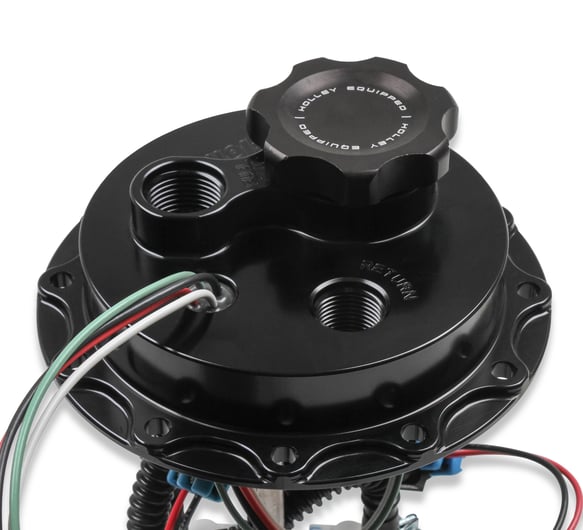
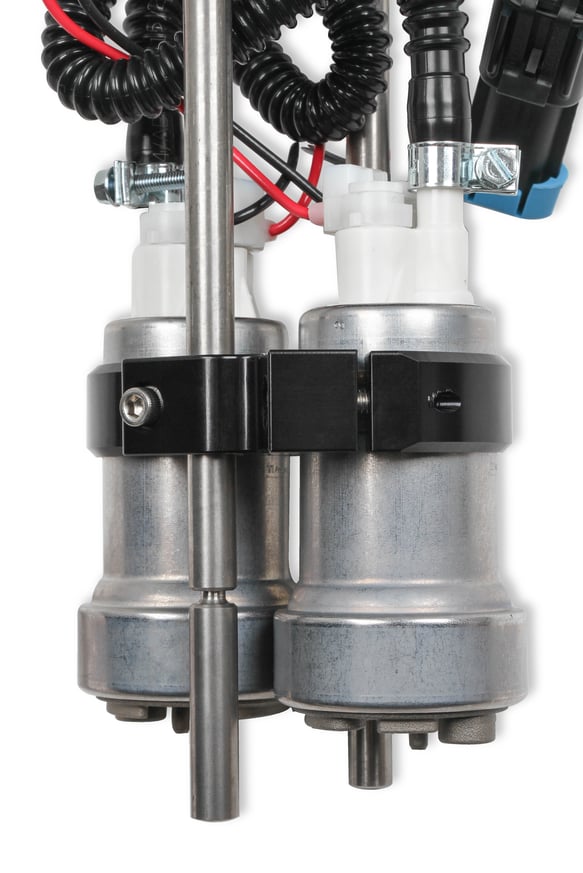
Unfortunately that isn't possible with this pump, not easily anyways. If I had a 3d printer, maybe I could make something that slid into here and guided the fuel back down to the bottom of the tank, but I'm not sure how I'd secure it, or if they make E85 safe filaments. The pump has 3 -10 ORB fittings that all just dump into this hole on the bottom of the fuel pump flange. I didn't like that aspect when I bought it, but I really wanted the brushless pump. It's amazing how quiet it is for a 3.5GPM pump.

The dual 4150 pump extends the return down up to a foot.
I get what you're saying, but I've got $3000 worth of fuel pumps that have lifetime warranties. 600LPH should be enough to fuel the blower and I shouldn't be running out of pump yet.
Good question, to be honest I didn't do either as I didn't look up his HP. I quickly calculated both how much HP 15 psi on a 6500 RPM 427 at ~110%VE would make, I also calculated how much HP it would take for a 6000 lb vehicle to hit 127 MPH in the quarter, both of those were less than 1100 HP, so that is what I used to calculate how much fuel he would need for a supercharged engine on E85, which is also about how much fuel he is flowing at boost.
If he is making more HP, and it is quite common, especially for a multi-use ride, to not get a lot of the power to the ground, then he would need more fuel yes. I did some quick estimates is all to see if the pump is in the ballpark. He could also be making more HP/lb/hr than I estimated, but that would change the HP per fuel flow not necessarily the fuel required.
If I use 1600 HP at the same .85 lb/hr/HP estimate, it's showing over 200 GPH asnd thats at 100% DC, which is very short bursts, his pump at 60 psi is less than that. Usually you would use 80 - 90% DC for street use, but he doesn't use full power on the street, there is also margin in the .85 number.
Over 260 GPH is needed at 80% DC at 1600 HP, and that is 4.2 GPM or 990 LPH at the same .85 BSFC.
I don't think he is making that much power, he is making a lot, but probably not quite that much, that flow would need over 200 lb/Hr injectors.
If you just use the simple fact that you want enough fuel to supply his 166 lb/hr injectors at 100% DC, he would need 767 LPH or 203 GPH, which is 3.4 GPM at 60 psi,
His fuel pump chart shows 150 GPH.
In either case, its a pretty good argument for the dual 450s vs the single 625.
I'm not sure where the 1600hp came from. I based my numbers on my dyno pull (950hp on a hub dyno) and that I put a slightly smaller pulley and 100hp worth of nitrous, so I was estimating 1100-1200RWHP.
Today I'm going to change the fuel filter. I have most of the components for the secondary fuel system, but I'm not sure if I'm going to install it now or after we take it to the track. Unfortunately it doesn't seem like I can test this anywhere other than at the track, which is the safest place to do it anyways.
Here is my plan for testing.
-First run, no nitrous, check fuel pressure after the run (checking to see if it was the filter).
-Assuming the problem still exists, add 6 gallons of E85 and try again (I usually start with 1/2 tank to prevent it coming out of the overflows).
-Assuming the problem still exists, swap the fuel pump with my spare and try again.
-Assuming the problem still exists, swap the regulator with my spare and try again.
If the problem still exists after that, I'm not sure what I'll do. If it's the pump, I'll send it in for a rebuild, if it's the filter, I'll try to get a 10 micron element for it to use next time.
If it fixes the problem, I'll see what time I can run without nitrous and figure out what I'm going to do for street car takeover. If I decide to install the secondary fuel system before Friday, I'll test it when I'm at the track.
It would be a major undertaking and expense for me to swap in a noisy brushed pump, so that isn't going to happen. If my pump isn't working properly, I'll get it fixed, if my fuel cell sucks, I'll get it fixed. Because the tank is right up under the bed, I don't have much room to go up on the vents which is why I can't run a full tank on the track.
I could add foam to the chamber the fuel dumps into, that should help with aeration, I could also add a sump and extend my pickup down further, I could weld a bung to the tank so I could return the fuel to the bottom, there's a lot of options, but unfortunately only one place to test them.