I've packed the bearings on my K5, but it's been a while...
That helps a bit. I'd like to find pics of both of them including a little more of the axle/steering so I could get the whole picture.
I take it that people don't like these things from a reliability/repairability perspective?
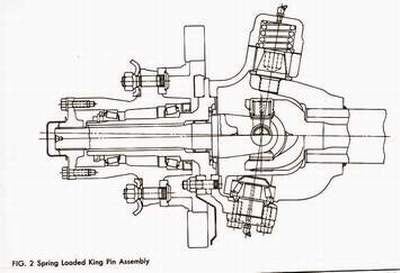
Spindle diagram:
You can see the axle shaft. Outside of that is the spindle. Outside of that are the bearings, outside of that is the hub.
The unit bearing basically takes all that and packs it into a sealed, non-serviceable unit.
I meant to keep this short and sweet but, I have too much tech floating around in my brain. Unit bearings are disliked by quite a few because they can't be serviced and some say they're pretty weak. However, they do have some advantages. Because they're sealed they're not nearly as prone to water damage. Yes, you can pull apart your hub and re-grease everything every time you submerge the hubs, but who honestly does that? Also, the axle shaft is actually supported by ID of the unit bearing quite well, which allows people to get away with smaller shafts and little to no breakage. I have no comment on the weakness aspect. I don't know enough people that have them to have any idea how strong they are. The people I know that do have them are Jeep guys, and don't wheel their junk hard enough to put them to the test anyways.
Despite their drawbacks, they are becoming more and more popular in the offroading world. Spidertrax uses them (F-350 unit bearings, the ones I posted a picture of earlier) on all of their aftermarket knuckles, and a fair numbers of competitors run their stuff.
Best example I could find of a Unit Bearing, even though it's not a four wheel drive application. Look at the lowest right picture. Imagine that with a hole through the middle to allow an axle shaft to pass through. The smaller top flange bolts to the knuckle where the spindle would normally bolt to. The bottom flange would be the lug pattern that you bolt your wheel to. Like I said, it's not a perfect example, but hopefully it's enough so that you get the general idea.
Also, typing in "unit bearing" on google image search brings up quite a few hits. If you're still having trouble picturing it there's plenty of stuff there to give you a better idea of where it goes and what it does. Ignore the axle shaft sticking through some of them. Yes, the shaft does pass through, just like a spindle, but it is not a permanent part of the unit bearing.
K, I'm done now, I promise.