Most internal amplifiers in H/U's are only made by a handful of manufacturers around the world (non-proprietary). The vast majority of those internal amps max out at 18-22 watts per channel (RMS) iirc, but they sound very bad doing anywhere near that. One notable exception are the Pioneer MOSFET units. Pioneer does make (or did at least) some heads that had a mosfet amplifier built in, and they really can produce in upwards of 40watts per channel (or so Ive read from tests). But I suspect, being such a small unit, with no real coolin capacity like an external amp, its not the cleanest in the world either. Going to an external amplifier on your main speakers (fronts mainly, but front and rears for many ppl) makes all the difference in the world. Any semi-serious subwoofer system will overpower most mids and tweeters that are powered off a h/u. Its tough to get really blended output from the entire system with a setup like that. But then, some people like a system with exagerated subbass too, so to each their own. Ive seen trucks with a wall of 15's, and the the rest of the system powered off the headunit.

Personally I wouldn't recommend a high powered sub, but then running your fronts off the h/u and using bass blockers. BB's are just shunts, dissipating the lost energy (from the freqs they filter out) as heat. So basically you'll already be powering the front speakers with a weak amp (h/u), and then you'll be losing more efficiency by using bassblockers. Get an external amp with a built-in xover and avoid all that mess, you'll be glad you did. Think about it, the front speakers play like 90% of the frequencies you'll hear from the stereo, why shouldn't they get the most attention when it comes to powering them, placing them, etc etc..?
RMS value of a speaker is (generally speaking) a rating of its thermal limits. There are two basic ways to blow a speaker, thermally and mechanically. Mechanically means bottoming the speaker out, physically pushing it further than its motor and/or suspension will allow. Blowing a speaker thermally means simply pushing more current through the speaker than it is capable of handling. A speaker's voice coil is made of a certain gauge wire, and at a certain temp, it WILL melt. The speaker has cooling capabilites that combat this, but that only goes so far. Basically, if you try to push a 100watt speaker with 1000watts, it will melt down. Now that's not to say you cannot use a 1000watt amp on a 100watt speaker, but you certainly could not push the amp to its full potential without damaging the speaker. Most manufacturer's RMS ratings are based almost exclusively off of thermal limits because mechanical limits are enclosure dependant. The manufacturer doesn't know what size/type of box you will be putting the speaker in, which is a major factor in a speaker's mechanical limits, so their specs are basically thermally limits.
This brings us to the next topic: distortion. Its a common misconception that power does not kill speakers, distortion does. I say this is a misconception because its only half true, at best. Power most certain can destroy a speaker as I described above, thermally. Distortion, in and of itself, wont hurt anything. It needs power to do damage to your speakers, let me explain. First off, Im discussing signal-source distortion at this point. When a speaker receives a signal, its in the form of a wave (as seen on an o-scope). The wave's shape, wavelength and amplitude all affect the speaker cone's motion. The wavelength of course affects the frequency. As the cone moves, it follows the motion of this wave (as seen from the side). When a piece of equipment in your signal chain distorts, it squares off the signal wave (at a given freq). When looking at it on the o-scope, the wave will not look like a rounded wave anymore, but will have a flat (think of a flat-top mesa). What this means is, as the speaker tries to reproduce this signal form, it hits this flat in the wave and stops moving (at the amplitude of the flat on the wave) and that is a very bad thing. I mentioned earlier that speakers have an ability to combat heat build-up within their motors, one major way is by pumping cool air in through the rear pole vent (that hole in the magnet) and across the voice coil, thereby cooling it. But, if you send a squared signal to the speaker, cone motion stops for a period of time each and every cycle, yet the current still passes through the speaker fully. So as you can imagine, this means heat build-up increases even more rapidly than if the speaker was being fed that much wattage, but with a non-squared wave (not distorted). The harder you clip the signal (square the wave), the longer the flat is in relation to the overall wave cycle, thus the speaker stands still longer and has more and more heat build-up.
That being said, a squared signal wave (distortion) will hurt nothing without an excess of power (watts). To the speaker, that squared wave is just another bit of the music its suppose to reproduce (and it will faithfully). The only difference is that stopping of cone motion every cycle. If the speaker can easily handle the power going through it, even when squared, it will not burn up. For example, hook a 100watt amp to a (true) 1500watt subwoofer, and I don't care how nard you clip the amp, you will not reach the thermal limit of the speaker, period. This is why people are correct to say 'dirty' power will kill a speaker sooner, but clean power wont. But, that's also why people are wrong if/when they say distortion kills speakers rather than power.
Lastly, a 'clipped' amplifier (one driven to distort based on incorrect input gain settings) can output (squared) power many mutiples of its rated output. So, clipping an amp can be fatal to speakers pretty easy, as it squares the signal wave (limits cone motion, thereby hurting the speaker's cooling abilities) AND it scales up the amount of current passing through the coil.


 Ive yet to get my hands on one of the Pioneer mosfet units, but Ive heard good things. Honestly, Id forgotten you said you had the Pioneer mosfet when I was speaking about your weak h/u amp... my bad. And, if you dont like it, you can always add the amp later. Let us know how it works out.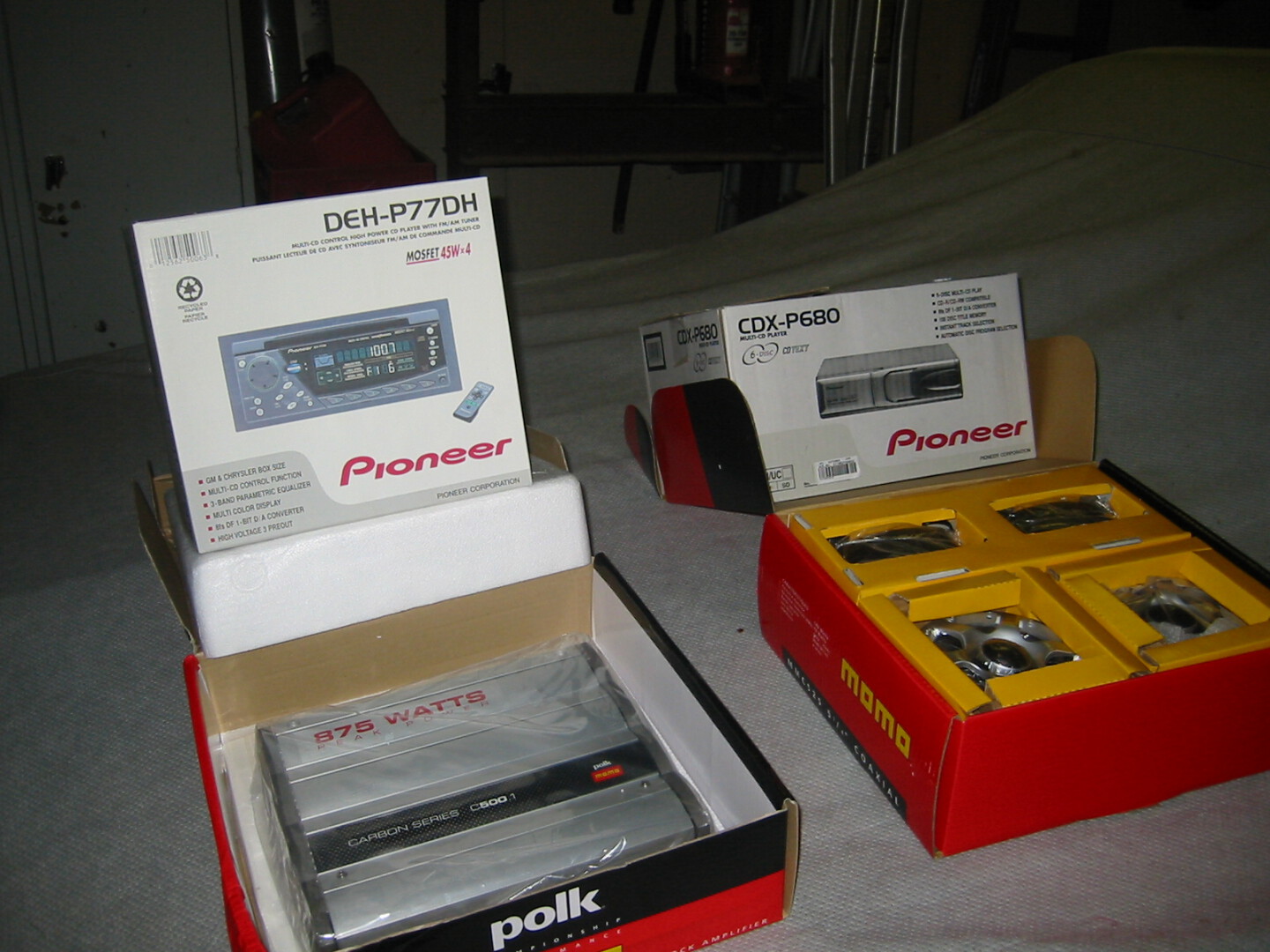
 eBay is my friend.