CK5
Register an account today to become a member! Once signed in, you'll be able to participate on this site by adding your own topics and posts, as well as connect with other members.

1989 K5 - Gradual Learning

First 4x4 - learning basic maintenance / upkeep and maybe some small mods.
Grats on test drive. Glad it mobile agian.

Do one thing before you ignore the shaking.

Double and triple check the firing order and spark plug wires.

You got this, Moab in Sept ?
I got it up to about 70 mph during the test drive, so I am thinking that I've got the wires and firing order correct. Still not a bad idea to double-check. There is distilled water in it right now that I need to swap out for coolant so I'll look then.

I'm coming to Moab in September for sure, with or without my Blazer. Hoping I can bring it though.

If you haven't driven it for a long time it means you have old fuel.
Did you add a bunch of new fuel to make it better or you still have old fuel ?
That causes erratic idle
Good idea, I will go and fill up tonight while running errands. Might calm it down a little bit.

Dude that’s great! I’d still say that rigs n brews overnighter trail ride would be a great test run for the truck and camping out of it. You got to Memorial Day weekend and if you need some help most of my weekends are open.

Keep in mind that deal will be mostly yota and jeep overland types so the trail should be pretty easy.
I'll get back to you on it. Definitely sounds fun but I'm out of town May 13 - May 21, so may not be feeling another trip so close.
 
You still don't have EGR?

Martin

LOL no... I never fixed it. It has been a problem since I bought the Blazer.

I am going to try and go through the procedure here and see what that gets me.
 
Can’t you just bypass it or eliminate it completely?

I had it blocked off awhile, but honestly I want to give it a go at fixing it. Hopefully it will run better once that issue is gone as well.
 
He’s definitely in an emissions county. However, he could totally fake it with a blockoff plate between the edge and intake so it passes a visual inspection. Given the test process on the rollers I doubt the egr gets really active enough to sway the numbers in that short time.

I’d block the sob off in a heartbeat. But I give Drew credit for trying to work the process and address it correct the right way.
 
There's been many cases of people "ripping out all that emissions crap" and the engine running worse because the carb and distributor were tuned around having EGR, air pump, thermal vacuum switches, etc. It's not that those things can't be fixed, but often the easiest approach is setting everything as stock.
 
Okay, I went through the EGR test steps tonight. I am thinking that my EGR valve might be bad. If I am right then that's pretty frustrating because I bought it in 2018 (20k miles ago) and the EGR code has never really gone away (for any length of time that I can recall). It is an AC Delco too.


TEST STEP NUMBER
TEST STEP INSTRUCTIONS
OUTCOME
0​
  • Before using this chart check for manifold vacuum to EGR solenoid, there should be at least 25 kPa (7" HG) of vacuum at 2000 RPM. Check vacuum hoses for leaks or restrictions.
I attached the Mityvac to the TBI vacuum port that goes to the EGR solenoid. I started the Blazer and the Mityvac gauge showed 15" at idle.

I have no way to measure RPM other than a multimeter, so I might need a friend to check what the vacuum gauge reads while I measure Hz. I guess I could just hold the throttle plates open at the TBI and just guess where 2000 RPM is. I did not do this and just went to the next step.
1​
  • Disconnect EGR solenoid vacuum harness.
  • Rotate harness and reinstall only the EGR valve side.
  • Ignition "ON", engine stopped.
  • Ground diagnostic terminal.
  • Install a hand held vacuum pump with gage to manifold side of EGR solenoid.
  • Apply vacuum and observe EGR valve diaphragm.
  • Valve should move. Does it?
Yes, the valve moved (barely). The Mityvac gauge showed perhaps 1" of vacuum.
2​
  • Unground diagnostic terminal.
  • Vacuum should bleed off and valve should close. Does it?
Yes, vacuum bled off very slowly. It was only at about 1" of vacuum, but it did lower slowly over time.
4​
  • Ignition "OFF".
  • Connect a vacuum pump to EGR valve.
  • Using a mirror, observe EGR diaphragm while applying vacuum.
  • Diaphragm should move freely and hold vacuum for at least 20 seconds. Does it?
The valve moves freely. Again, it will only hold about 1" of vacuum. If I go past that (e.g. to 5" or 10"), it will bleed off extremely quickly. When it gets down to 1" it will hold there for a long time.
5​
  • Apply 34 kPa (10") vacuum to EGR valve.
  • Start engine and immediately observe vacuum gage on vacuum pump.
  • Valve is good if diaphragm has moved to seated position (valve closed) and vacuum dropped while starting engine.
I can't perform this test because my valve won't hold 10" of vacuum.
 
Try starting engine, then apply 10"hg to the egr valve. Some valve require exhaust back pressure to close a check valve in the pintle.
 
I fussed around with the EGR a little bit more tonight.

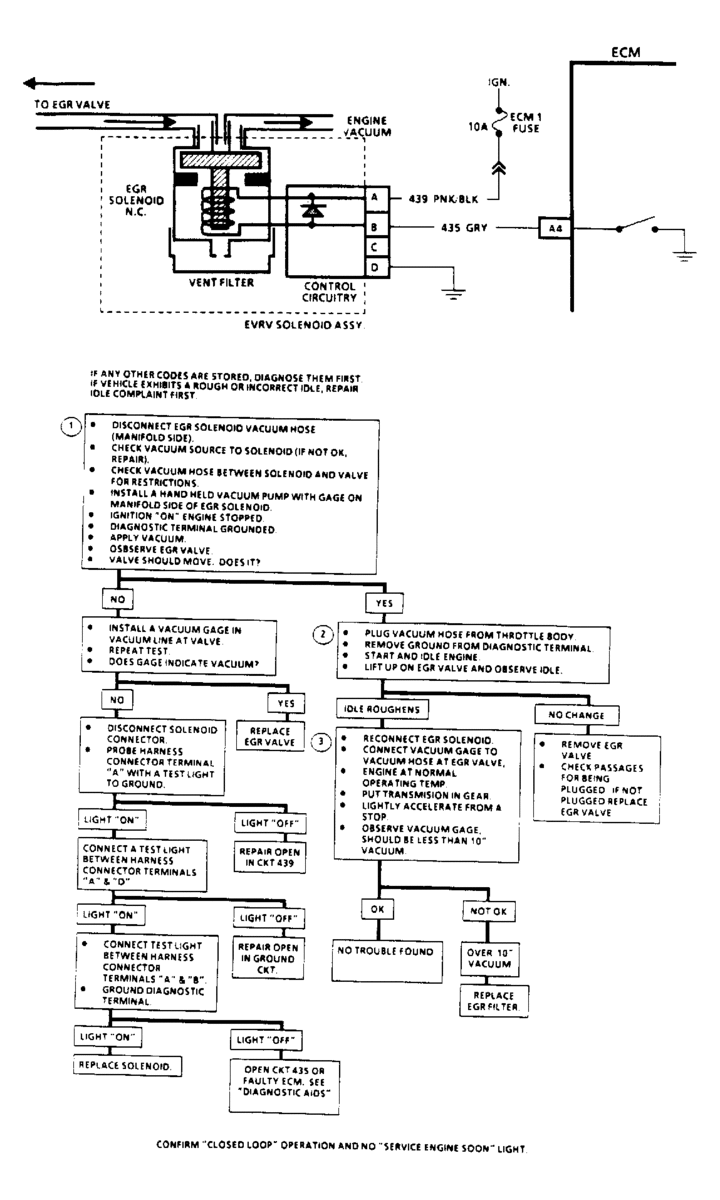
The diagnostic tree I originally followed was from the TBI Trouble Codes thread and the testing was sort of inconclusive. I have attached a screenshot of the diagnostic decision tree to this thread and my summary from the test is a couple of posts back.

Today I was looking through the old posts on this build thread. I was trying to find information about the EGR valve and solenoid that I purchased back then. Both were bought in 2018 and both were AC Delco. While I was surfing the pages I saw that @ZooMad75 had posted a different diagnostic tree:

Here's the diagnostic trouble tree for the 32 code to follow. It should put you in the right direction. You might want to run the test with the engine up to temp as it sounds like heat/drive time is having an effect on the code setting.


I followed the diagnostic tree that he posted and it was much easier to follow and the results were clear. I have attached a screenshot of the diagnostic tree with a red line showing my path. It comes out to "replace EGR filter".

EDIT: I just realized that the diagnostic tree Rob posted is for the 5.3, which I think is further evidence that my valve could be bad. If there was a filter at the EGR valve in 5.3 engines and too high of vacuum indicates that filter needs to be replaced... and on mine there is no EGR filter and vacuum is too high between the solenoid and the valve... maybe that points to the valve being faulty.

Screenshot 2025-05-26 at 8.45.36 PM.png

Screenshot 2025-05-26 at 8.49.47 PM.png
 
Last edited:
[TPS]

The Blazer's main symptoms these days are:
  • Consistent code 32 (EGR).
  • Engine surges up in RPM when coming to a stop (more prominent when cold).
  • Engine shakes and occasionally surges/hunts when in Park (more prominent when hot).
When reading stuff all over the internet I've seen the TPS mentioned here and there. I bought a new one a while ago and it is sitting on the shelf. Finally decided I should test it out to see if mine is good or not. I tested it last night using this video. It tested fine - 0.6v at closed throttle up to about 4.2v WOT with no jumping or dead spots in between. That is nice.

[EGR]

Still fussing with the EGR. I picked up some stiff vacuum line (Dorman 47418) to replace the line between the solenoid and the valve. That section was a cobbled-together line of like 5 separate pieces and it felt good to clean it up.

My Haynes manual has an EGR test procedure in it that is fairly simple to follow. I went through the steps:

TEST STEPTEST DESCRIPTIONTEST RESULT
1Engine off. Manually move the EGR valve diaphragm with your finger. Should move freely.Moves freely with no issue.
2Engine running at normal operating temp. Push up on the diaphragm. Engine speed should drop.Engine speed drops.
3Increase RPM to about 2000 RPM. The EGR valve diaphragm should move. If the EGR valve diaphragm moves, the EGR system is operating correctly.The diaphragm moves as expected.

I don't know how good this test is, but technically my system "passes". With the new line now in place between the solenoid and valve, I might just clear the codes and roll around town a while and see if it comes back.

I am still bothered that:
  • My EGR valve doesn't hold more than 1" of vacuum. If you apply more than that then it bleeds vacuum immediately. Still considering getting another valve, I'm just sick of not having a definitive answer and I'm afraid of spending more money on the parts cannon.
  • Code 32 came up yesterday when I was going less than 50mph. No clue what's up with that - the ECM is only supposed to check EGR operation when you're going 50mph or faster.
[Distributor Ignition Module]

I still plan on replacing this, I've just been focused on getting rid of code 32. I have a big job coming up on the K30 so I need to clean up the garage so that both bays are open for work. Then I can pull the Blazer in and get after the ignition module.
 
Last edited:
Over the last couple of days I have been doing some EGR stuff and also some ignition module stuff.

For the EGR, I was desperately trying to narrow down whether the valve itself was bad or if something else was going on. I have tried doing testing a few different ways (a couple of different service manual tests and then also a test from my Haynes manual). The results are just a few posts above this one in the thread... they were always unclear or inconclusive. Anyhow, I felt like there was enough evidence to suspect that the EGR itself was bad (stuck open). I found this thread on a Toyota forum and someone suggested taking the EGR off and flipping it upside down and then filling it with carb cleaner. I did that test and carb cleaner leaked out when the valve was supposed to be "closed", so I went ahead and ordered another valve off of RockAuto. I went with the same GM Genuine 2145073 and got that installed yesterday evening.

For the ignition module, I pulled out the distributor and replaced the ignition module with a GM Genuine D1984A. The module that was in there was an "Echlin", which looks to be a NAPA part.

PXL_20250630_011058297.jpg

It did have the thermal paste on the bottom part of it BUT the paste didn't appear to cover the full surface area that it was supposed to. I made sure to apply the thermal paste to the new module and got it installed on the distributor. When reinstalling the distributor, I had a little bit of difficulty...

On the first go, I did not seat the distributor all the way down inside the intake... the notch on the bottom of the distributor was not lining up with the oil pump shaft. I didn't realize it and when I went to start the truck it obviously did not start. That was stupid.

On the second go, I decided that I really wanted my #1 post on the distributor cap to line up with the coil. I got the engine to TDC and the distributor rotor was pointed way off at like 7 o'clock. I pulled the distributor out, rotated the rotor by hand, and dropped it back in. It took a bunch of tries but eventually I got it seated so that the rotor was pointing directly to the coil. Then I got the cap back on and rotated the base so that the post on the cap was also perfectly in line.

After that I got everything all hooked up. When I went to start the truck, it just cranked and cranked and cranked but would not fire. I got so angry! Cursing up a storm and I even punched the side of the K30. All pissed off about it, I decided to call it a night. I went inside and jumped in the shower and while standing there I realized... I forgot to plug in the distributor. This morning I went out first thing and reconnected those two wires and the truck started up fine. I'm an idiot.

All I need to do now is time it and take it out for a test drive. Will keep you guys posted on the results.
 
Top Bottom