CK5
Register an account today to become a member! Once signed in, you'll be able to participate on this site by adding your own topics and posts, as well as connect with other members.

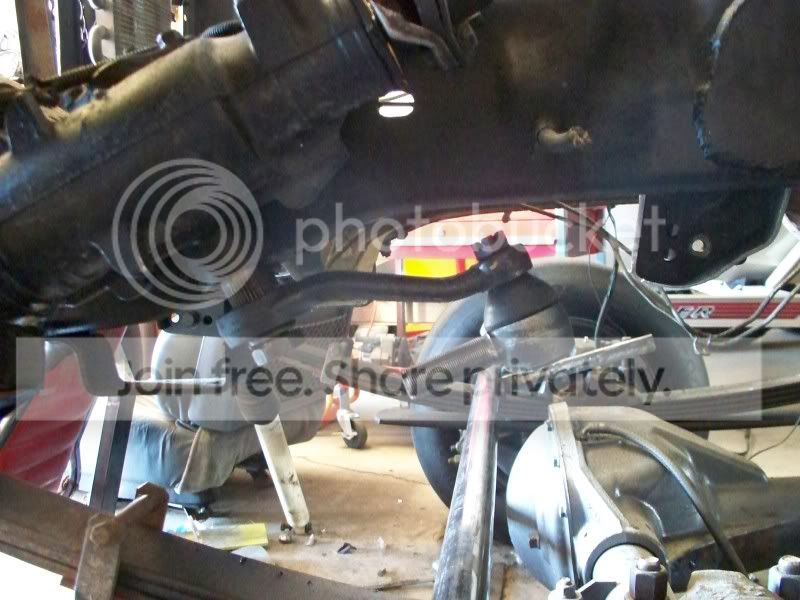
2WD pitman arm that barely clears the frame.

K10A'sBROinSLO said:
Think his website gives more details too.

I just looked and he tapers them for Chevy DLE while I run the ORD ends that have the angularity of a DLE but the taper of a TRE. He machines in house so I am sure I would be able to get one with the TRE taper.


Ira
 
The pitman is a lever rotating on the sector shaft. If the distance from sector axis to the ball joint axis is shortened, you will have more power in turning the wheel, but less travel potential. Basically the same result you get from lengthening the arm at the knuckle. If you go with a shorter pitman, make VERY sure you set your stops higher so that you don't blow the steering box.
 
Nope, that's backwards. If the ram is your stop, then the ram will move it's full stroke regardless. All other things remaining the same, that means your steering box must turn the sector further than is did with the longer pitman. Depending on how much throw your box will tolerate, and how much shorter the pitman may be, this could be a major problem and ruin your box or break your frame or???

Better would be a longer pitman (if it did not interfere) since it would take strain off the box and turn faster. The lost mechanical advantage due to a longer pitman would then be made up by the hydro-assist.

It's simple geometry. Think about it in the extreme if the pitman were turned 90* to the frame rail. A shorter pitman will have moved your steering drag link less distance for the same gear box 90* rotation. The effect is most pronounced at 90* where the difference in drag link movement is equal to the difference in pitman arm length, but the effect is increasing from "0" as soon as the pitman moves off parallel with the frame.

Will this be a problem for you? Depends on how much shorter the pitman is, how long your knuckle arm is, and how far your ram allows the tie rod to move before it “limits” the steering. And don’t forget to consider “edge cases” where static extremes are exceeded due to things like articulation, bump steer, frame/link flex, and so on. It may be fine tested setting level, or even articulated with a front end loader or something, but then on the trail, when things are really getting loaded, you’ll break a sector shaft or blow the end of the box. Not much fun...

Not to be rude, but you (and that means anybody, not picking on you specifically) really shouldn't play around too much with steering components unless you spend some time doing the math and fire testing the results in controlled/safe conditions. For anyone who is not comfortable with going the whole way to do it right, then I would strongly suggest using a known good off the shelf system from one of several good vendors. It would really suck to crack or damage something on the trail, but not fail completely until your rolling 60 down the freeway and hit a bump or something, then you have NO steering at all as you careen around at random, possibly into oncoming traffic. This is probably the most important and most sensitive system on the vehicle with the possible exception of brakes, though I would rather loose brakes than steering at speed...
 
BadDog said:
Nope, that's backwards. If the ram is your stop, then the ram will move it's full stroke regardless. All other things remaining the same, that means your steering box must turn the sector further than is did with the longer pitman. Depending on how much throw your box will tolerate, and how much shorter the pitman may be, this could be a major problem and ruin your box or break your frame or???

Better would be a longer pitman (if it did not interfere) since it would take strain off the box and turn faster. The lost mechanical advantage due to a longer pitman would then be made up by the hydro-assist.

It's simple geometry. Think about it in the extreme if the pitman were turned 90* to the frame rail. A shorter pitman will have moved your steering drag link less distance for the same gear box 90* rotation. The effect is most pronounced at 90* where the difference in drag link movement is equal to the difference in pitman arm length, but the effect is increasing from "0" as soon as the pitman moves off parallel with the frame.

Will this be a problem for you? Depends on how much shorter the pitman is, how long your knuckle arm is, and how far your ram allows the tie rod to move before it “limits” the steering. And don’t forget to consider “edge cases” where static extremes are exceeded due to things like articulation, bump steer, frame/link flex, and so on. It may be fine tested setting level, or even articulated with a front end loader or something, but then on the trail, when things are really getting loaded, you’ll break a sector shaft or blow the end of the box. Not much fun...

Not to be rude, but you (and that means anybody, not picking on you specifically) really shouldn't play around too much with steering components unless you spend some time doing the math and fire testing the results in controlled/safe conditions. For anyone who is not comfortable with going the whole way to do it right, then I would strongly suggest using a known good off the shelf system from one of several good vendors. It would really suck to crack or damage something on the trail, but not fail completely until your rolling 60 down the freeway and hit a bump or something, then you have NO steering at all as you careen around at random, possibly into oncoming traffic. This is probably the most important and most sensitive system on the vehicle with the possible exception of brakes, though I would rather loose brakes than steering at speed...


I understand all that and I appreciate the data on clearing up my backwardness. I thought the van arm was the same length hole to hole as the arm that ORD sells with their crossover kit (which is what I have) I am looking for an arm that gets the Drag link closer to the frame at the box and also need to know how moving that end of the draglink off of parallel will effect the steering as it flexes. Is it minimal? When I move my axle forward I am going to have clearance issues and I need to figure this out.


Thanks

Ira
 
Look for some old posts on "bump steer". Summary is that the more you go off vertical with the drag link, the more your going to steer as the axle goes up and down. And yes, this could take you over the limit at the sector shaft. So could flex steer, but that's a very tough mathematical problem to work out on paper, beyond any but those with significant modeling skills such as MEs (and probably beyond many of them). That's why I say test it if you think you are anywhere near the limits.
 
I do know that my steering box will turn farther than the stops are set to right now. I found out I was binding my u-joints before I had my hydro assist put on. Now the stops are set and the ram limits the box.

Ira
 
But I suspect that is at static ride height? What about extremes caused by flex/bump steer, and also, don't forget that it's at the extremes where things change (by far) the fastest, so you run out of runway VERY quickly and it often comes as a rather dramatic surprise. And don't forget, your going to be entering that rapid change range considerably sooner by using a shorter pitman. I'm not saying it won't work, but rather that YOU must be absolutely sure that it works with significant room to spare (because it's unlikely that you can accurately predict frame/spring side flex and twist even if you can predict geometry changes and normal (to the ground plane) spring deflection.

Good luck...
 
BadDog said:
But I suspect that is at static ride height? What about extremes caused by flex/bump steer, and also, don't forget that it's at the extremes where things change (by far) the fastest, so you run out of runway VERY quickly and it often comes as a rather dramatic surprise. And don't forget, your going to be entering that rapid change range considerably sooner by using a shorter pitman. I'm not saying it won't work, but rather that YOU must be absolutely sure that it works with significant room to spare (because it's unlikely that you can accurately predict frame/spring side flex and twist even if you can predict geometry changes and normal (to the ground plane) spring deflection.

Good luck...

My question is not on the length of the pitman arm but solely on the slight angle of the draglink over the parallel draglink that I have now. Is the ford arm shorter than the superlift arm? The only thing I have seen about shorter arms is the jeep arms. I need to know about draglink angle only and a 2" rise will be what about 10 deg difference than now?

I would prefer a pitman arm that is the same length as what I have but with less drop.

Ira
 
Then that Ford Van arm is perfect for your needs. It has essentially the same radius as the stock arm, as does the huge drop Ford arm.

The effects of the change in angle have been covered above.
 
The shorter Dodge pitman I was running until I killed (endoed) my blazer this weekend was too short. I didn't have assist ram yet, but the shortness of the arm seemed to make up for that, as I was able to get by without the ram in the rocks. The problem was climbing steep, loose, rocky notches where I was pinballing off the sides at some speed trying to claw my way up with momentum and wheel speed. I think the shorter arm slowed down my steering and it made it very difficult to respond to the pinball effect and keep it pointed the right direction. I'm worried about the ram slowing me down for that kind of stuff when/if I get something built or rebuilt to wheel again.
 
Jeep Cherokee

Not tightened yet

It doesn't really mount that straight though,i think I can still get full steering left and right though

100_0179.jpg
 

Latest Posts

Top Bottom