CK5
Register an account today to become a member! Once signed in, you'll be able to participate on this site by adding your own topics and posts, as well as connect with other members.

350 SBC build--abnormal questions PICS!!

Definitely has a proclivity to detonate with timing values based on "old" heads. I cobbled together a timing map based on stock Vortec motor tune, and compared to the timing map for non-fast burn heads, the timing values are extremely low, except at idle/very low load & RPM, which are about 2* higher at 23*. 32* is the highest in the Vortec tables, but I have no idea what base timing was on the Vortecs, and whether GM had another advance adder in the tune. 47* is the highest value from the 1989 Corvette .bin I have, although the spark limiter is apparently set to 41* from the factory.

Even though I originally knocked timing off the "upper" regions of the Corvette timing map by 2*, it liked to detonate under any sort of increase in throttle...steady cruise and a bit more pedal, slight pinging. Climbing a logging road, slight pinging. That's all gone now, but since I don't have a good tuning cable yet, I'm not just going to throw more timing at it. I think high base idle, with very conservative mechanical and conservative vacuum advance would serve well on a non-injected setup. I'd certainly want an adjustable vacuum advance can to "tune" cruise.

Those are some good numbers for reference, I haven't done a lot of fooling with timing curves on my old engine and I'd like to squeeze as much power as possible out of this one. There's a good chance I'll go TBI down the road, particularly now that I'm getting it figured out and they are soooo common in our Pick 'N Pull yards. I figure with a 454TB and a quality adapter on the Edelbrock manifold it should be able to get plenty of fuel.

For now I'll be building a tuned up Qjet, starting with a 45 rod/74 jet combo and a few other little goodies . . .
 
Lots of tuning to be had with the Q-jet and HEI. Definitely seen some benefits from playing with primary rods and jets, and on the secondary side as well.

The Vortecs/fast burn chamber are an entirely different animal when it comes to timing. I haven't played around with a non-EFI HEI yet, I wonder if you can actually get base timing up as high as you can with EFI, while maintaining decent timing elsewhere? I suppose it would be pretty hard, since timing drops off as load increases, then slowly gains as RPM's do. Perhaps base timing as high as you need to get into the 20's, coupled with an adjustable vac can that will pull a bunch of timing so your base timing could be as low as possible....manifold vacuum on the can, and a very slow mechanical curve?
 
Let me make sure I've got it straight in my head--the theory is that timing advances with RPM to compensate for shorter combustion time plus the fact that it takes a fixed time for the spark to reach the plug regardless of RPM . . .

But timing retards under load because actual cylinder pressures/real compression ratio increases as a result of more throttle without a corresponding increase in RPM.

Would that be roughly accurate as a really simple explanation? What other events and factors come into play with setting timing?
 
Picked up a Mallory distributor with the adjustable vac. can and several different mechanical advance weights/springs, a few other dress-up goodies, and got all my stuff back from the machine shop this weekend. I'll start bolting her together tomorrow . . .:D
 
Sorry I didn't get to the last question...must have let it get too far down on the page. :)

As it pertains to Vortecs, the burn time/efficiency is what makes the changes to timing necessary. As you mentioned there is a bunch of different factors playing into the timing equation, and that's why "the max" timing isn't the best. When you throw different chamber design into the equation, even old baselines don't apply.

I'd be really interested to see what kind of base timing you can run with a carb and Vortec heads and how it sounds. I think I'd start on the timing (after making sure it's running good) with just setting base timing up around 20* if you can. Then try and tune around that, and see if it works.

I noticed a pretty good difference in idle quality around 23* over even 20*, so it would be interesting to see if that is repeatable with the vortecs.
 
i've read that parts of the runners and under the valves shouldn't be polished, the theory is that a little turbulance is good to keep the fuel mixed w/air, if everything is polished smooth the fuel can clump back together and fall out of the airflow
 
Made some progress in the last couple of days, pics will come shortly but in the meantime I have a question. I'm pre-oiling the engine on the stand and all the lifters on the drivers side are flowing oil out the top, but the lifters on the pass. side are not even pumping up. I'm oiling with two oil pump driveshafts end to end instead of with a distributor base. Help?
 
Ok, I think I figured it out. The oil gallery on that side relies on the distributor shaft to block flow and maintain pressure--I base this on the fact that the dist. shaft is a close fit in the hole immediately above and below the gallery and is grooved exactly level with the gallery. I'll try again with a distributor.
 
Ok, I think I figured it out. The oil gallery on that side relies on the distributor shaft to block flow and maintain pressure--I base this on the fact that the dist. shaft is a close fit in the hole immediately above and below the gallery and is grooved exactly level with the gallery. I'll try again with a distributor.

Yep, that is why you can't get oil to the passenger side without a distributor body installed.
 
Phew, I was worried for a bit that I'd have to start disassembling the thing and checking for problems.

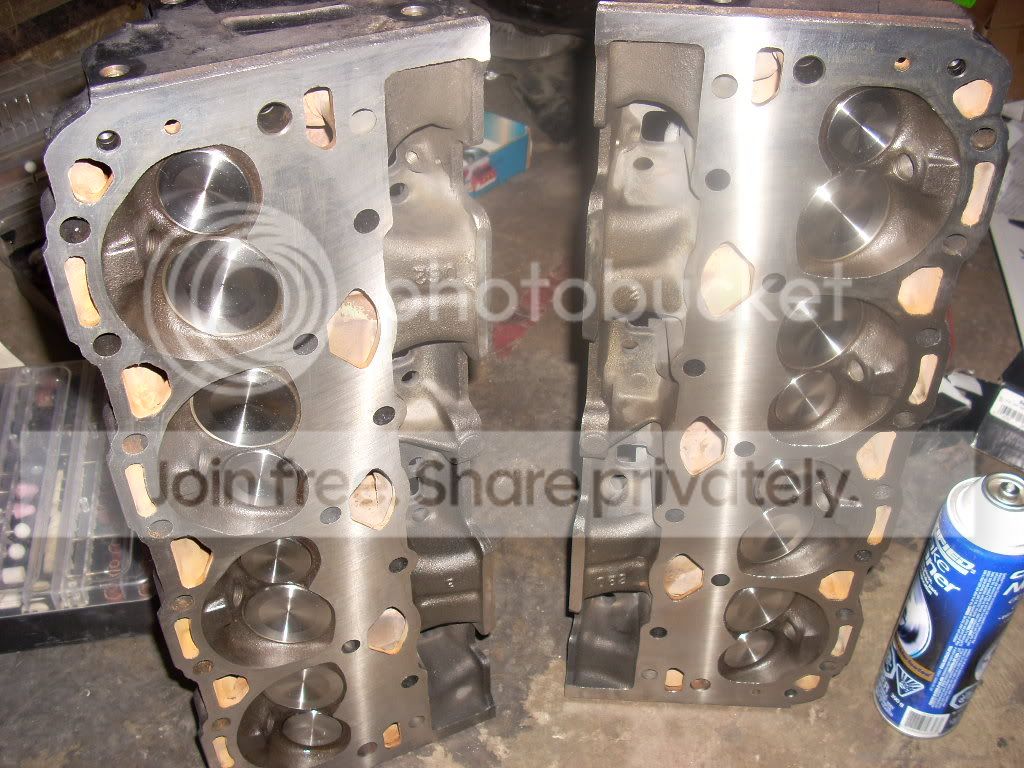
Vortec heads with stainless undercut valves and polished runners
DSCN1559.jpg


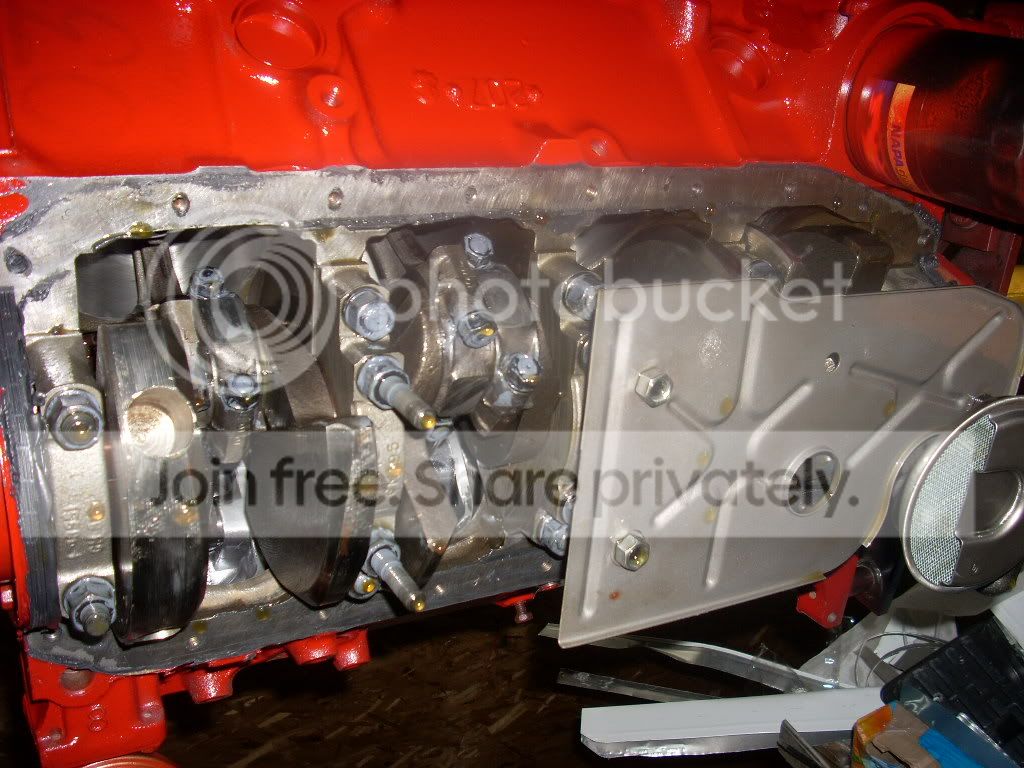
ARP studs and align honed, ARP rod bolts and rods resized, cheap windage tray
DSCN1565.jpg


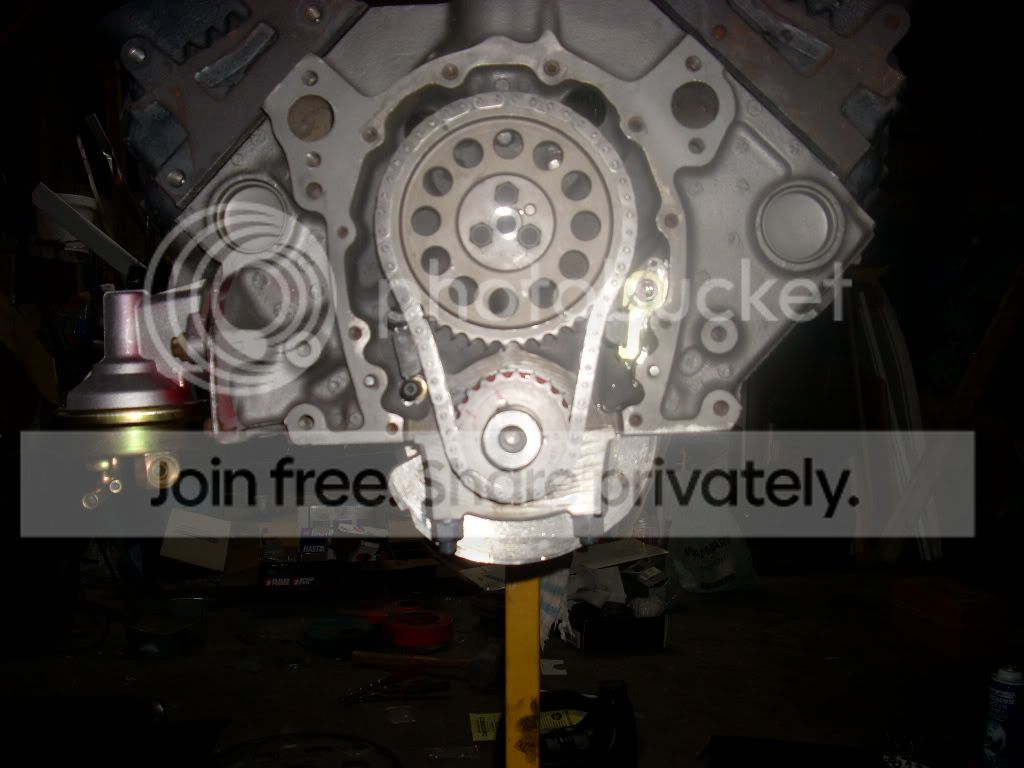
Timing chain tensioner, probably not necessary but a good idea because of the align hone, on a Cloyes .250" double roller timing set.
DSCN1561.jpg


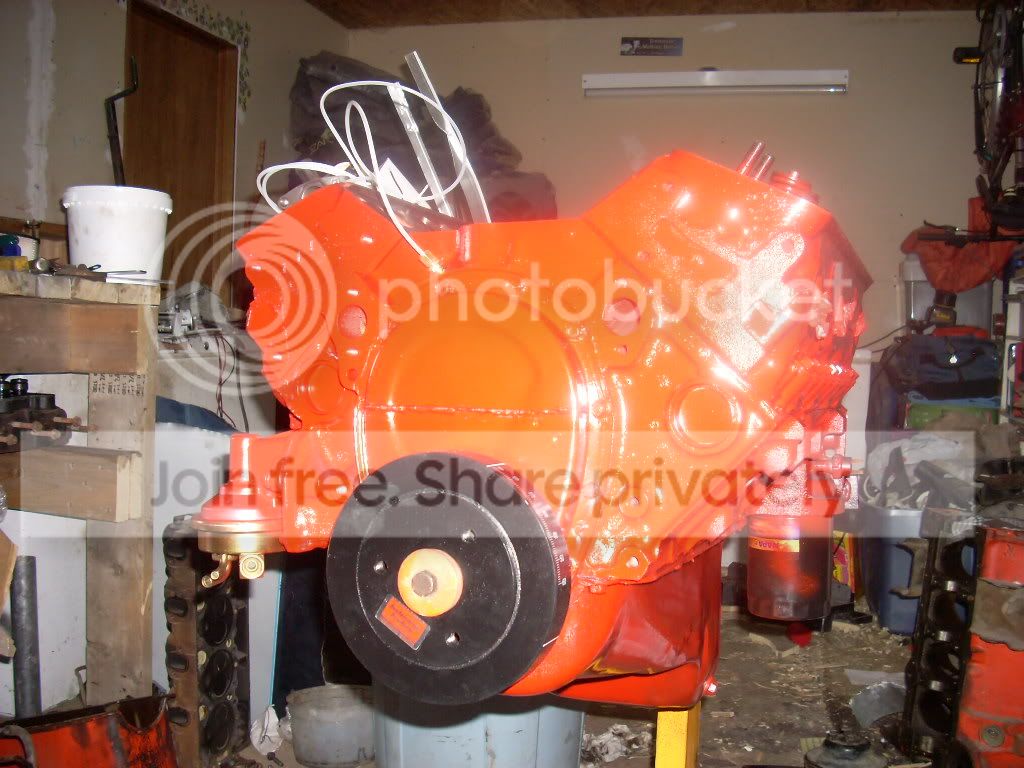
Oil pan in place with a Professional Products degree'd balancer installed
DSCN1563.jpg


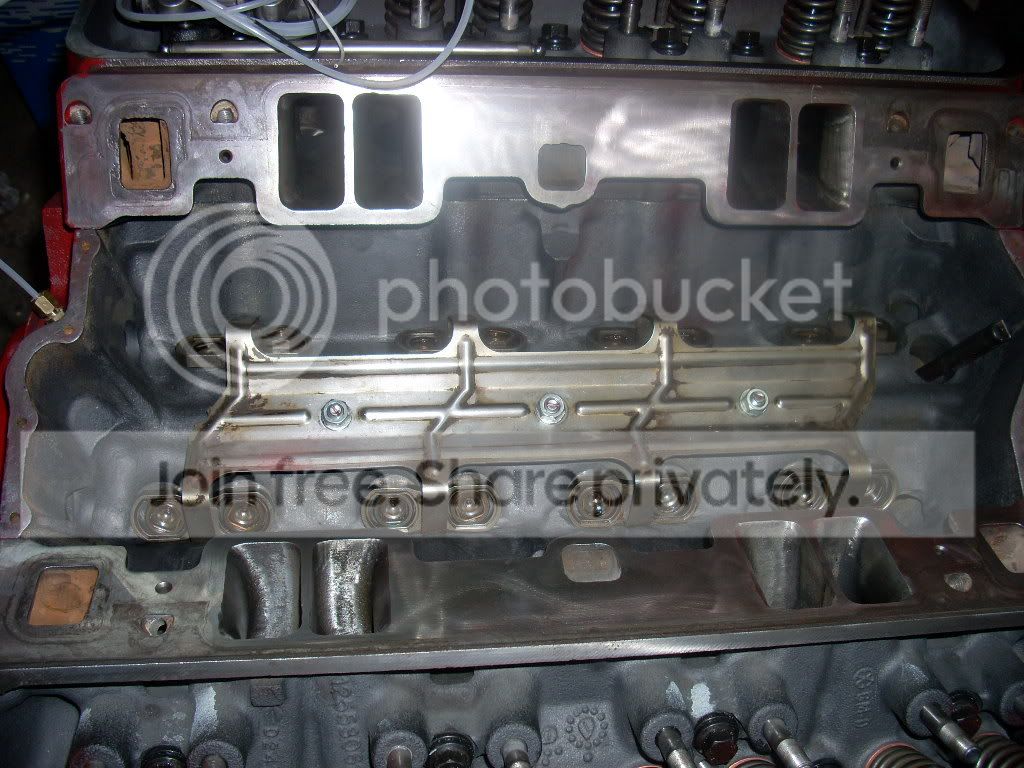
Lifters in place and guide plates bolted down
DSCN1564.jpg


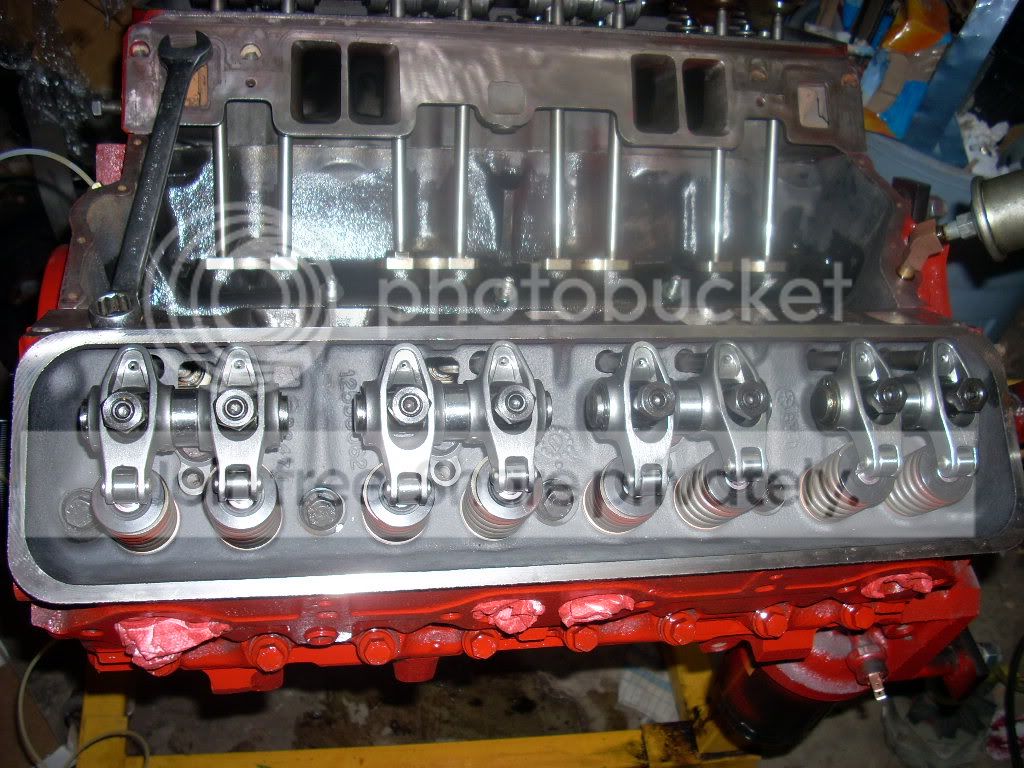
Shaft mount roller rockers--they have to be self guided on the vortec heads, I'm not sure shaft mount was the brightest idea. Might still have to come up with something different as I'll explain below.
DSCN1566.jpg


Because the seat depth varies from valve to valve, the shaft doesn't sit square when the two arms are tightened to match their respective valves. That will in turn create a lot of extra pressure and wear on the valve train. Do these type of rockers require the valve seats to be cut to equal depths, or is there some other way of fixing this problem?
 
Only thing I can think of is shimming the pedestal(s) they mount on, but that would seem likely to induce binding if one side is higher since the two rockers are connected.

What say Scott? :)
 
First i must say i've never used or even physically seen the shaft mounted rockers before. I've seen them in the magazines but never in hand. With that said i don't think there is any "pedestal" it is simply a set of rockers connected with a shaft to keep both rockers aligned over the valve tips. The flaw in this design is exactly the issue he is having now. Unless both valve tips are set to the EXACT height then the shaft cannot sit properly and will stress the rocker studs. The best thing in this case is to machine the heads for guide plates and then change the rockers to a standard rocker arm and make sure you use hardened pushrods for use with guide plates. The first option though would be to use the self aligning roller rockers designed for use with the later heads.
 
Ugh, no pedestal??

Quick scan of the thread tells me nothing, those look just like my comp cams pro magnum rockers, wonder if you can buy just the trunnions of the non-shaft mount ones and replace them.

Tying two rockers together, with or without a pedestal, seems like a recipe for frustration at best.
 
I went in and talked to my machinist and he said pretty much what Scott said. The rockers were being sold as Vortec roller rockers, and I didn't know any better at the time. Apparently the application would be where you have an adjustable valve train, dunno how that would work, or you make the valves all the same height when building the heads.

I also have a set of individual roller rockers, and was informed that I could modify them to be self guided simply by removing the roller tip, opening up the end a bit with a grinder, and installing little disks on each side of the roller tip to keep it centered on the valve stem.

For the time being I'll run the stock rocker arms.
 
Yet another question--I know you can't use the stock distributor gear, but is it necessary to buy a bronze gear, or can I simply swap the Vortec distributor gear on?

I still don't understand the reason for needing a different one, maybe if I did I'd be able to answer my own question . . . .
 
as many engines as i have rebuilt over the years, i have never seen 1 of those timing chain tensioners for a sbc, not even in the parts books..who makes it & where did you get it from...i'm about to actually build me a 383 & a 377, i figured since i'm robbing parts from 1 for the other and vice versa, that i would go ahead and have all machine work done and buy all the parts to put them both back together.

as of recent i haven't been rebuilding many engines, just swaps,..I've been going to salvage yards and buying 96-00 vortec 5.7's..complete w/accessories and all(complete from water pump to flexplate & air filter to oilpan, harness & ecm still connected), usually about $650-1k depending upon the mileage(w/ no core charge), sometimes i'll buy 2 or 3 at a time to get a better deal and buy 2-3 gmpp carb intakes at once, so i have the next engine ready to swap out when i get next customer(i'm starting to get a pretty good rep locally, word of mouth goes a long way, i don't advertise and i've been doing 2-3 a month, sometimes 4, i just started right after thanksgiving doing a swap for a friend and it's started snowballing, i've been thinking i may get a biz license and open shop)

then i pull the intake and all the electrical crap and trashcan them( i may start trying to eBay the original intake,sensors, & ecm, heck if i get anything for it, better than going in the dumpster), and then i put a gmpp dual plane carb intake on it, w/their old carb cleaned up(i'll rebuild it, if it needs it), then use their hei thats been cleaned up & rebuilt w/accell's hi output coil & modual set, cap, & rotor, and new cam gear, then a set of after market gauges & sending units, if they didn't already have them.

i can't build a comprable engine any cheaper than doing this swap...and when i swap out the engine i set the old engine along my shop wall, i have like 10-11 5.7 sbc's lined up inside my shop, also 2 small jrnal 327's and 2 400's(1 is 4 bolt main)so i have @ 15 sbc's waiting their turn to be turned into something special.

so when i run out of vortecs or it gets hard to find low mileage 1's, i'll have plenty to rebuild, most all of them that i pull out, were running when i pulled them, they just were smoking bad or burning a qt of oil a day, i do these engine swaps for other people, ussually can get them there vehical back to them after 2 days(they bring it early monday morn, they can pick it up tuesday afternoon) they give me the cash to buy replacement engine upfront, and when i finish i get paid for my labor and i get to keep the engine i yank out(5.7's)

if they have a 305 & don't want to go w/a 5.7, i'll strip it to a longblock and pick up a reman longblock and give them their engine as a core(i've only done 2 of these), and they cost more than buying the vortec and gmpp carb intake,....i've ordered so many intakes(gaskets & bolts) from Scoggin Dickey Parts Center, i can just about tell them my name and i need my ussual and they know what i want..lol

you've done alot of custom work and R&D, keep us posted on how it goes, you've posted alot of good info, especially about the different lifters and such, deffinitly keep us up to date!
 
You can use the stock distributor. The cam gear on the billet cam is sintered iron even though the cam is steel billet. I'm currently running a comp cams roller cam in my engine with the factory distibutor gear. If you don't believe me then call comp cams and they will verify it for you (that is what i did).
 
i never doubt you 4x4high, as i've told others, when you chime in about engines, you can pretty much etch it in stone. i reuse their hei and put new gear on it b/c it already has a wear pattern from the old engine and not sure if the pattern will be compatable w/the cam in the used vortec, so i put a new bronze gear on so it can lap itself into the pattern of the cam in the vortec, just to play it safe, so 2 different wear patterns aren't trying to sync up.
 
Phew, I was worried for a bit that I'd have to start disassembling the thing and checking for problems.

Vortec heads with stainless undercut valves and polished runners
DSCN1559.jpg


ARP studs and align honed, ARP rod bolts and rods resized, cheap windage tray
DSCN1565.jpg


Timing chain tensioner, probably not necessary but a good idea because of the align hone, on a Cloyes .250" double roller timing set.
DSCN1561.jpg


Oil pan in place with a Professional Products degree'd balancer installed
DSCN1563.jpg


Lifters in place and guide plates bolted down
DSCN1564.jpg


Shaft mount roller rockers--they have to be self guided on the vortec heads, I'm not sure shaft mount was the brightest idea. Might still have to come up with something different as I'll explain below.
DSCN1566.jpg


Because the seat depth varies from valve to valve, the shaft doesn't sit square when the two arms are tightened to match their respective valves. That will in turn create a lot of extra pressure and wear on the valve train. Do these type of rockers require the valve seats to be cut to equal depths, or is there some other way of fixing this problem?

The Adjustment on a shaft style rocker is on the top of the rocker where the pushrod sits. You basically have a threaded shaft with a cup on one end and it threads up and down inside the rocker. Then the nut is used to lock it all together. the way it is now it will bind and break studs.
 
Top Bottom