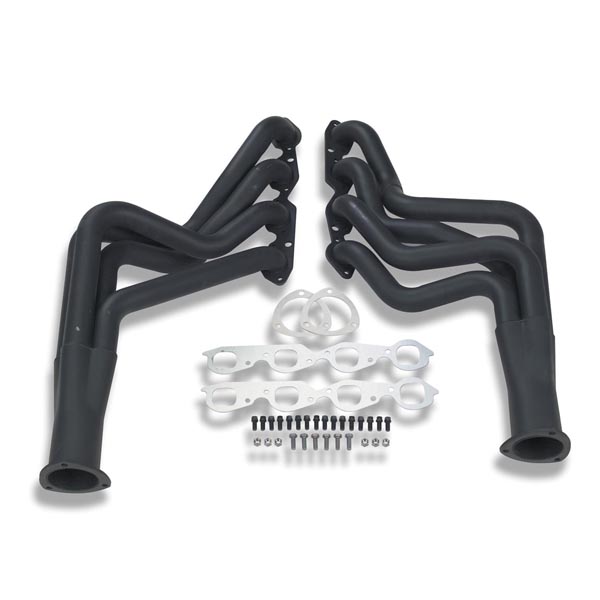
CK5
Register an account today to become a member! Once signed in, you'll be able to participate on this site by adding your own topics and posts, as well as connect with other members.
Curious...How do you finish weld with all the tubes in place??
 
Yeah, JUST MAKE SURE THE FILLER IS ON THE WORK OR YOU'LL HIGH FREQ YOURSELF!!!!

So THAT'S what that tickling sensation is!!!!! I've been wondering why my welding sometimes makes me feel kinda funny. :haha:


Curious...How do you finish weld with all the tubes in place??

Very small hands!

You actually cut the tack welds at the header flange and remove the 4 tubes for finish welding, then reassemble them to the flange afterwards. The collector goes on last.....


Anyway... here's the progress from last night:

I spent about an hour playing around with routing options for the #4 primary, and realized that there really isn't a way to use that big open space underneath the #2 tube... All of the options I tried ended up coming too far outward and would interfere with the strut. It's mostly an issue with the 6" CLR tubing which isn't very space-efficient. I like the gentle bends since they are less-restrictive, but if I was willing to use a smaller CLR, I would have more options.

In any case, it was too hard to jam myself into that area while trying to hold about 5 segments of loose tubing together to figure things out, and since I knew where I wanted the tubes to go it made more sense to just pull the header off the engine and put it on the workbench instead.

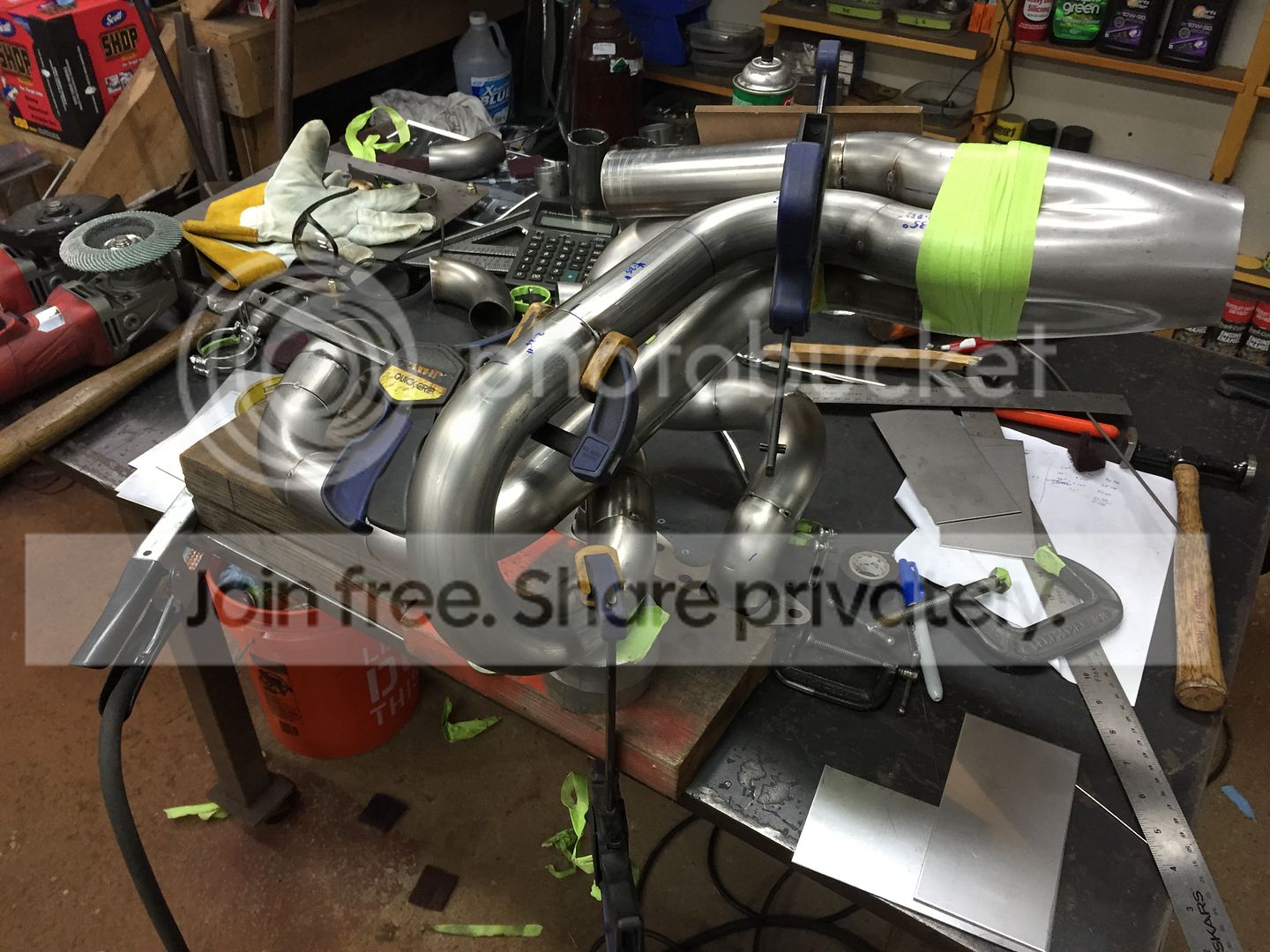
In this photo, the #6 primary is still just "green tape welded" together so I decided to just finish that off and tack the parts together before I moved to #4....

IMG_6694.jpg


It's pretty challenging to hold parts tightly together for TIG. You don't have any extra hands to hold parts since it takes both hands to weld (and one foot!) so getting a "setup" that can hold everything together without gaps is a huge time waster.

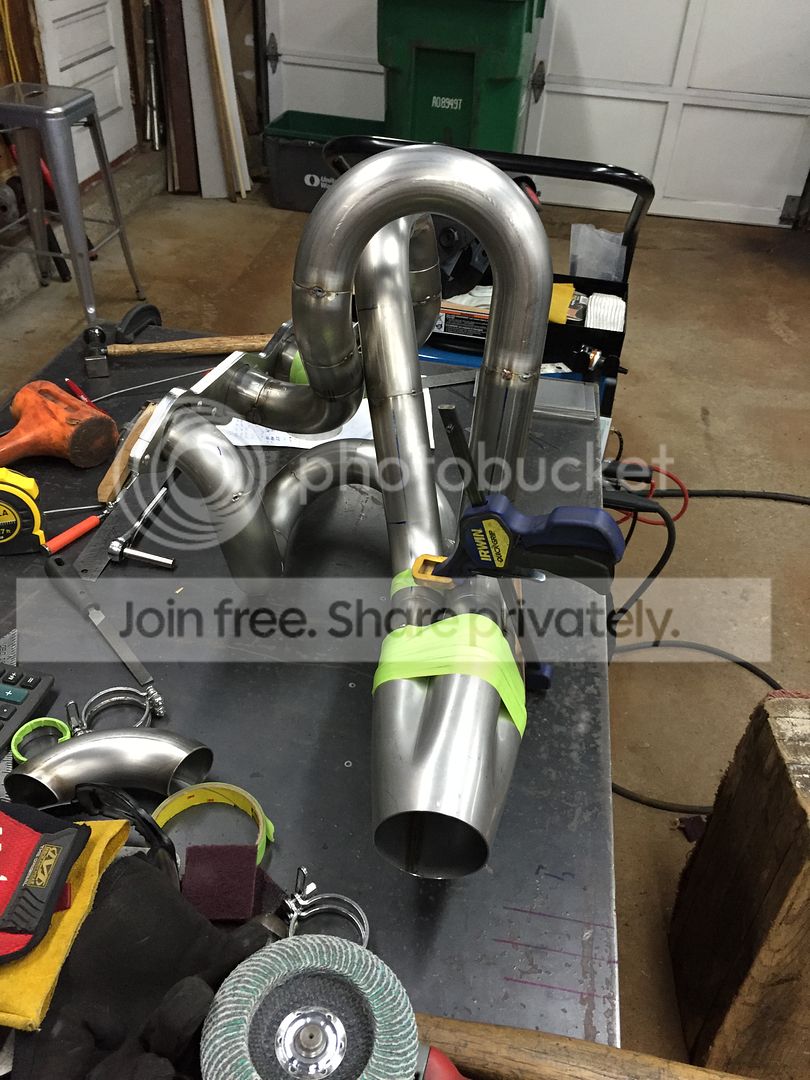
Eventually though, I got something that worked.

IMG_6700.jpg


I can see why guys buy those welding tables with all the threaded holes in them.... having a really flexible clamping system would make life a lot easier if you TIG a lot.

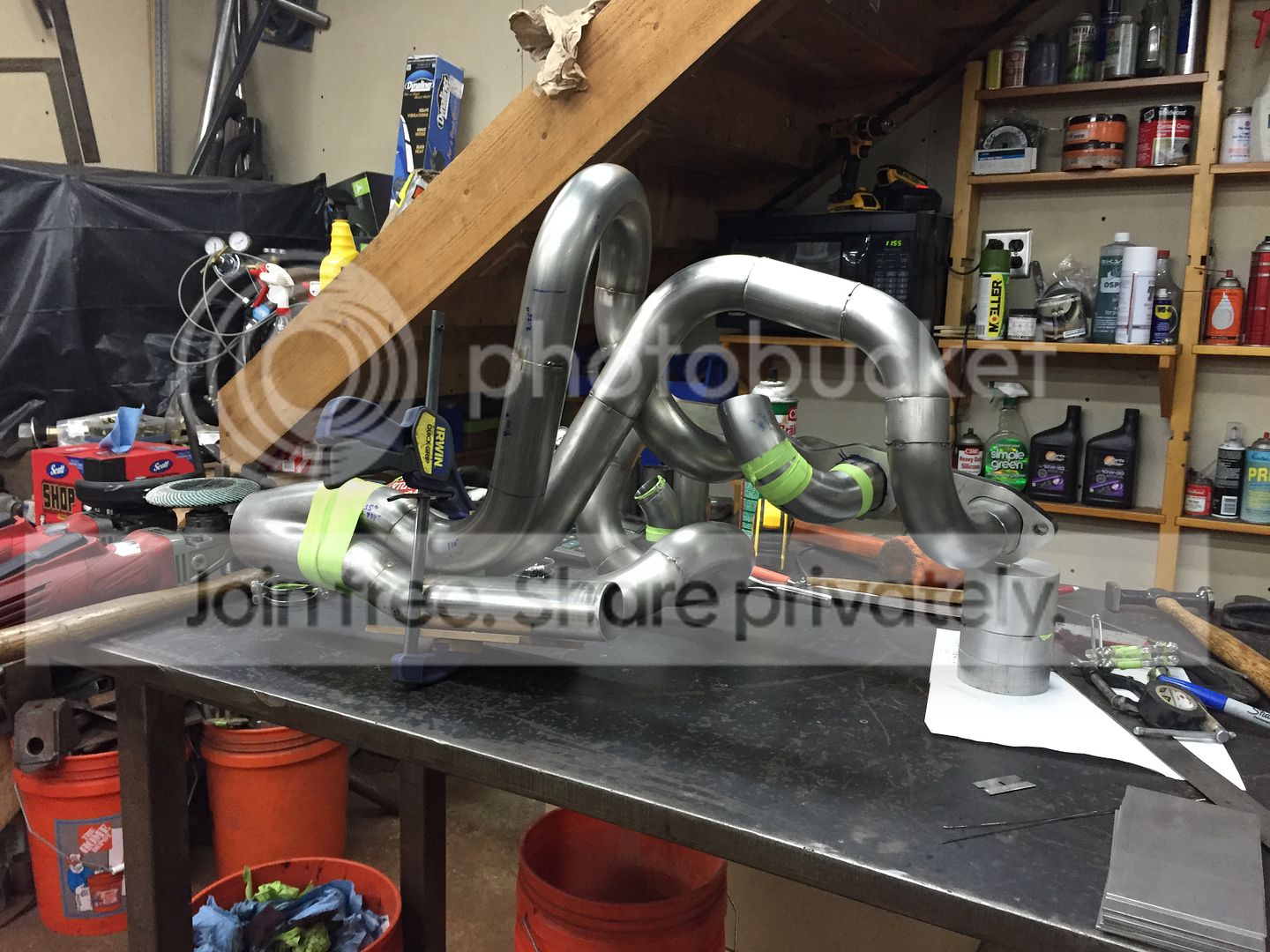
After a few small cuts, tweaks and adjustments I was able to get the tacks in place on #6. Here's a cool side-view of the header that shows all the curly routing that's going on.

IMG_6709.jpg


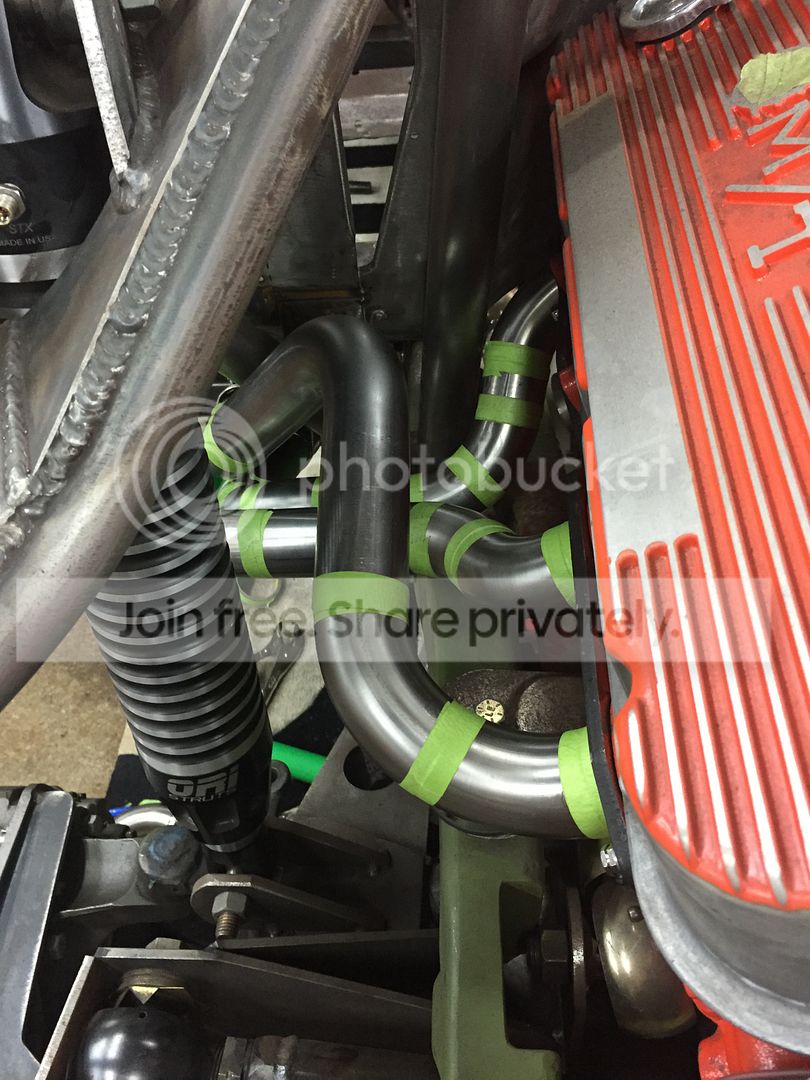
....and after a few hours, I didn't really have any extra progress on #4 (except for confirming where I know it now needs to travel), but at least the first 3 primary tubes were finally all "locked down" and looking good.

IMG_6712.jpg


Interestingly..... as crazy as this header looks, it actually STILL unbolts and can be removed from the truck pretty easily. I was expecting that with tubes running in all directions it would become sort of "trapped" in the engine cradle and I'd never be able to remove it without lifting the engine up a few inches. :D


So I guess tonight I will make a 2nd attempt at getting #4 designed and built. Honestly, I think it will go a lot faster and easier now that the headers are on the workbench instead of the truck. We'll see.... :thinking:


-G
 
thats just wild Greg! It is looking more and more like the tentacles of a kraken.
I hope it all works out and if you have any finishing trouble that they are easily remedied. Good luck man!
 
They are works of art, but all this talk of molten metal makes me think of Salvador Dali...

-- A


Custom headers first......then I'll do some melted pocketwatches. :haha:


-G
 
You cant take number 4 up and over number two and basically mimic number 6?


Good eye! :waytogo:

That's basically what will have to happen with #4.

The more centralized open areas are too close to the strut, so I need to steer the first few segments (coming off the #4 head flange) rearward and immediately start angling them upward to add to the overall length of the tube. As it sweeps to a vertical it will be positioned to use a full 180* bend to take it over the top of that tall #2 primary tube and bring it to the front side of the collector where it needs to eventually terminate...

There are some interferences underneath the upper strut mount where I welded in a couple of re-inforcement (anti-ballooning) plates, so I need to keep a close eye on how tall I allow the tube to go, and I may need to rotate everything slightly forward (coming out toward the wheel) so that I don't have clearance issues.

Otherwise, it should be pretty straightforward. :D


-G
 
Huh?

Those headers look nice, as long as I don't need to ever turn the front wheels.


:)

-G
 
Huh?

Those headers look nice, as long as I don't need to ever turn the front wheels.


:)

-G


I didn't mean exactly....


The furthest one has one bend, and the shortest one has more bends to make the difference


Can you do something similar to get rid of the crazy octopus?
 
Also they blocked photobucket at my work, so I have no idea what your latest pictures look like. They are just little X's :whistle:
 
I didn't mean exactly....

The furthest one has one bend, and the shortest one has more bends to make the difference

Can you do something similar to get rid of the crazy octopus?


Not really.

It's been several hundred posts since I showed a photo with the strut actually installed.. but here's one from a few pages back:

IMG_5329.jpg


Normally yes, all you need to do is sweep each primary tube straight out from their respective exhaust port, through in a bend (or two) to send them back to the collector and you're done.

I'm REALLY constrained by the strut location AND by the way the tire tucks into the firewall area under hard right turns (while fully stuffed). If you remember, my very first mock-up looked awesome until I remounted the wheel/tire and did some clearance testing. The inside sidewall crushed the primary tubes just before they went into the collector!! :yikes:

Also, I can't move the collector back underneath the truck any further because of the small "passthrough" area I'm left with between the floor and the rockslider. Having it so far forward really jams-up my useable space and is forcing me to make a LOT of turns and bends to get a 36" primary while avoiding the strut and tire sidewall areas that I already know are an issue.

Ultimately, I think the headers are coming out really cool and unique with all the bends and curves.... and like almost everything on this truck build, I'm learning a LOT of new skills as I burn through dozens and dozens of hours in labor.


-G
 
Got on my phone.

That pic explains all.

Never mind lol.


Yeah.... the engine "setback" is a bit deeper than normal as well.... #8 has to come FORWARD quite a bit before it can even think about curling over the frame and around the engine cradle tubing....

-G
 
Perhaps that was an overstated gap... The gaps I have are narrow enough that if I lay a piece of .030" filler rod on them it fills the gap and sits slightly above the seam.... so in reality, we're a talking closer to 1/32". I know, I know....it's a difference of 1/32" but can't we all just get along? :haha:

-G

1/32 is a 50% reduction, I do agree that is a big difference actually.

In all seriousness though.... at what point (length) does a primary tube qualify as a mid-length vs. a long-tube? 30"? 24"? 20"? Maybe having a clearer sense of that would help talk me down from the ledge. :D
-G


Typically a shorty header is specifically designed to be a bolt in replacement for an exhaust manifold, which is why they don't make as much hp. The collector is limited to the collector size that the factory manifold was, and the primary tubes are shorter.

91830flt.jpg


Some shorties have a larger collector, and they are much better, but they are still very short tubes which does not leave much time for the exhaust gas to cool before it merges in the collector.

Mid length headers typically have a little longer tubes and a larger full flow collector. They typically exit at an angle down next to the transmission right under/behind the firewall. The exhaust then takes a slight bend and heads back right after the collector. These are much better than most shorties but still not a full length header, although for most applications a mid length will probably give you most of the benefits of the long tubes.

2474_3-3hkr.jpg


Long tubes have full length tubes that promote better scavenging and better velocity in addition to a longer time for the exhaust to cool before it merges in the collector. They typically exit down under the floorboards on most vehicles after making the complete turn down and around the firewall.

2455hkr.jpg


So if you think about your headers Greg, you are actually trying to build a mid length header with long tube lengths, and the main reason you are pulling it off (other than your infinite patience in the persuit of perfection) is the extra room for the fenderwell exit.

Hot gas takes up more volume than cooler gas, directly proportional via the ideal gas law (PV=nRT). So the most important place to have the flow in the exhaust is immediately after the cylinder head. A stock 350 will gain hp from shorties and a better Y pipe yes, but it will still be limited. However, the moment you start changing cams, heads, or intakes, etc, then manifolds will kill a lot of the power. Here is an article showing how on a stock SBC they only gained 16 hp, but 53 ft-lbs of torque! However, the same stock manifolds on a mild performance SBC making 425 hp with headers killed almost 70 hp!

headers vs manifolds

Also, many shorty systems immediately dump into a Y pipe, which is not a big deal on some near stock engines, but on a performance build it can be a big difference. My brother picked up ~40 hp on a mild 350 SBC that was making around 425 hp by removing the shorties and Y pipe and installing long tubes. So on a performance build, I never recommend shorties or Y pipes.

A common myth is you want restriction in the exhaust to create backpressure, which is not true. If you have too large of primary tubes you will lose velocity, which hurts scavenging of the cylinders working with each other, however, most of this is done in the primary tube and collector. So in most hp builds, if the primary tube and collector are the correct size, a larger exhaust tube dia will probably not hurt, and may only help.

Yeah, JUST MAKE SURE THE FILLER IS ON THE WORK OR YOU'LL HIGH FREQ YOURSELF!!!!

Very true! I thought that was a given but it should be stated.

Want to hear something stupid, earlier this week I was firing up the TIG again to weld some stainless exhaust and I couldn't figure out why I wasn't getting any gas flow. I had a new regulator I only used a couple times, so it was suspect. I coudn't hear the gas flow so I had this bright idea to hold the TIG torch closer to my ear and tap the pedal to listen for the gas flow. :doah: High frequency arcing onto your ear is not exactly a comfortable sensation. :eek1:

Turned out in my quick TIG hookup I inadvertently hooked the torch and ground connectors backwards. No wonder I wasn't getting any gas flow, easy problem to fix after you arc your ear. :doah::doah:

Curious...How do you finish weld with all the tubes in place??
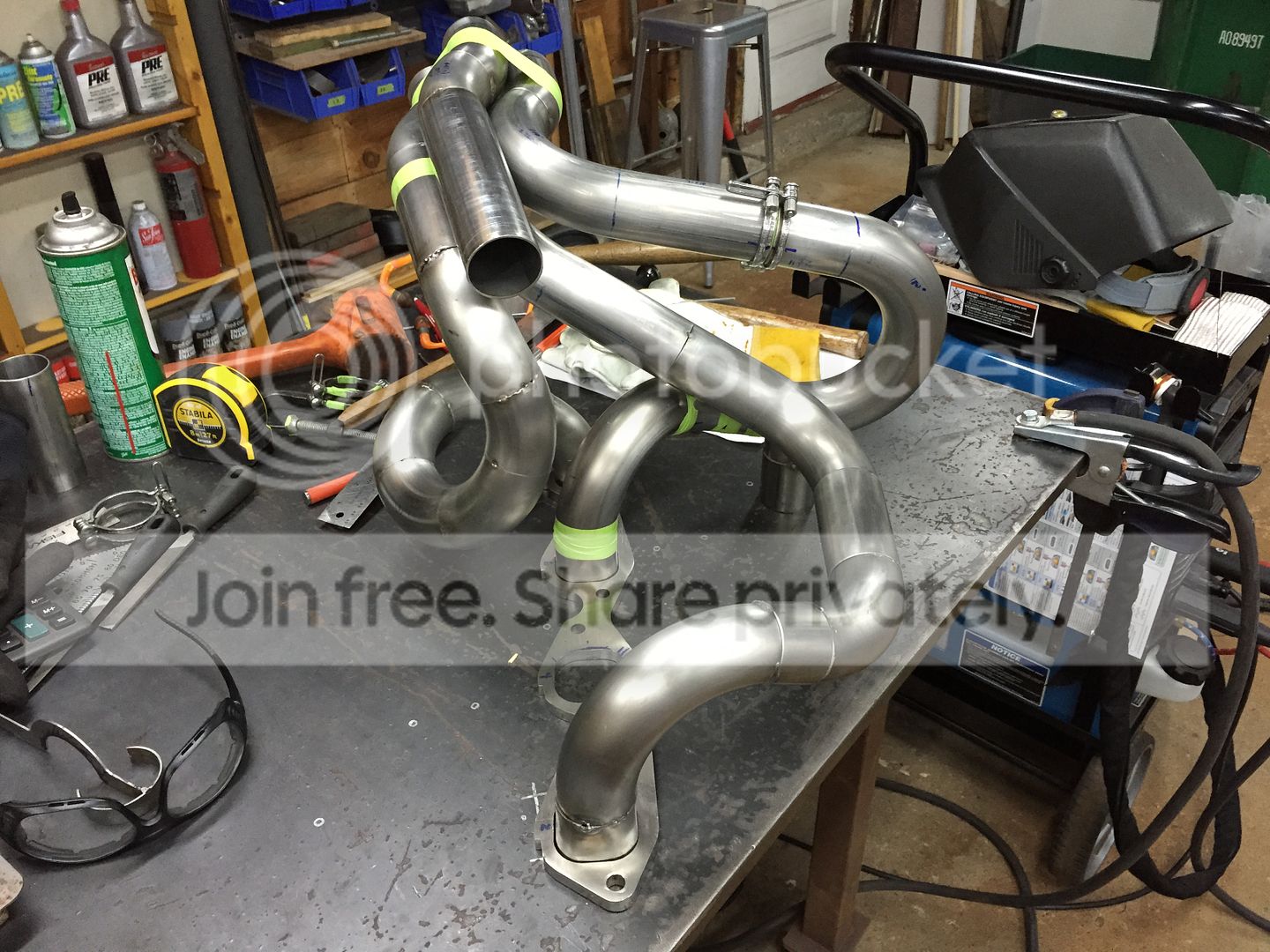
You actually have to remove all 4 tubes and weld them all seperately, then weld them back to the header flange and collector assembly.
 
Last edited:

Latest Posts

Top Bottom