CK5
Register an account today to become a member! Once signed in, you'll be able to participate on this site by adding your own topics and posts, as well as connect with other members.
glad ya got it worked out Greg... after picking my 105 up last week, I've been following this closely.. down the road definitely..

btw, is the bending vid only fubared for me guys? it's all jumpy and unwatchable.... :(
 
Yeah, if you look closely at that Bosch angle finder you can see that one of the legs is a sort of "U" shape so that it can be collapsed onto the other leg for storage. The problem is that I couldn't get it to sit convincingly against the tube without shifting around, and I wanted to make sure that I was measuring the "flats" beyond the bend area.... you'll notice I finally gave up and grabbed a small scrap of flat stock to use as a backer for that side, and then I was finally able to get both sides fitted up nice and tight for the measurement.

As for your other comment about the degrees....I have no idea what you are telling me there. :dunno: The demonstration piece travelled a total of 93 degrees around the degree ring indicator, and the actual part on the bench came to 93 degrees also.

I'm still puzzled why there is no apparent "springback" in the bender, but the best I can figure it's because as I approach the value on the degree ring and start feathering the controller to hit the number, the springback of the tube is already being bled-out of the part so the pointer is showing what is truly in the part with no stored energy.... :thinking:


:usaflag:

When I saw your finished angle and you were saying let's see if this is 90 degrees and I am looking and it looked a little open so I figured a little more than 90.
Is the angle finder measuring from the outside of the pipe to outside of pipe or is it measuring from straight line to the finishs point of the pipe?
Because your angles on the bender start at zero when the pipe is straight, and start going up as you bend the pipe, but it looked to me like the measurement you got with the angle finder is the angle between tht 2 ends of the pipe wich is 180 minus your angle.
If that doesn't make sense let me know then I will draw up a pic, but I don't feel like it. :p:
 
Iceman, you are confused. A shape of a perfect L is 90* (which is what he measured with the angle finder) and the shape of a perfect U is 180* ;)
 
When I saw your finished angle and you were saying let's see if this is 90 degrees and I am looking and it looked a little open so I figured a little more than 90.
Is the angle finder measuring from the outside of the pipe to outside of pipe or is it measuring from straight line to the finishs point of the pipe?
Because your angles on the bender start at zero when the pipe is straight, and start going up as you bend the pipe, but it looked to me like the measurement you got with the angle finder is the angle between tht 2 ends of the pipe wich is 180 minus your angle.
If that doesn't make sense let me know then I will draw up a pic, but I don't feel like it. :p:

WINNER!

Iceman, none of that would have made any sense to me if I hadn't been out in the shop tonight scratching my head over this thing...

I started all over again with a fresh 3' piece of tube and reset the indicator needle to read at exactly 0* when the tubing was loaded and just slightly loaded by the ram. When I completed the bend and looked at the result, it was clear that I hadn't gotten to a full 90*....then I threw the Bosch on it, and the reading was: 96.8! :yikes:

It turns out that the issue is exactly as you describe...the Bosch is assuming that 180* is a straight piece of tube, and us "truck guys" assume that a 180* is a hoop. The real value must be calculated as (180 - indicated value). In the case of my fresh bend tonight, the actual bend was 83.2*, not the 96.8* I was reading on the gauge.

More importantly, this also tells me that I actually DO have a springback value.... 6.8 degrees. (The difference between the indicated value on my degree ring, and the actual bend I got)

I'm already working on a simple conversion chart so that I can quickly get "real" bend values from the indicated ones on the Bosch... there is no way I'm going to trust myself to do the math correctly every time, and I'm already getting tired of wasting tube with all of this diagnostic work.


:usaflag:
 
WINNER!

Iceman, none of that would have made any sense to me if I hadn't been out in the shop tonight scratching my head over this thing...

I started all over again with a fresh 3' piece of tube and reset the indicator needle to read at exactly 0* when the tubing was loaded and just slightly loaded by the ram. When I completed the bend and looked at the result, it was clear that I hadn't gotten to a full 90*....then I threw the Bosch on it, and the reading was: 96.8! :yikes:

It turns out that the issue is exactly as you describe...the Bosch is assuming that 180* is a straight piece of tube, and us "truck guys" assume that a 180* is a hoop. The real value must be calculated as (180 - indicated value). In the case of my fresh bend tonight, the actual bend was 83.2*, not the 96.8* I was reading on the gauge.

More importantly, this also tells me that I actually DO have a springback value.... 6.8 degrees. (The difference between the indicated value on my degree ring, and the actual bend I got)

I'm already working on a simple conversion chart so that I can quickly get "real" bend values from the indicated ones on the Bosch... there is no way I'm going to trust myself to do the math correctly every time, and I'm already getting tired of wasting tube with all of this diagnostic work.


:usaflag:

Sorry if I wasn't clear before, The engineer in me knows what to do, but I was never a good teacher. :D
 
FWIW the JD2 dies I have have a very nice finish to them...even so I usually grease the follower. Makes bending the tube that much easier seeing as I still have the "armstrong" set up. ;)

Rene
 
Greg, maybe Pro Tools has updated their dies since you bought your bender. All of the dies i have for my Pro Tools 105 HD (1.25"-1.5"-1.75") have a nice smooth polished finished. :dunno:

Greg, i also have Jim on the project now. :thumb: I might hear from him tomorrow.
 
Rene,

I think part of the problem I had was actually when reversing the die to get the tube out....it seems like that's where a lot of the galling came from. Since doing the smoothing of the die & follower and being more careful on the retract, the tube looks perfectly normal now.

Scott,

Guess you got my drawing OK, and it made enough sense for Jim to work with?? :deal: Keep me informed... if he's able to do it, I'd like to move as quickly as possible.


:usaflag:
 
just for the record... I'm sure Greg and experienced benders know this, Pro Tools does say in it's instructions that deburring and polished of the dies may be done and desired to prevent galling, scratching, etc..

personally, I'm not overly concerned, but when I actually get to bend some tube, I may feel differently...

Greg, how many feet do you think you put in your last cage?
 
The last 6-point cage with a front seat cradle was around 100' of tube.

I bought 200' of tube for this one, since I'm sure there will be mistakes and practice bends.... in fact, I've already burned through the first 20' stick with precious little to show for it. :rolleyes:

As for you comment about the dies....there is "factory finish", and there is what actually WORKS. I've got an almost mirror finish on the dies now, and a good radius on all the previously sharp edges. Things are working a lot better, and it's not nearly as critical to spray lube all over the follower block the way it used to be.


:usaflag:
 
2008.03.01 - UPDATE! - CAGING THE BEAST!

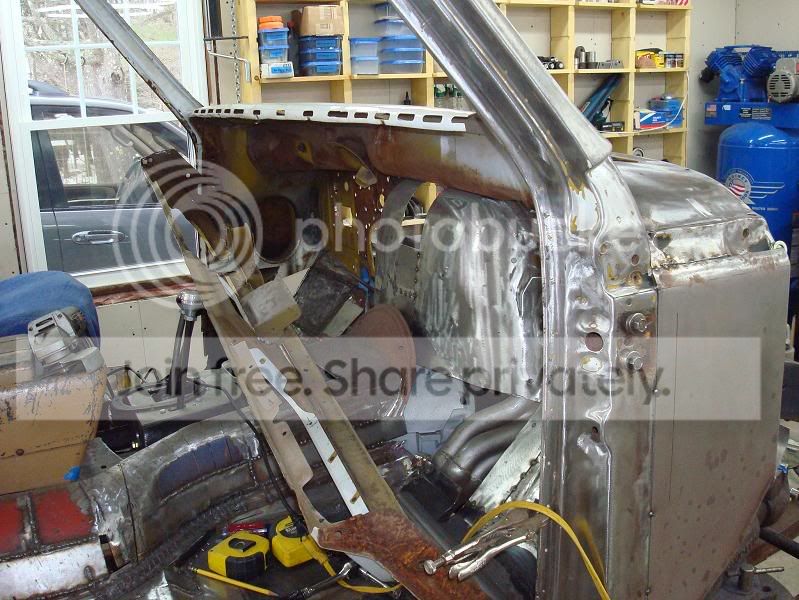
The "Might As Well" struck early, and since I'm planning to run the cage bars through the top of the dash it makes a whole lot of sense to remove the dash rather than struggle underneath it.

DSC01449.jpg


It really not that hard to remove the dash. There are three 5/16" bolts on either side that need to be removed, and some cuts on the sides to seperate the front of the dash from the top part. Finally, a long cut just below the front slots under the dash pad. This is a good spot to use since the new dashpad will cover the repair once the dash is welded back in place.

The next thing I did was to make up a six-inch plate for each side of the dash that re-used those lower two 5/16" holes from the dash and created a mounting point for a transverse cage bar. I like being able to have a factory "index" point to help insure that the cage stays square and accurate. In this photo, you can see the plate, and the lower a-pillar bar in place. This bar will also serve as a good place to connect other tubes that will be going to the firewall (and through into the front clip area)

DSC01461.jpg


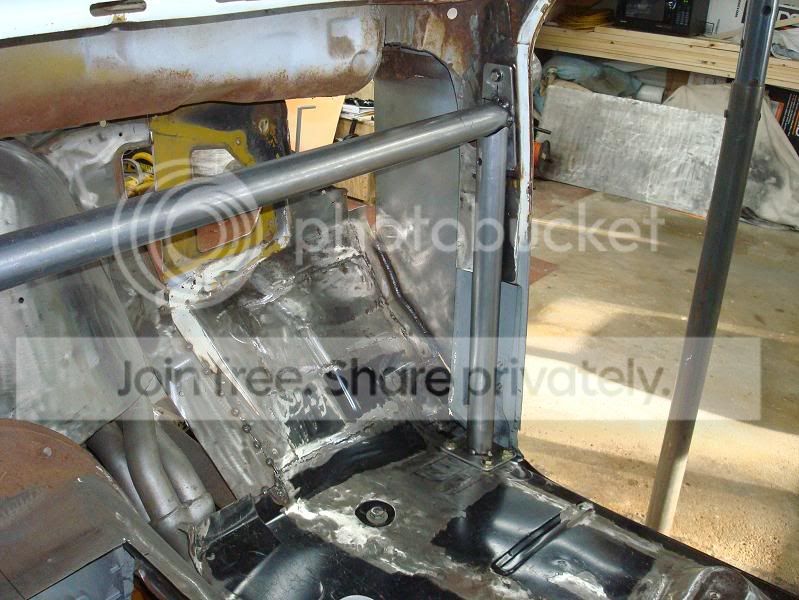
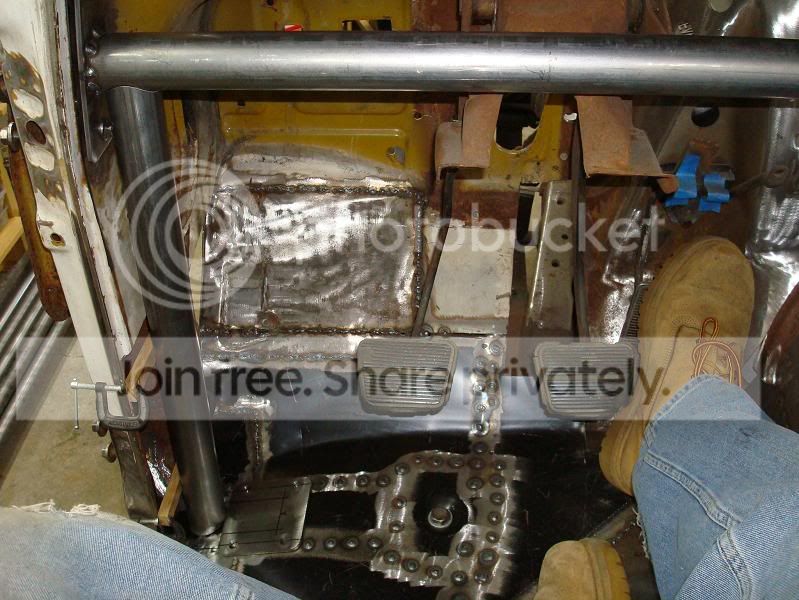
I've been in plenty of trucks with rollcages, including my own...where the rollcage legs wind up blocking all sorts of stuff like the glovebox door, window cranks, A/C vents and sunvisors. They always seem to be in the way of the footwell too. On this cage, I'm fighting really hard to keep the intrusions to a minimum and in this photo you can see that I'm using small spacers to get the tubes within 1/2" of the interior sheetmetal.

DSC01460.jpg


My intention is to work equally hard to keep the upper part of the a-pillar tight to the windshield frame to maintain good visibility, and maximize headroom.

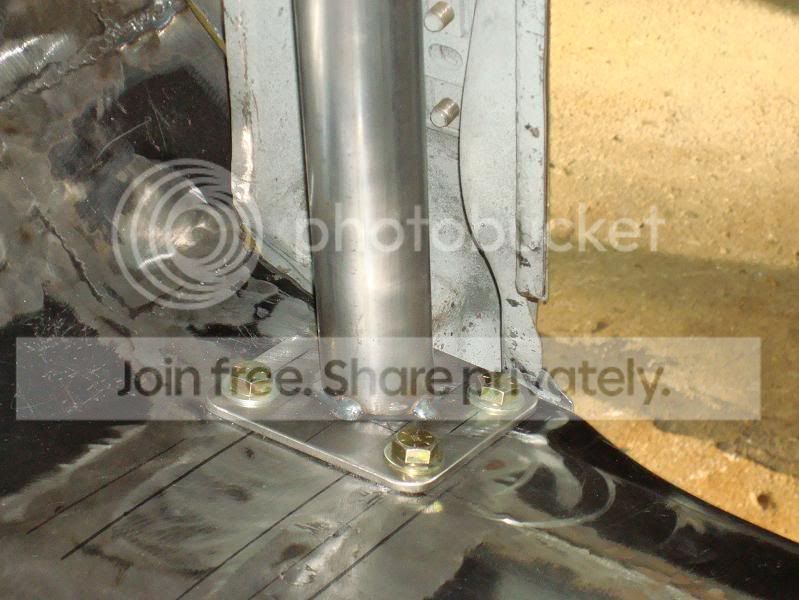
Whether by accident or design (I'll never admit which), the cage plates for the front a-pillars lined up perfectly with the front cab supports underneath. With about a 3" hole-to-hole spacing on the cageplate I was able to get bolts on either side of the re-inforcement, and the holes landed perfectly on the mounting flange on both sides! :saweet:

DSC01462.jpg


Ultimately the underside will have more re-inforcement, and will carry that mounting point to a rockslider-type support. I guess ultimately it didn't matter that the tube lined up where it did, but it made my OCD feel good. :D

At this point, I still need to do the final fitment of the driver's side tube, get the plate in position and drill the through-holes for the mounting bolts. After that I can start working on the upper a-pillar tubes and trying to match up some bends and angles to the body lines.


:usaflag:
 
Last edited:
you might have posted this before, but what kind of welder are you using?
 
Lincoln SP175+

It's their smallest 220V welder. I've been really happy with it, but if I get the chance I might step up one size to either a Miller or Lincoln "200" series...

:usaflag:
 
nice...

what do use for notching? do you print out templates?
 
I have a holesaw notcher for the obvious ones, and for the custom fitments, I just use a flap disc on my grinder and do about 1000 test fittings, and small, incremental adjustments.

ProTools software has a "wrapper" function which will be helpful on other sections of the cage, but for this initial part, I can't really use the software the way I want.

:usaflag:
 
What's your plan for lining the interior (rhino, linex, etc) around the cage plates? Are you going to mask off the area underneath the plates or bolt them down and line right over them?
 
My plan is to remove the cage, then completely Line-X the interior... using small plugs to keep the holes from getting filled-in.

Once the cage is finish-welded and painted it will go back in on top.

The trick of course is to build carefully so I don't create a cage that's so tight that it's impossible to slide back and remove. So far I "think" the parts I've built will come out as a single assembly, but I'll try it once I have the driver's side leg tacked into final position with the cage plate.

It's a big puzzle, just like fitting replacement body panels into the rocker area / footwell and floor areas. :wink1:


:usaflag:
 
I was wondering if you were going to mask off the entire area under the cage plates so you have metal to metal contact there or whether you would just sandwhich the layer of liner material between the cage plate and the floor?

I was planning on welding in a plate onto the floor that's the same shape as the cage plate. Then that floor plate could be masked off when it's lined and you don't have to worry about moisture getting between the liner and the plates and down any mounting holes.
 
Top Bottom