
CK5
Register an account today to become a member! Once signed in, you'll be able to participate on this site by adding your own topics and posts, as well as connect with other members.
The part numbers for the water pump is either:

3975928 or 8975928

I will probably end up going v-belt also as I already have a water pump, steering pump, york compressor for air and alternator. The v-belt setups are much more affordable too if you already have your own accessories.

Does your motor have aluminum heads and if so are you painting those as well?


Nope, no aluminum heads on mine... this one started out life as a 502HO. Only the ZZ502 and RamJet 502 have the aluminum heads IIRC.

Someday when I've got nothing better to do with my money and time, maybe I'll swap in a set of AFRs.... but there's plenty of other stuff to do before that becomes a priority.

:usaflag:
 
2009.06.22 - UPDATE! - BACK IN THE SADDLE...

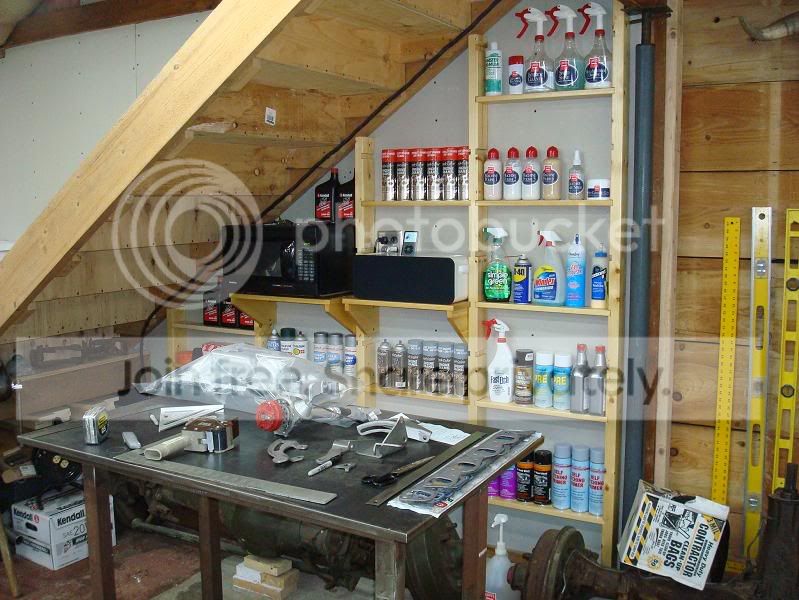
I spent almost the entire weekend in the shop. The shelving was the first order of business, so I got that finished and loaded up with the supplies that had been overflowing the area.

DSC01630.jpg


With that completed, it was time to deal with a huge mess in the upstairs attic. I cleaned up a bunch of items, and photographed and put the "extras" in the General Parts for Sale Forum.... to gather a little cash for the build and to re-claim space for parts that I actually still want to use and be able to find again.

Once that was done, it was time to get started on the truck. My main objective was to try to fit a new radiator/electric fan setup and make sure I had the clearance, so I loosely installed the waterpump and pulleys. It turns out that the water pump pulley didn't accept 5/16-18 bolts the way I'd expected....and even trying some 8MM bolts (as suggested by Scott) also didn't work. As far as I can tell, the tapped holes are all boogered up on the waterpump. Not only are they not cut right, but they are cut slightly out-of-alignment (ie. crooked) too. Thanks GM Performance Parts! :mad: At some point I'll need to drill and tap 4 new holes correctly...my fear is that re-cutting the existing threads won't give me a strong enough thread engagement and the bolts will just back-out over time.
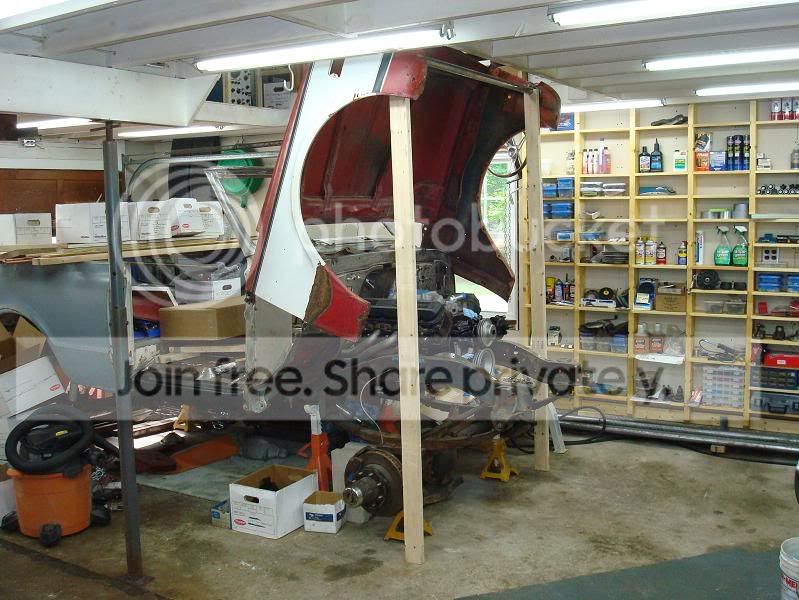
Another interesting thing I did was to add a small bushing to the upper fender mounts on both sides to create a nice strong pivot point for the front clip... it allows me to swing the whole thing up and get it WAY out of the way to do my work...

DSC01631.jpg


I took my 1-3/4" holesaw and cut a small "saddle" out of the end of some 2x4s and made some prop rods that won't slip out of position and kill me. Safety first.

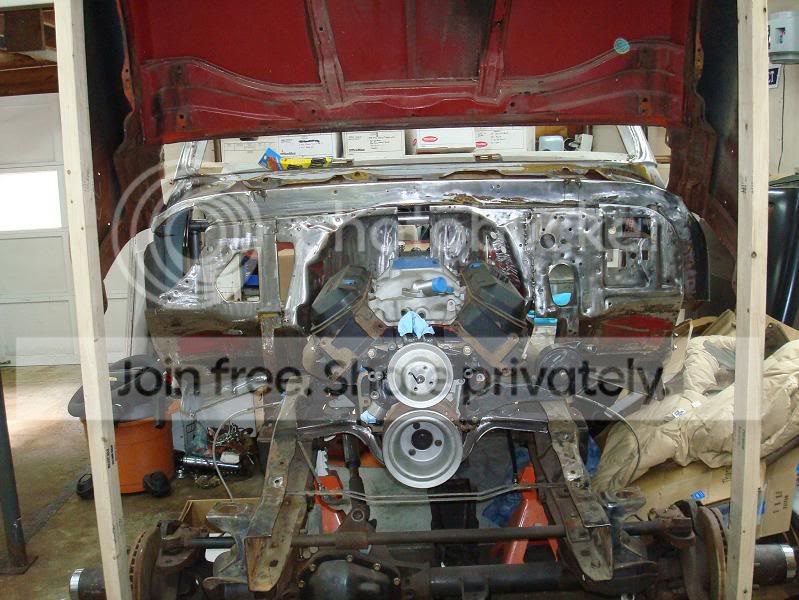
Finally, here's a shot of the engine compartment from directly in front. When I was cleaning up, I found a cool old power steering bracket that actually places the pump WAY out to the side of the engine over the driver's side framerail. There's not a lot of clearance (1/4") above the framerail but it might still work as long as the motor doesn't rock too much under throttle.

DSC01633.jpg


Next step will be to order up the radiator, now that I confirmed it will fit where I want it. Then start building the front cagework in the engine compartment to wrap around it and connect back to the firewall area. Looks like I'm finally going to get to spend some quality time with the hydro-bender I built a few months ago. :thinking:


:usaflag:
 
Last edited:
Now that is organization! My shop needs you to come over and do a makeover on it!!!

Very interesting pivoting front clip. I don't think I understood that was something you were doing - is the hood welded to the fenders? Maybe I need to go and re-read some of your previous posts in this thread :-)
 
The hood is tack-welded to the fenders and it will ultimately be a one-piece front end. Originally I was planning to make it a forward tilt setup, and also make it removeable for wheeling.

This solves the immediate problem of having to lift it into place myself when checking for clearances / interference issues. And it gives me a lot more floor space since I don't have that massive clip blocking access to everything. I like that with this current setup, I can fabricate some chassis bars....then lower the clip to check for clearances...then swing it back up out of the way. It should speed things up considerably.


:usaflag:
 
Greg, those water pump bolts will be a fine thread either 5/16" - 24 or 8mm x 1.25
 
Guess I'll head back to HomeDepot and try again. My "collection" of Gr-8 bolts is only coarse thread, and I'm not going to double it's size to add fine threads too! :yikes:


:usaflag:
 
Greg, your imagination, foresight, and ability, simply amaze me. You rock!

Thanks, I appreciate the kind words.


Quick updates: The bolts for the water pump ARE fine-thread. (5/16-24) Boy what a hassle, especially since now I've boogered up one of the holes by trying to "clean up" the threads with a 5/16-18 tap! ::rolleyes:

My punishment for being hasty is that I'll need to weld it up and re-drill/tap it to a fine thread to match the other 3 which work perfectly now.

Also I had a nice long conversation with the folks at Ron Davis Racing Products and they set me up with a nice aluminum radiator, shroud and two massive 16" Spal fans to cool the beast. These guys seem really knowledgable.... their products are being used in the Robby Gordon desert truck, and in the Shannon Campbell KOH buggy so I figure they should probably work just fine in my humble rig as well.

There should be some "new parts" photo porn on this thread by the middle of next week.... but they already warned me that my charging system had better be in good shape. These fans move serious air and draw serious current (about 44A to start them up, and about 40A of continuous draw when operating)... :yikes:


:usaflag:
 
Greg, just heli coil the hole that you fubared up on the waterpump. I don't know if you ever tried to drill a hole in a weld yet but it ISN'T FUN or easy. The heli coil will be just fine and alot quicker ALTHOUGH if you don't own a heli coil kit then it will cost you with the purchase of one. The other option is to weld the hole and THEN find out you can't drill through the weld and have to buy a new pump which i'll guarantee will cost more than a heli coil kit. :deal:
 
Thanks, I appreciate the kind words.


Quick updates: The bolts for the water pump ARE fine-thread. (5/16-24) Boy what a hassle, especially since now I've boogered up one of the holes by trying to "clean up" the threads with a 5/16-18 tap! ::rolleyes:

My punishment for being hasty is that I'll need to weld it up and re-drill/tap it to a fine thread to match the other 3 which work perfectly now.

Also I had a nice long conversation with the folks at Ron Davis Racing Products and they set me up with a nice aluminum radiator, shroud and two massive 16" Spal fans to cool the beast. These guys seem really knowledgable.... their products are being used in the Robby Gordon desert truck, and in the Shannon Campbell KOH buggy so I figure they should probably work just fine in my humble rig as well.

There should be some "new parts" photo porn on this thread by the middle of next week.... but they already warned me that my charging system had better be in good shape. These fans move serious air and draw serious current (about 44A to start them up, and about 40A of continuous draw when operating)... :yikes:


:usaflag:
Did you get a custom or the Stock car rad. The stock car was really inexpensive compared to the other options. The fans are loud and you will really notice the current draw. I jumped the first time they kicked on.
 
After talking with Dennis there we decided that one of their Offroad radiators made the most sense. They are a double-pass design, which is great because the fluid spends twice as much time getting cooled in the radiator. The only downside is that the inlet and outlet ports are now on the same side of the radiator, so I need to buy a special swiveling waterneck to get the hoses to connect right.

For high-speed, high-RPM applications they suggested a normal mechanical fan over the electrics, but for the low-speed crawling he said the electric setup would be ideal.

They apparently did a massive R&D project last year and did a bunch of flow tests on all the available electric fans on the market. They measured the CFM both in open air, and more importantly when drawing air through a radiator core. Many of the fans they tested pulled WAY less air than advertised when installed in a real application... apparently, this is when they really started to be impressed with the SPALs. They said the other giveaway that a fan isn't really going to work right is by measuring the current draw....fans that nominally pull 15 - 20A in free air, won't be able to still move the CFMs under real-life conditions.

It's a bummer about the noise level, but maybe there will be a way to wire it to run in single-fan mode at certain temps, then turn on both fans if the temperature continues to escalate? I'll have to look into that more later on.


:usaflag:
 
Greg, you might look into whether they have two speed capability. If so, you can set them up to come on at low speed for normal temperature swings, and only rev up to high speed when the extra is needed. I bet even with a 502, you won't always need that kinda cfm.

I think vtblazer did that using single speed fans, but using a fat resistor to force the fans to run slower?
 
Greg, you might look into whether they have two speed capability. If so, you can set them up to come on at low speed for normal temperature swings, and only rev up to high speed when the extra is needed. I bet even with a 502, you won't always need that kinda cfm.

I think vtblazer did that using single speed fans, but using a fat resistor to force the fans to run slower?


I like to set up dual fan setups for 2 speeds as well. It isn't that hard to wire them up to run in series for low speed and run them in parallel for high speed. Wiring them this way eliminates the need for resistors (which don't live very well) and only requires one additional relay (for a total of three) with some slightly confusing wiring to make work.

With the 2 speed system you can have the low speed fans come on at around 190 and then switch to high speed at around 200-210. This will help reduce the electrical load and the noise level as well. The other nice thing is reducing the load when the fans kick on. If you go directly from off to high speed the motors can draw 50% more current than they do just running. That additional start up current will shorten the life of your alternator, wiring, fan motors etc. When the fans are running at low speed it takes a much smaller amount of current to jump them up to high speed.

If you're interested in doing such a setup let me know and I'll see if I can post up a diagram.
 
If you're interested in doing such a setup let me know and I'll see if I can post up a diagram.

Chad,

It looks like there's interest all the way around... post up the diagram, I'd like to see it. (and totally steal your idea too if we're being honest with each other!) :D

BTW -> I'm still waiting on an answer from you for the last PM that I sent ya! :deal:


......and to the rest of you: 50,000 VIEWS for this thread???? You guys are fanatics. :yikes:


:usaflag:
 
Chad,

It looks like there's interest all the way around... post up the diagram, I'd like to see it. (and totally steal your idea too if we're being honest with each other!) :D

BTW -> I'm still waiting on an answer from you for the last PM that I sent ya! :deal:


......and to the rest of you: 50,000 VIEWS for this thread???? You guys are fanatics. :yikes:


:usaflag:


I'll see if I can get a diagram put together that will make sense, look for a new thread.


PM sent:o


50,000 views!!!??!! wow how does it feel to live in a fish bowl Greg? Now go and put some pants on for goodness sake!!:eek1::haha:
 
I like to set up dual fan setups for 2 speeds as well. It isn't that hard to wire them up to run in series for low speed and run them in parallel for high speed. Wiring them this way eliminates the need for resistors (which don't live very well) and only requires one additional relay (for a total of three) with some slightly confusing wiring to make work.

Makes good sense.

By powering them in series, they share the available 12v's so they run slower.

Powering them in parallel gives each the full 12v's so they run at full speed.

...but keep in mind that lowering the voltage, will raise the amperage.

Use the appropriate gauge wire and you'll be all set Greg.
 

Latest Posts

Top Bottom