CK5
Register an account today to become a member! Once signed in, you'll be able to participate on this site by adding your own topics and posts, as well as connect with other members.
Kyle,

The link calculation is based on the following formula in my Excel spreadsheet:

Lower Link Force =(-(Vehicle_Mass*Acceleration/2)*UA_Z)/(K101*(UA_Z-LA_Z)+K103*LA_X)

Vehicle Mass: Self-Explanatory (I'm using 5500Lbs as my target)
Acceleration: 6 <- This is the factor of safety of 6G's
Divided by 2: Presumably because 2 links are sharing these loads...
UA_Z: Location of Upper Axle mount in Z-axis (height from ground) This is 33"
K101: Lower link vector for X (actual value is .9008)
LA_Z: Location of Lower Axle mount in Z-axis (Height from ground) This is 23"
K103: Lower link vector for Z (actual value is .0693)
LA_X: Lower Axle mount vector in X-Axis (Distance across ground, front to rear of vehicle) This is 4"

So I guess the actual forces on the link are 1/6th that original number I posted, but since it's such a critical part I wanted to add a LOT of design margin.

Is this a complete enough answer, or do you need other details?


:usaflag:
 
Ok, I just grabbed a copy of Dan Barcroft's excel sheet to see what you are working from. That is one sophisticated spreadsheet.

*EDIT* - Ok, so given that the lower link force under a 6G acceleration would be the 58k pounds (the psi threw me off) per bar, wow... Tempered 4130 steel with it's 110kpsi yield strength in 1/4" plate on either side of the link would be able to hold a 82.5k pound load in a straight tension pull. This is likely what most people are using instead of straight carbon steel.

I wouldn't call the 6G a factor of safety. 6G's on a suspension component if you are offroad racing isn't that far out of the question.

Even with a 6G acceleration load, 1/4" thick tempered 4130 would give you a 1.42 factor of safety. Basically, provided that the mount design FS is higher than the link FS, you shouldn't bust up the mount. As I said earlier, your design on how the mounts attach to the axle housing will dictate how much they can take.

The numbers that you have used for your link locations, are they based off of the axle tube centerline or the actual wheel lug centerline? With the mog drop boxes, there is a difference.
 
Last edited:
One thing to consider is that if the 3/4" bolts in your link are creating a frictional clamping load on the tab in addition to the shear/tension load, wouldn't that effectively give you some more yield resistance?
 
Kyle,

Those link positions are relative to the ground, not the wheel centerline.... the true wheel centerline is 19" (~38" tire)

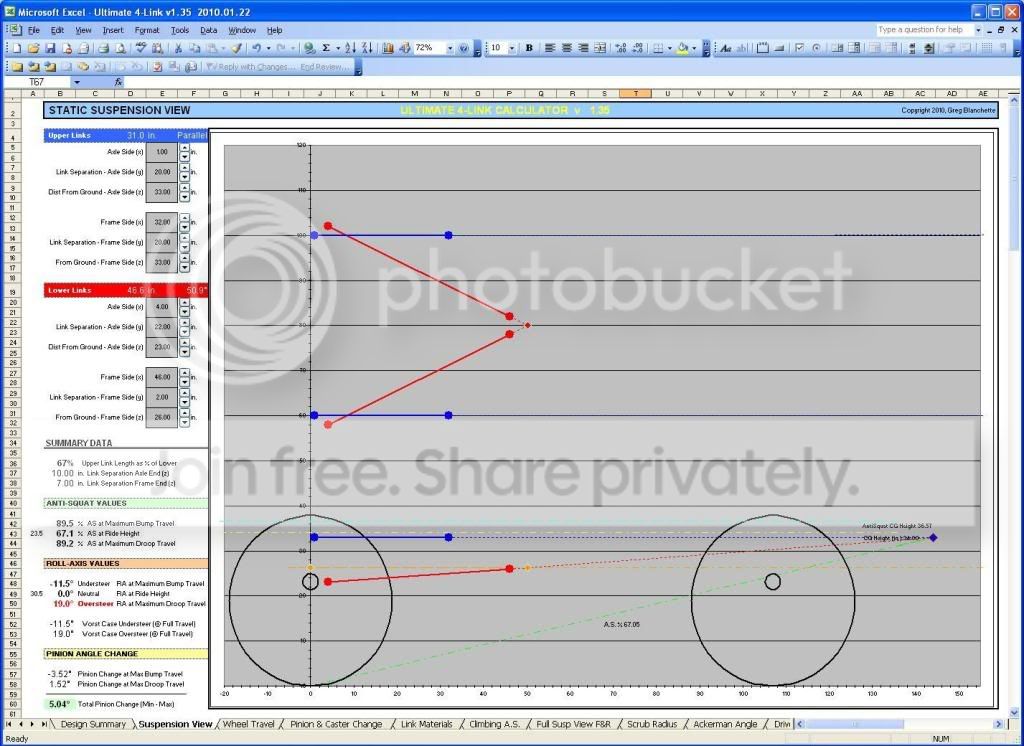
This is a reasonably close version of the suspension I'm actually building now...you can see that the wheel centerline (19') is NOT the axletube centerline as you already observed.

Suspension1.jpg


Do you think that 6G's is not enough of a safety margin for suspension components? I'd be curious to hear your opinion on what you think the real number might be.

:usaflag:
 
@bp71k5 - It most definitely would. I am kind of leaving it at a worst case scenario. If you are the type to design things like Greg is, you are also the type that will likely nut/bolt some of the critical points on the truck before/after a run. So there you could get away with using some lighter material or a little less girth and still be ok.

Looking at the shear strength of a Gr.8 3/4" bolt loaded like these will be loaded, you have ~80k pounds load before failure. So this falls in line with what 1/4" 4130T mount side plates would be given a pinned tension loading. As I said, things will be stronger in compression as you have the beef of the mount to take up the load, not just the thinnest section. I would have to see exactly what the configuration of the mount would end up looking like and do a quick FEA on it to tell you what the max stresses in the mount would be for the combined load scenario. The ideal design of a mount would to have the connection point to the axle tube be along the axis of the link. But given that the mount will be below the axle tube, you will have a moment arm trying to twist the mount off of its weld points.

@Greg - I think that 6G's is actually a somewhat safe number to use.

BTW, what calculator are you using?? It isn't the same as the one I was able to dig up.
 
Last edited:
Dayum,...so much for a little "light reading" in the afternoon sippin' on a barley. :haha: :bow:
 
2010.03.02 - UPDATE! - TAKE TWO ASPIRIN....AND LOOK AT SOME RELAXING PHOTOS... :D

Not everyone wants to talk about mechanical engineering (well, I actually would! :haha:) but since I got a "bonus night" out in the garage we can take a break from all the headaches and look at some nice relaxing photographs... :deal:


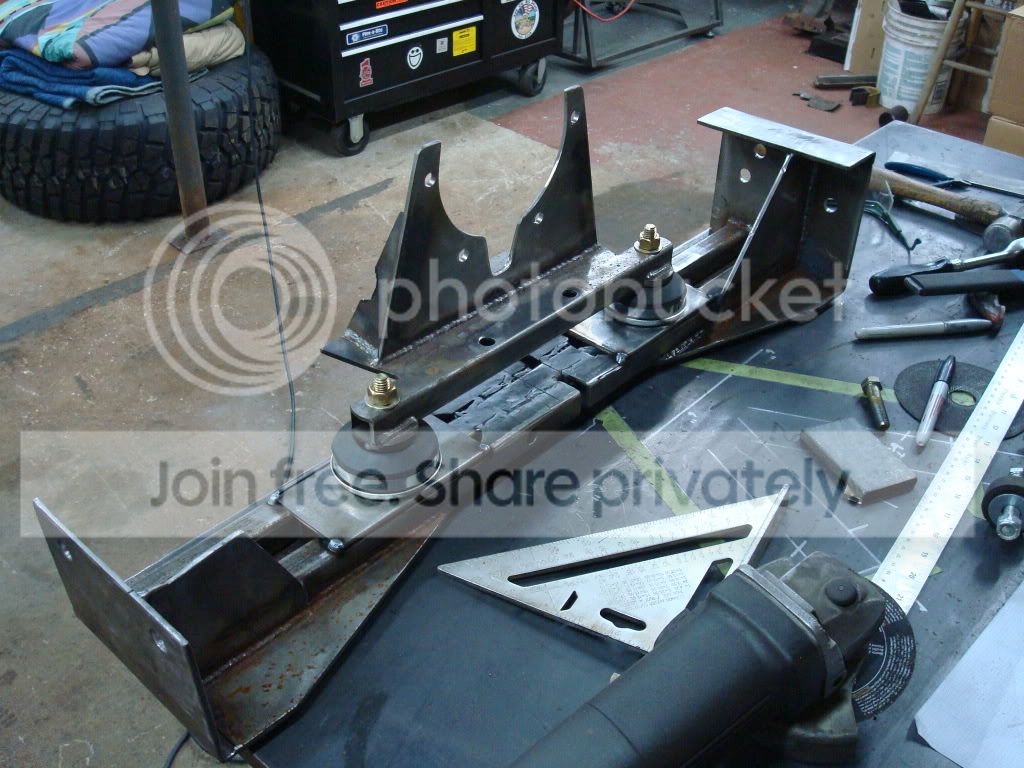
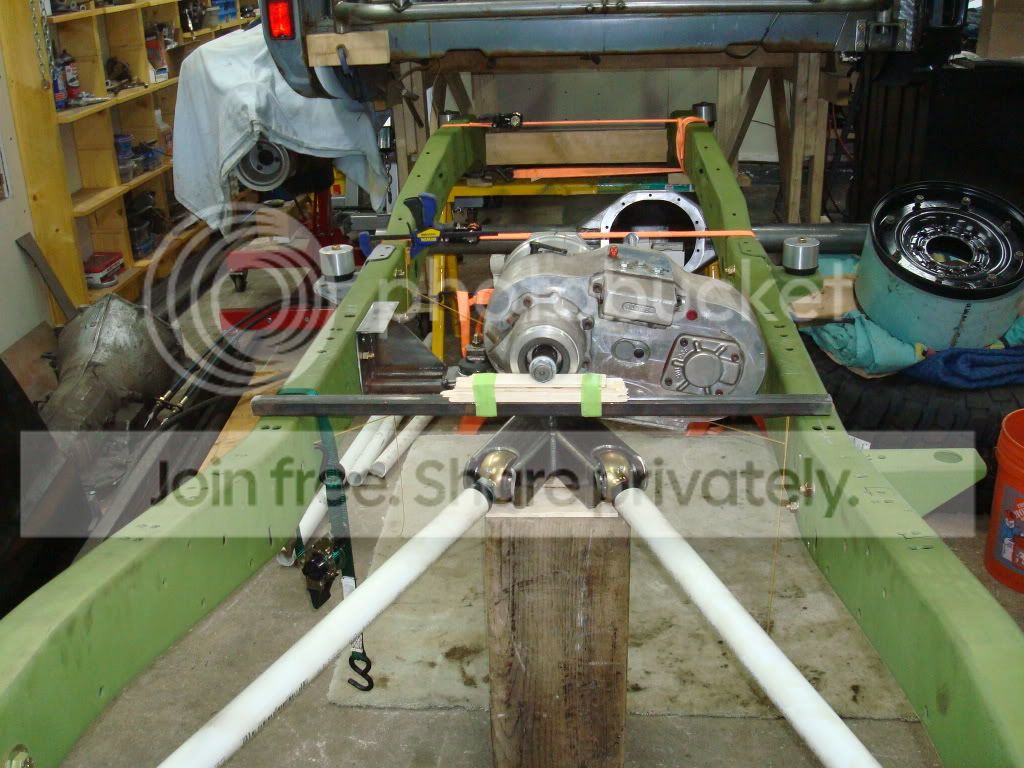
It is becoming increasingly clear that I'm going to be in BIG trouble if I simply design the rear suspension soup-to-nuts without considering how the front suspension, transfercase or other items will also be packaged. So I decided it was time to take my old crossmember design out of retirement, shorten it up a bit (due to the smaller inside dimension of the boxed frame) and put it back into commission....at least for some mock-up work.

DSC02566.jpg


I had to drill a couple of new holes for the rubber mounts to re-center them, but it didn't take too long to make it useful again.

The lower rear frame-side mounts are going to land really close to the transfercase, so it's important to understand EXACTLY how much room I have to work with.... once I had the crossmember in place in it's original holes (which establishes all the driveline locations I'd already solved about 6 months ago) the height and clocking of the Atlas was just as it was before I took on the whole frame boxing process.

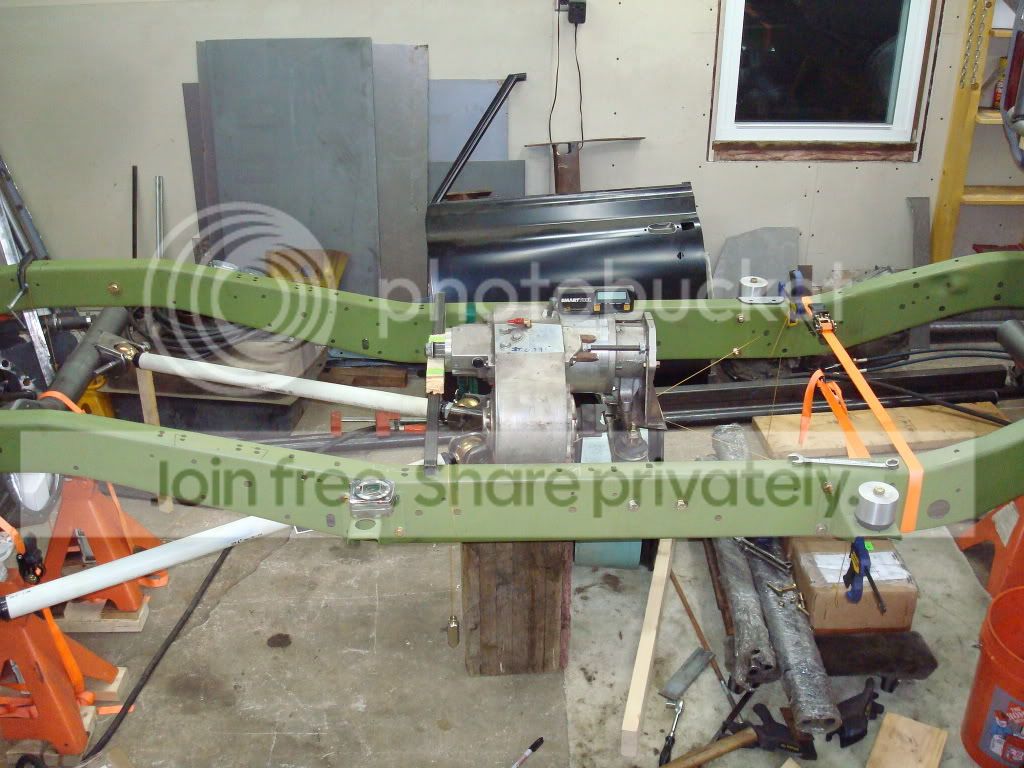
Here's a side-view of how it looks:

DSC02568.jpg


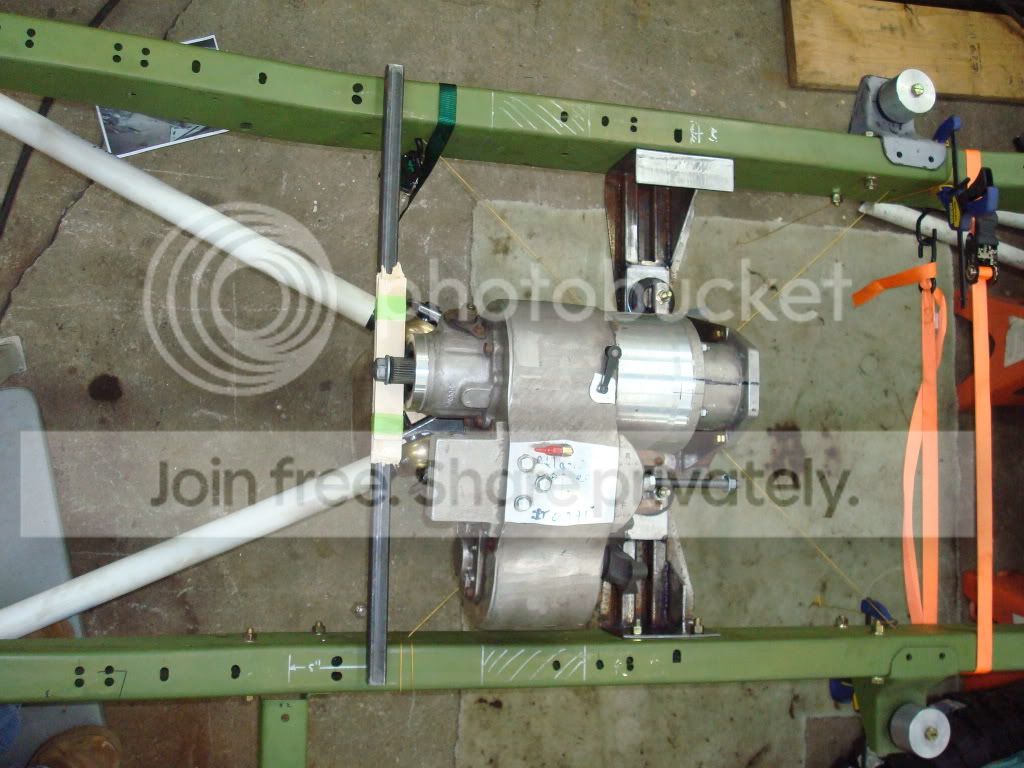
From the top view (which isn't easy to get for you guys!) you can see that fitting the links with the Atlas is a bit like a game of Tetris. Each part has a certain shape that must fit just so...

DSC02580.jpg


Finally, a rear view which also clarifies the packaging challenges...

DSC02582.jpg


Not a bad night's progress....


:usaflag:
 
Ok, I just grabbed a copy of Dan Barcroft's excel sheet to see what you are working from. That is one sophisticated spreadsheet.

*EDIT* - Ok, so given that the lower link force under a 6G acceleration would be the 58k pounds (the psi threw me off) per bar, wow... Tempered 4130 steel with it's 110kpsi yield strength in 1/4" plate on either side of the link would be able to hold a 82.5k pound load in a straight tension pull. This is likely what most people are using instead of straight carbon steel.

I wouldn't call the 6G a factor of safety. 6G's on a suspension component if you are offroad racing isn't that far out of the question.

Even with a 6G acceleration load, 1/4" thick tempered 4130 would give you a 1.42 factor of safety. Basically, provided that the mount design FS is higher than the link FS, you shouldn't bust up the mount. As I said earlier, your design on how the mounts attach to the axle housing will dictate how much they can take.

The numbers that you have used for your link locations, are they based off of the axle tube centerline or the actual wheel lug centerline? With the mog drop boxes, there is a difference.

OK, now that the headaches have subsided, I want to get back to the topic of tab sizing.... :D

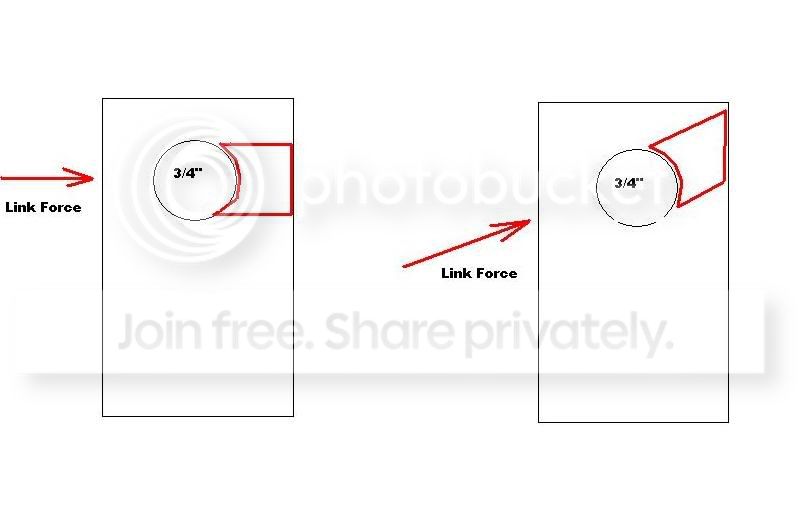
Here's a diagram to clarify what I think you're saying:

Linktabs.jpg


This metal tab has a 3/4" through-hole and 3/4" of material around the hole in each direction (I didn't draw a radius on the top, so just play along). Example #1 shows that the link force is perfectly aligned with the tab, so the force vector is horizontal and I believe the area in red represents the material that you are calculating for when you figured out the number of sq in x thickness x yield strength??? :thinking:

Example #2 would be if the link forces were not exactly aligned with the tab, and the red outline shows that the material involved in the calculation would be somewhat different from Example #2. Am I understanding this correctly? :dunno:

Finally, if the total force to of the links was 59kpsi (from the suspension calculator), then presumably the load for a single link is half that number (29.5kpsi) and that load is held on each side by two tabs.... am I right in assuming that the material strength calculation value is doubled since two tabs per side are sharing the forces?


To answer your other question, the screenshots I'm posting are for a calculator that I'm working on that is not in the public domain (yet). It is an extension of the original ExcelCAD and 4-Link Calculator stuff that Dan Barcroft and I worked on starting in 2003...


:usaflag:
 
I actually thought he was referring to the vector you would draw between the hole in the tab and the center of the tab edge at the place it's welded to the tube. If that vector is not parallel to the link orientation, you then have to factor in the torsional forces on that tab so it's not just a tension calculation.

Edit: that means you better weld the tab onto the housing really well. :) Also, if your using tempered steel, would weld heat alter the tempering? Something to consider...
 
What, nobody has brought up Mohr's circle yet? Is a pure tension or compression load assumption valid here? (Edit, Brian beat me to it.)

What about Hertzian contact stress at the bolt/tab interface?

thumb_smileyvault-stirthepot.gif
 
Are you building this thing to run King of the Hammers???
 
Last edited:
When I get a chance I'll see if I can throw together a rendering in CAD to show you what I mean by lining the load up to limit the twisting of the mount. From the top it would appear that you have it lined up quite well, but from the side, there may be some room for improvement.

As far as the heat of the weld taking the temper out of the steel; to a certain extent it will, however, your weld area is typically a lot larger than the smallest area in the part and thereby under lower stress. Ideally, you would want to keep welding to a minimum; cutting the part out and bending it to form the shape if at all possible, only welding it to the axle tube.

I am spoiled with CAD and will likely have my whole frame in ProENGINEER before I start cutting anything. Wonder if the guys downstairs can scan it in with the FARO-arm...?
 
What, nobody has brought up Mohr's circle yet? Is a pure tension or compression load assumption valid here? (Edit, Brian beat me to it.)

What about Hertzian contact stress at the bolt/tab interface?

thumb_smileyvault-stirthepot.gif


It's considered poor form to refer to cool-sounding formulas in my thread without actually providing a calculation or two... :deal: :D


:usaflag:
 
It's considered poor form to refer to cool-sounding formulas in my thread without actually providing a calculation or two... :deal: :D


:usaflag:


It has been too long for me to remember any more than the fact that Mohr's circle is used to combine different stresses (tension, shear, etc.) to get a picture of the total stress.

Same with contact stress, I know there are different ways to evaluate them (Hertz's method being one). I don't think that will be an issue with your setup though. Usually that is something you think about when designing bearings.

I could look it up on Wikipedia, but I think what you are really going to be concerned with is the shear stresses in the bolt and tab.
 

Latest Posts

Top Bottom