CK5
Register an account today to become a member! Once signed in, you'll be able to participate on this site by adding your own topics and posts, as well as connect with other members.
2010.04.20 - UPDATE! - A LOT BETTER...

I have been slowly dismantling the old bracket setup one plate at a time and replacing each one with something I like better.

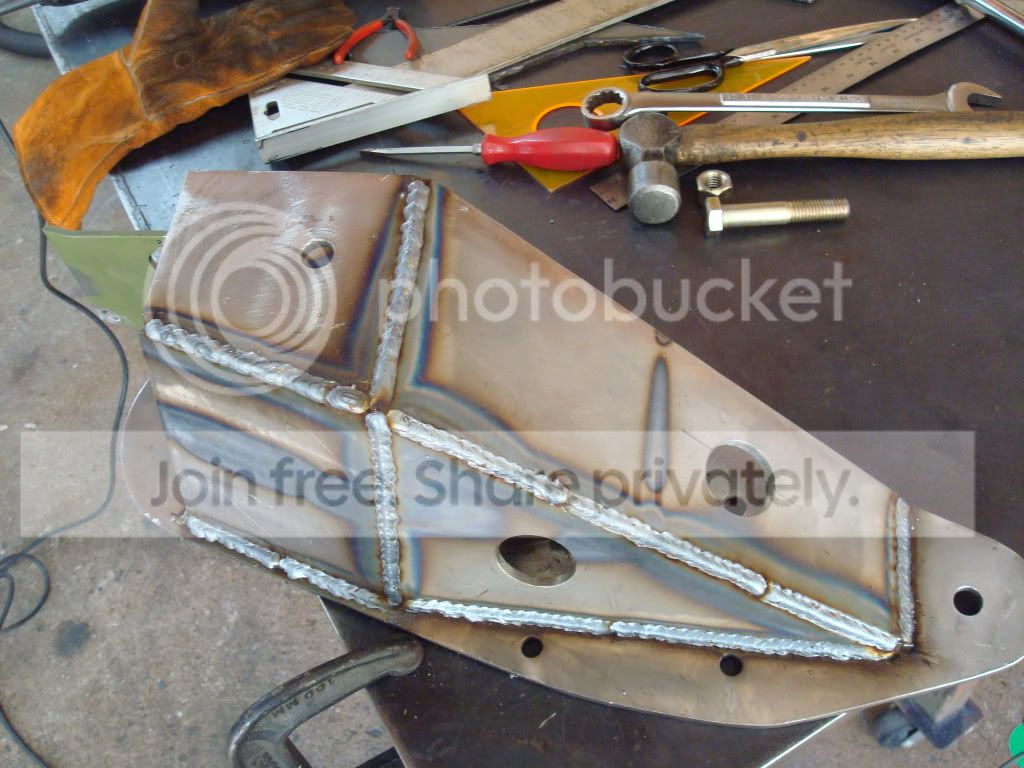
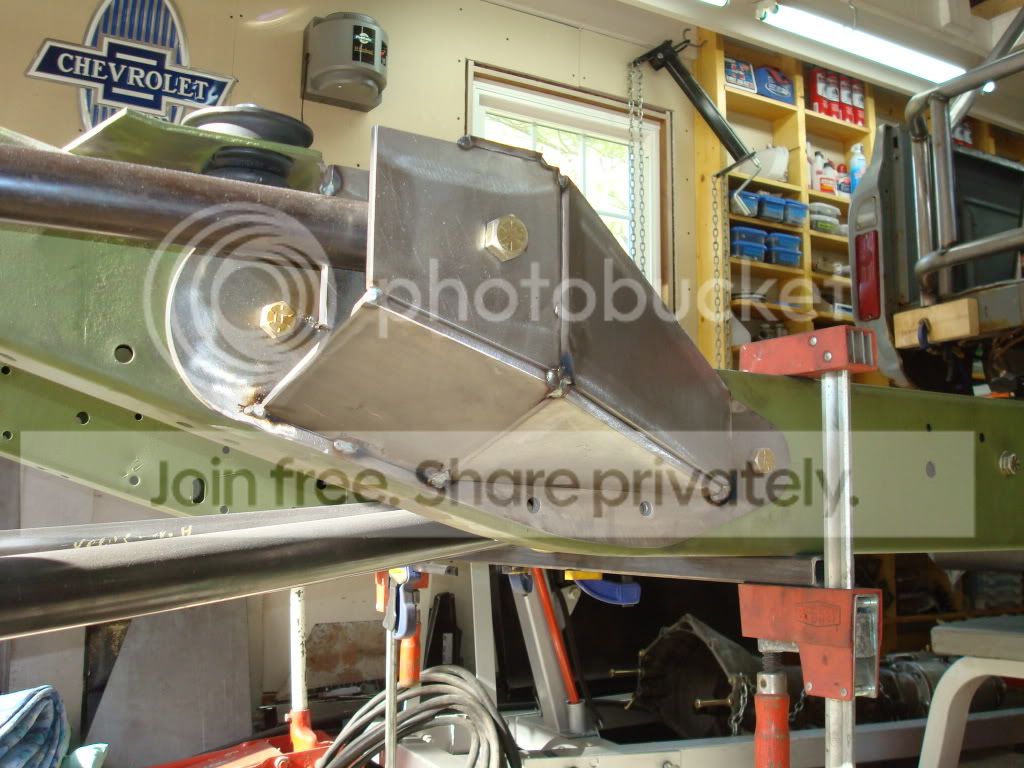
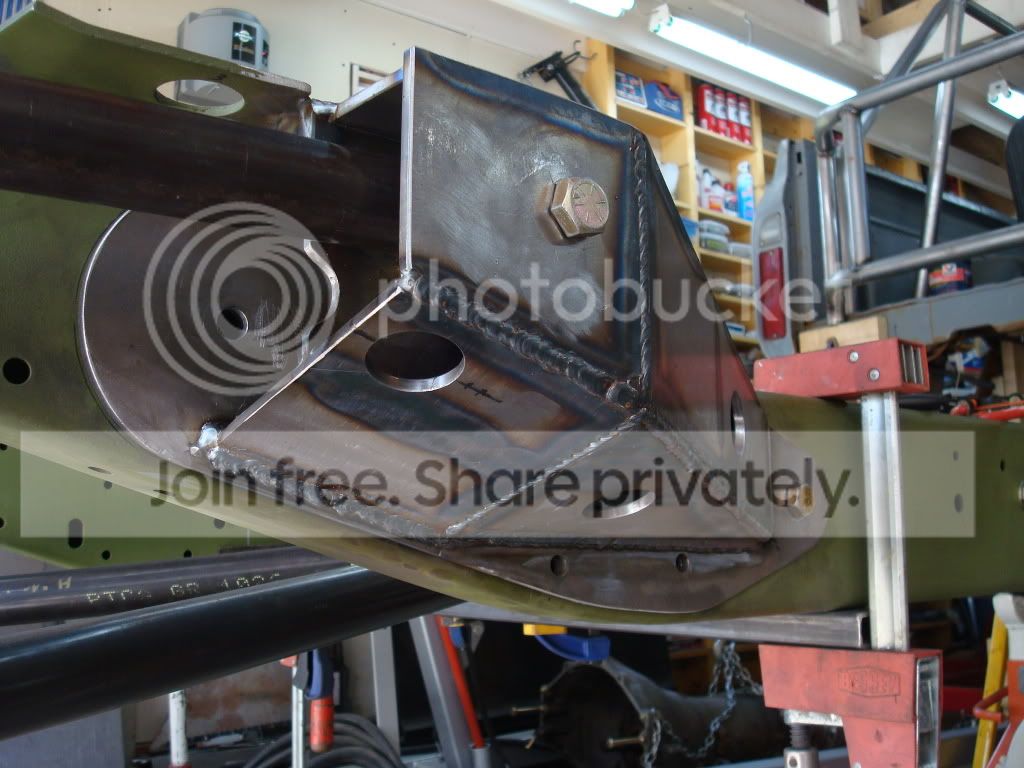
This first shot is the new mount plate. It picks up two large 5/8" factory frame holes at each end, and the 4 square-pattern holes in the center represent where the body mount hanger used to be. This plate is substantially longer than it was previously.

DSC02973.jpg


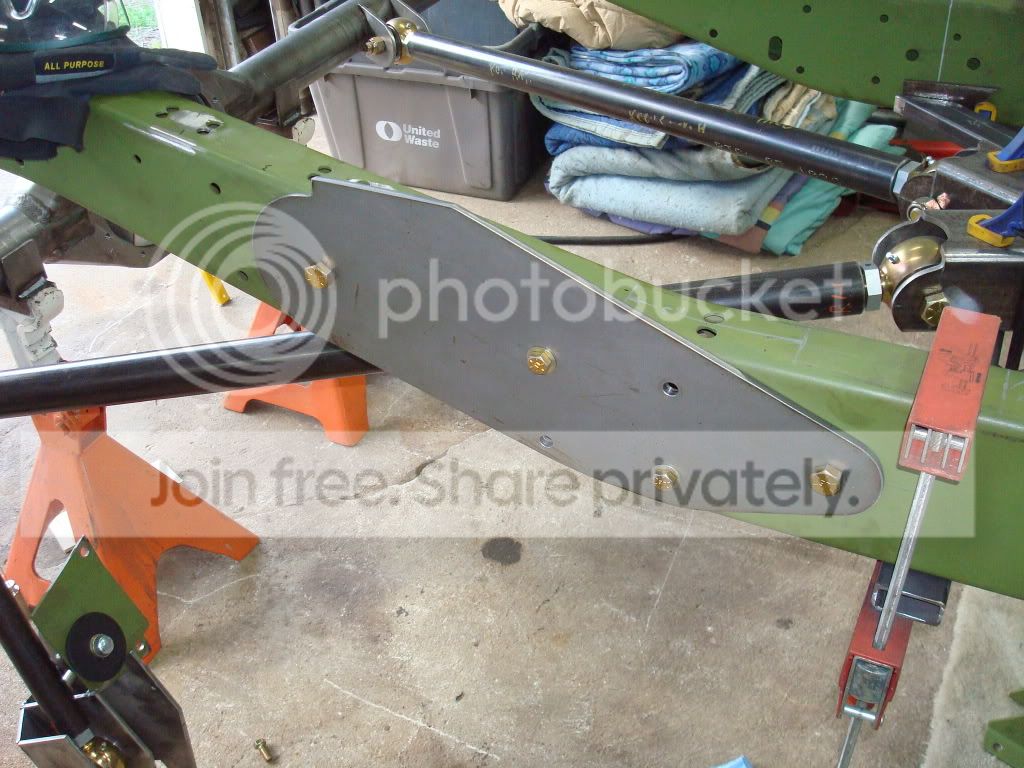
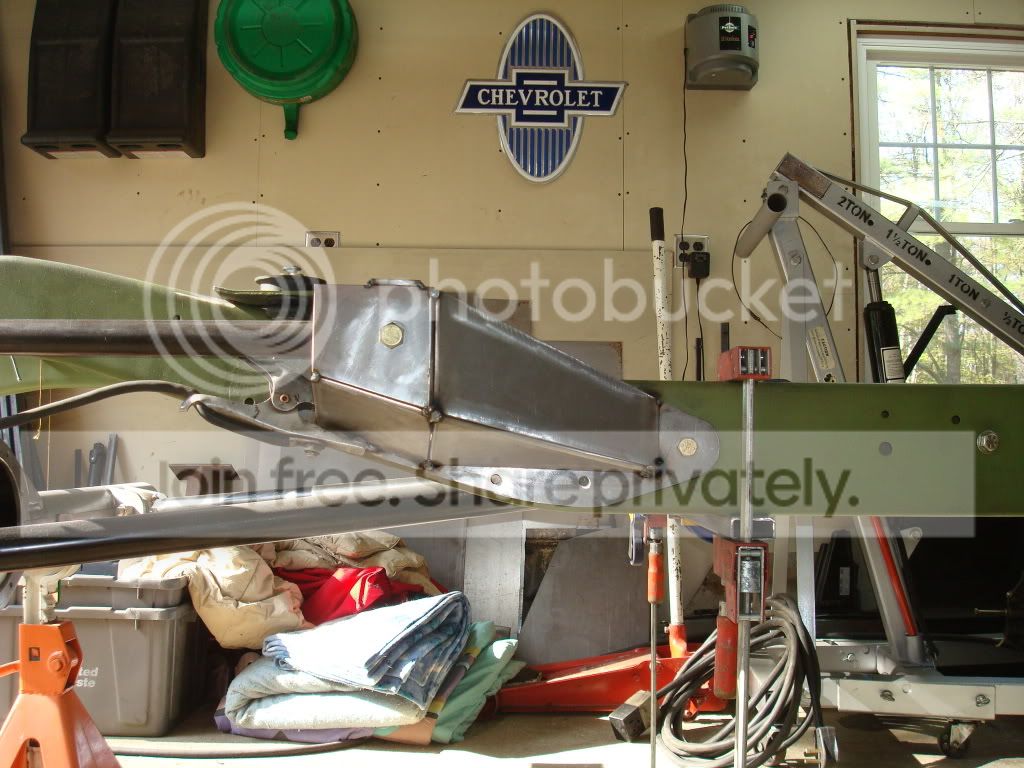
Here's a shot of the new outer plating, with the original middle plate still installed (and hacked for clearance!) to hold the dimensions steady while I removed everything else. The long plate that angles in toward the rear 5/8" bolt will be remade longer on the near side so that it intersects with the other plates in the photo. Working in 3D space with flat sheet stock has been a learning experience.... I've ended up cutting plates that just wouldn't join together without leaving huge gaps between the pieces. Fortunately, I think those days are behind me and now I can see how to build the remaining plates to close this thing up.

DSC02975.jpg


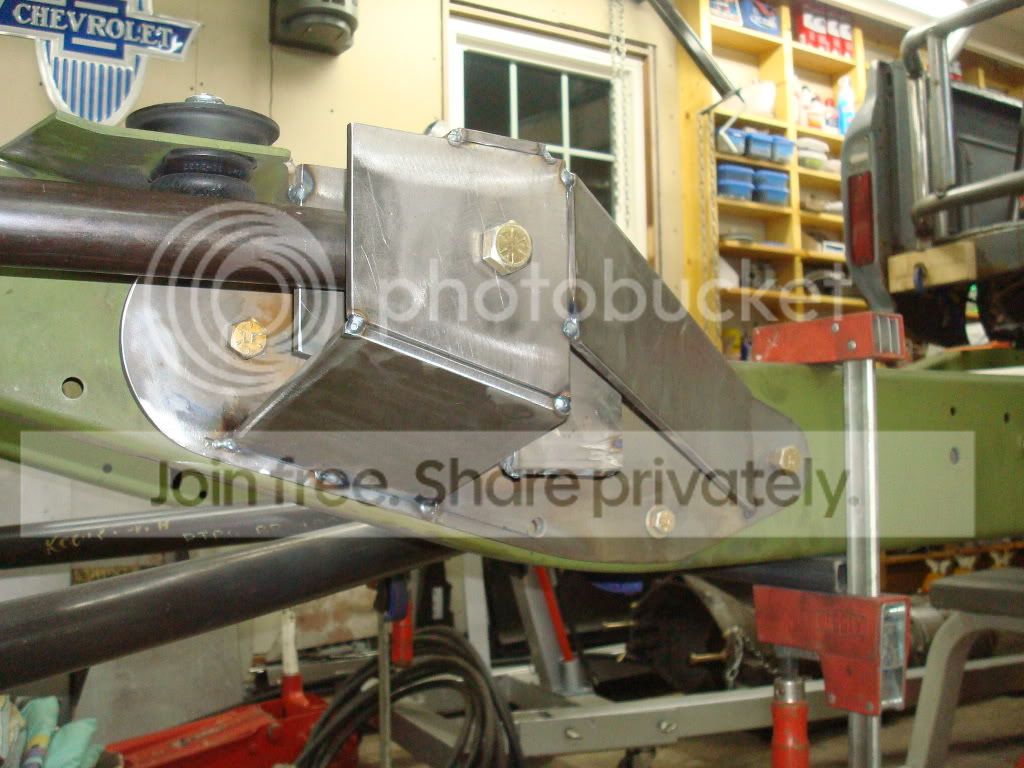
A different angle to show how much better the forces are being transferred to the frame now that the body mount is relocated. Ignore the small triangular brace across the top for now....that will eventually be replaced with a full width plate that covers all three vertical plates and gets fully welded.

DSC02984.jpg


I really like the look of this new bracketry and it seems like it will do a much more respectable job of taking the massive link forces. The only minor challenge will be leaving access to the bodymount bolts/nuts so that they can be reinstalled and torqued down. I'm designing this mount to be fully removeable and replaceable just in case it ever gets bent or damaged or I want to modify the position of the upper link mount...

:usaflag:
 
Havn't peeked in here in some time. Progress is awesome. Very nice job on the new link setup. Re-working stuff sucks to do but very necessary or ya just won't be satisfied. Just one of those things while fabrication like this we all have to deal with from time to time. I always like your attention to detail.
 
As for the body mount bolts. I'm sure you're planning on installing sleeves through the frame like you did at the rear so why not just weld some nuts to the link plate and then use long bolts from the inside of the frame going through the body mount, frame, then thread into the welded nuts?
 
Hey I have never done anything like what you are doing but my goal is to learn so I can do serious work on mine. I have a question about the mount for the outside link on the axle, does it look like it will hit the underside of the body when compressed or is it just me??? From the pics it looks like it only has about 6-8 inches of uptravel before it hits. Please school me..
 
It's pretty likely to hit by 6 - 8" of uptravel, but then again so will the axletube on the underside of the frame.

I'm building with a 16" travel shock in mind...that probably translates to closer to 20" of travel at the wheel itself. That's a massive amount, and certainly a lot more than any leafsprung truck could hope for. The plan is to allow for about 6" of bump travel and 10" of droop at the shock.

I'm willing to do trimming or clearancing of the tub or frame if needed to get the uptravel clearance.


-G
:usaflag:
 
So, maybe I missed it...will this be on coils, or coilovers like King Coils? Do you have any thoughts on anti sway/roll so it's somewhat streetable? After running some super soft Alcan's on my K5 with Bilstein 5150's, really soft, long travel suspension kinda spooks me on the street.

Rene
 
I'm sold on the ORI Struts I've been reading about...

Basically it's like a coilover, but charged on both sides of the piston with nitrogen to set the ride height and overall damping. They are exceptionally good at reducing body roll, so you basically don't need sway bars. Bump stop functionality is also built into the strut so you don't need those either. Supposedly you also don't need limit straps, but I'm still planning to put on a set for extra insurance.

http://www.oristruts.com/index.html


Pricy.... but I'll save money somewhere else in the build! :D


:usaflag:
 
Pricy.... but I'll save money somewhere else in the build! :D

Ha ha, I just don't see that is going to happen on this rig.

Your build blows me away every time I come to the "Might as well thread".

Great work Greg.:saweet:
 
Quick Update:

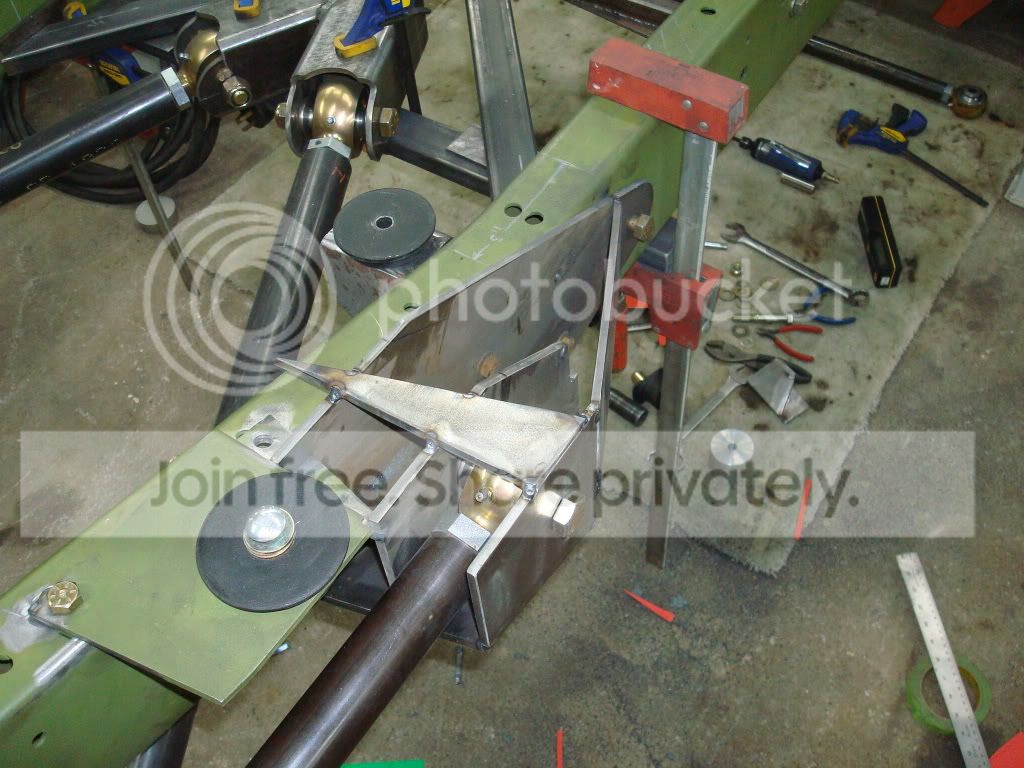
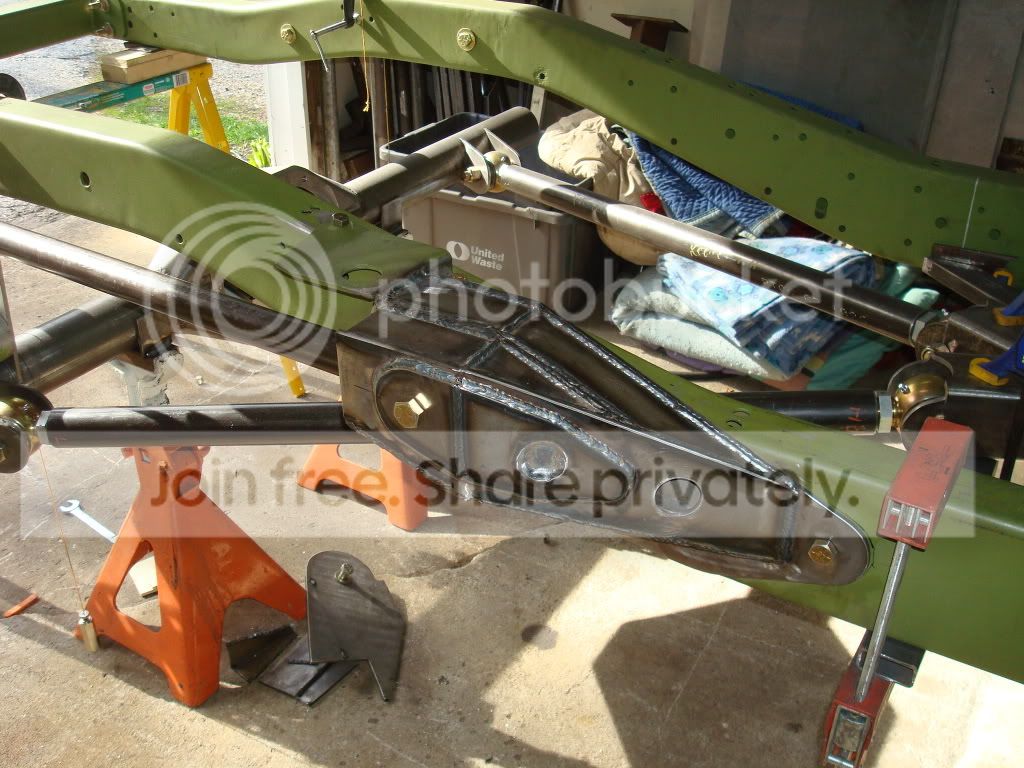
Got the final two plates in to validate my new design. It looks WAY nicer than my first version of this bracket, and tomorrow I'll weld it up and plate it in across the top... then move to the driver's side to do it all again!

DSC02994.jpg


DSC02992.jpg


:usaflag:
 
looks stout....

Greg, how do you do most of your plate cutting?
 
looks stout....

Greg, how do you do most of your plate cutting?


Semi-Old School.....Hypertherm Plasma and a straightedge for the straight cuts and a steady freehand for the curves. Followed up with 4-1/2" flap discs on my grinder to bring the cuts down perfectly to the Sharpie marker lines. Tedious but satisfying when they all lay-up nice and tight. Probably a lot like working with composite and getting nice crisp edges. :thinking:


:usaflag:
 
Looks real nice. Question, was there a reason you chose to use multiple plate pieces vs one piece for each of the plates and bent it for the side piece and bottom piece and top piece?
 
I think you might want to think of some drainage holes or something, looks like a nice pocket to trap road poopy in.
 
Looks real nice. Question, was there a reason you chose to use multiple plate pieces vs one piece for each of the plates and bent it for the side piece and bottom piece and top piece?

Rob,

Just working within the limitations of what I have..... no OA torch, and no shop press = no plate bending. (Especially not 1/4" plate! :D). Up until now, I didn't even know what the final part would look like and it took a few tries to get it the way I wanted it. I suppose now that things look pretty dialed-in I could use all of my cardboard templates to trace up a larger part on a single sheet of 1/4" flat stock so that it could be bent up out of a continuous piece of metal. But seeing as how I only need to do one more (the other side) I'll just build it out of piece-parts. My plan is to fully weld the inside joints first, then fully weld the outer joints too. With my new Lincoln 255 MIG there aren't any concerns about getting a nice hot and deep weld, so strength won't be an issue.

I'm still thinking about doing a few laminations with a second layer of 1/4" plate is select areas (like around the bolt holes) to add even a bit more strength. A lot of guys on Pirate continuing to warn me about the fantastic loads that the portals will generate on link brackets and a few of them have BTDT and already have the twisted tabs to prove it.

For sure I'll be drilling a few drain holes. I'd already realized what a huge swimming pool this bracket could be if I didn't. There will be a few holes in the side plate also to give me wrench access to the upper body mount bolts as well.


:usaflag:
 
You don't need a press to bend 1/4 plate. All you need is leverage, some 1/2 steel plate and inginuity. I have bent 1/4 plate lots of time at home with just those items. I'm going to do a "how-to" pic on this. Takes too long to describe it. Besides, I'm at work right now.
 
I'll be interested to see that....

When I start selling 1st Gen 4-Link kits, I'll need a faster way to make these brackets. :haha:


:usaflag:
 
2010.04.25 - UPDATE! - WELL, THAT TOOK A WHILE....

After that Friday update it seemed like a simple matter to just finish up a couple last plates, cut a few access/drain holes and burn the whole thing in. Not quite.

Everything takes longer than you expect, even when you have a pretty good knack for guessing lots of hours. But by the end of the day the results were worth it.

The first step was to do all the interior welding on the bracket. Access was difficult, and I ended up removing the bottom triangular plate to allow me better access to most of the seams. I had a good HAZ (heat affected zone) pattern after doing the interior welding, so I knew I was getting a good hot weld and good penetration. Once the inside seams were done, I tacked the bottom plate back on and welded it on the inside.... then I welded all the exterior seams as well.

It's not visible in these photos, but I cut an additional section of 1/4" plate and welded it to the inside heim mounting hole to effectively thicken that area to a 1/2" mounting flange. I didn't want to take any chances with strength.

At this point, I also cut two 1.5" through-holes. The lower hole is a water drain hole which conveniently also gives me wrench access for the upper body mount bracket bolt. The hole on the side is an access hole for the other upper body mount bracket bolt. Plus it adds lightness and SPEED! :D

DSC03015.jpg


With most of the welding out of the way, I bolted the bracket back on and figured out the final two plates to close-in the top of the bracket. Initally, I was going to lay a big flat plate section across the top of all three vertical pieces, but it didn't make sense due to the difficulty in getting a strong weld... the best I would have been able to accomplish would be a perimeter weld from the top, and it would have been nearly impossible to weld from the inside now that the bracket is all sealed up. I decided to do the plating as two smaller strips and recess them by around 1/4" on each side. This allowed me to do a nice strong fillet weld and really get a lot of strength on the top plating. This plating is a critical component of the design and if it doesn't hold, the entire bracket will distort and ultimately twist into a pretzel under suspension loading.
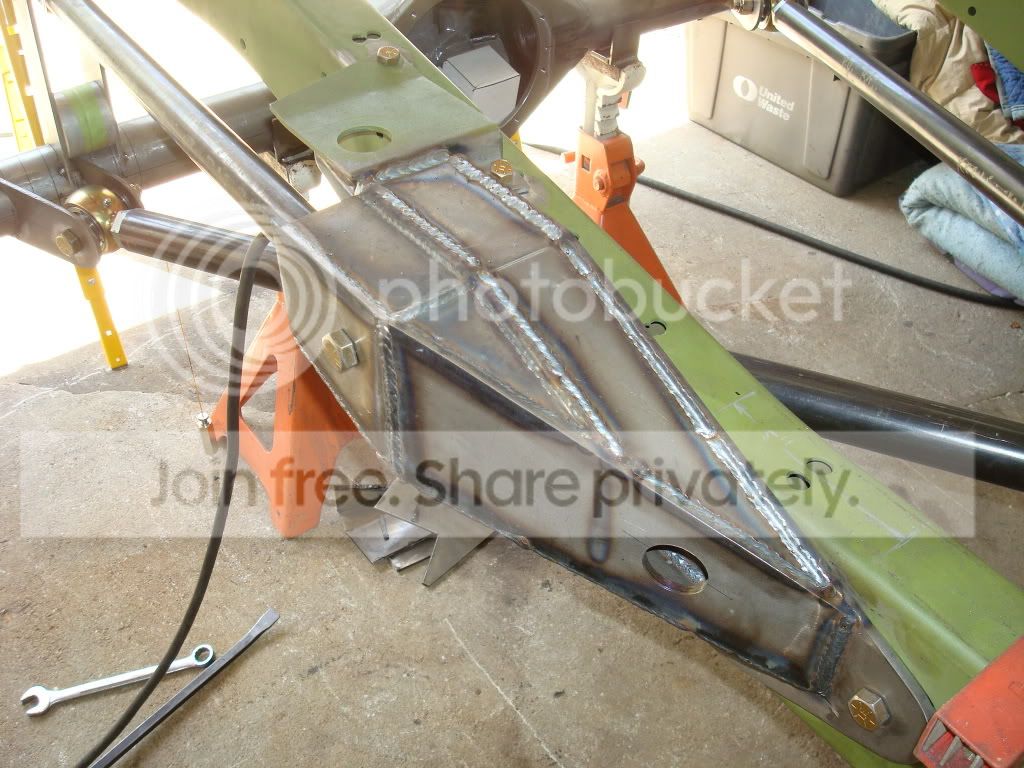
DSC03025.jpg


After the upper plates were burned in, I realized that the grease zerk for the upper heim was now blocked in a way that would prevent me from ever getting a grease gun fitting on it (zerk was facing UP at about a 45 degree angle). The answer was to mount the heim with the zerk pointing down, and to cut another speed hole that would give me a straight shot to the fitting for easy service later on. In this shot you can also see a small crescent-shaped clearance cut that was made to allow the large mounting bolt to be removed if needed. It also gives good clearance for a deep-walled socket.
DSC03033.jpg


The final item was the addition of an outer laminated plate, again to reinforce the mounting bolt area for the heim and make it 1/2" thick on the outer surface as well. This was accomplished with another piece of 1/4" plate wrapped around the corner and perimeter welded. I cut yet another hole, but this time for the purpose of getting more weld area to hold the plate down snugly. I wanted to make sure that the plate was held tight not just at the edges, but also from the center so that it didn't "balloon" from the original bracketry. The welded hole added a cool look and I don't have any concerns about strength now.

DSC03046.jpg


So.......another 8 hours were spent on this bracket but I can finally say that it's DONE! :waytogo: I was very careful to modify all of my cardboard templates to indicate the new holes, clearance cuts, etc. So when it comes time to do the driver's side I can cut and finish each plate completely BEFORE they get assembled. That will save a tremendous amount of time...and obviously, now that I have a pattern to work from I should be able to cut, fit and weld the other side in just a few hours....instead of days!


:usaflag:
 
Looks BAD ASS! It is SOOOO nice the second one never takes as long as the first, otherwise it would always be a bitch the whole way through when fabbin stuff like this. Nice job.
 

Latest Posts

Top Bottom