CK5
Register an account today to become a member! Once signed in, you'll be able to participate on this site by adding your own topics and posts, as well as connect with other members.
Awesome! Loving the updates!

Everybody in my shop has read this thread in its entirety and regularly ask me if Greg72 has done anything new.

You now have a non CK5 following in the NAVY! :waytogo:
 
Awesome! Loving the updates!

Everybody in my shop has read this thread in its entirety and regularly ask me if Greg72 has done anything new.

You now have a non CK5 following in the NAVY! :waytogo:


That's cool! :thumb:

Tomorrow is going to be a shop day, so I'll be trying to make some good forward progress. I suspect that I'll pull the truss off the axle and try to get all the finish welding completed on it (inside and outside) so that I can permanently attach it to the axle....then weld the link mounts (inside and outside for each tab) and then fit the plating that boxes and strengthens them. I'll probably do some selective laminations with another layer of 1/4" plate to strengthen some of the bolt holes and surrounding metal.

If I remember correctly, I think I only actually built one portal assembly all the way with the disk brake and caliper setup so I've got some work to do there as well. I still haven't gotten help machining out the backing plates for the air passages for CTIS, so the portals will have to be pulled apart at LEAST one more time before this whole process is finished.

Timing-wise, I think the ORIs will show up at the perfect time. I will be ready to cut through the bed floor in a couple weeks to figure out a REALLY stout set of upper mounts. Since these struts not only act like a shock, but also hold up the entire weight of the truck (like a coilover) there's a lot more to it than just building a simple "shock hoop" and calling it good. Preliminary calcs indicate that the strut will just barely peek out above the bedrail (when viewed from the side)..... So it won't look as rediculous as I had originally feared! :D

For today though, it's another long and tedious installation of hardwood flooring in the kitchen / dining room area. Fun. :rolleyes:


-G
 
2012.05.29 - UPDATE! - PAGING RENE!....

Major progress today! :waytogo:

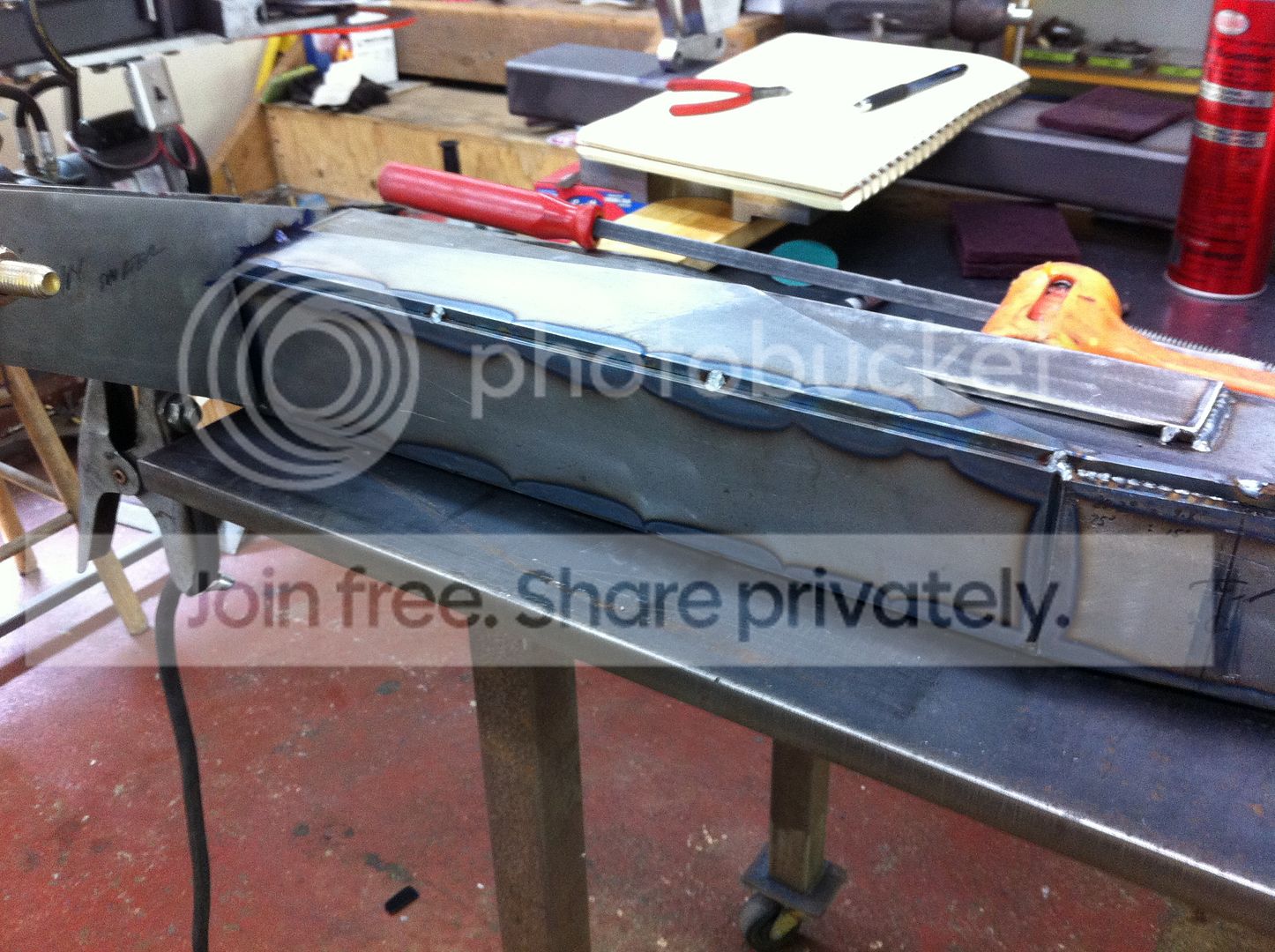
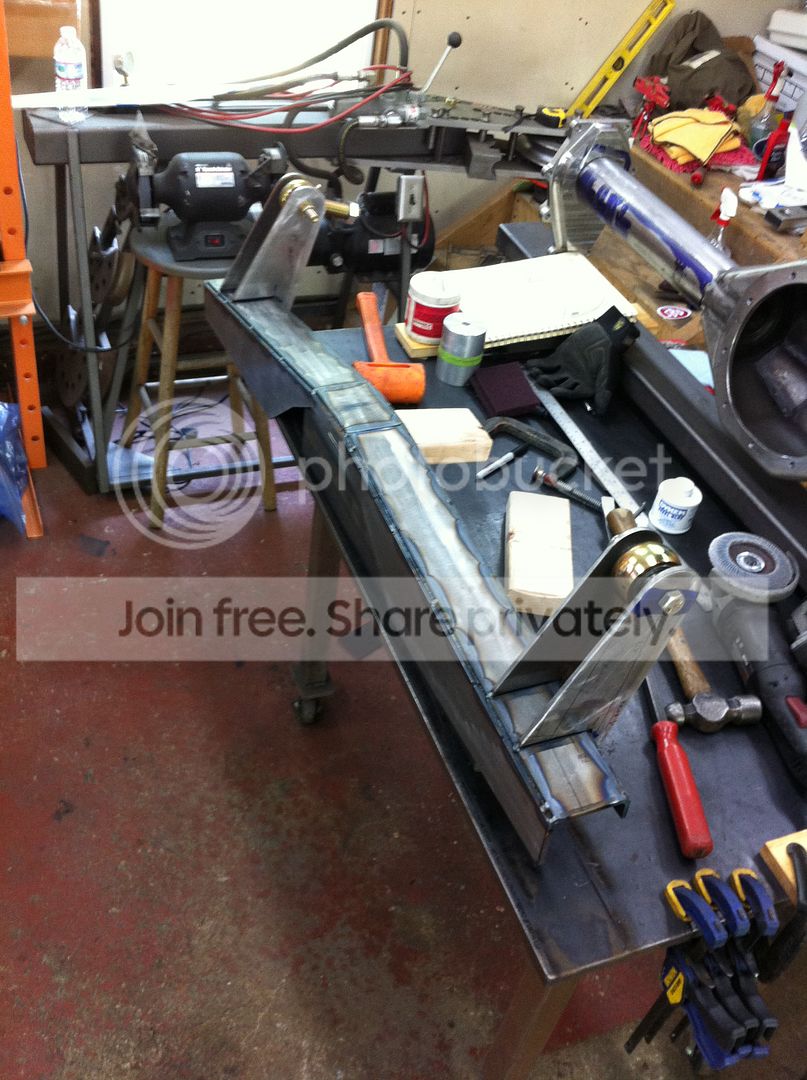
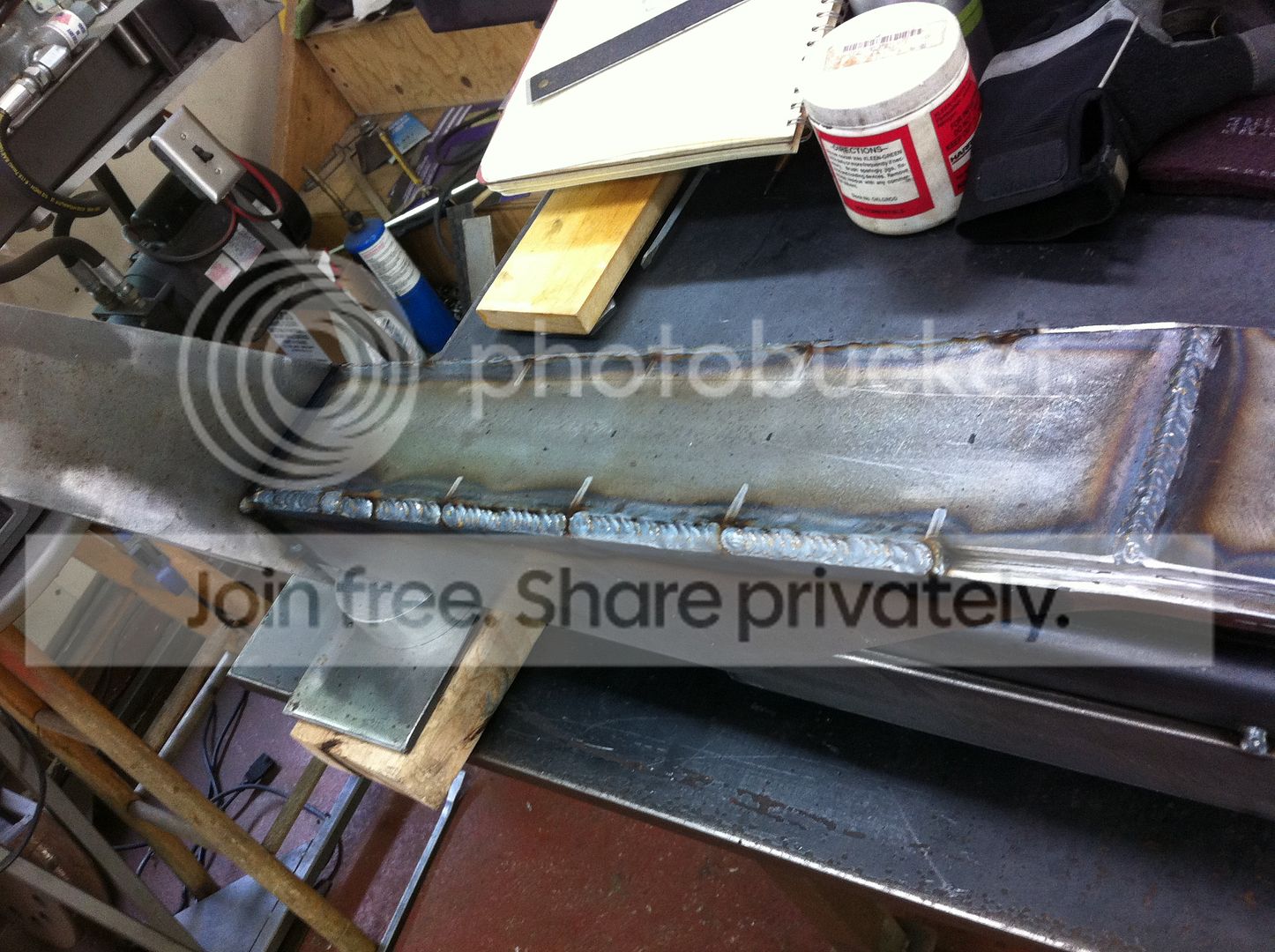
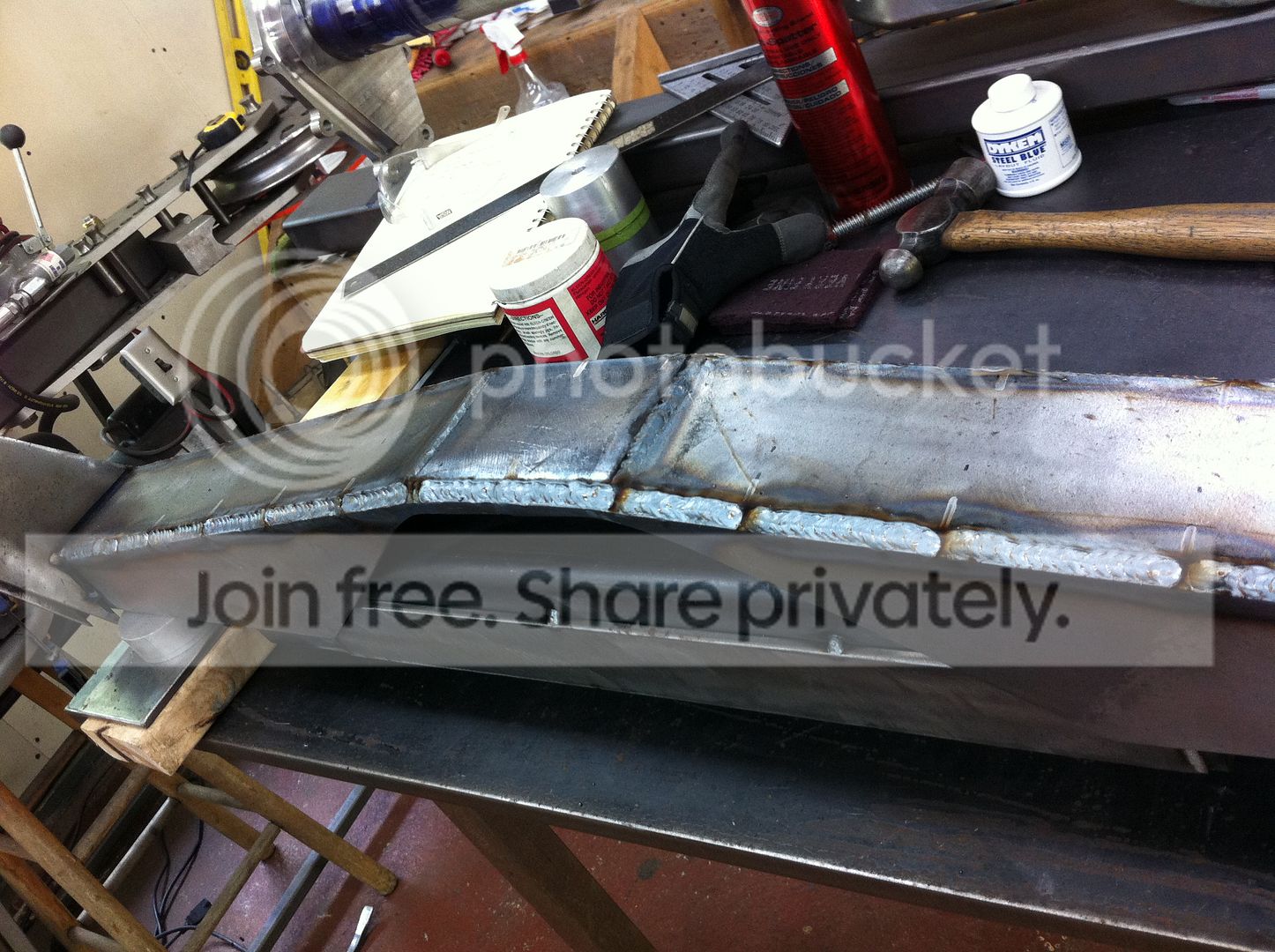
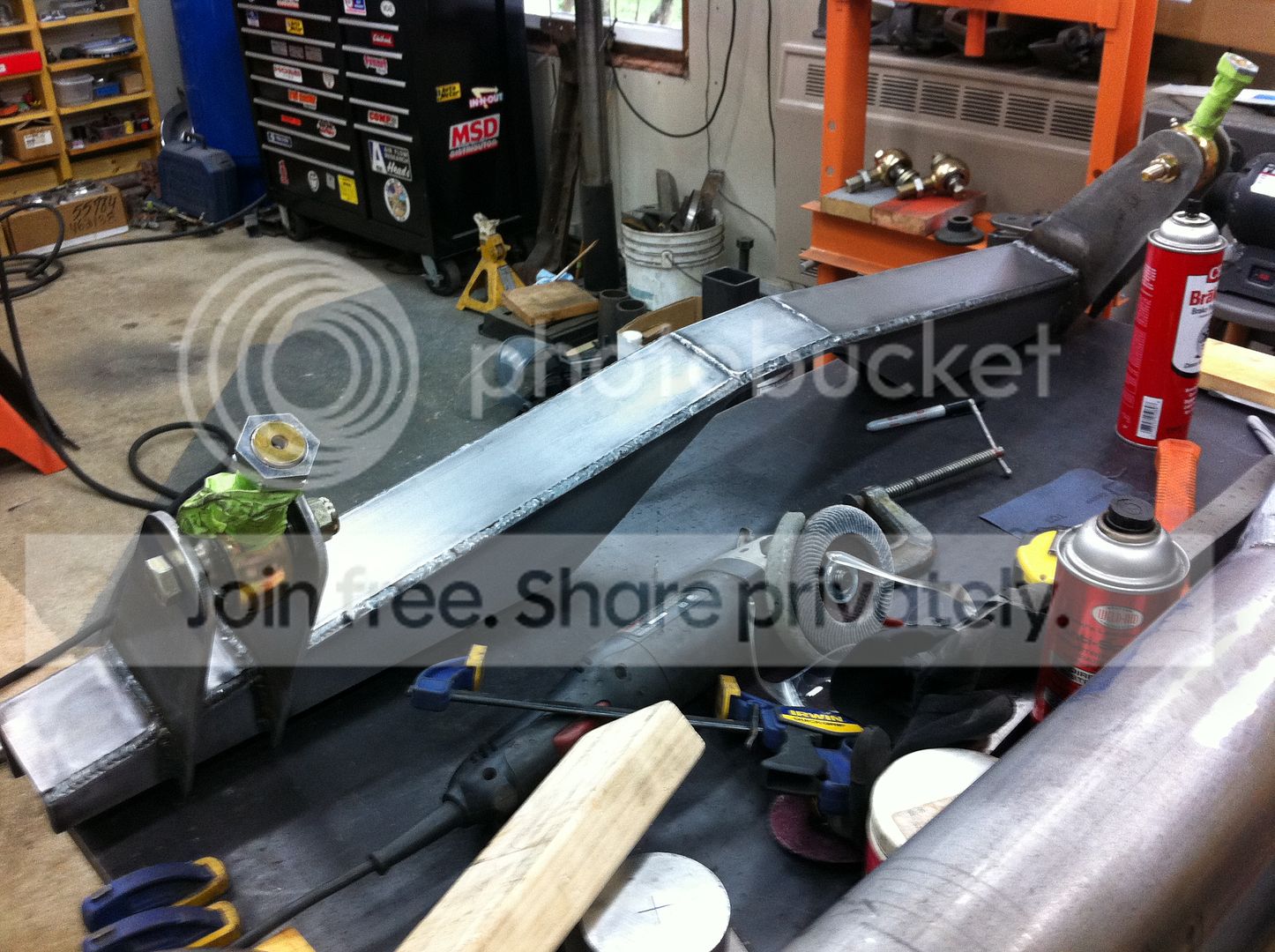
I removed the axle truss and was able to get all of the welding done on the interior fillets. I used a rectangular tube as a spacer to help prevent warping and distortion as I worked. Here is a shot of the truss upside-down during the welding processes.

The HAZ (heat affected zone) that you see in these photos is from the welding on the interior surfaces of the truss... at this point the exterior is only tacked in a few spots.

IMG_2095.jpg


I used the welding sequence that I remember hearing Rene talk about previously. Basically, I welded only about 3" at a time (front edge first, then back edge on the same side of truss, then opposite side of truss front edge, then rear edge of truss on opposite side). This was my attempt to keep the heat evenly distributed across the part on each side, and I worked from the outside toward the middle.

IMG_2100.jpg


Also, instead of always welding from the spots where I left off previously I would start 3" away in a fresh spot on the truss and then "back step" the weld until I reached the end of the previous weld (3" away). I believe this approach is a more uniform way to add heat to the part.... And based on the observed HAZ on the finished welds it appears to work well.

IMG_2107.jpg


A nearly finished shot (interior completely welded, exterior almost finished):

IMG_2113.jpg


I spent a few minutes with a red Scotchbrite pad cleaning up the welds and entire truss to see how it looked....

IMG_2116.jpg


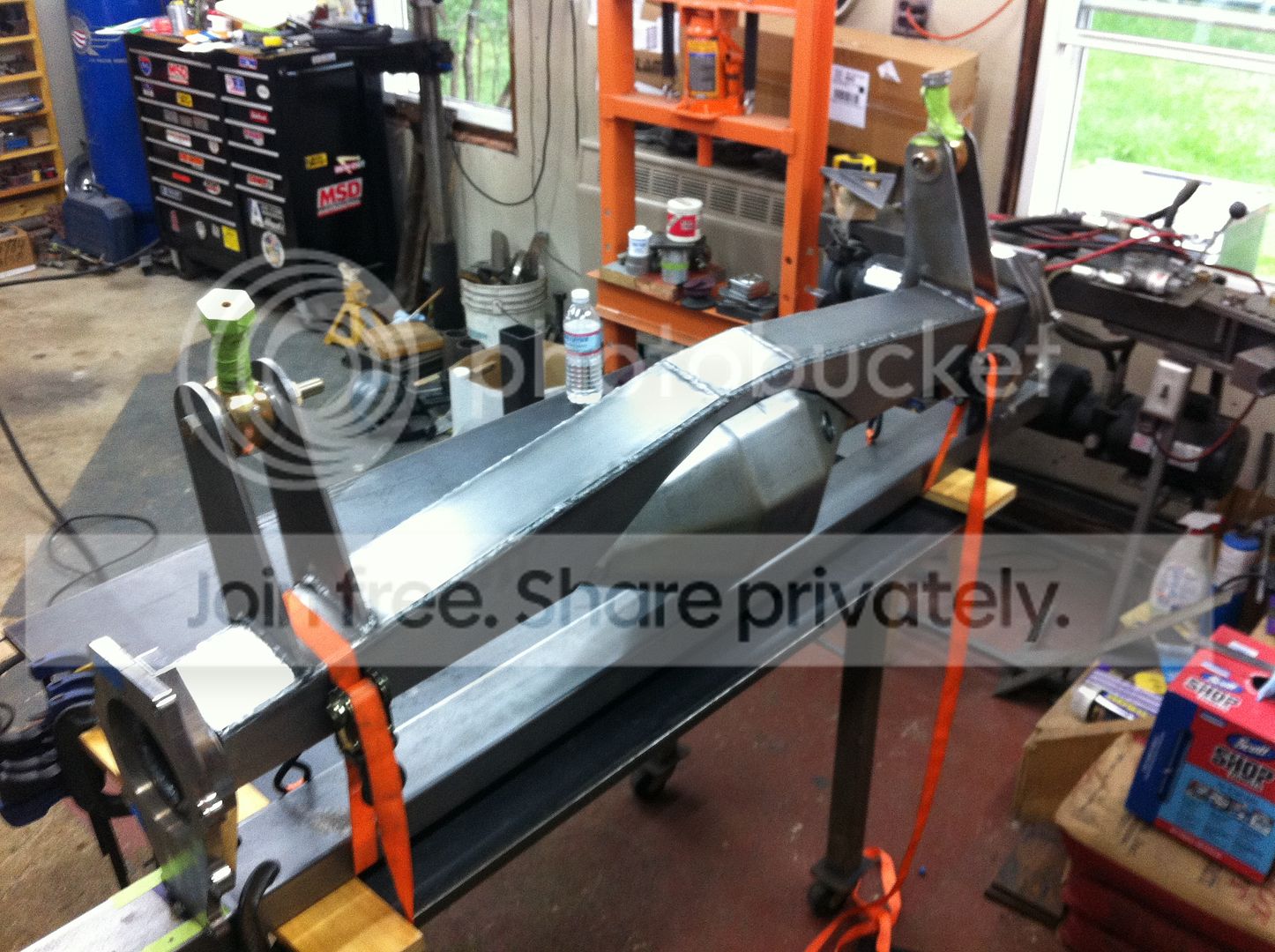
Then I refitted the truss and made a few small adjustments to get it back into it's original position. There was a slight "crown" from the final welding near the top of the truss which pulled up on the ends. With the ratchet straps I was able to easily bring that back into position...

dd84d238.jpg


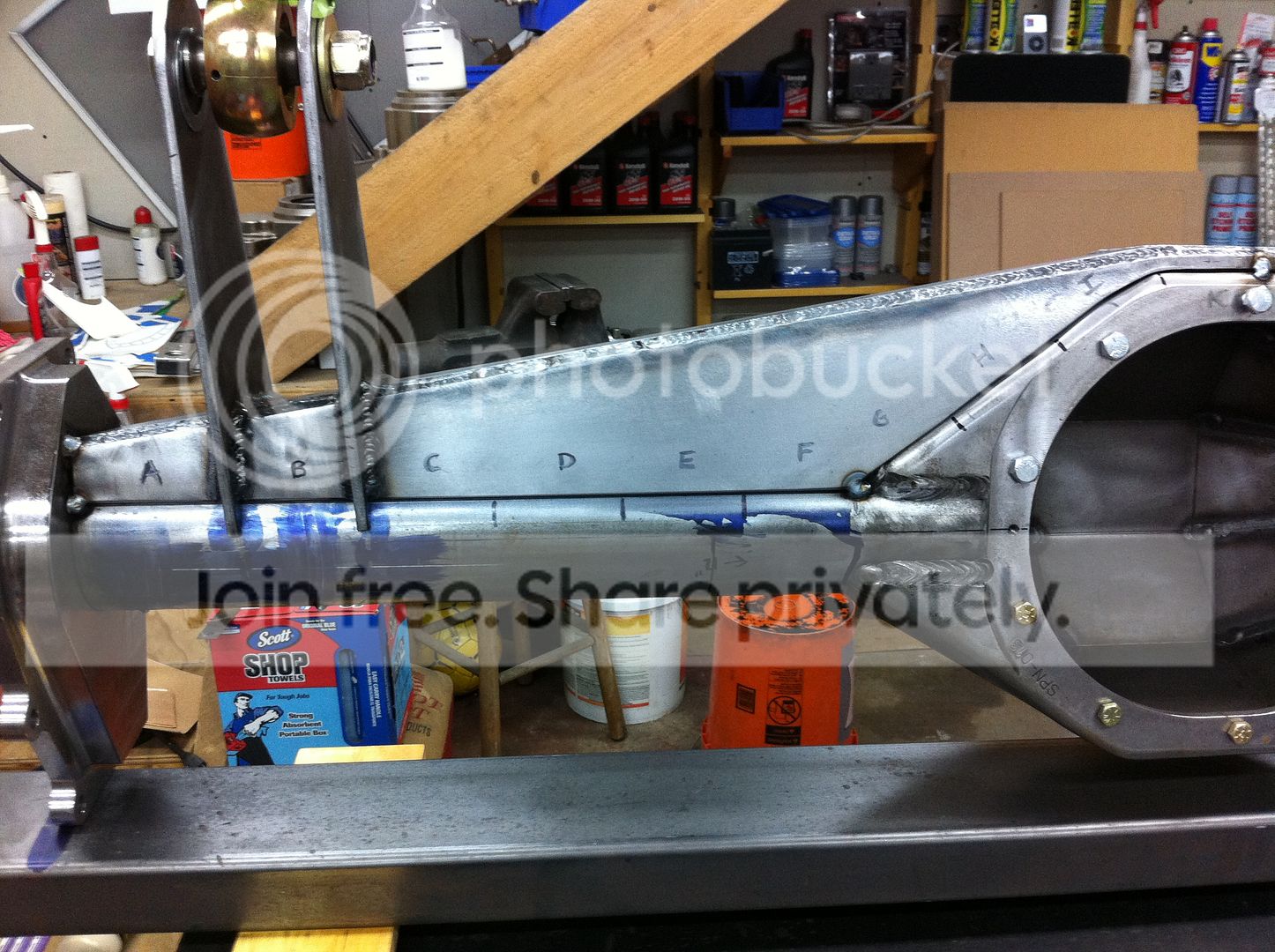
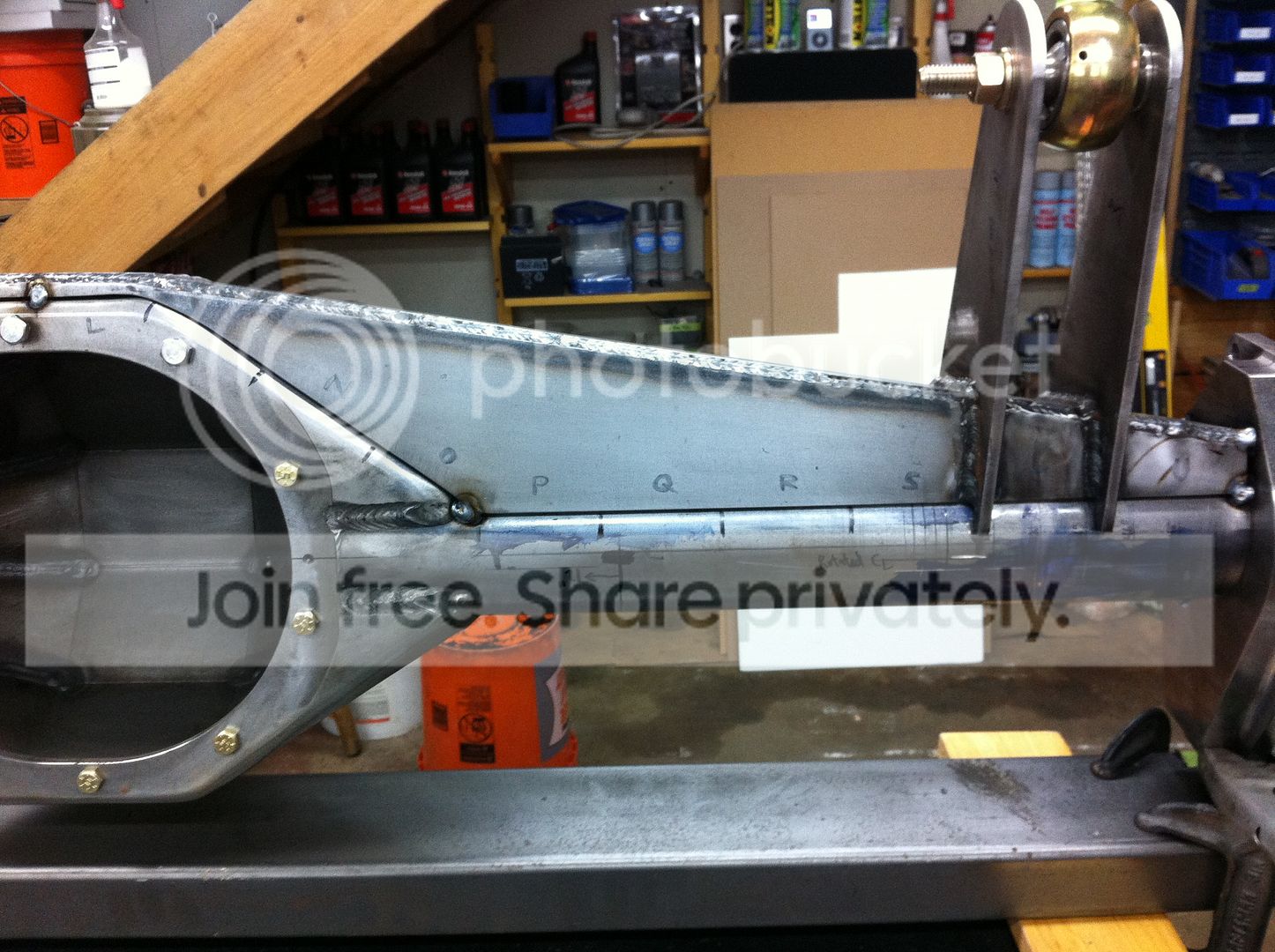
I laid down some heavy tack welds in the extreme corners and in a few strategic places on the truss to lock-down the positioning, and then I marked out a symmetrical spacing pattern for the final welding of the truss to the axle housing itself...... This is where I got stuck and where I now need help.

There are a total of 20 segments marked-out across the axle truss (approximately 2.5" each)... The labeling starts on the far left at letter "A" and then continues to the letter "U" on the far right. (inexplicably I skipped over the letter "J" for some reason) :D

Here's a shot of the left side (passenger):

933abe82.jpg


And here's the shot of the right side (driver):

55392664.jpg


So....what I need now from Rene (or any other welding experts who want to chime in) is the exact welding sequence that I need to follow to get this truss locked-down permanently with the smallest amount of distortion possible.

If I had to guess, my strategy would be to weld starting at "A" to the beginning of "B"..... Then go to the back side of the truss and do the exact same segment. Then...go over to section "U" and weld toward section "T".... Then move to the rear of the truss and weld that same segment in the same direction.

Then: go to section "C" and do the backstep welding to bring me back to the end of my previous weld that ended at "B".... Then do the rear section....skip over to section "S", backstep weld to "T"'... Do the rear segment, etc, etc. Following this process will have me finishing up at to top of the pumpkin on both the front and rear of the truss...

I'll be anchoring the entire axle as much as possible to preload the axle and prevent any dramatic shifts when I start pouring heat into the welds.

At this point, I'm reluctant to do this next step until I get some expert welding feedback. :bow::bow::bow:


-G
 
Last edited:
Nice work, Greg. :waytogo:

It sure is nice having you back in the garage and giving us some awesome updates. With you and Paul back at it, I think it helps us normal Joe's, sack up and build up a little inspiration to push the envelope on our own projects. :pimp:


Hopefully you can keep it up, even after you run out of garage tokens. :thumb:
 
You must have taken notes Greg! the truss looks like it was able to be re-fit pretty easily, and the welding looks good. Thanks for taking pics of the HAZ you get with back stepping, it's a good visual reference to have here.

Your aplphabet lay-out will work as you described. :waytogo:

nothing to do now but to do it...remember, no guts, no glory. :D
 
You must have taken notes Greg! the truss looks like it was able to be re-fit pretty easily, and the welding looks good. Thanks for taking pics of the HAZ you get with back stepping, it's a good visual reference to have here.

Your aplphabet lay-out will work as you described. :waytogo:

nothing to do now but to do it...remember, no guts, no glory. :D

OK just a suggestion here and I want Rene's opinion about this, but I would do the ends as you described A then U, but then would go back to F then P to lock in those corners then go back to C etc...
Do you think it would be better that way?
 
You must have taken notes Greg! the truss looks like it was able to be re-fit pretty easily, and the welding looks good. Thanks for taking pics of the HAZ you get with back stepping, it's a good visual reference to have here.

Your aplphabet lay-out will work as you described. :waytogo:

nothing to do now but to do it...remember, no guts, no glory. :D


Thank you sir! :bow:

I will try to find some time tomorrow to get this final welding step completed... The suspense is killing me.

Sorry about the blurry pics. I take a lot of photos with my iPhone but the screen is so small it's hard to know which ones to upload to Photobucket. Since I'm not at my normal PC the updates happen on my iPad and it's a tedious process to link the Photobucket images to this thread. I'll be back in front my real PC on Thursday so I will swap out some of these pics for better versions that show the welding and HAZ more clearly.

It was great practice laying down all those welds today... I ended up using .030" wire, Gold gas and 19.0V @ 330 ipm wire speed. Once I started really "watching" the puddle and getting into that zen-type place the welds started looking really uniform, flat and nice! :waytogo:

-G
 
OK just a suggestion here and I want Rene's opinion about this, but I would do the ends as you described A then U, but then would go back to F then P to lock in those corners then go back to C etc...
Do you think it would be better that way?

ideally each sharpie line Greg has will get a nice hot tack, and the whole thing will be constrained on his work table or with other mechanical bracing. "Other mechaqnical bracing" will allow Greg to rotate the part for easier/prettier welding

Greg, 19 volts? The welds look good, and I'm not trying to throw in any seeds of doubt...but more voltage would be better. I recall your machine has a max voltage output in the 24 volt range right? Try cranking the voltage up into the 22.5-23.0 range, and then play with wire speed for best possible result. Obviously on some similar thickness scrap...

No worries on the welds I've seen, an idiot can see they are bruned in there nicely. still hotter = gooder. Just remember you'll have to move a bit faster with it dialed up.
 
Since I'm not at my normal PC the updates happen on my iPad and it's a tedious process to link the Photobucket images to this thread.

-G

I'm sure you know this but if you go to the "full" site on your iPad you can go to the album you upload all these pics to then just check the boxes on the pictures you want and go to the bottom of the page and have it make a list of code to copy and paste.
That's what I do on my build thread instead of copy/pasting for every individual picture.

Nice updates! Keep them rolling in. :D
 
2012.05.29 - UPDATE! - PAGING RENE!....

Major progress today! :waytogo:

I removed the axle truss and was able to get all of the welding done on the interior fillets. I used a rectangular tube as a spacer to help prevent warping and distortion as I worked. Here is a shot of the truss upside-down during the welding processes.


I used the welding sequence that I remember hearing Rene talk about previously. Basically, I welded only about 3" at a time (front edge first, then back edge on the same side of truss, then opposite side of truss front edge, then rear edge of truss on opposite side). This was my attempt to keep the heat evenly distributed across the part on each side, and I worked from the outside toward the middle.

Also, instead of always welding from the spots where I left off previously I would start 3" away in a fresh spot on the truss and then "back step" the weld until I reached the end of the previous weld (3" away). I believe this approach is a more uniform way to add heat to the part.... And based on the observed HAZ on the finished welds it appears to work well.


Once all the welding was complete, I refitted the truss and made a few small adjustments to get it back into it's original position.


I laid down some heavy tack welds in the extreme corners and in a few strategic places on the truss to lock-down the positioning, and then I marked out a symmetrical spacing pattern for the final welding of the truss to the axle housing itself...... This is where I got stuck and where I now need help.

There are a total of 20 segments marked-out across the axle truss (approximately 2.5" each)... The labeling starts on the far left at letter "A" and then continues to the letter "U" on the far right. (inexplicably I skipped over the letter "J" for some reason) :D

Here's a shot of the left side (passenger):


And here's the shot of the right side (driver):


So....what I need now from Rene (or any other welding experts who want to chime in) is the exact welding sequence that I need to follow to get this truss locked-down permanently with the smallest amount of distortion possible.

If I had to guess, my strategy would be to weld starting at "A" to the beginning of "B"..... Then go to the back side of the truss and do the exact same segment. Then...go over to section "U" and weld toward section "T".... Then move to the rear of the truss and weld that same segment in the same direction.

Then: go to section "C" and do the backstep welding to bring me back to the end of my previous weld that ended at "B".... Then do the rear section....skip over to section "S", backstep weld to "T"'... Do the rear segment, etc, etc. Following this process will have me finishing up at to top of the pumpkin on both the front and rear of the truss...

I'll be anchoring the entire axle as much as possible to preload the axle and prevent any dramatic shifts when I start pouring heat into the welds.

At this point, I'm reluctant to do this next step until I get some expert welding feedback. :bow::bow::bow:


-G

Greg, I thought I taught you better. Left and right are ALWAYS as seated in the vehicle (left is driver side and right is passenger side). :D

BTW looking real good and can't wait to see the rig sitting on the rear axle and not hanging under it with something.
 
Last edited by a moderator:
Rene,

I will do some experiments with higher voltage on some scrap to see what it looks like. I'll be honest, I usually just look up the settings on the inside cover and start with those. For 1/4" plate the setting is 19.0V / 330 ipm. What I learned after some practice at those settings is that the gun angle, travel speed and weave pattern makes a BIG difference in the final result. (Duh, right? :wink1: ). I actually played around with a slightly slower wire speed briefly to get a flatter weld profile but as I messed around with my technique I was able to get the flat welds at the 330 setting after all. The slower speeds were giving me more of that "spitting" effect too... Where the wire was disappearing before it even got into the puddle. That was my clue that the speed was too slow and I should look elsewhere for the solution. I have a feeling that I weld slowly by professional standards.... I seem to be very methodical and slow, even though MIG is supposed to be a fast process. I'm sure that's part of the reason why my settings seem "off". I'll try the higher voltage and try to pick up my pace! :)

Avery,

I hear ya on the Photobucket stuff, but I don't upload ALL of the photos I take (dozens per shop day). I usually pick 5 or 6 from the iPhone to upload and hope they look good at high resolution once they are uploaded.

Scotty,

Yes, left is DS and right is PS.....no argument. For some reason when the parts are just sitting on a workbench the 3rd member side "feels" like the correct side to work from and I end up thinking in terms of left & right based on that.... (as mentioned before I also forgot the letter "J" when labeling the axle). I'm only human. :haha:

-G
 
I don't blame you for being reluctant, when I was welding all the brackets on my front axle I actually only welded 2" at a time and waited for it to cool again before welding any more. It just took a while and I had to do other stuff in the meantime.

That truss looks awesome Greg, nice work. Are you going to put a brace up the center of your upper control arm mounts to make them more like an I beam? I sure hope you don't have to move them down the road, they look pretty permanent already.
 
The upper mounts will get plated-in on both front and back. I just wanted to get the interior welding completed before closing it all in. A lot of the Mog guys report problems with torn mounts due to the torque of the portal boxes..... So I want as many welded inches between the mount and the axle tube as possible. I'll probably do some laminations around the bolt holes as well for extra beef.

You'll notice that the lower mounts had to be removed to allow the truss to come off for welding, so I need to re-fit those in position, then do the interior welding, exterior welding and plate those in the same way.

Gotta remember to also design some drain holes so that water can escape if it ever gets into those bracket areas.

Another thing I'm doing is putting a small 1/32" shim next to the heims before I snug the bolts down for welding. The thought process is that the welding will shrink the brackets slightly and it will be a nightmare to get the heims installed later on if the bracket doesn't have just a slight bit of extra clearance. I figure the torquing of the heim bolt will easily suck-out that 1/32" clearance and still give me a nice uniform clamping load during final assembly of the suspension.

-G
 
The upper mounts will get plated-in on both front and back. I just wanted to get the interior welding completed before closing it all in. A lot of the Mog guys report problems with torn mounts due to the torque of the portal boxes..... So I want as many welded inches between the mount and the axle tube as possible. I'll probably do some laminations around the bolt holes as well for extra beef.

You'll notice that the lower mounts had to be removed to allow the truss to come off for welding, so I need to re-fit those in position, then do the interior welding, exterior welding and plate those in the same way.

Gotta remember to also design some drain holes so that water can escape if it ever gets into those bracket areas.

Another thing I'm doing is putting a small 1/32" shim next to the heims before I snug the bolts down for welding. The thought process is that the welding will shrink the brackets slightly and it will be a nightmare to get the heims installed later on if the bracket doesn't have just a slight bit of extra clearance. I figure the torquing of the heim bolt will easily suck-out that 1/32" clearance and still give me a nice uniform clamping load during final assembly of the suspension.

-G

I noticed those shims, depending on how high your end plates go .031" might be a little much and only make bolt contact on the outer portion of the bracket. I think .010" - .015" might be much better. I didn't use any shims, I just tack welded the brace plates in before I welded it, then welded it all up and they fit in just fine. I kept the bolts and joints in until it was all tack welded in place, then removed them and welded it up. I do agree though, you don't want it to tight or it will be a PITA to get the thing assembled after that.

I also created drain holes, your thinking of all the right things, excellent work as always.
 
Do you think a single .031" shim is too much per heim? I am only shimming on one side of each bracket... Not both. Just to clarify, I'd only get half of that clearance on each side of the heim. :thinking:

-G
 
.031 is a little big but not too big. If you can get some spacers that are the same legth as your hiem and spacers plus the .031 and bolt them in during all welding processes. It's not uncommon to loose .010 to .020 when welding up the brackets even with spacers installed.

Looks good, I suggest attaching the ends of the axle to a solid surface and perhaps even giving them a bit of pulling pressure downward. I have yet to do a truss and have the axle straight when it's done, even with all the steps you are taking. I have never tied the ends down and done the preload thing though.
 
I use a piece of all thread and 4 nuts to lock down the distance when I weld brackets up. Put the flex joint or bushing or whatever you are using in there measure the distance, put the all thread in, get it set and then space it out .010 on each side. This allows the flex joint to slide in easy and the bolt will tighten down and take up the very small space you are left with.

I actually widen the space with a thicker bracket. Most brackets I work with are made of 1/4

I also typically have my front and back ( or top and bottom as it may be) tacked in before final welding and have used a coupler nut to help keep the spacing there if I final weld the bracket out of its actual position
 
I have yet to do a truss and have the axle straight when it's done, even with all the steps you are taking. I have never tied the ends down and done the preload thing though.

Brandon,

So I have to ask: If the housings always end up warped how do you ultimately deal with it? :dunno:

There must be some amount of distortion that is acceptable.... The clearance of the axle splines and/or the wheel bearings should tolerate a slight misalignment... The question is how much? :thinking:

I've also heard of shop that will put a warped housing into a MASSIVE hydraulic press and with a talented operator, it is possible to make it perfectly straight again.

There is still time for me to buy an alignment bar (I think Currie sells them) for around $350 and try to fixture and clamp the tubes internally before the final welding happens... I just dont hear of many 4x4 guys going to this much trouble when they add a truss to an axle......


-G
 
Brandon,

So I have to ask: If the housings always end up warped how do you ultimately deal with it? :dunno:

There must be some amount of distortion that is acceptable.... The clearance of the axle splines and/or the wheel bearings should tolerate a slight misalignment... The question is how much? :thinking:

I've also heard of shop that will put a warped housing into a MASSIVE hydraulic press and with a talented operator, it is possible to make it perfectly straight again.

There is still time for me to buy an alignment bar (I think Currie sells them) for around $350 and try to fixture and clamp the tubes internally before the final welding happens... I just dont hear of many 4x4 guys going to this much trouble when they add a truss to an axle......


-G

They do it with Crankshafts, I don't see why a housing couldn't be done.
 

Latest Posts

Top Bottom