CK5
Register an account today to become a member! Once signed in, you'll be able to participate on this site by adding your own topics and posts, as well as connect with other members.
FYI...

It appears that the Unimog front knuckles have no caster built into them. I was getting ready to tack weld my CNC adapter plates to the axletube today, and squared the plate to the ground. Thankfully, I decided to bolt the knuckle on just to see what sort of caster there would be once I set the pinion angle correctly. Turned out the caster is 0.0* if you don't rotate those backing plates a bit.

Fortunately I caught it in time, set the top of the CNC plate for 8* of caster and kept on pressing forward.

Now you know. :)

-G

All the garage time you have been logging lately making me feel incredibly bad. I need spring to be here so my shop can go in. Either that or I am going to kick my wife out of the garage. Btw good work as always :thumb:
 
All the garage time you have been logging lately making me feel incredibly bad. I need spring to be here so my shop can go in. Either that or I am going to kick my wife out of the garage.


Kicking the wife out of the garage is a short term loss ( of sex, love, your comfortable bed etc.) long term gain. :D:D

They get over it
 
All the garage time you have been logging lately making me feel incredibly bad. I need spring to be here so my shop can go in. Either that or I am going to kick my wife out of the garage. Btw good work as always :thumb:

As I'm sure you know, I served a two-year sentence in "baby jail" since Danger was born.... Just got paroled about a month ago! :haha:

Technically speaking it was a combination of baby stuff and a ton of simultaneous large-scale house projects that made garage time impossible. I'm definitely thrilled to be back in the shop again... It puts me in a much better mood for sure.

Mom's doing a bit of shopping so I'm watching a bit of Team Umizumi with my little guy right now.... Should be back out to work in the next hour or so. Negotiated shop time for tomorrow night after work also! :waytogo:

-G
 
Last edited:
Greg, you are setting your pinion about a degree or two up from the driveshaft angle (which should be right at the tcase output if you use a CV) with your caster at 8 correct? The front wants to turn the same direction as the back, but since the pinion sticks out the other side, it wants to rotate down under power.

Ignore me if you are already doing that. It will be easy to change the caster and pinion angle when you are done with the link lengths, but you obviously won't be able to rotate the knuckles anymore.
 
Hmmm..... I thought that was more of a "leafspring thing" :thinking:

With the links & heims, is there really going to be an issue with the pinion rotating / axle wrap?...

Everything is tacked in place, so I can certainly make adjustments as needed. Now's the time to do it before I start burning in bracketry.

-G
 
Leaf springs flex WAY more than 1 - 2 degrees. My uncle even puts 1 degree in the dragsters with all solid heims and links only ~18" long.

With my half bushings/half sphericals I put it ~2 degrees high. With your heims I would lean closer to 1. But you don't want zero or the u-joint can wear out prematurely because the needles just contantly wear on the same contact point with almost no motion.
 
At 1* I'm all set....

Re-read the UniMog Service Manual this AM to figure out why there was no caster on those plates. Turns out even the Unimog housing rotates the plates.... they use 7* of caster for their spec, so I've can "give back" 1* for this pinion rotation item and still be right on the money.

-G
 
I just ran some numbers on the most recent suspension positions, and it looks like I'll get 4* of caster change (@ 6" of uptravel) and 3.25* of caster change (@ 8" of droop)....

Assuming I set my initial caster at 7*, my caster should increase to 11* maximum on bump and even at full droop (airborne) I should still have 3.75*....

Since my driveshaft is substantially longer than my front links, I would guess that the u-joint angularity changes would be even smaller from full-bump to full-droop??? :thinking:


-G
 
Since my driveshaft is substantially longer than my front links, I would guess that the u-joint angularity changes would be even smaller from full-bump to full-droop??? :thinking:
-G

Not necessarily because the IC of your 3 link is way longer than your driveshaft, with a radius arm you could make that assumption. But with your driveshaft, it's just a triangle, so if you know the length and angle to start, we can calculate the new angle quite easily. Then you can add or subtract the pinion angle change to calculate the u-joint angle at the pinion.
 
Instant Center (x) = 110.67"
Instant Center (z) = 30.0"

Pinion is going to be roughly:

x = 10"
z = 25"

Driveshaft length = 52"
Slope toward pinion = 8.8*

X-Z Coordinate for latest front 3-link design:

Upper link (axle side) = (0,30)
Upper link (frame side) = (28,30)
Lower link (axle side) = (4,20)
Lower link (frame side) = (36,23)


Have at it hoss.... :waytogo: :bow:


-G
 
You are giving me more credit then necessary, with these things I just tend to simplify them and accept the small error I get with the simplified calculations.

Your driveshaft is 52" at 8.8 degrees. It will get longer or shorter, but 2" on a 52" driveshaft is less than 4% error.

Also, your pinion will be changing angle slightly, you said it is about 10" and changes up to 4 degrees either way during travel. That equates to about .7" change in height up, .6" going down.

That means if we assume the driveshaft is equal length, and just look at the angle change using trig you start with 8.8 degrees, with bump at 6" - .7" for increased caster is 5.3" up at the pinion. So the dshaft now angles 3 degrees at bump. So the driveshaft angle changes up 5.3 deg while the pinion angles down 4. You started at 1 up at the pinion, the angle of the shaft changed 5.3, so now you are at 6.3, but then the pinion moved down 4 you said, so the angle is now 2.3 degrees, pretty mild, but that won't be where the problem is, the droop is where a problem would show up.

So back at ride height at 8.8 degrees, your driveshaft will droop 8" plus another .6" due to the pinion angle change, that changes it to 18.7 degrees. So your dshaft changes 9.9 degrees from 1 degree up at the pinion, which puts it at 8.9 degrees, plus the 3.3 degrees of pinion change equals 12.2 degrees at the pinion.

So your answer is 12.2 degrees at droop at the pinion. Also, if your engine is 4 degrees back, you add that to the 18.7 which puts your CV at 22.7 degrees at full droop.

Now, I could take a bunch of time and setup files to calculate the exact angle changes including the driveshaft length change, but that would take quite a bit of time and this gets you to within 5% error most likely, and tenths of a degree at the d-shaft don't matter much.

Oh, I did use an excel sheet I made many years ago that uses trig to calculate triangles. It has 4 inputs, each side, and the angle, you fill in any two cells and it spits out the other two. It saves a LOT of time when doing triangles, and there was a lot of them here...
 
Today's update......

I did some foam-core bracket mockups of my latest 3-link design, installed them on the frame and stepped back to see how it looked.

HATE IT....HATE IT.....HATE IT!!!!! :angry1:


Did I mention, I hate it?

The frame side mount for the lower links was spec'ed at 24" high. That's to the exact CENTER of the heim, so by the time you account for the nearly 3-1/8" diameter of the "Large" EVO joints (Plus a little room for clearance), the bracket is hanging down almost 5" from the bellypan on each side. Looks like total crap, especially when compared to the really well-integrated rear link setup where almost nothing is visible from the side-view.

Back to the drawing boards. :thinking:


-G
 
Hang in there:D


Still loving this build from a lurkers viewpoint, almost inspires me to go work on something..allllmost
 
Thanks Shawn.

It was just a frustrating evening in the shop. I went out there expecting to fire up the plasma cutter and welder, and after several hours all I had done was cut up a bunch of foamcore board..... and I didn't even get my hands dirty! :haha:

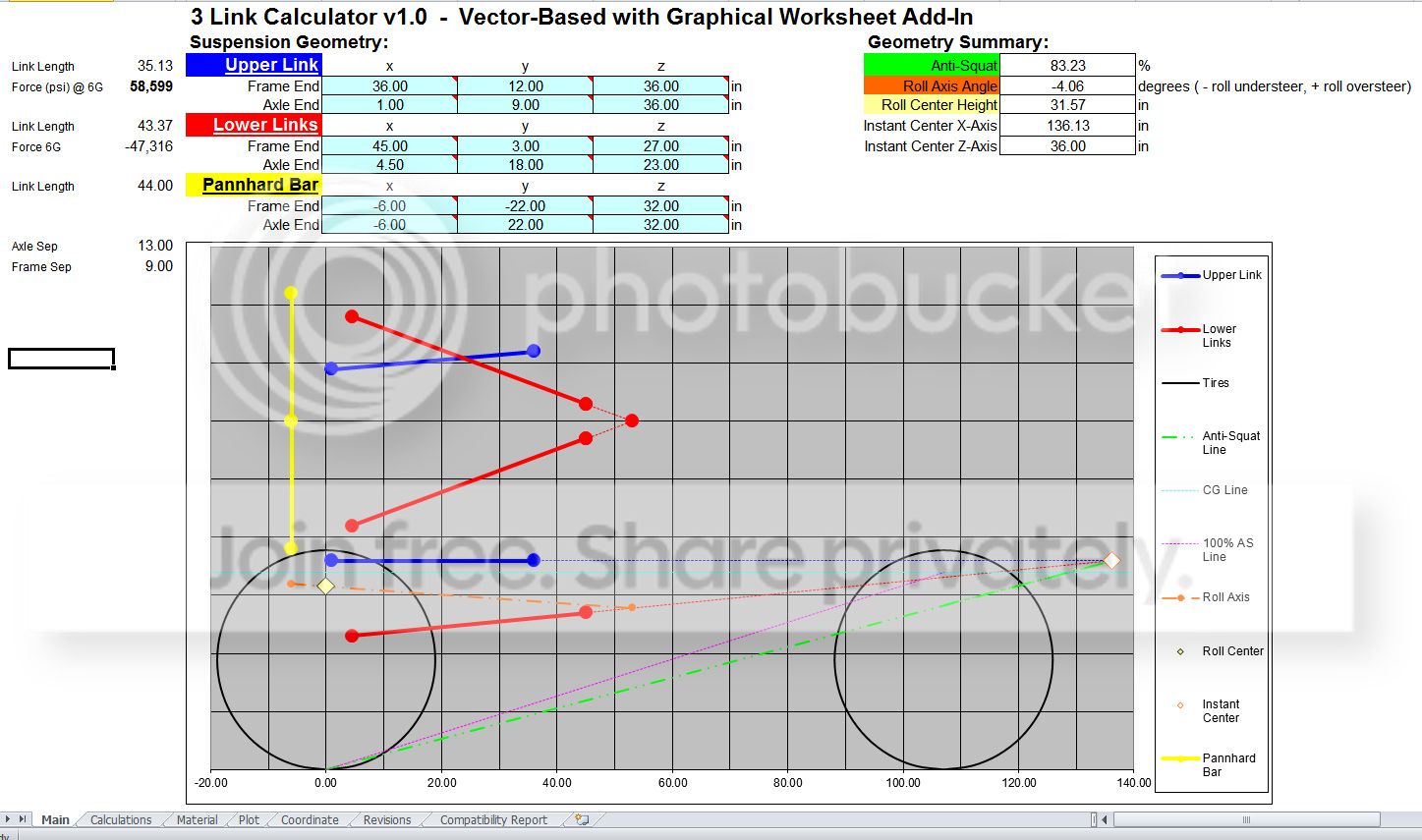
OK, rant over. Time to re-focus... here's a new attempt. This one borrows heavily from my rear 4-link setup:

Tues3Link.jpg


The Good:
  • Frame side lower link mounts are now at 27" instead of 24", which means that the brackets will just barely stick out from the bellypan
  • Roll Center Height is still high (good), and Roll Axis is still a few degrees negative (understeer)
  • Anti-Dive is below 100% though maybe not quite as low as I'd hoped.
  • Link Forces of the upper link are manageable (I'd seen numbers as high as 75,000psi in previous attempts!) :yikes:
The Bad:
  • The lower link axle-side mount is getting pretty high (23" vs. 19" wheel centerline). That is a big contributor to the link loads I'm getting. If I drop it lower my AS% goes sky-high.
  • Vertical link separation is now at 13" (which is awesome) but may not actually package into the available space. I suspect PS motor mount issues.
  • Converged lower links are going to require a stout crossmember to take those loads.
Anyone else want to critique this one with items for either the "good" or "bad" list.... :thinking:


-G
 
One thing I have noticed on rigs if if the lower link mounts hang down on your front suspension it isn't as bad as them hanging down on the rear when it comes to getting hung up on them. Usually when you go over a ledge you hang near the rear of the frame, not right off the front. Could you maybe split the difference of the old/new setup and taper your brackets out so it isn't an abrupt hanging down bracket but almost like it continues the link profile up into the frame. Does that even make sense?
 
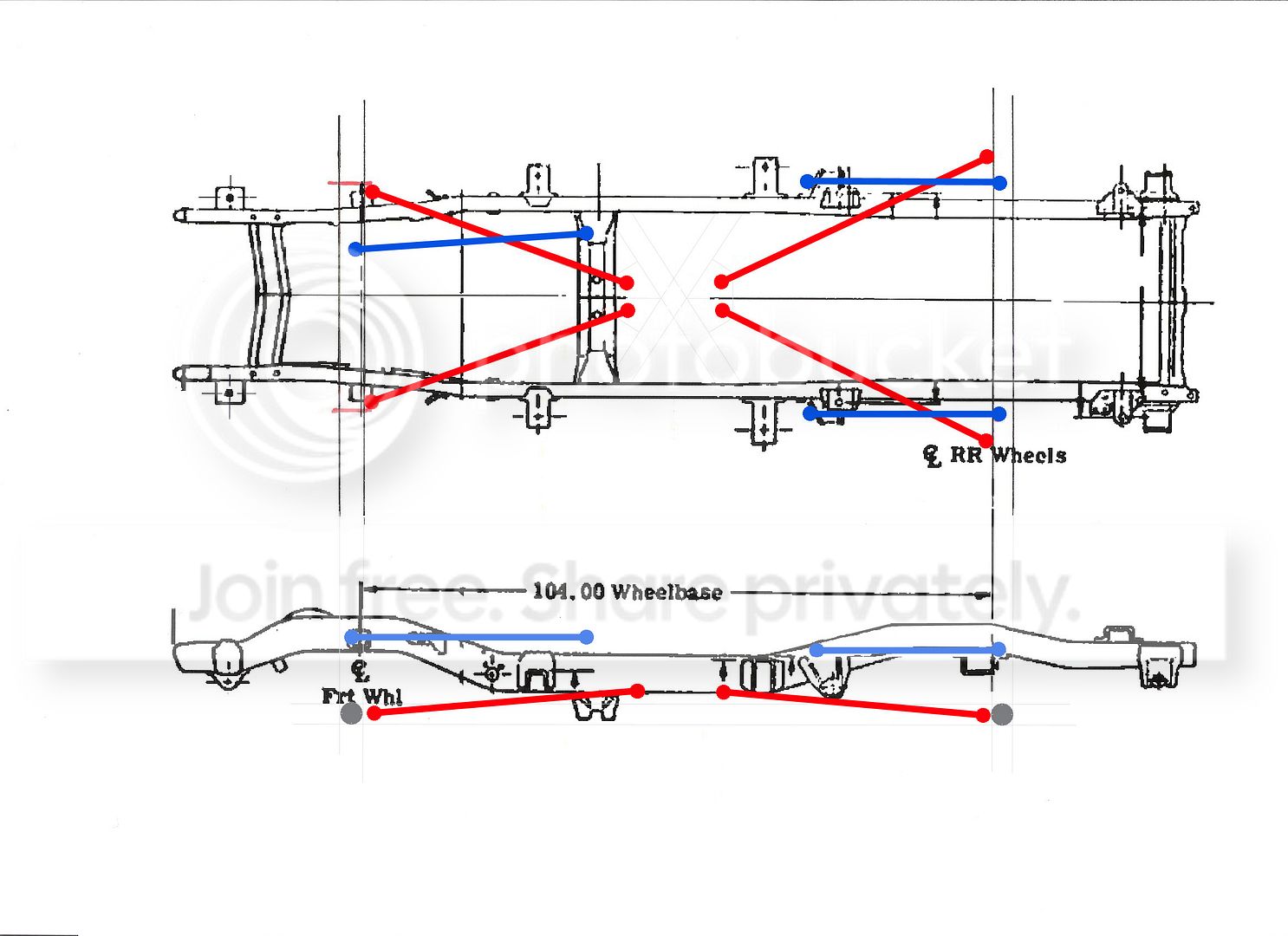
One more thing for the "Good" category is that the triangulated lowers (front & rear) end up landing very close to each other underneath the truck, so they could share a X-style crossmember / link-mount(shown in light grey):

K5FRonFrame2.jpg


The lower link forces are under compression (pushing against the crossmember) both front and rear, so if they were to share a common, well-triangulated crossmember most of those forces would vitrually "cancel" each other out.

Rear link forces: -58,167 psi (compression)
Front link forces: -46,950 psi (compression)

Note: Those forces are using a 6G Factor of Safety, so those do not represent "actual" loads under normal circumstances...


:thinking:

-G
 
Last edited:
One thing I have noticed on rigs if if the lower link mounts hang down on your front suspension it isn't as bad as them hanging down on the rear when it comes to getting hung up on them. Usually when you go over a ledge you hang near the rear of the frame, not right off the front. Could you maybe split the difference of the old/new setup and taper your brackets out so it isn't an abrupt hanging down bracket but almost like it continues the link profile up into the frame. Does that even make sense?

This is kind of the way we ended up doing the links on the race car. We call them nut sacks.:whistle: build them solid to protect the jewels, while not totally attractive they are useful and not really a hindrance in most situations.

Greg I would try as hard as you can to keep the links a near level at ride height as you can. I also find it easiest to get the initial juices flowing with the axle set at full stuff, usually this is the worst case for clearances and you can do some basic mockup tabs from there. Don't be afraid to use a bit of steel to make some mockup parts. Flat bar makes OK mockup links, tabs etc.
 
The lower link forces are under compression (pushing against the crossmember) both front and rear, so if they were to share a common, well-triangulated crossmember most of those forces would vitrually "cancel" each other out.

Rear link forces: -58,167 psi (compression)
Front link forces: -46,950 psi (compression)


-G

I think it's great they can share a crossmember for strength, but the front will only be under compression during braking(when the anti-dive takes effect). The lower links in the front will be under tension during acceleration.
 
I think it's great they can share a crossmember for strength, but the front will only be under compression during braking(when the anti-dive takes effect). The lower links in the front will be under tension during acceleration.

Heath,

That's assuming that I'm in 4WD under acceleration, correct? :dunno: It seems that there has to be applied torque in the axle to change from compression to tension...

Without power going to the front end, are the lower links under compression for both ends? (I'm trying to think in terms of the vehicle just sitting stationary on the ground, with gravity pulling down on it).

What about if I take it off a "sweet jump" (Napoleon Dynamite style :wink1:) and land on all fours basically flat onto the ground? That would be a fairly high G's event so it would be nice to know if the compressive link forces are going to be cancelled-out during an event like that.


-G
 
Last edited:

Latest Posts

Top Bottom