CK5
Register an account today to become a member! Once signed in, you'll be able to participate on this site by adding your own topics and posts, as well as connect with other members.
2015.07.14 - UPDATE! - HEADER IS NOW 97.5% COMPLETE.....!!!!


Time to tell you guys a few more of the "Rules" I'm learning as a neophyte custom header fabricator. :D


Rule #6: Expect that the tubework you already completed will end up right in the way...

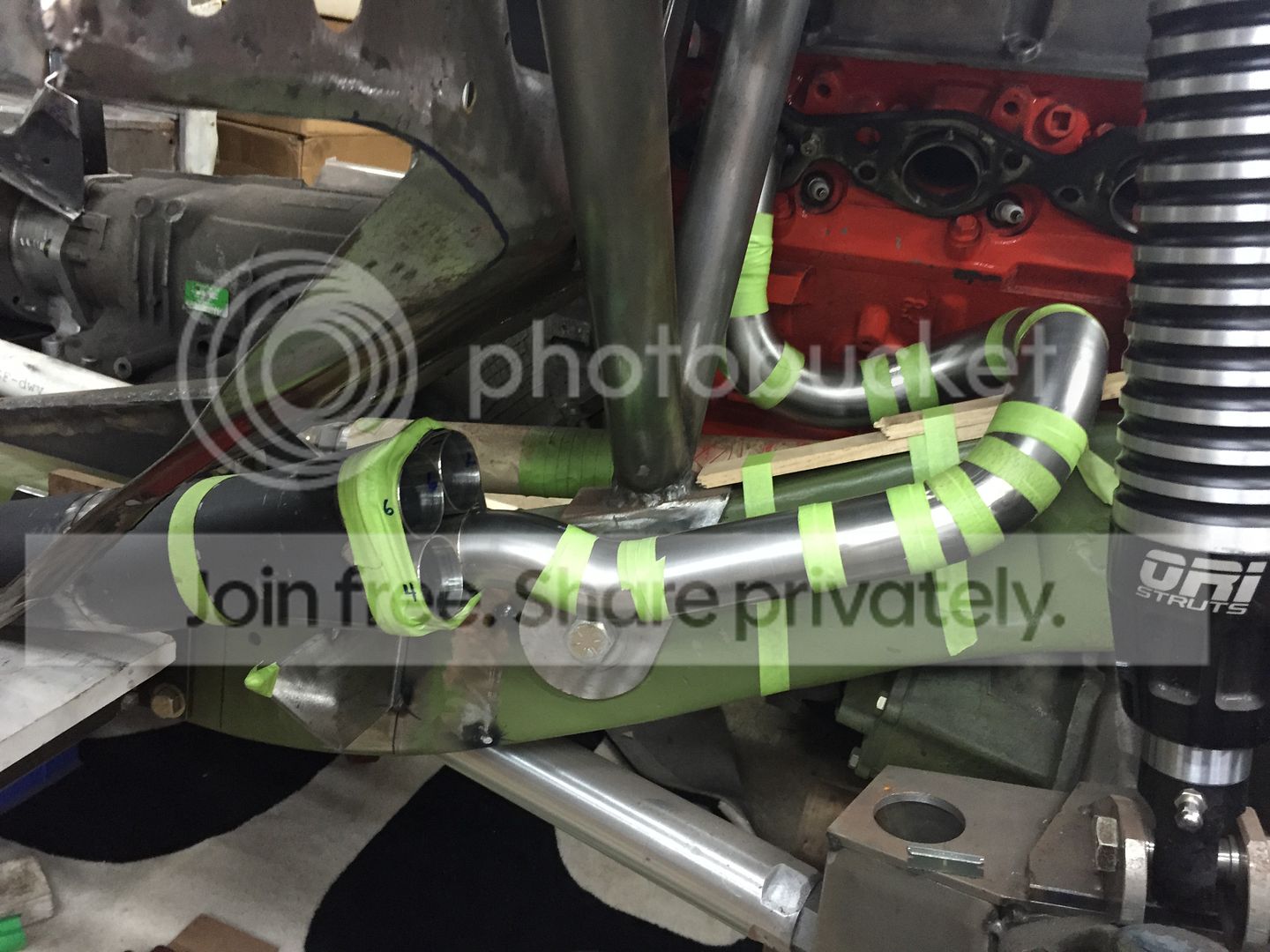
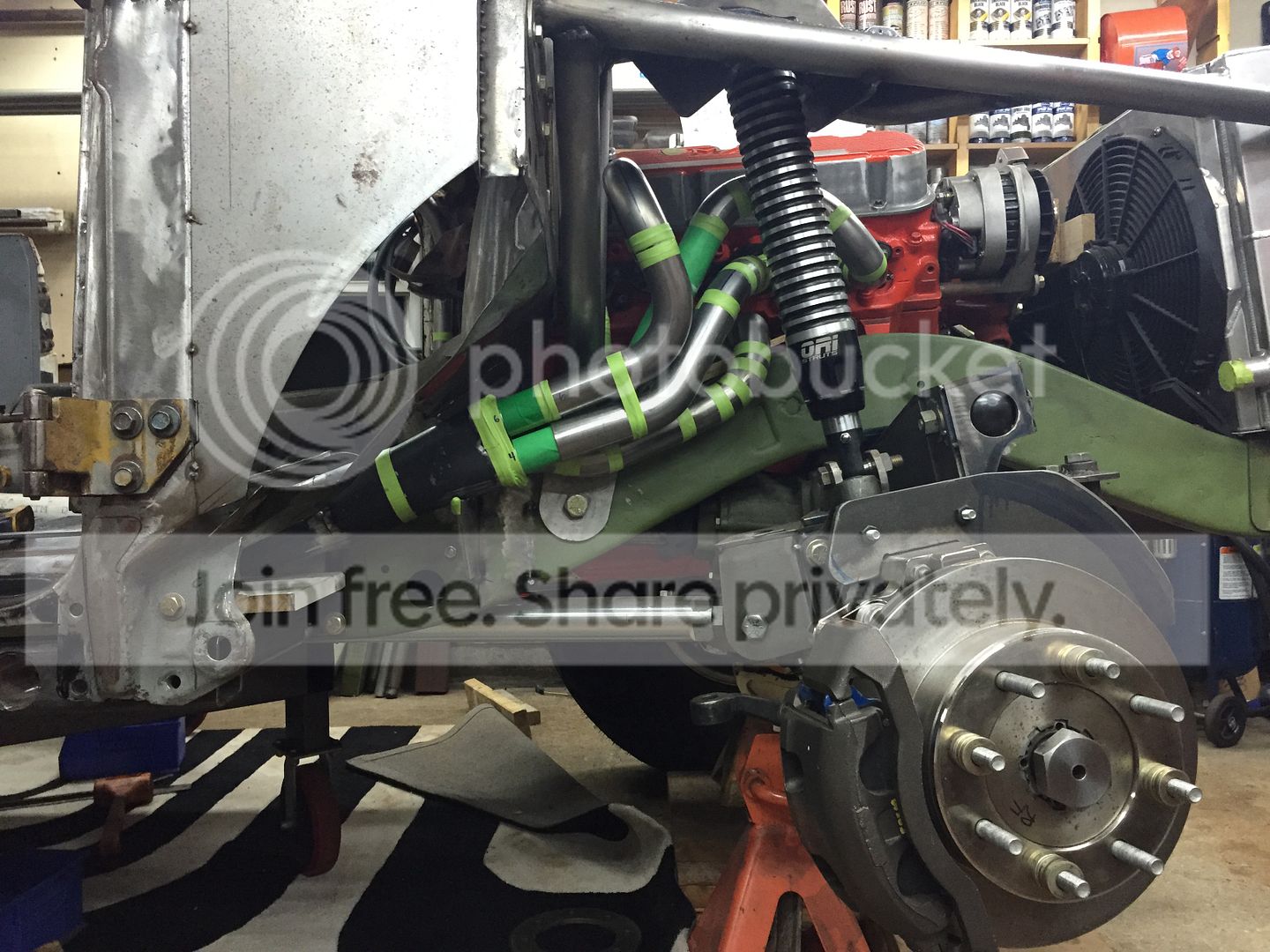
When the cowl/floor support was removed, it revealed about 4" of extra room to move the collector around. This bought me valuable clearance around the tire, but started encroaching on the cowl-to-frame "V" bar that was already fully welded in place. The location of the collector is pretty constrained.... it can't go further back because my "pass through" to the torsion box area is only about 3 - 3.5" tall and the collector is more than 4" tall....AND it's important to still have some clearance around the exhaust so that it doesn't rattle when the engine rocks on the motor mounts. At this point, I've welded a small extension to the collector that necks it down from 3.5" to 3". This is the inlet size for my mufflers anyway...so it made sense to get that transition completed as quickly as possible after the collector merge to save space.

IMG_5476.jpg


In this photo, you can see that the tubes closest to the frame (#8 and #2) are swept downward immediately after the collector, and then sweep back up around that V-bar area.

IMG_5480.jpg


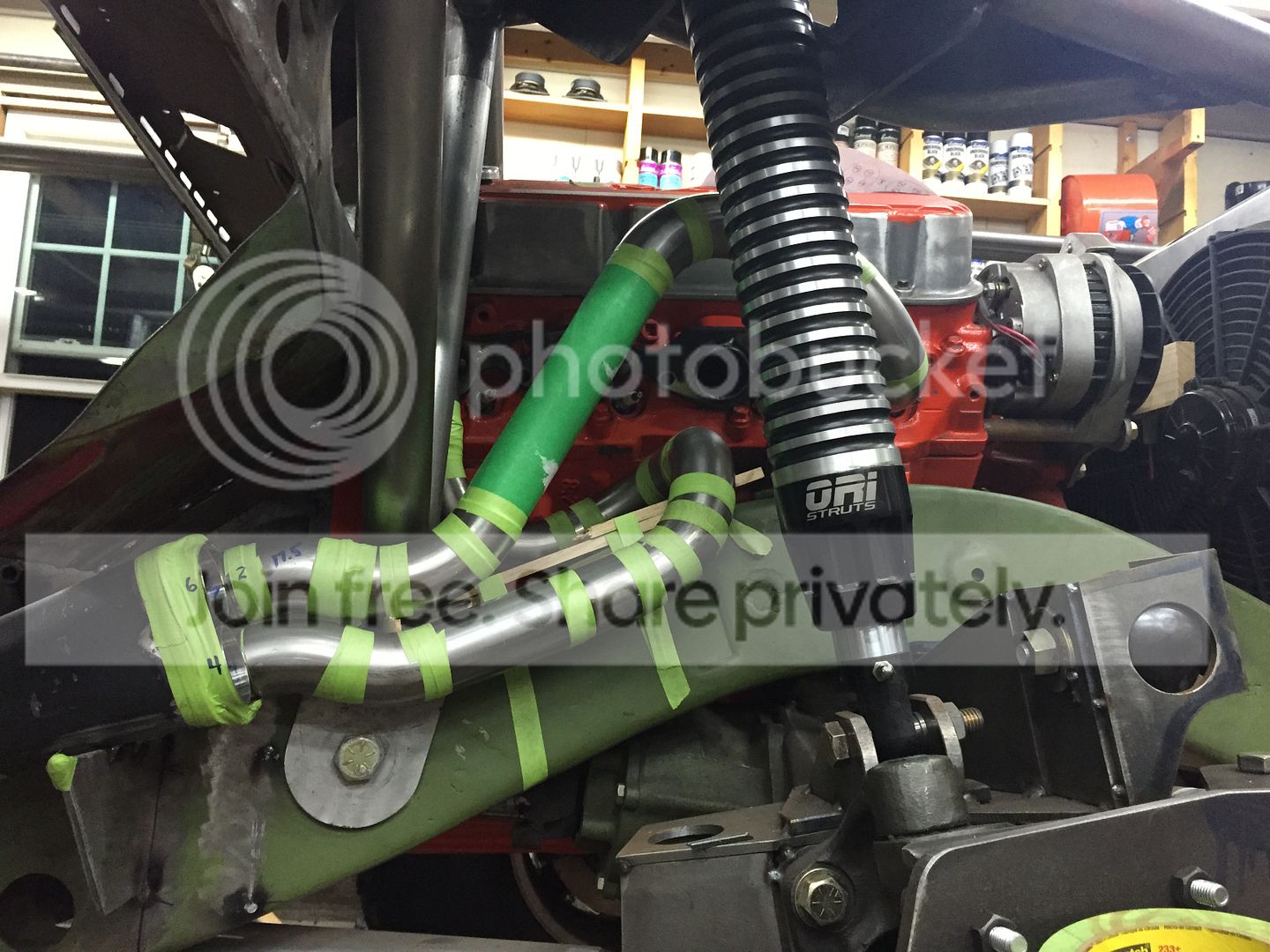
The photos always seem to collapse the depth-of-field and make the clearances look impossibly tight, but here's a photo that shows about 1" of clearance between the exhaust primaries and the ORI strut body.

IMG_5486.jpg


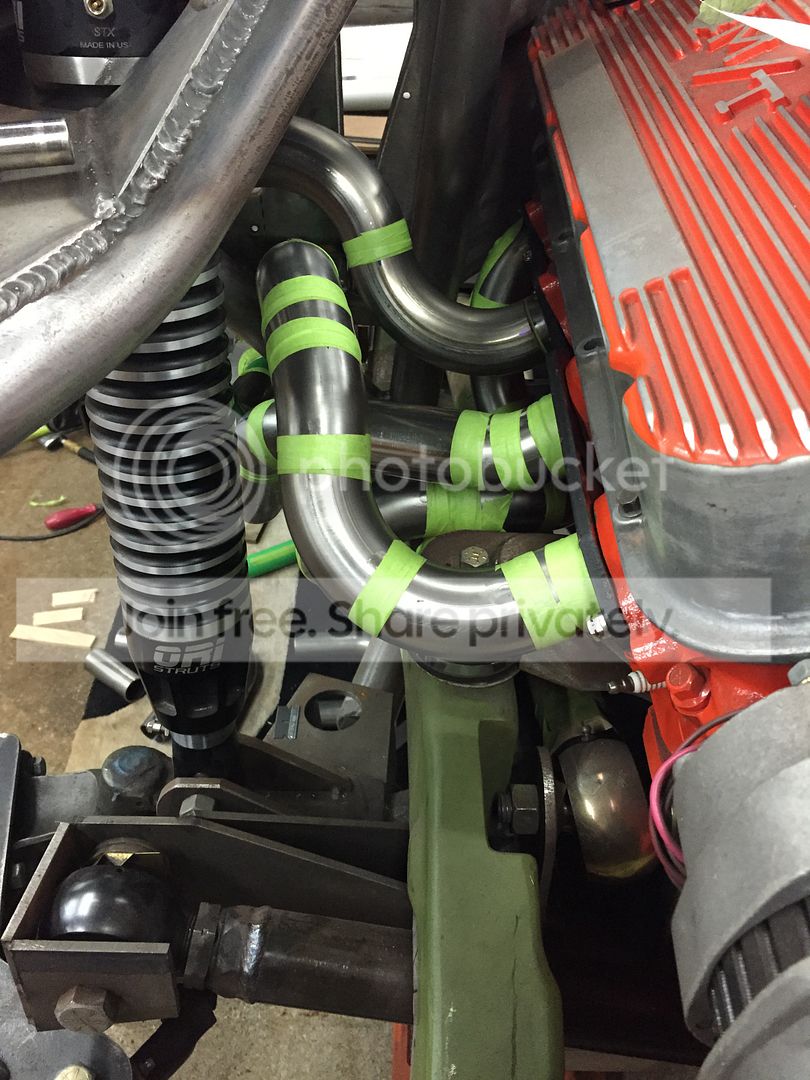
The challenge with having the collector so far forward on the frame is that the primary lengths end up a LOT shorter than optimal if you aren't careful. Using a simple point-to-point routing of the primary tubes, the #8 cylinder would only be around 18" long, instead of 36" (optimal)...the other cylinders are a bit longer but are still WAAAAY too short also. Hence, the reason why the primaries look more like the snakes of Medusa, and less like a traditional long-tube header design! :haha:

I actually dig it..... :waytogo:

IMG_5497.jpg


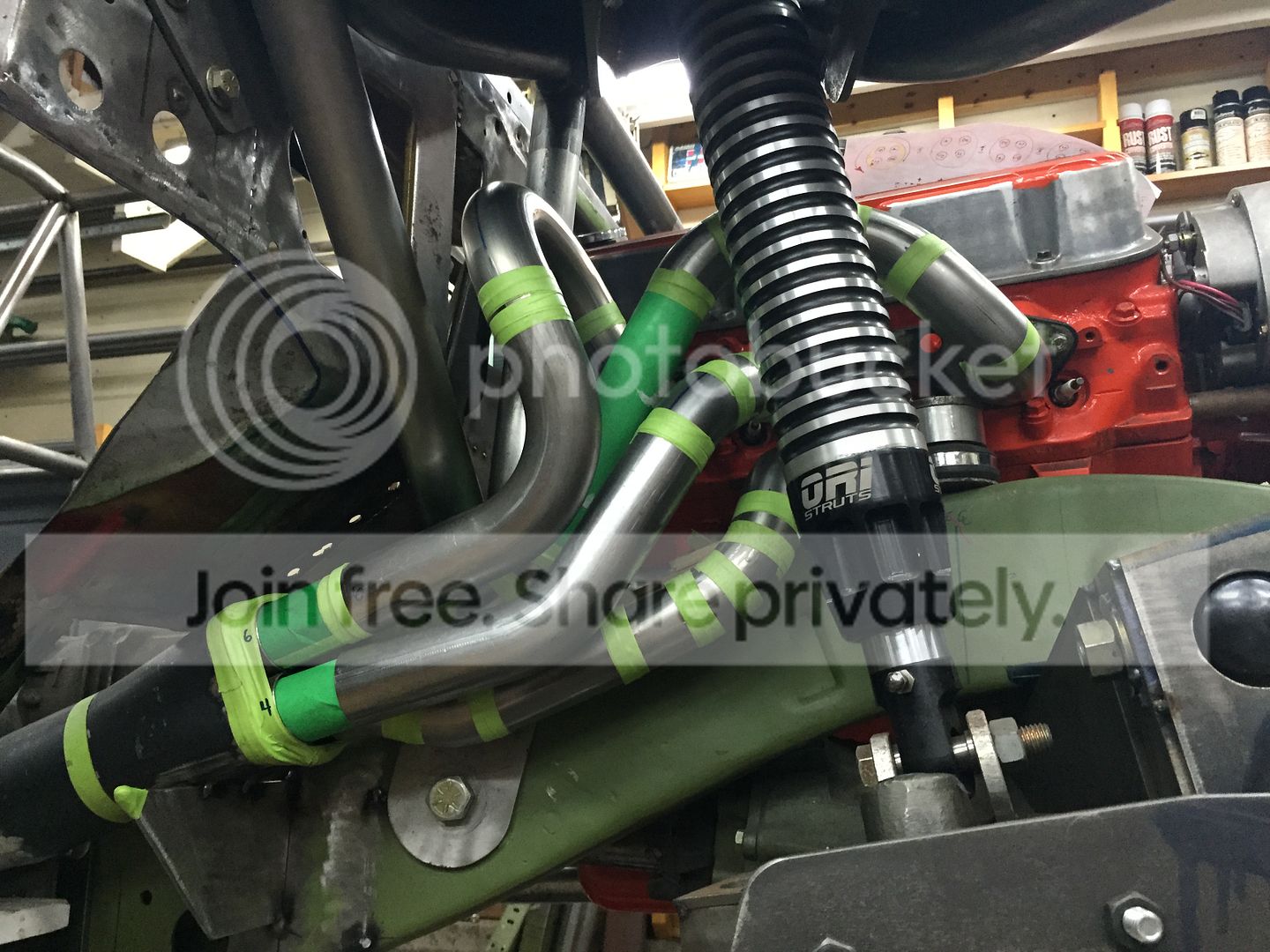
Parting shot from a distance....

IMG_5504.jpg


Next step is to put the new steel wheel/hubcap setup back on there and crank the whole thing hard-right. I've been checking those clearances occasionally as I went through my last 5 header revisions (but who's counting?)....so there SHOULDN'T be any unpleasant surprises. :whistle:

The last time I placed an order with Cone Engineering for my mild steel tubing, I bought a builder-kit for a full set of headers. But due to the amount of crazy bends and routing...there is no way that I will be able to complete the driver's side header with the remaining scraps of material that are left over. So when I call today to order up my 304 Stainless, I'm going to have to think more carefully about the exact number of U-Bends and straight sections that I need, instead of just buying a "kit" of tubing.

Between the tubing order and getting the stainless collectors and stainless V-bands.... it's starting to feel like it's going to be an expensive phone call!!! :eek1:


-G
 
Its looking good Greg. Mid length headers are the next best thing from long tubes, and since you are keeping it 3" I wouldn't worry about it, I like it!

One thing to keep in mind, many aftermarket cylinder heads raise the exhaust port some. So if you ever plan to get some aluminum heads you might want to keep that in mind with your clearances. Although you can probabloy find some with stock height ports I suppose, but they will be limited.

Also, make sure you droop that side, that will probably be when the header is the closest to the shock.

BTW, have you ever wondered why ORI calls them a strut? I do, technically a strut contols not just the height but also the angle of the steering knuckle. To me they are more like a really fancy air shock.
 
Its looking good Greg. Mid length headers are the next best thing from long tubes, and since you are keeping it 3" I wouldn't worry about it.

One thing to keep in mind, many aftermarket cylinder heads raise the exaust port some. So if you every plan to get some aluminum heads you might want to keep that in mind with your clearances. Although you can probabloy find some with stock height ports I suppose.

Thanks Heath!

Unless there is an AFR Marketing Rep lurking on this thread (just waiting for the right moment to offer me a sponsorship) I don't see aluminum heads happening anytime soon. :D

-G
 
I was thinking the same thing.


In all seriousness.... the thing to keep in mind is that the fact that these headers are "outboarded" actually helps with sparkplug access quite a bit.

With traditional headers, as soon as the primary tube leaves the head flange they need to bend sharply to squeeze between the engine block and the framerail.... resulting in all sorts of blocked-access to bolts and sparkplugs.

By contrast, these headers have the luxury of coming out a few inches before working their way over the framerail toward the collector, and it seems to be creating some really nice "access pockets" around each plug.

That's not to say that swapping plugs will be effortless, but I think it will be an acceptable tradeoff to get the primary tubes finessed into a limited space. Fortunately, I'm going EFI so it's not like I'm going to be pulling plugs all the time (cough, Deuling...cough, cough :D) to see if my fuel mixture is running too rich or lean.


-G
 
In all seriousness.... the thing to keep in mind is that the fact that these headers are "outboarded" actually helps with sparkplug access quite a bit.

With traditional headers, as soon as the primary tube leaves the head flange they need to bend sharply to squeeze between the engine block and the framerail.... resulting in all sorts of blocked-access to bolts and sparkplugs.

By contrast, these headers have the luxury of coming out a few inches before working their way over the framerail toward the collector, and it seems to be creating some really nice "access pockets" around each plug.

That's not to say that swapping plugs will be effortless, but I think it will be an acceptable tradeoff to get the primary tubes finessed into a limited space. Fortunately, I'm going EFI so it's not like I'm going to be pulling plugs all the time (cough, Deuling...cough, cough :D) to see if my fuel mixture is running too rich or lean.


-G
:haha:

Two guys walk into a machine shop,the mechanic says "Deuling"!

Poor Adam....:haha:
 
In all seriousness.... the thing to keep in mind is that the fact that these headers are "outboarded" actually helps with sparkplug access quite a bit.
-G
Interesting. That makes sense now that I think about it. :waytogo:
 
Ok gents....it's official.

I just placed my order for nearly $1000 worth of 304 Stainless 16GA (.065") tubing... U-bends, straights, collectors, merge cones, etc etc. everything I should need to completely build both sides.

QUESTION:

I was told that the best filler rod would be either 308 or 309. What say you? :dunno:
I'm thinking that 1/16" filler is a perfect match for 16GA tubing since they are basically identical (.065" vs. .0625")

I've got a few days before materials arrive, so I want to get all of these small details figured out now, so I don't waste time later on.

I also need to figure out a purge gas valve / splitter for my Argon tank.


-G
 
Header mock up looks nice, I'd put less of a angle in the number 8 tube to lay it up to the rest of the tubes, looks lonely hanging out there on its own
 
I run 3/32 308 and a 3/32 tungsten for the 12 and 14 gauge 304. 1/6th filler and tungsten should do it for you. For my back purge I just run a T after my flow meter with a ball valve and some vinyl tube to that sintered stone I linked earlier in the thread.
 
1/16 filler rod and 1/16 tungsten. I use 308.

I run 3/32 308 and a 3/32 tungsten for the 12 and 14 gauge 304. 1/6th filler and tungsten should do it for you. For my back purge I just run a T after my flow meter with a ball valve and some vinyl tube to that sintered stone I linked earlier in the thread.


So what's the deal with the 309? When I talked to the tech at Cone Engineering he said that they did the bulk of their own fabrication with 308, but 309 might be a little "nicer"..... I took that to mean maybe more forgiving, or maybe easier to work with? He said it definitely was more expensive than 308, but if it helps me up the TIG-welding learning curve a little faster (or makes me look like a more experienced welder than I really am) I'd definitely pick up a sleeve of it for my practice sessions.

Are there any preferred brands out there, or terrible ones that I should specifically avoid? I was just going to jump on Amazon.com and see what I could find there using my Prime account.


Coolest looking fender well headers ever!


Thanks! I really like them too....it's a shame that they will basically become invisible once I bolt up the wheels/tires and build a set of inner fenderwells.


-G
 
308 is a stainless on stainless, you can use it on different quality stainless with good results(409 and 304 stainless). I use weldcote, just what my local weld shop has on the shelf. 1/16 tungsten makes the puddle easier to control, and the 308 flows nice.


edit- i was wrong, 309 is used typically for mild to stainless welds, 308 is stainless to stainless.

that being said, 309 is more flexible, better suited for stainless to unknown, unknown stainless to unknown stainless.
 

Latest Posts

Top Bottom